
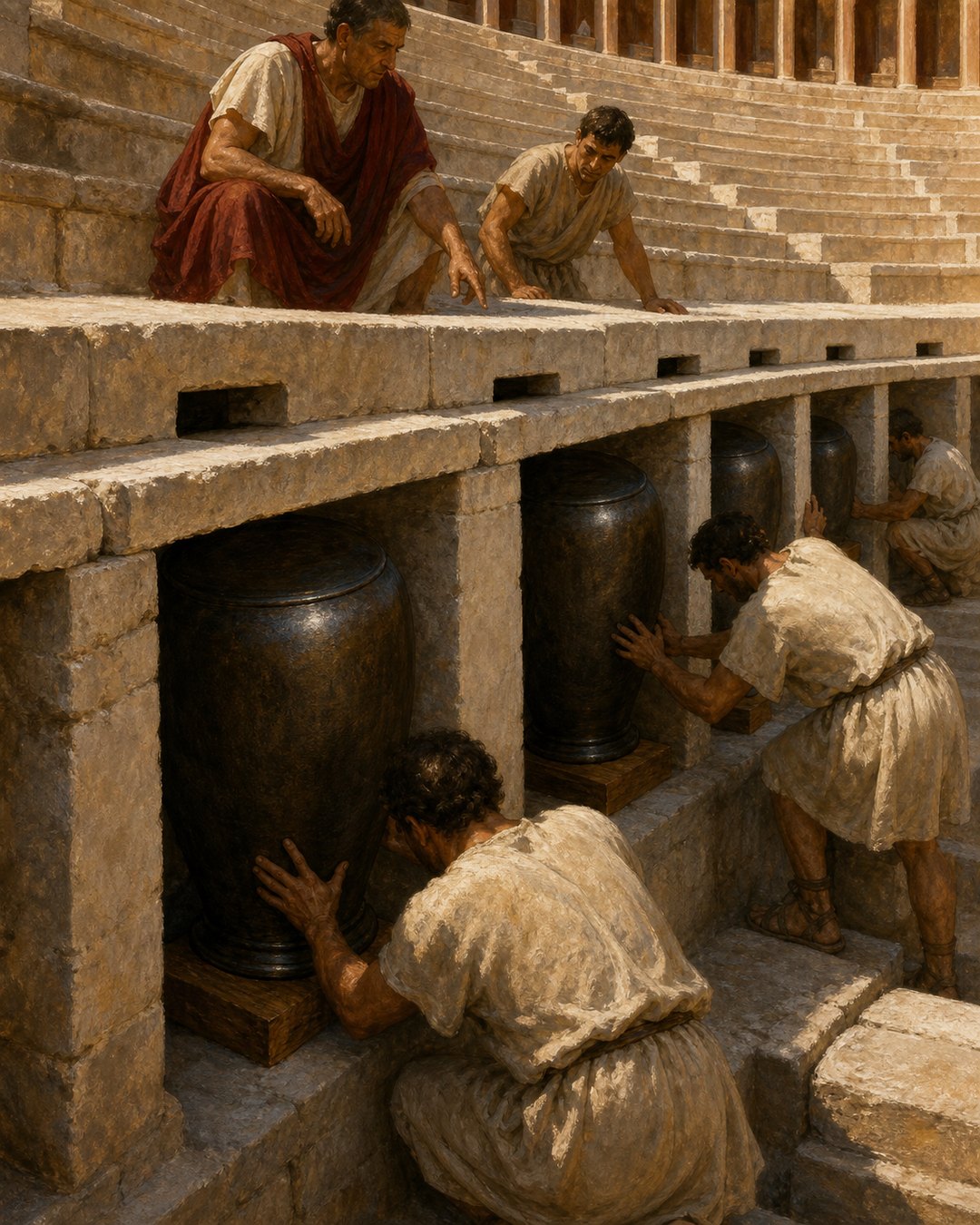
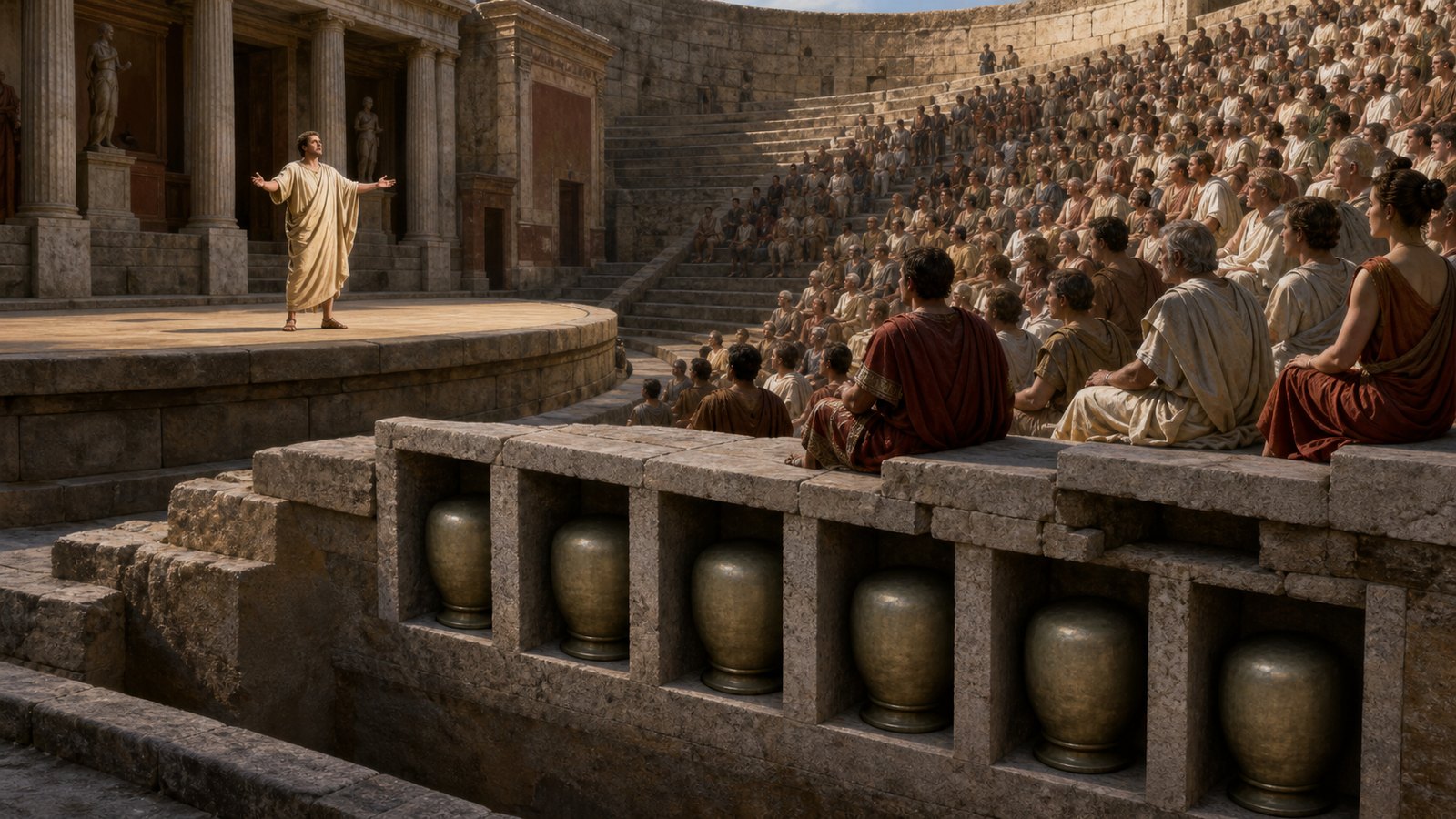
An actor spoke from the stage, and hidden bronze vessels beneath the seats were supposed to answer.
Vitruvius did not imagine them as decoration. He specified their pitches, positions, clearances and openings. In a moderate theatre, thirteen cavities formed a measured ring halfway up the seating. Each vessel sat upside down, isolated from the wall and lifted toward the stage on wedges.
The system treated a voice as moving energy. Sound spread from the performer, reached cavities among the spectators and excited vessels tuned to consonant intervals. Material placed out of sight was meant to return clarity to words travelling across stone.
Roman theatre design is often seen through columns, masks and crowds. Vitruvius asks us to listen beneath the steps.
The design began with intervals rather than containers
Before Vitruvius explains where the vessels went, he spends time on music. He names the fourth, fifth, octave and wider consonances, following Greek theory. The digression is not ornamental learning. A container of random shape and pitch would not serve his purpose.
The bronze vessels had to be made according to mathematical proportions appropriate to the theatre’s size. When struck, they were to sound at planned intervals. The architect therefore needed more than masonry competence. He had to translate a tonal scheme into objects and then distribute those objects through a building.
This is a different kind of precision from Vitruvius’s use of eight winds to orient streets. Wind planning manages a force moving through an entire city grid. The theatre vessels work on a voice produced at one point and heard by a bounded audience. Both convert invisible movement into geometry.
Vitruvius credits the musical scale behind his explanation to Aristoxenus. A reader who wanted fuller understanding could consult a diagram. That admission shows the limit of prose. Names of intervals alone could not teach the ear or reveal every proportion. The architect needed a working relation among number, pitch and place.
The result was not simply louder sound. Vitruvius promises increased clearness and harmony when a voice meets a vessel in unison. His concern is intelligibility shaped by consonance, not brute amplification from a giant horn.
Thirteen cavities turned seating into an acoustic array
For a moderate theatre, Vitruvius places one row at half the building’s height. Thirteen cavities sit at twelve equal intervals. The arrangement makes the central vessel and matching positions across the curve part of a planned sequence rather than a collection of pots tucked wherever builders found room.
The seating bowl already organized sight. Rows rose around the orchestra so spectators could see the stage without standing. The acoustic cavities added another structure to the same slope. A spectator might never see the vessel below or behind a step, yet its position depended on the geometry shared by stage and cavea.
Vitruvius imagines the voice expanding from the scene as from a centre. That model explains why equal spacing mattered. Sound crossed the theatre in many directions, and the curved array offered several points where its energy could meet a tuned cavity.
The plan belongs to the same architectural world as the seating rules that turned civic rank into visible geometry. Social hierarchy divided bodies into zones. Acoustic design divided tones and resonators into positions. The audience occupied a building that sorted both people and sound.
Thirteen was not a magical number in the explanation. It followed the range of pitches Vitruvius wanted across a moderate theatre. Larger buildings required a more elaborate response.
Inversion, air gaps and wedges made the vessel work
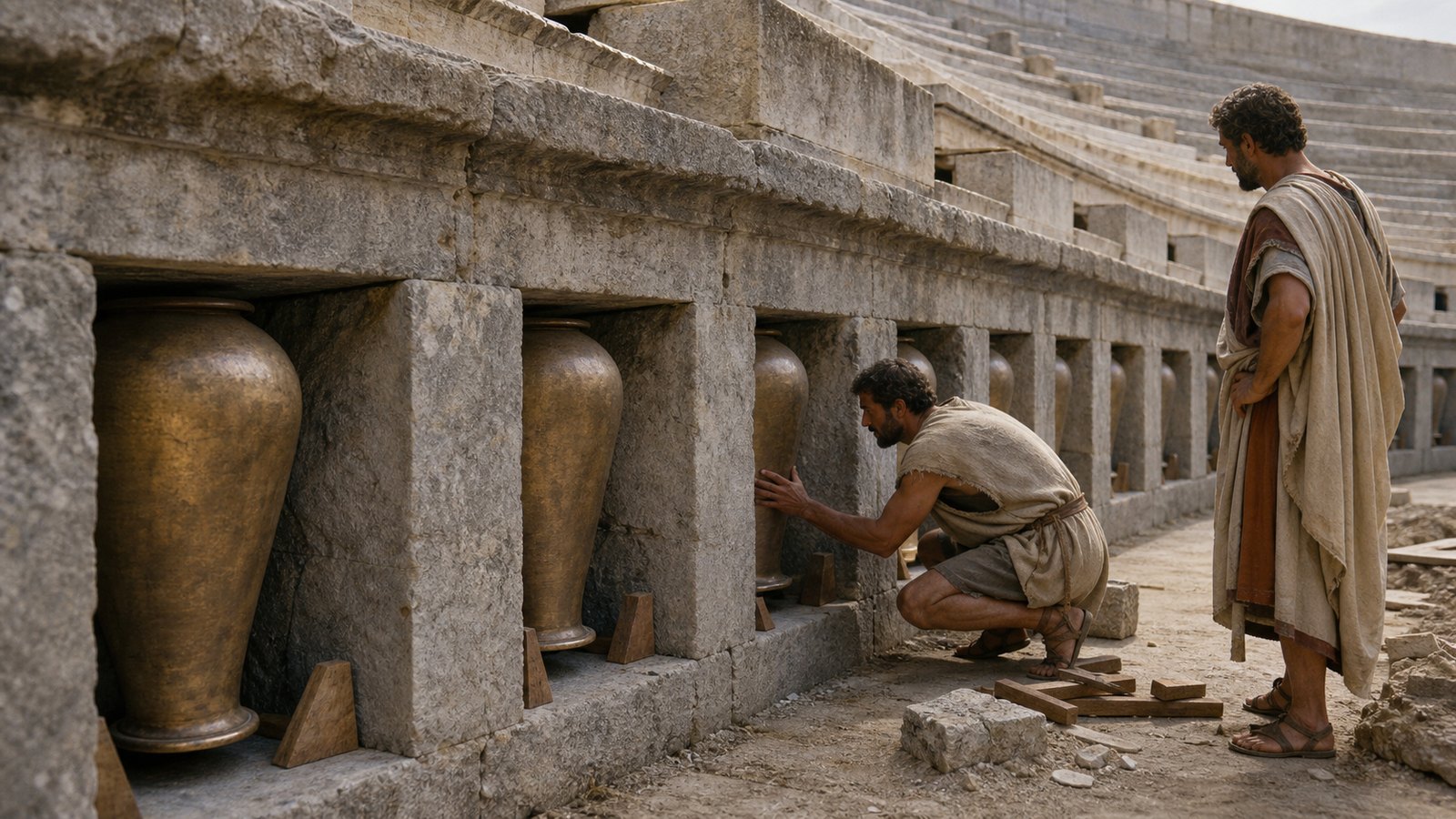
The installation details are the most physical part of the account. A vessel must not touch the wall. Clear space must remain around it and above its top. Contact would interfere with the free behavior Vitruvius expected from the bronze and cavity.
Each container was fixed upside down. The side facing the stage rested on wedges at least half a foot high. An opening in the lower surface of the seating communicated with the cavity; Vitruvius gives it a length of two feet and a width of half a foot.
These measurements turn a musical proposal into a construction task. Masons had to reserve cavities. Metalworkers had to produce tuned forms. Installers had to orient them without pinning their surfaces against masonry. Finishers had to leave the sound opening clear rather than sealing it during later work.
The system could fail through ordinary mistakes. A vessel touching stone, a blocked aperture, a wrong pitch or an incorrect position would weaken the planned relation. The audience would not necessarily see the defect. Acoustic workmanship hid inside the completed seating.
That hidden coordination contrasts with the treadwheel cranes whose mechanical advantage appeared through obvious moving parts. A crane made labour visible as rope, wheel and suspended load. The theatre installation waited motionless until a performer supplied sound.
Large theatres required several tonal systems
Vitruvius expands the scheme for a larger theatre by dividing its height into four parts and using three ranges of cavities. The lower row carried the harmonic arrangement. Middle and upper rows received chromatic and diatonic vessels.
His exact tonal vocabulary is difficult for readers without ancient Greek music theory, but the architectural principle is clear. Scale changed the number and distribution of resonant points. A solution suitable for one ring halfway up a smaller cavea could not simply be enlarged without modification.
Some positions in the chromatic row remained empty because Vitruvius found no consonant sound appropriate to the centre. Absence was therefore designed as carefully as placement. The architect did not fill every cavity for visual balance; the musical relation determined whether a vessel belonged there.
The proposal also recognizes that audiences hear from different distances and heights. A large stone theatre extends the path between stage and upper seat. Multiple rows let resonance meet the voice at more than one elevation.
None of this proves that every surviving cavity in an ancient theatre held one of Vitruvius’s resonators. Buildings changed, containers were removed and other structural uses can resemble acoustic niches. His text is a technical prescription, not a label automatically attached to every archaeological recess.
Wood, stone and city budgets changed the solution
Vitruvius anticipates an objection: Rome built many theatres without this system. His answer distinguishes materials. Wooden public theatres contained many floors that conducted sound. Performers seeking a stronger effect could turn toward scene doors and use the surfaces to throw the voice outward.
Solid theatres built from rubble, cut stone or marble behaved differently in his account. They required deliberate acoustic planning because their mass did not conduct sound like layered timber. Monumental durability created a new hearing problem.
When challenged to name a theatre in Rome equipped with the vessels, Vitruvius admits he cannot. He points instead to examples in parts of Italy and Greek cities. The candour matters. He presents a system he considers effective without pretending that the capital supplied an obvious surviving model.
He also remembers displacement and substitution. Lucius Mummius, after the destruction at Corinth, brought bronze theatre vessels to Rome and dedicated them as spoils at the Temple of Luna. Objects designed to serve voices in one building became trophies in another setting.
Small cities lacking bronze could use earthen vessels tuned to the proper tones. Vitruvius says clever architects employed them with considerable advantage. Budget changed material but not principle. The vessel still needed pitch, placement and a cavity that let it respond.
The prescription reveals a craft network behind performance. Actors trained voices, but builders shaped whether those voices survived distance. Musicians supplied intervals, potters or founders supplied resonators, and architects coordinated them with stone.
Once the seats filled, the machinery disappeared beneath ordinary attention. Spectators heard speech crossing the theatre and may never have known that hollow objects waited below them. Vitruvius’s thirteen cavities made the building an instrument whose largest visible part was the audience itself.
Sources
Vitruvius, On Architecture 5.4–5.5