Sacred Chickens Refused to Feed Before Drepana

Before the Roman fleet attacked near Drepana, sacred chickens were offered grain. They would not eat. The consul Publius Claudius Pulcher had received a bad omen at the moment he wanted speed. Later Roman writers gave him a line designed never to be forgotten. If the birds would not eat, he said, let them drink—and … Read more

Geese Woke Manlius Before the Gauls Reached the Capitol

The Gauls climbed toward Rome’s Capitoline in darkness. They found a route so steep that the defenders had left it unguarded. Livy says the first man reached the summit without waking a sentry or even disturbing the dogs. Then Juno’s geese began to call and beat their wings. Hunger had not persuaded the besieged Romans … Read more

Pompey’s Four Elephants Could Not Fit Through Rome’s Gate

Pompey wanted four elephants to pull his triumphal chariot into Rome. He had brought the animals from Africa, and their size made the claim unmistakable: the young commander was returning with victory, kings and the living scale of another continent behind him. The city answered with masonry. The gate was too narrow. Pompey abandoned the … Read more

A Wooden Tablet Carried Rome’s Password Through the Camp

Before darkness settled over a Roman camp, a small wooden tablet had to complete a journey. It began with the tribunes and moved through a chain of maniples. At each handover, witnesses marked that the message had passed. The tablet eventually came back to the officers who had issued it. If every tablet returned before … Read more

Two Rival Centurions Saved Each Other Beyond the Rampart

Titus Pullo shouted his challenge where the whole camp could hear it. “Why hesitate, Vorenus?” Caesar has him ask. If Lucius Vorenus wanted to prove his courage, the day had arrived. Pullo then stepped beyond the fortifications and charged the densest part of the Nervian line. The two centurions were rivals for promotion. Each year, … Read more

One Touch of a Tribune’s Cudgel Began the Whole Camp’s Sentence

The tribune did not deliver the killing blow. According to Polybius, he touched the condemned soldier with a cudgel. The rest of the camp then closed in with clubs and stones. A small official gesture transferred a judicial decision into collective violence. This punishment, usually called the fustuarium, appears in Book 6 of Polybius’s Histories … Read more

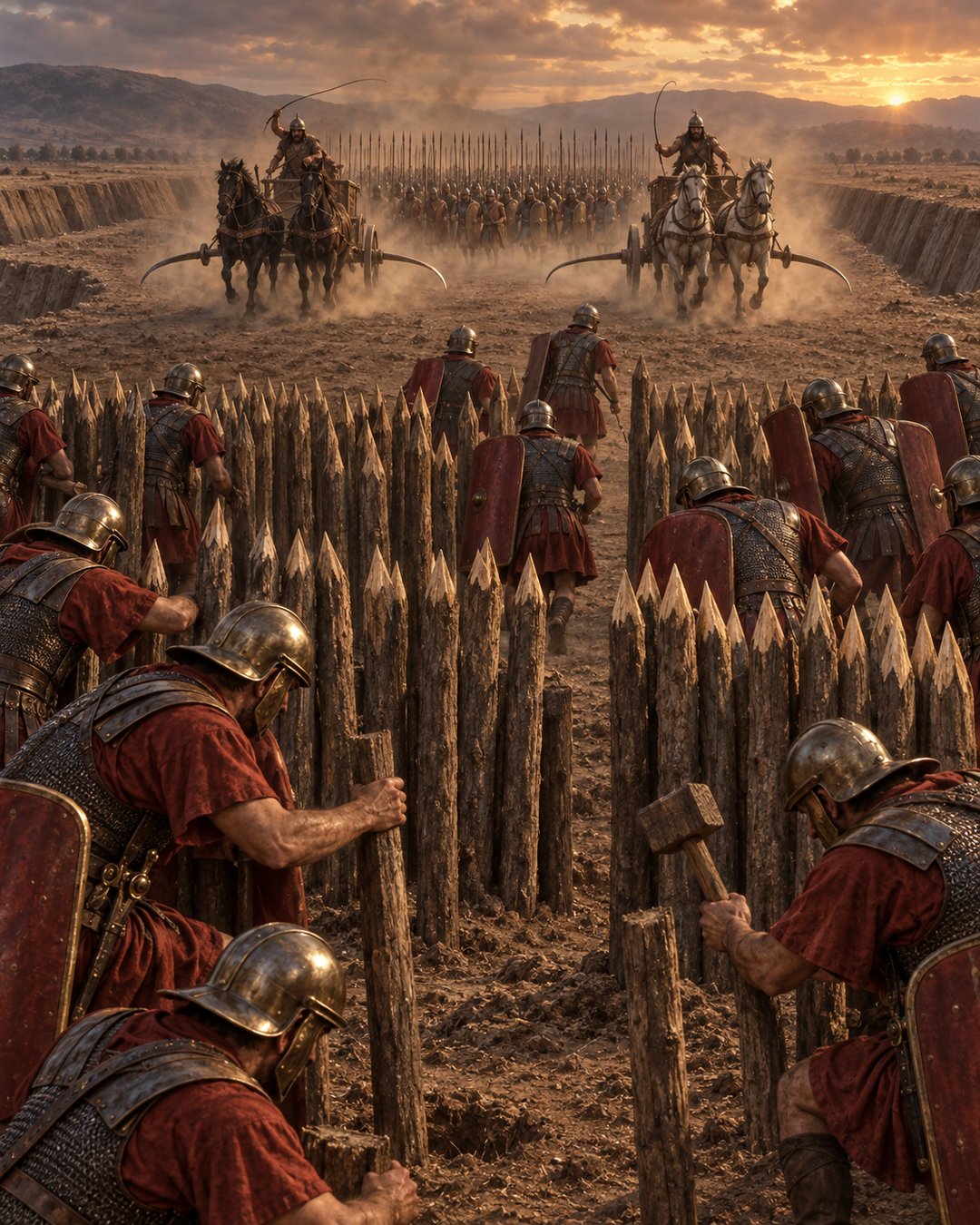
Fire Left Larignum’s Larch Tower Standing

The soldiers carried exactly what a wooden tower should have feared: bundles of dry firewood and burning torches. They packed them around the structure outside Larignum’s gate and watched flames climb so high that, in Vitruvius’s telling, they seemed to reach the sky. Everyone expected the tower to collapse. When the fire died, its crossed … Read more

One Missing Body Made Marcus Caelius’s Stone a Cenotaph

Marcus Caelius stands in stone wearing the rewards of a long military life. A civic crown rests above his face. Two torques lie at his shoulders, bracelets circle his wrists, and five round phalerae fill his chest. Beneath that confident portrait, however, his inscription admits a problem no decoration could solve: the body was not … Read more

Most of a Roman Cohort Was Somewhere Else

On 18 May in the 90s AD, a clerk at Vindolanda began with a reassuringly large number: 752 men in the First Cohort of Tungrians. Then subtraction took over. Guards served the provincial governor. A far larger body stood at Coria, probably Corbridge. A centurion was in London. Other groups occupied damaged lines. By the … Read more

Sacred Chickens Turned a Naval Defeat into a Religious Scandal

The grain landed on the deck, but the chickens would not eat. For a Roman commander preparing a fleet for battle, this was not a minor problem in animal handling. The birds had been brought aboard precisely because their appetite could be watched, interpreted and reported before thousands of men were committed to an irreversible … Read more