
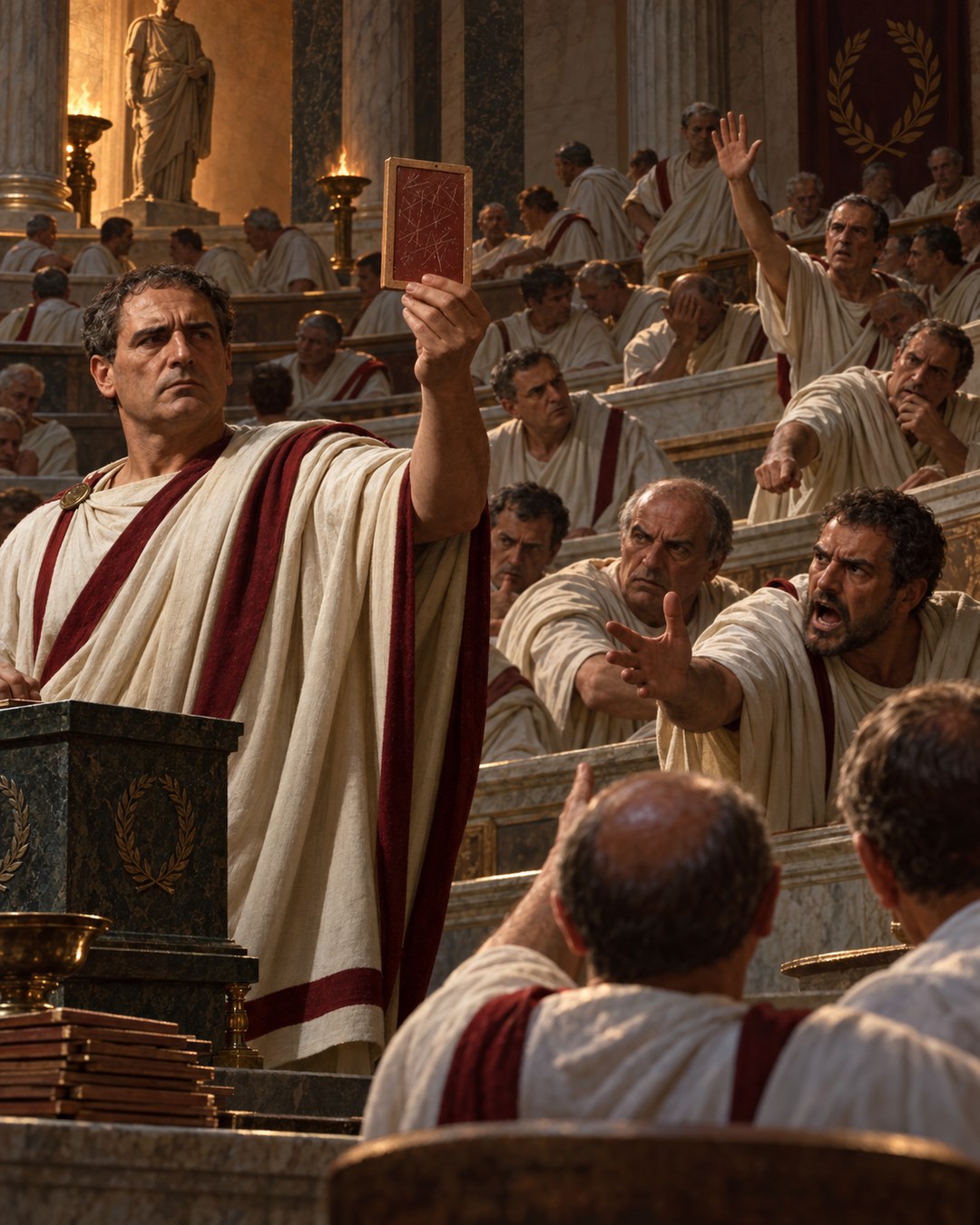
The senate found the offensive marks, but not the hand that made them.
Some election cards carried jokes, others obscenities, and one named voters where candidates should have appeared. Anger filled the chamber while the writer remained seated inside it.
The ballot had concealed a choice. It had also concealed sabotage.
A Warning Became Evidence at the Comitia
Pliny the Younger wrote to Messius Maximus after a senatorial election. He reminded his correspondent that he had already warned about the possibility of abuse in balloting.
Events, he said, had confirmed the danger. At the latest comitia, officials encountered voting cards that did not perform their basic task.
A ballot was supposed to identify a candidate while withholding the voter’s identity from immediate scrutiny. Instead, several writers used the protected surface for flippant jokes and obscenities.
One card inverted the procedure more sharply. It carried the names of voters rather than the names of candidates. The object still looked like part of the count, but its content redirected attention from election to mockery or exposure.
Pliny does not preserve the words. That omission prevents us from identifying the targets, judging the humor or knowing whether the voter names accused anyone of a particular act. The secure facts are the categories he supplies and the institutional response.
The senate was furious. Members loudly appealed to the offended emperor to punish the writer. Their reaction treated the incident as more than spoiled paperwork.
A senatorial comitia was a formal act through which an elite body assigned office and displayed its own dignity. Turning the ballot into a private stage made the chamber appear unable to govern even its instruments of decision.
Roman election design had long balanced access, visibility and pressure. Voting bridges organized the movement of citizens toward the ballot. Pliny’s episode concerned a different boundary: what happened after the voter received a card and bent over it.
The Same Cover Protected Choice and Misconduct
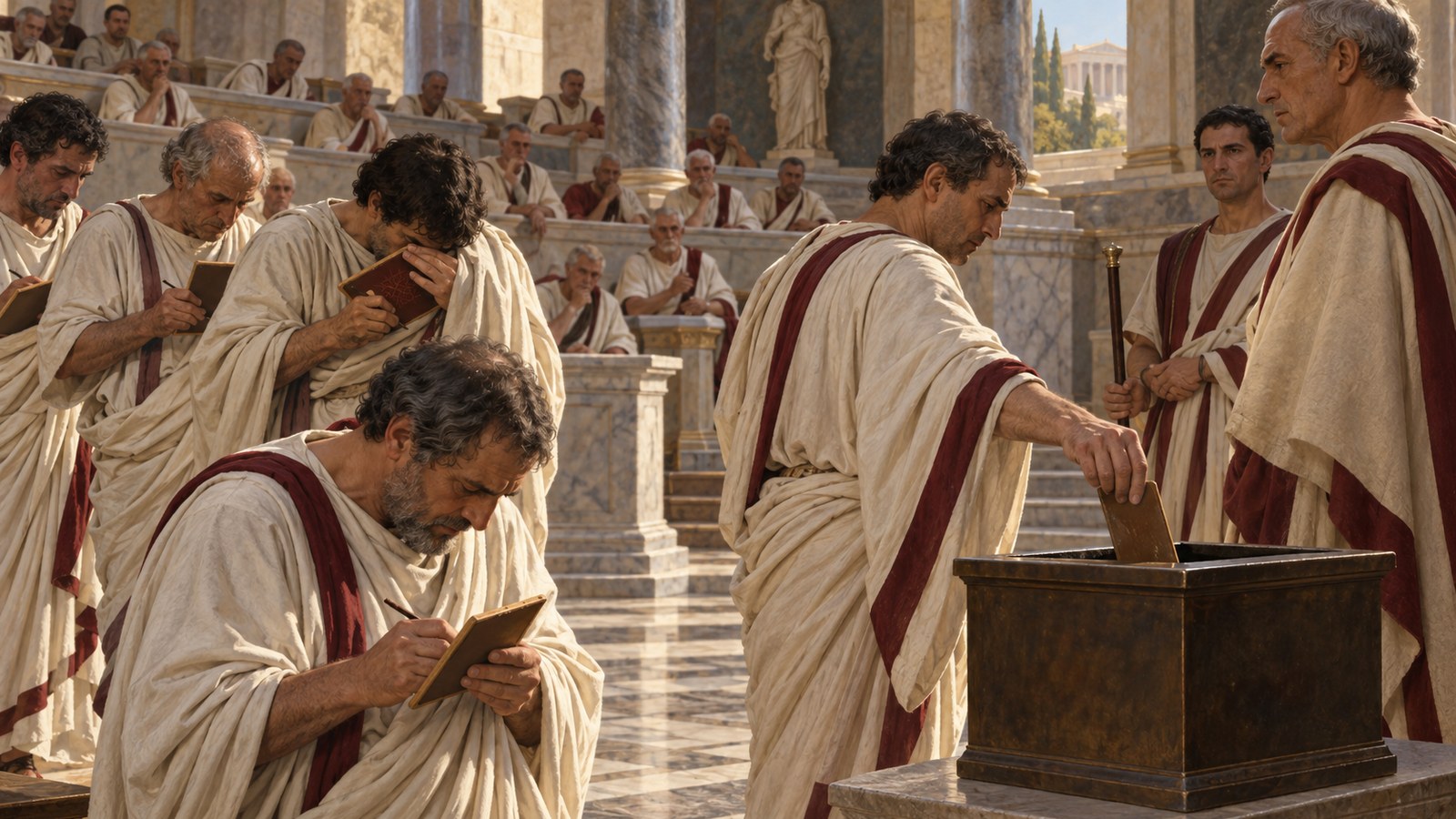
Pliny describes the physical sequence in compact terms. A man asked for a voting card, took a pen in his hand and lowered his head.
That posture created a private writing space in a public room. Nearby senators could see that he was voting without seeing exactly what he inscribed.
Privacy served a recognizable purpose. If every choice could be watched, powerful colleagues could reward compliance, punish independence or challenge a voter before the count.
The card allowed the voter to separate his public presence from his recorded preference. Yet the procedure separated authorship from content so thoroughly that it also covered deliberate invalidation.
That distinction is easy to miss if secrecy is treated as a single switch. The voter’s body remained visible, the act of receiving and returning a tablet remained visible, and the final marks became visible during the count. What disappeared was the durable connection among those three observations. Everyone could watch the procedure while no one retained the link needed after an abusive card appeared.
The offender did not need to forge an official seal or enter a restricted archive. He used the same card, pen and bowed posture as everyone else. Misconduct traveled through the ordinary channel because the channel was designed not to reveal the writer.
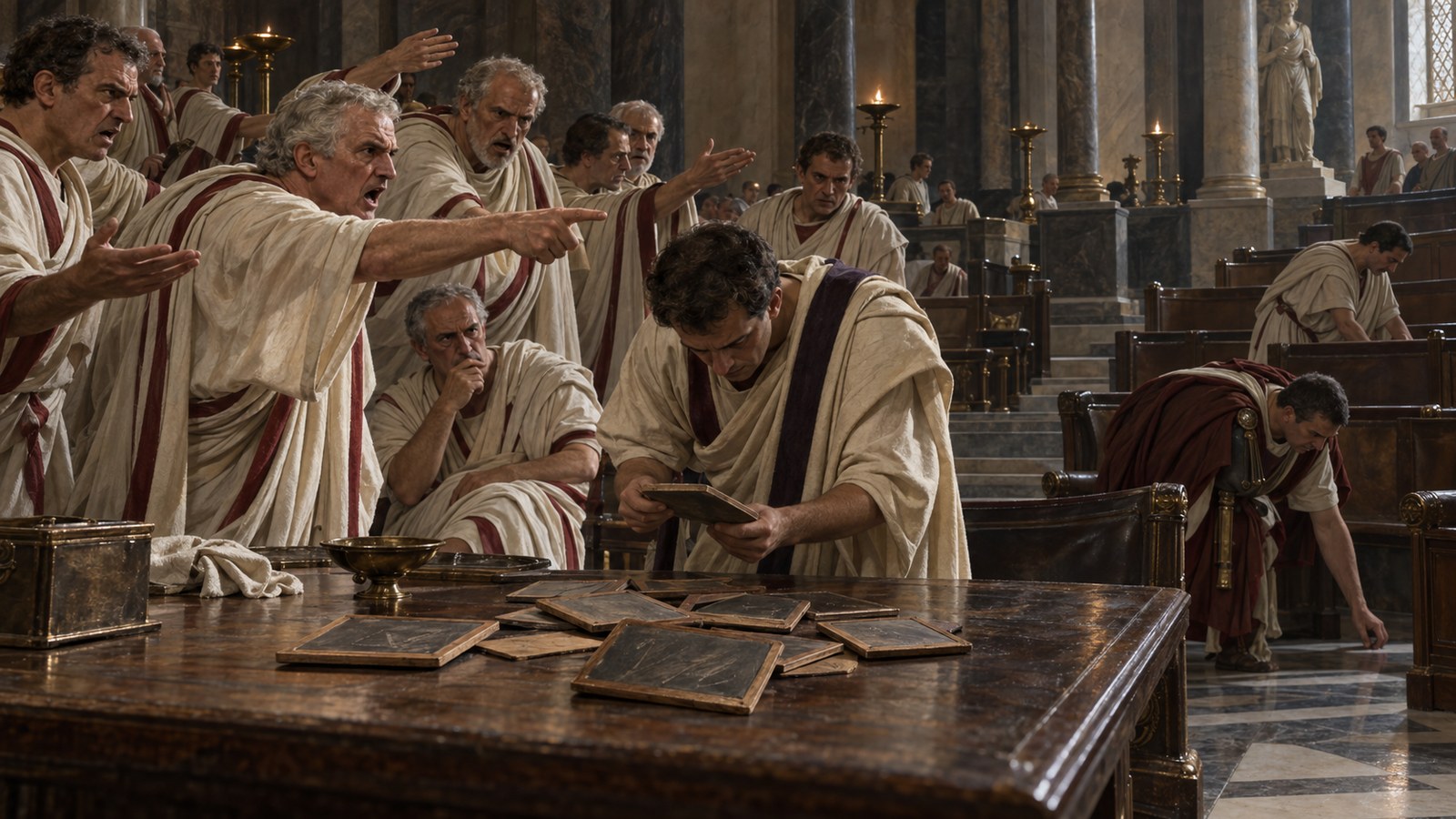
This is why the senate’s indignation did not identify him. Members could inspect the offending objects after deposit. They could recognize that jokes and obscenities were improper. They could not reverse anonymity and recover the hand behind one tablet.
Pliny even suspects that the author may have joined those displaying the greatest anger. Anonymity let the person divide himself into two roles: hidden writer during the vote and righteous senator during the inquiry.
The claim is conjecture, not a named accusation. Pliny uses it to deepen the moral problem. A procedure that concealed authorship also let the offender perform loyalty after the fact.
Roman ballot tablets turned preferences into countable objects, but countability did not guarantee validity. A physical vote could be present in the box and absent from the election’s purpose.
Collective Outrage Could Not Become Enforcement
The senators called on the emperor to punish the writer. Their demand assumed that a severe response could restore seriousness, but punishment required a person to punish.
No culprit emerged. The writer stayed quiet, and the chamber lacked evidence strong enough to distinguish him from every senator making the same complaint.
Pliny frames the failure in terms of character. What might such a man do at home, he asks, if he behaved disgracefully in a grave public matter while presenting himself in the senate as incisive, courteous and witty?
The contrast reflects elite moral language, but it also describes an enforcement gap. Public reputation could not be matched reliably to a private inscription.
Pliny imagines the offender’s confidence in a question: who will find me out? Belief in non-discovery reduced the restraining force of shame.
That does not mean every anonymous voter behaved badly, or that secrecy caused obscenity by itself. One incident supplies evidence of misuse, not a count of honest and dishonest ballots across Roman elections.
Nor does Pliny propose a workable technical cure. Signing every card would make authorship visible but weaken secrecy. Watching every stylus would expose choices to influence. Examining handwriting could create accusation without certainty.
The senate wanted two properties at once: a voter free enough to choose privately and a system able to identify anyone who abused that privacy. Pliny’s letter shows the collision but does not resolve it.
Officials could have discarded the invalid cards and continued the tally, but procedural recovery would not answer the affront. The jokes had already converted a solemn collective act into material for ridicule. The demand for an author was therefore about institutional authority as much as the mathematical result of the election.
The emperor’s authority offered punishment after detection, not detection itself. Calling upward could amplify condemnation while leaving the original evidentiary problem untouched.
The Failed Ballot Still Revealed the System
Pliny ends pessimistically. Evils, he says, were stronger than remedies, and imperial working hours grew longer under the burden of unruly behavior.
His conclusion flatters central supervision and condemns the offender. It should not be mistaken for a neutral institutional report.
Yet the letter preserves unusually concrete details: cards, pen, lowered head, invalid names, chamber outrage and an unidentified author. Those details let us reconstruct where accountability failed.
The procedure could verify that a card had been deposited. It could inspect what appeared on that card. It could reject content that was not a candidate’s name. It could not attribute that content without sacrificing the concealment on which private choice depended.
The replacement of candidate names with voter names made the vulnerability especially pointed. A device meant to hide who chose could itself be used to display identities as content. Even without knowing which names appeared, the inversion exposed how little the physical tablet distinguished a valid preference from any other scratches placed upon it.
A modern reader may be tempted to turn the story into a simple argument for or against secret ballots. Pliny gives something narrower and more useful. Any institution that hides identity for a legitimate reason must decide what happens when the same protection shelters misuse.
Rome’s senators discovered that the answer could not be improvised after counting. Their loud demand for punishment arrived only once the information needed for punishment had been deliberately discarded.
The offender’s message did not alter the official candidate list, as far as Pliny tells us. Its power came from forcing the senate to read a private joke at the center of a public decision.
Anonymity had made the card safer for choice and cheaper for provocation. The writer exploited both properties at once.
The senate could condemn him in chorus. The ballot’s success as a screen ensured that no one could point to where he sat.
Sources
Pliny the Younger, Letters, book 4, letter 25.