
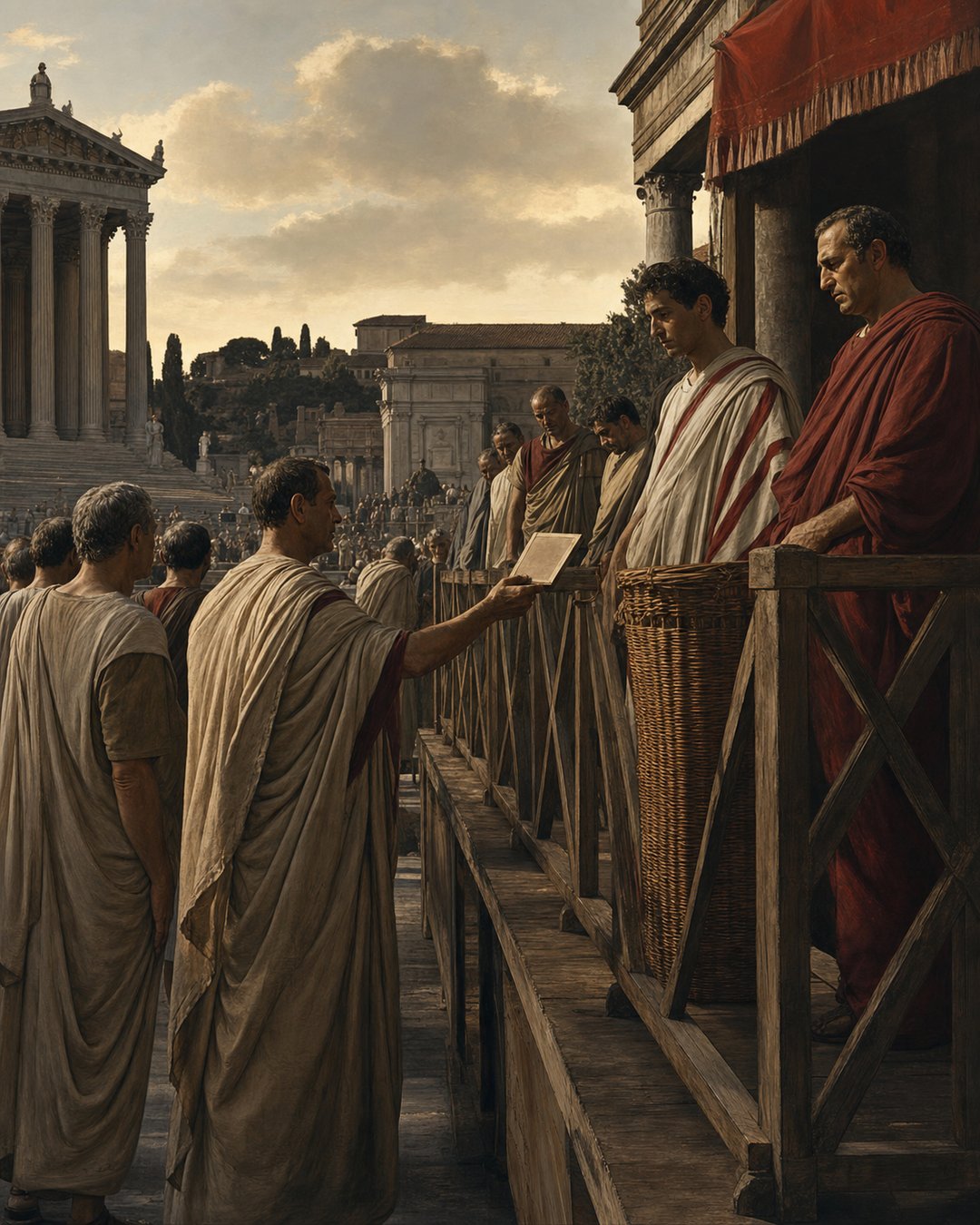
A ballot tablet sounds like a small object, but in Rome it could change the shape of a crowd. It let a citizen carry choice in his own hand while still moving through a public ritual that everyone could see.
Roman ballot tablets made choice public in a paradoxical way. They protected a mark from immediate pressure, yet they placed the voter inside bridges, baskets, assemblies, and official procedure. Secrecy did not remove politics from public life; it gave public life a new choreography.
The vote was a civic act, not a mood
Suffragium reminds us that a vote was not merely private preference. It was a recognized act inside a civic order. A Roman citizen did not simply have an opinion; he performed a choice through a procedure that gave the opinion legal weight.
That distinction matters. A crowd can shout without producing a decision. Voting required a form that could transform many individual choices into an outcome the community was expected to accept.
The tablet made choice portable
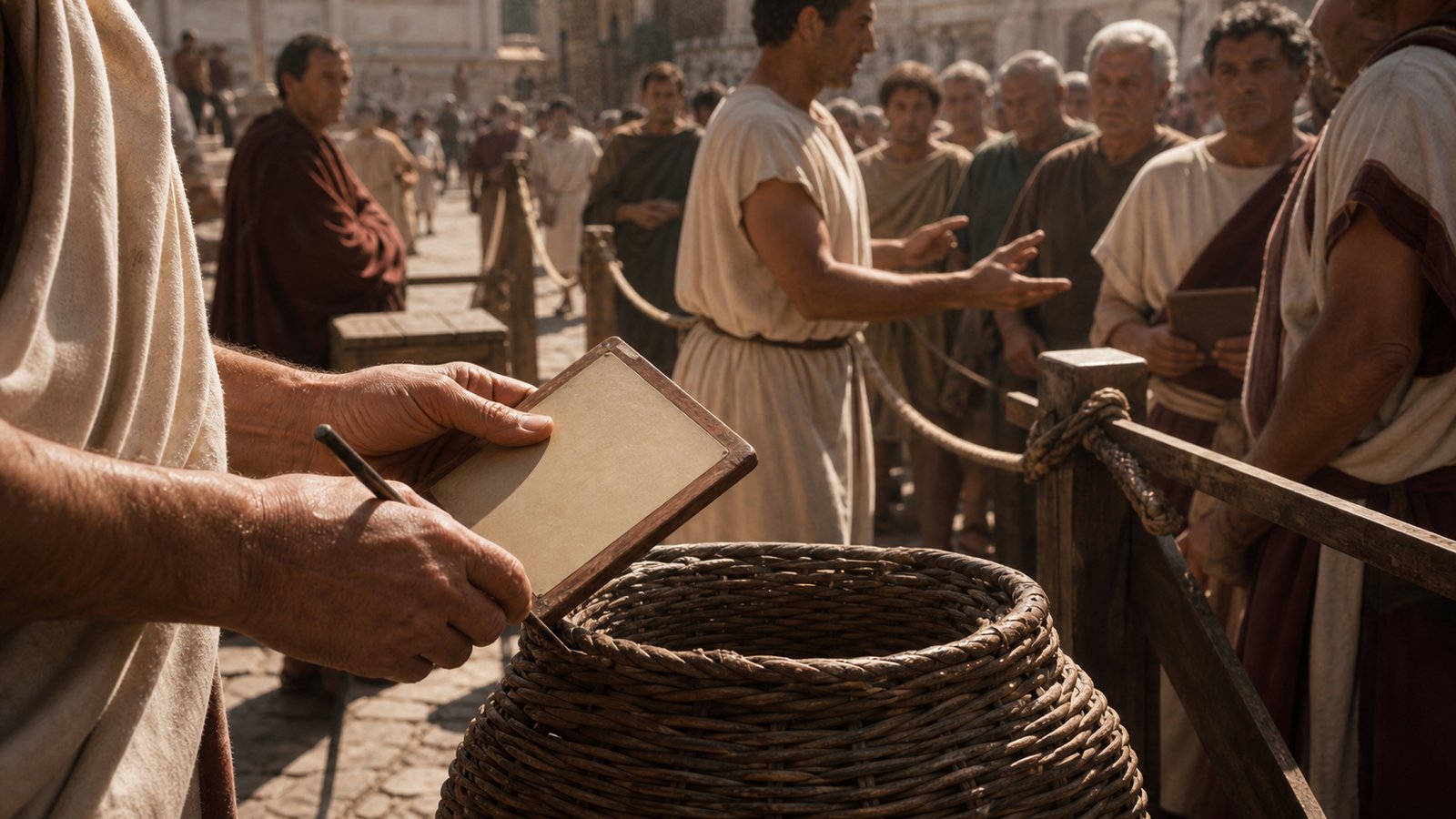
The tabella turned a decision into a small physical thing. Instead of leaving choice as a voice exposed to the pressure of nearby bodies, the tablet let the voter carry the act toward the place where it would be collected.
Picture the mini-scene: a citizen pauses with a wax tablet and stylus, the crowd presses behind a rail, an attendant watches the line, and the basket waits ahead. The choice is private in the hand, but the hand is not alone.
The bridge made secrecy move in public
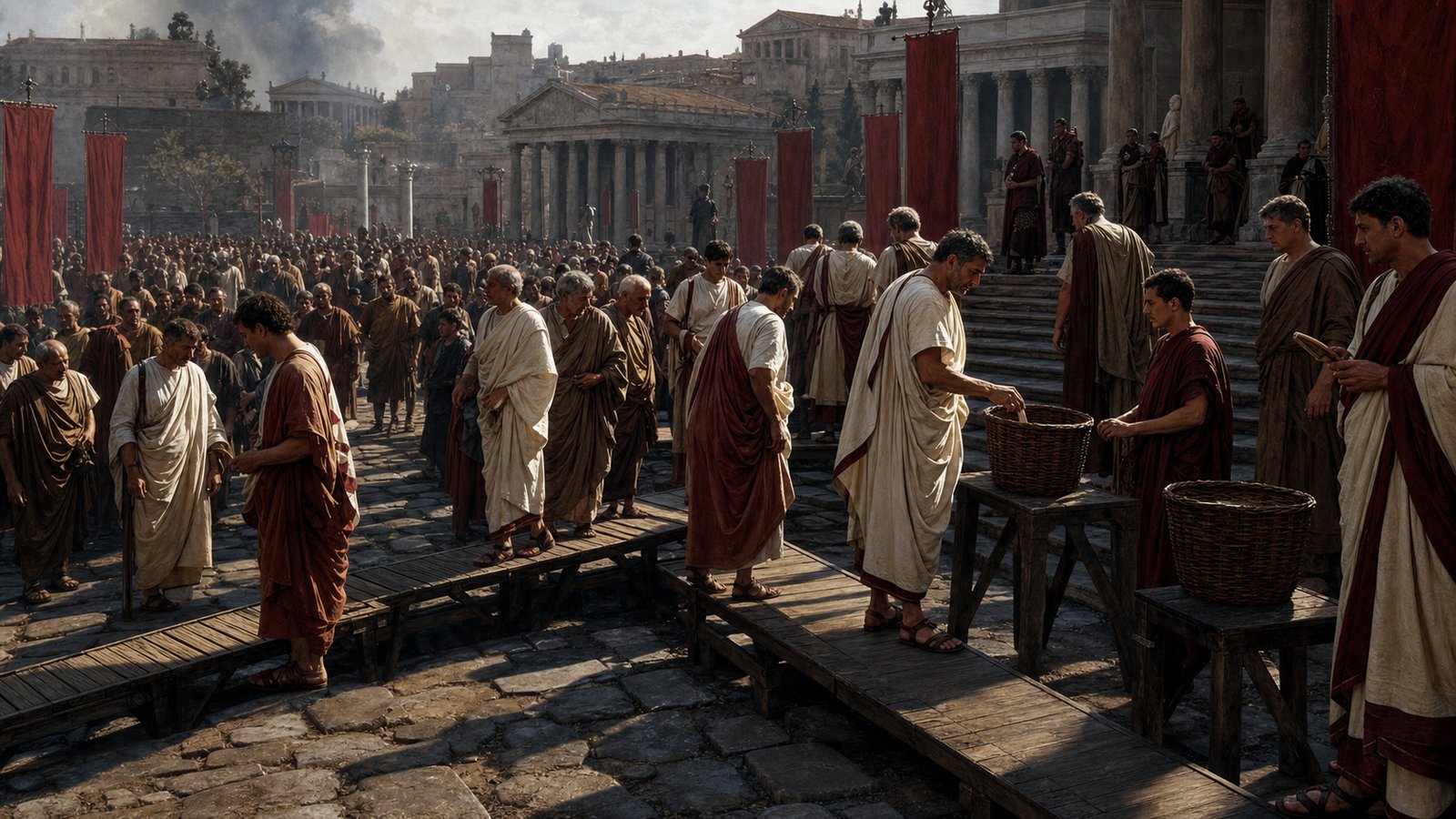
The pons, the voting bridge or gangway, organized the movement of citizens. It mattered because secrecy still needed a route. The voter had to pass through a visible sequence before the hidden mark could join the count.
This is the paradox. The more the tablet protected the individual mark, the more the surrounding procedure had to be trusted. People could not see each choice, so they had to see the fairness of the path that carried choices to the basket.
The basket made private marks countable
The cista, the basket or box, gave the procedure a visible end point. Private tablets did not remain private forever. They gathered into a container that turned separate hands into a collective result.
A basket is humble, but politically it is powerful. It says that the community will accept a count made from objects no single spectator could fully inspect at the moment of marking. Trust moves from seeing the vote to seeing the process.
The assembly gave the ritual authority
The comitia placed voting inside a formal public assembly. That setting is what kept secrecy from becoming isolation. Citizens made choices individually, but they did so as part of an organized body.
The result was a public ritual built around partly hidden acts. Rome did not make politics private when it used tablets. It made public politics depend on visible procedure, controlled movement, and a count that could claim authority over the crowd.
This is why the ballot tablet deserves attention as an object of political history. It is small enough to overlook, but it shows a culture wrestling with pressure, reputation, control, and trust.
Open voting can make courage visible, but it can also make intimidation easy. A tablet changed that balance. It did not create modern democracy, yet it altered what citizens and powerful observers could know at the instant of choice.
The physicality of the system is important. Politics happened through wood, wax, stylus, basket, rail, bridge, steps, and bodies. Procedure was not an abstract diagram; it was a route people walked.
That route could calm suspicion when it looked orderly. If citizens moved one by one, if attendants watched the basket, if the assembly recognized the sequence, then hidden marks could be accepted as public decision.
But the same route could produce anxiety. If the bridge felt controlled, if the basket seemed vulnerable, or if the crowd suspected pressure before or after the mark, secrecy would not solve the deeper problem of trust.
A Roman voter therefore lived inside two kinds of visibility. His mark could be shielded, while his presence, movement, social rank, companions, and timing remained observable. The tablet protected choice without making the chooser disappear.
That mixed condition is historically revealing. Public life often wants the legitimacy of individual choice and the reassurance of collective visibility at the same time. The Roman ballot tablet stood at that crossing point.
The cista made the crossing point concrete. A basket full of tablets was not a crowd shouting; it was a public object containing many private moments. Counting it required faith in the ritual that had filled it.
The comitia gave the count its political frame. Without the assembly, the tablet would be only wax. Inside the assembly, it became part of a decision-making machine that could bind winners, losers, and witnesses.
The pons added discipline. It forced the body to follow a path, and paths are one of the quiet tools by which institutions create order. A vote became not just a mark, but a movement through designed space.
That movement could be tense. A citizen carried a private decision while surrounded by people who might hope, guess, threaten, flatter, or remember. The tablet gave him a little room inside a very public world.
The room was never complete freedom. Roman voting belonged to a society marked by status, patronage, wealth, and unequal influence. Yet the tablet still mattered because it changed the moment when pressure could be applied and the evidence by which choice could be judged.
This helps explain why political procedure is never mere detail. The difference between a shout, a raised hand, a tablet, and a basket is a difference in how power reaches the citizen. Objects decide what can be seen, hidden, counted, and disputed.
Roman ballot tablets made choice public because they taught the crowd to trust a visible path around an invisible mark. That is a subtle achievement, and a fragile one. The tablet did not end conflict, but it gave conflict a form that could become a decision.
The voting bridge also made delay meaningful. A man waiting his turn could feel the pressure of eyes and rumor, but he still moved toward a moment where the mark belonged to his hand. Procedure created a narrow space between public reputation and private choice.
The basket then joined those narrow spaces into one public claim. No citizen could see every decision as it was made, but every citizen could see that choices had passed through the same visible mouth of the system. The object gathered trust as well as tablets.
That is the practical genius of the arrangement. Roman politics remained unequal, competitive, and often harsh, yet the ballot tablet forced power to reckon with a protected instant of choice. A small wax surface could briefly interrupt the crowd before returning the result to the crowd.
Sources & Further Reading
- Smith Dictionary, Suffragium
- Smith Dictionary, Tabella
- Smith Dictionary, Comitia
- Smith Dictionary, Cista
- Smith Dictionary, Pons