
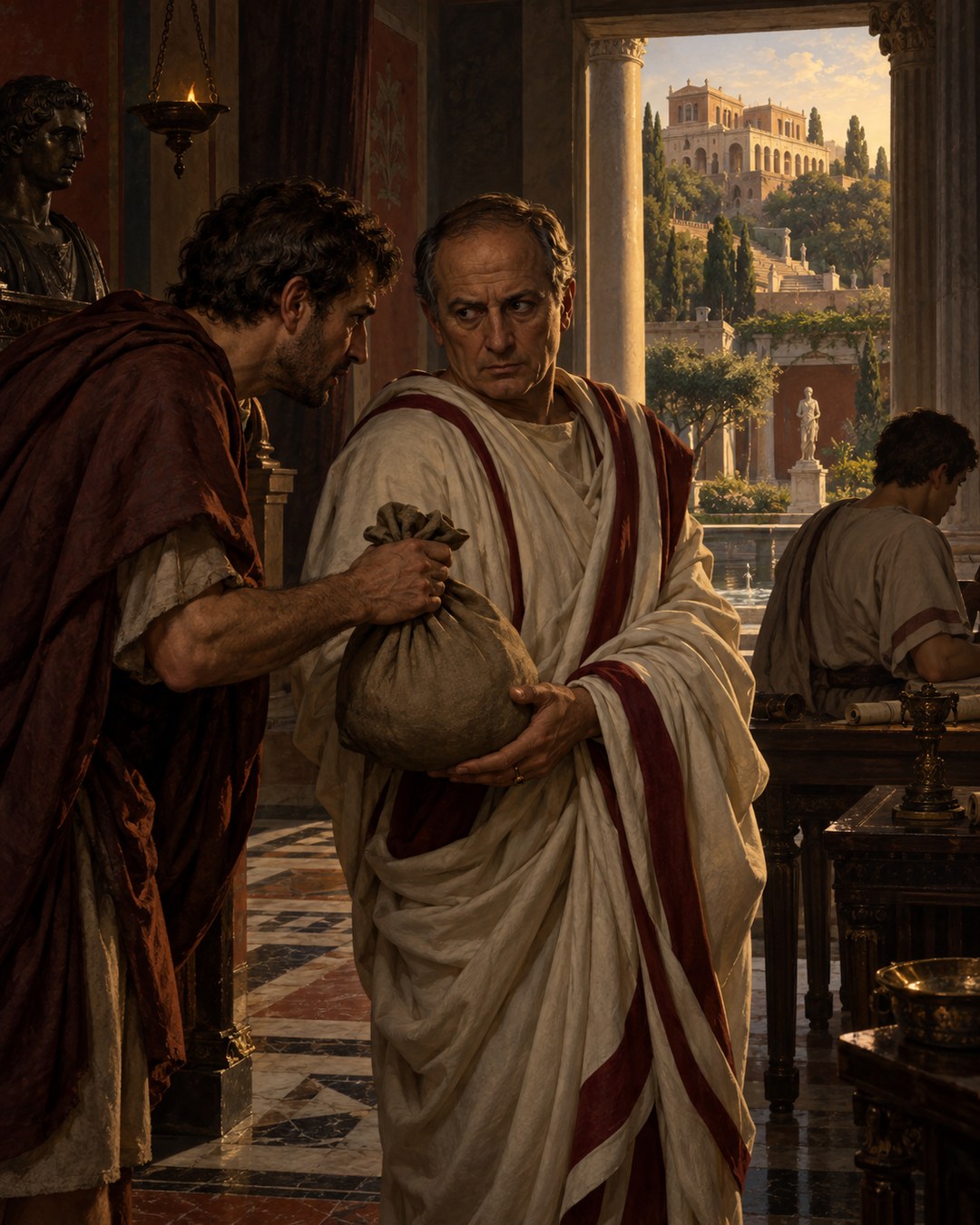
Cicero denied the loan, denied the house and then bought the house.
The money had come secretly from Publius Sulla, an accused man, before the transaction became public. When friends later confronted Cicero in the Senate, he did not retract the falsehood.
He recast it as the caution of a buyer who refused to advertise his bid.
A Palatine House Needed Money Cicero Did Not Have
Aulus Gellius begins with a desired property. Cicero wanted to buy a house on the Palatine, but he did not have the money immediately available.
The location raised more than a domestic question. A house on the Palatine placed its owner near the physical center of elite political life. Address, access and reception space could reinforce the public identity of an advocate and senator.
Roman houses were not sealed private retreats. The arrangement of an elite house admitted clients, advocates, bankers and magistrates into graded spaces. Buying such a property acquired a platform for relationships as well as rooms.
Cicero solved the immediate shortage through a loan. Gellius says Publius Sulla secretly advanced him two million sesterces.
The amount gave Cicero purchasing capacity before his own liquid money was available. Credit connected a future property to a present obligation: the house could be secured because another man’s funds arrived first.
The lender made the arrangement politically dangerous. Publius Sulla was under accusation at the time.
Gellius’s story does not say that the loan itself bought a legal favor, and it does not provide terms, security or repayment schedule. The reputational problem came from the relationship visible on its face. An advocate and statesman had taken a large secret sum from a defendant.
Secrecy tried to keep the financing separate from the public transaction. A seller could see a buyer ready to pay without every observer seeing whose money made readiness possible.
But a secret loan is secure only while the chain of knowledge holds. Before Cicero completed the purchase, the arrangement escaped that chain and entered public discussion.
The Leak Joined Legal Reputation to Market Intent
Once the loan became known, criticism followed. Cicero was reproached for accepting money from an accused man for the purpose of buying a house.
The objection bundled three facts: the lender’s legal vulnerability, the size and secrecy of the advance, and the intended use. Each made the others look less ordinary.
A house purchase by itself was not scandal. Borrowing by itself was not proof of corruption. Representing or associating with an accused person did not automatically make every transfer improper. Yet their combination invited observers to ask what obligation traveled with the money.
Cicero reacted to the unexpected charge by denying that he had accepted the loan. He also denied that he intended to buy the house.
The second denial did work beyond the first. If there was no planned purchase, the reported purpose connecting loan and property collapsed. Cicero was not merely disputing a transfer; he was disputing the transaction that made the transfer intelligible.
The denial also affected the market. Announced demand can strengthen a seller’s position and attract competitors. A prominent buyer who appears committed may face a higher price or lose the property to someone bidding strategically.
Roman policy could move wealth into property through explicit rules. One imperial measure required candidates to place a third of their fortunes in Italian land and helped drive prices upward. Cicero’s problem was narrower but governed by the same principle: information about who must or strongly wants to buy can change bargaining power.
That does not make the denial true. It explains why concealing intent could have economic value at the same time that concealing the lender had political value.

The Completed Purchase Exposed Both Denials
Cicero later bought the house. The completed transaction made one part of his earlier statement impossible to sustain.
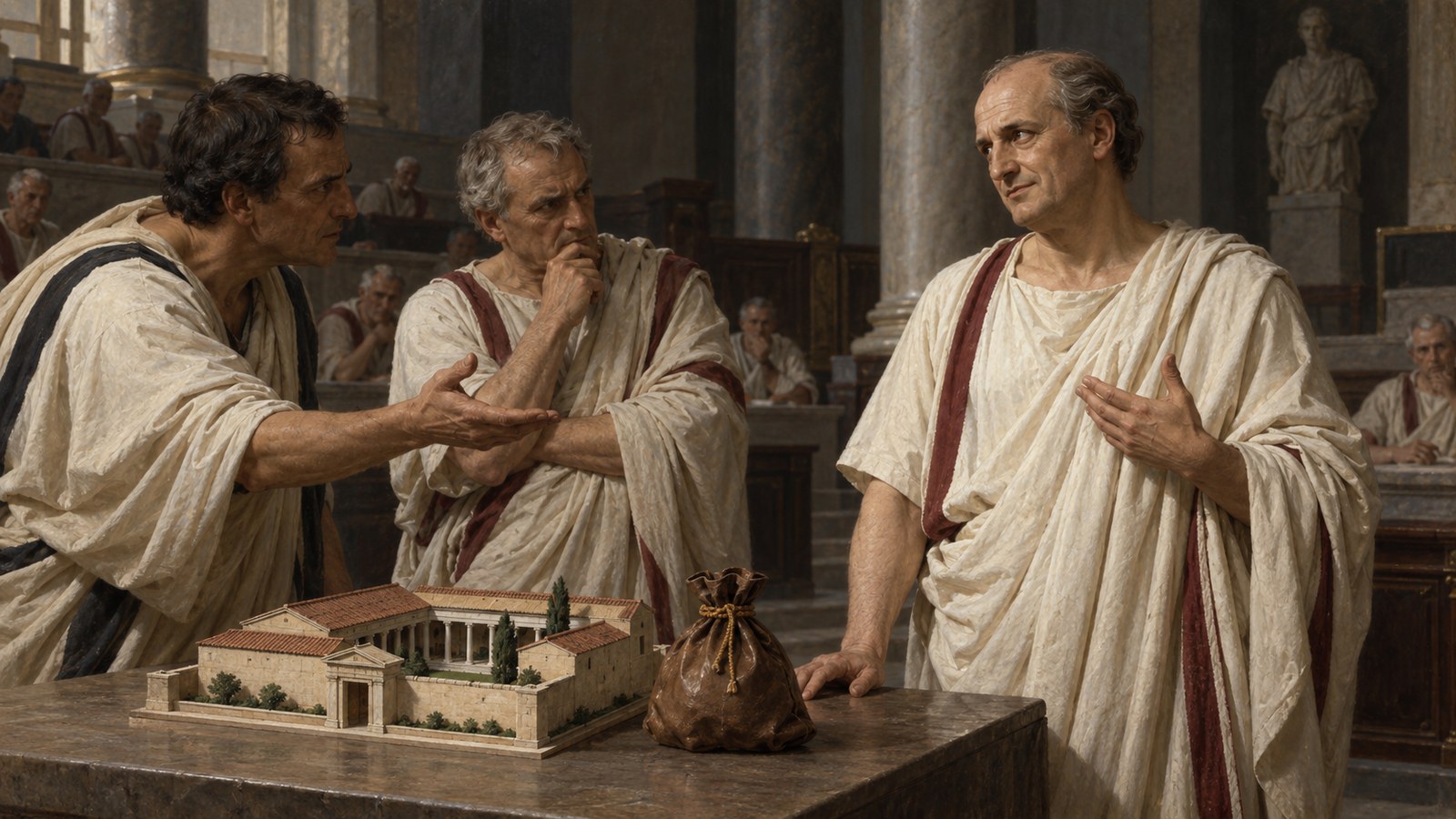
Friends confronted him in the Senate with the falsehood. The location of that confrontation returned a supposedly private purchase to public judgment.
Gellius says Cicero laughed. He called his critics people without practical understanding and supplied a rule for prudent household management.
A careful head of household, he argued, denies that he intends to buy the thing he wants because rival purchasers exist.
The reply was clever because it changed the category of the lie. What had sounded like a defensive denial under ethical pressure became a bargaining tactic familiar to anyone competing for scarce property.
It also moved attention from the lender to the competitors. Publius Sulla’s status had made the leaked loan objectionable. Cicero’s joke asked the audience to think instead about buyers who might exploit his disclosed intention.
The reframing answered the house denial better than the money denial. A purchaser may rationally hide interest from rivals. That does not by itself explain why he denied receiving funds from an accused man after the transfer became known.
Gellius’s compressed anecdote lets Cicero’s wit bridge the gap. Laughter and practical language turn a morally charged challenge into a lesson in shrewdness.
The property made that performance possible. Because Cicero had successfully acquired it, concealment could be presented as evidence of competence. Had the purchase failed, the same denial might have looked merely desperate.
The house thus became both the object of the strategy and the proof used to defend it.
Market Prudence Did Not Erase Political Dependence
Cicero’s answer identifies a real information problem. Buyers do not normally advertise their maximum desire to sellers and rivals. Concealment can preserve negotiating room.
Yet the story also shows how market explanations can narrow a broader ethical challenge. The critics were not only rival bidders asking why Cicero hid his interest. They objected to the source of two million sesterces.
A loan creates a relationship that outlasts the handover of the bag. Repayment, gratitude, access and expectations can matter even when no illegal exchange is proved.
For a public advocate, that relationship could affect how observers interpreted later speech or action. Dependence need not dictate conduct to damage trust; the undisclosed possibility may be enough.
Cicero’s joke protected him by combining two kinds of secrecy. Concealing a bid sounds prudent. Concealing a financially significant connection to an accused man sounds more troubling. Treating both as one buyer’s tactic allowed the safer explanation to cover the riskier one.
Roman property could anchor status, but it could also reveal the financing behind status. The finished Palatine house made Cicero’s wealth visible while the leaked loan showed that visible possession did not identify whose capital had enabled it.
Gellius does not tell us the sale price, loan terms or what Publius Sulla expected. Those absences prevent a claim of purchased influence.
They do not make the false denial disappear. Cicero’s friends could compare a public house with a previous statement that no purchase was intended.
The timing made comparison unusually concrete. The loan was revealed before the acquisition; the denial addressed an intention that the later deed made visible. Unlike a vague rumor about future ambition, the sequence ended with possession of the precise kind of property Cicero had said he did not plan to buy.
That sequence also separated successful tactics from truthful explanation. Concealment may have helped him avoid pressure from rival purchasers, but commercial success could not retroactively turn a false statement into an accurate one. It could only supply a motive his audience might admire enough to forgive.
His defense succeeded as rhetoric because it admitted the behavior while disputing its meaning. He did not say his friends had remembered wrongly. He said they misunderstood what a cautious buyer must do.
The transaction therefore survived two exposures: first the secret credit, then the contradiction. Cicero met both by making commercial prudence carry more explanatory weight than public candor.
The house stood on the Palatine after the joke ended. So did the question the joke could not settle: whether hiding a bid and hiding a politically sensitive debt were ever the same kind of caution.
Sources
Aulus Gellius, Attic Nights, book 12, chapter 12.