
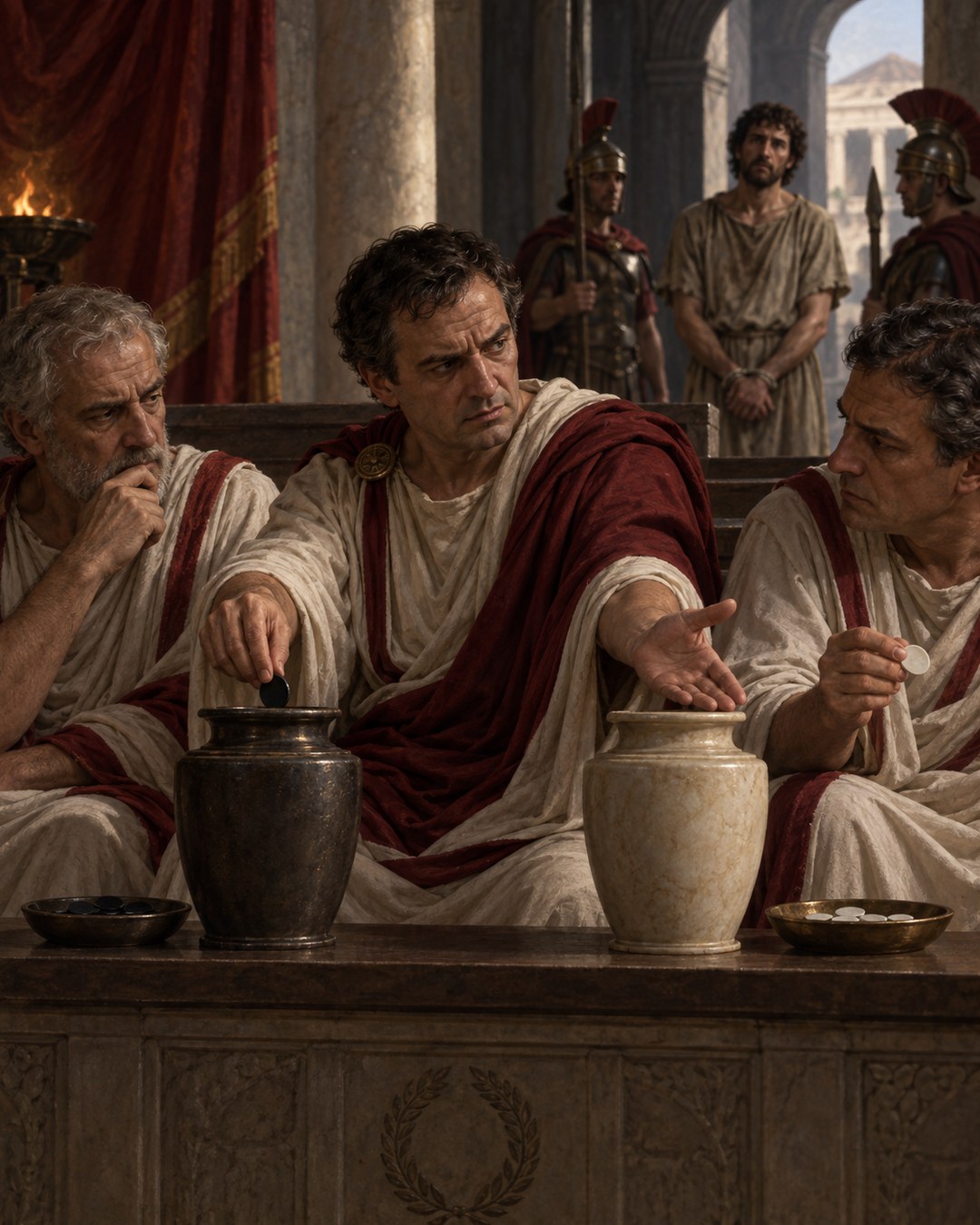
The judge condemned his friend with one hand and saved him with the other.
On a panel of three, he cast his own vote for conviction. Before the count, however, he persuaded both colleagues to acquit.
The majority freed the friend. The dissent let the architect of that freedom call himself faithful to law.
A Three-Person Panel Made the Split Possible
Aulus Gellius preserves the case as a conflict between judicial duty and friendship. A man sat as judge over a friend, together with two other judges.
The small panel matters. One vote could record an individual judgment, while two votes controlled the outcome. The difference between personal ballot and collective verdict created room for a carefully divided strategy.
Gellius’s judge did not doubt the friend’s guilt. The story says the law made condemnation necessary. His problem was therefore not uncertainty about evidence but the cost of acting on a conclusion already reached.
He described the alternatives starkly. Either his friend’s life or standing had to be lost, or a fraud had to be committed against the law.
That framing leaves no easy lawful acquittal. The judge could not honestly say that the case fell short, that a rule was ambiguous or that another penalty applied. In the story as told, the legal answer pointed one way.
Friendship pulled the other. Roman elite relationships carried obligations of aid, loyalty and reciprocal support. A friend did not become a stranger merely because he entered a tribunal.
Courts forced those obligations into a public form. Roman discussions of punishment separated correction, honor and deterrence into different rationales. Gellius’s dilemma begins later: the applicable rule and guilty person are already fixed, but the judge still wants a result the rule forbids.
The panel gave him leverage unavailable to a judge sitting alone. He could preserve one formal act of condemnation and use speech to determine two other acts.
His Ballot Obeyed the Rule He Undermined
Gellius says the judge considered the double danger at length. He eventually chose what seemed to him the best solution.
He cast his own vote silently for condemnation. Silence kept the ballot itself direct. It did not contain a speech softening guilt or transferring responsibility.
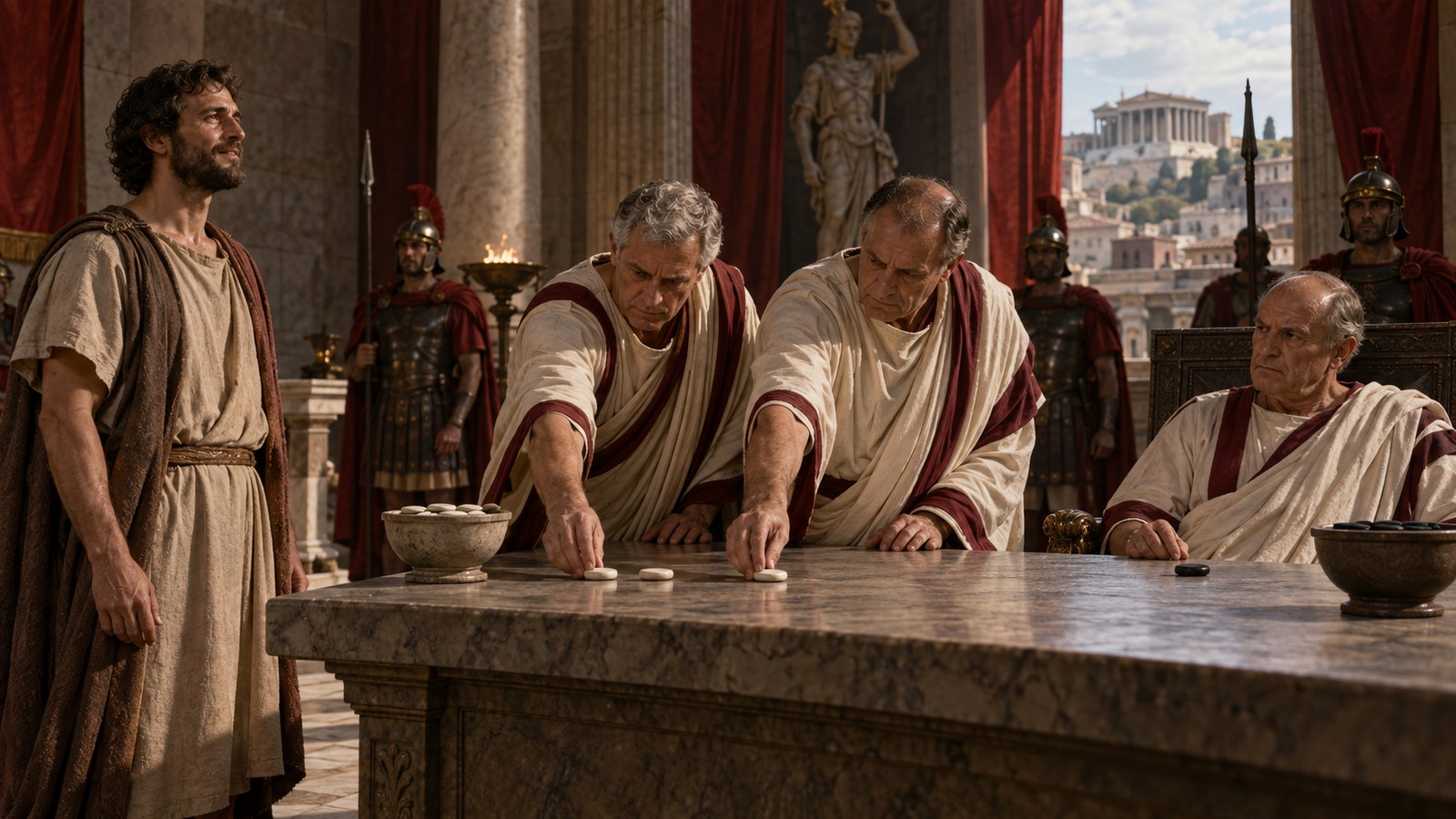
Yet he had already persuaded the other two judges to acquit. Their ballots produced the majority and therefore the operative judgment.
The arrangement separated three kinds of agency. His hand supplied a lawful vote. His voice supplied the arguments that moved the panel. The tribunal supplied the final acquittal.
That separation allowed a narrow defense of each visible role. As a judge, he could point to the conviction token. As a friend, he could point to the defendant walking free. As one member of a panel, he could say the majority—not he alone—determined the verdict.
But the sequence makes that defense unstable. The acquittal was not an accidental result he reluctantly accepted after voting. He worked to create it.
Advice is not outside judgment merely because another hand places the token. On a deliberative panel, reasoning offered to colleagues is part of how the institution reaches a decision.
The archive’s recent ballot story shows a different separation. Senatorial secrecy concealed which voter made an abusive mark. Here the judge’s influence was known to the two colleagues, but its effect could be hidden behind their formally independent votes.
The panel distributed authorship without erasing intention. Two men owned their ballots; the third owned the plan that made those ballots useful to his friend.
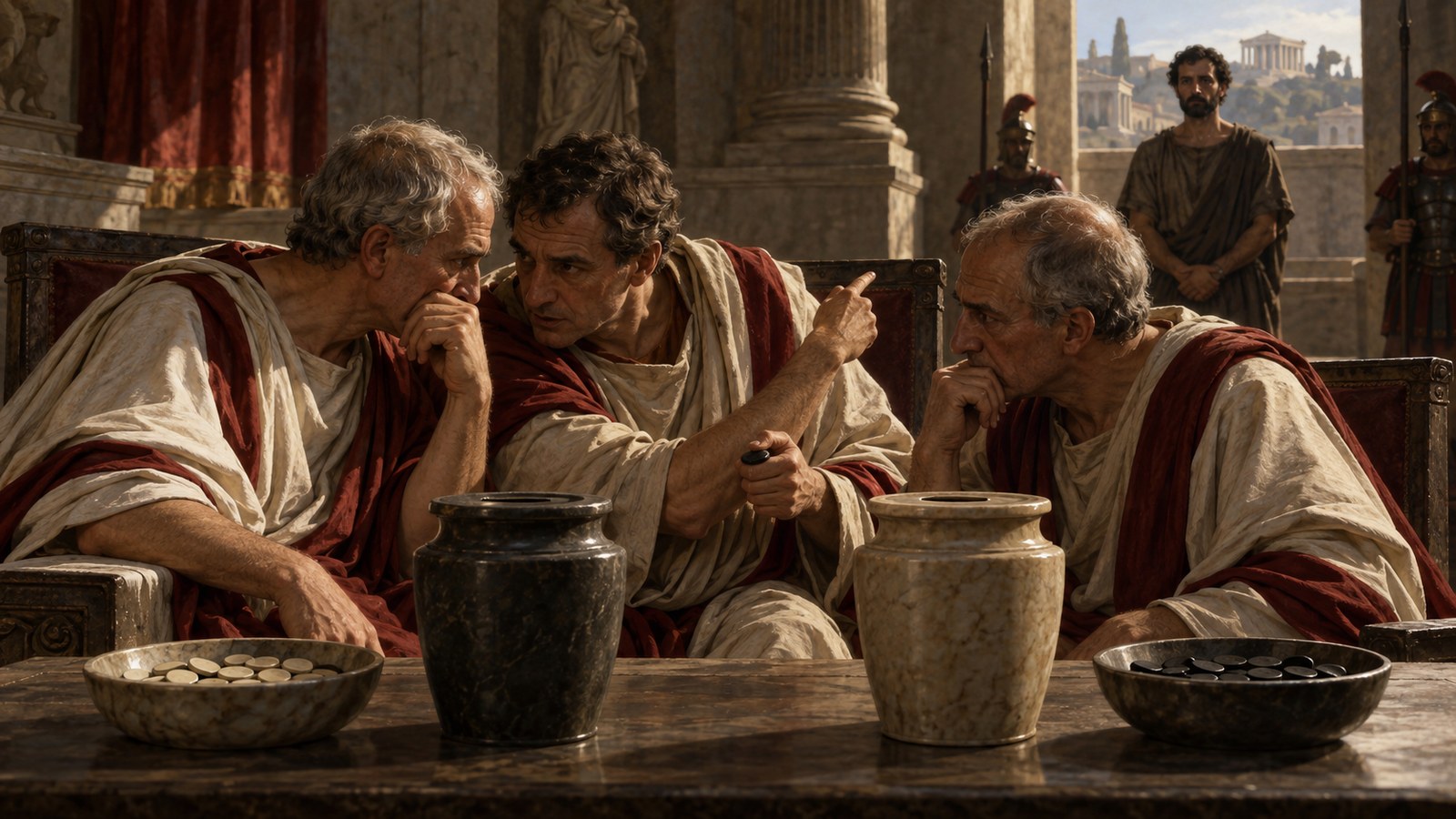
Friendship Was Saved by Borrowing Other People’s Votes
The judge believed he had preserved both offices: judge and friend. That conclusion depends on defining duty as a collection of isolated acts.
His judicial act becomes only his own vote. His friendly act becomes only persuasion. If each is judged separately, one can appear lawful and the other loyal.
The institutional result exposes the weakness. Courts do not exist to collect private moral gestures. They exist to decide cases through a procedure that combines votes into judgment.
If the law required conviction, persuading the majority to acquit used the court to produce what the judge himself regarded as a legal wrong. His dissent did not reverse the defendant’s release.
The friend benefited from more than sympathy. He benefited from the judge’s position inside deliberation. A person outside the panel might plead, but this advocate also knew the views, timing and vulnerabilities of the two votes that mattered.
That is where friendship became institutional power. The judge did not merely comfort a condemned man or support him after punishment. He redirected the mechanism deciding whether punishment occurred.
At the same time, the story does not let the judge simply falsify his own vote. He refuses the cleanest fraud: casting an acquittal token while believing conviction obligatory.
His compromise therefore reveals a real moral pressure even if it does not solve it. He wanted a trace showing that he had not personally declared the guilty innocent.
The dark token became that trace. It recorded a judgment without securing the consequence the judgment demanded.
Roman litigation often made reputation part of the event. Paid applause could manufacture the sound of forensic success around an advocate. In Gellius’s panel, the manufactured appearance was quieter: one lawful-looking dissent beside an acquittal the dissenter arranged.
The Verdict Tests Where Responsibility Ends
Gellius presents the solution as a memorable attempt to reconcile competing duties. It has survived because it invites disagreement rather than because it supplies a simple rule.
One reading emphasizes the ballot. The judge refused to pronounce a false personal judgment and trusted colleagues to exercise their own authority. Persuasion did not physically compel either vote.
Another reading emphasizes causation. He chose arguments for the purpose of defeating the legal result he believed necessary. The colleagues’ freedom does not erase his intention or influence.
The three-judge structure makes both readings possible. No single token contains the whole decision. Responsibility moves through deliberation, vote aggregation and enforcement.
This is why the story reaches beyond a claim that friendship corrupts. The judge did not abandon legal form. He used its divisions with precision.
The two colleagues cannot be reduced to empty instruments. They heard an argument and made their own choices, and Gellius does not preserve their reasons. That uncertainty limits how much blame can be assigned to each participant. It does not remove the initiating judge’s purpose. His plan depended on finding two independent votes willing to carry the acquittal he would not put under his own name.
Nor did secrecy make his conviction vote morally costless. A silent ballot protected the friend from a public denunciation, but it also protected the judge from explaining why the law required the result he was privately working to prevent. The design separated not only duties but audiences: the count received condemnation, the colleagues received persuasion, and the friend received release.
Formal compliance can coexist with substantive defeat when an official narrows his duty to the one act that leaves a favorable record. The conviction vote protected the judge’s account of himself; the persuaded majority protected his friend.
What remained unprotected was the court’s stated rule. If condemnation was legally necessary, the institution delivered the opposite because one member separated what he voted from what he caused.
The case also warns against treating a dissent as complete evidence of opposition. A recorded minority position may show what an official placed in the count. It does not always show what that official did to shape the majority.
Gellius’s judge wanted to be both roles at once. His solution did not merge them. It assigned judge and friend to different channels inside the same proceeding.
The friend walked free because the advice outweighed the ballot. That outcome is the best measure of which action governed.
Sources
Aulus Gellius, Attic Nights, book 1, chapter 3.