
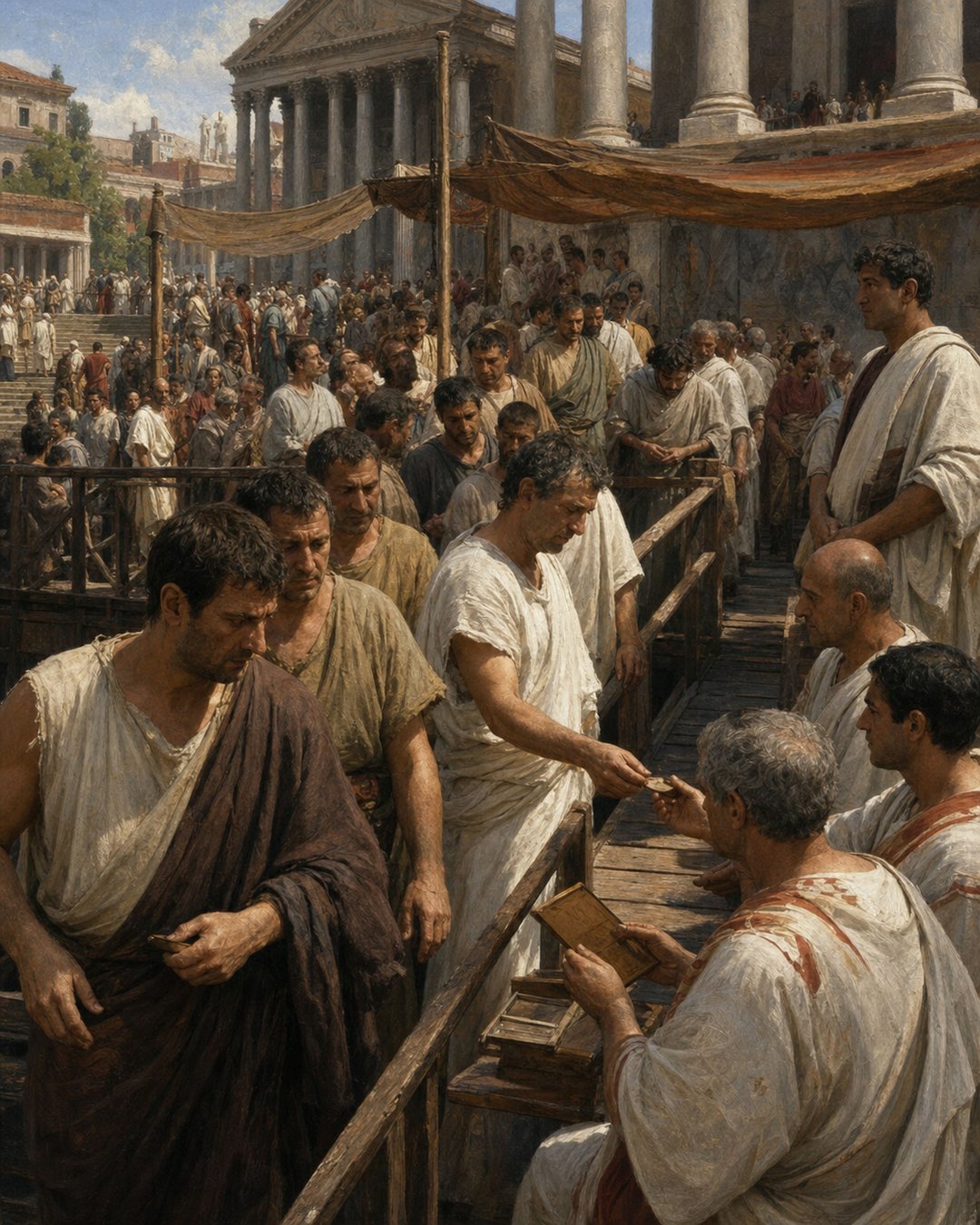
A Roman election could look like a crowd before it looked like a result. Men gathered, waited, pressed forward, argued, recognized neighbors, and watched officials impose order on bodies that did not naturally move in neat units. The vote had to become something more precise than noise.
Roman voting bridges made elections visible because they converted political will into a physical route. A citizen crossed a narrow passage, carried a small tablet, placed choice into a process, and left behind an act that could be counted. The crowd remained public, but the moment of choice acquired shape.
The bridge turned crowd into sequence
Pons could mean a bridge, and the word matters because voting needed controlled movement as much as public enthusiasm. The narrow passage did not merely get voters from one side to another. It made the crowd pass through procedure.
Imagine the morning scene: dust under sandals, awnings snapping above the enclosure, officials watching baskets, and one citizen after another stepping onto the wooden way. The bridge slowed the crowd enough for choice to become legible.
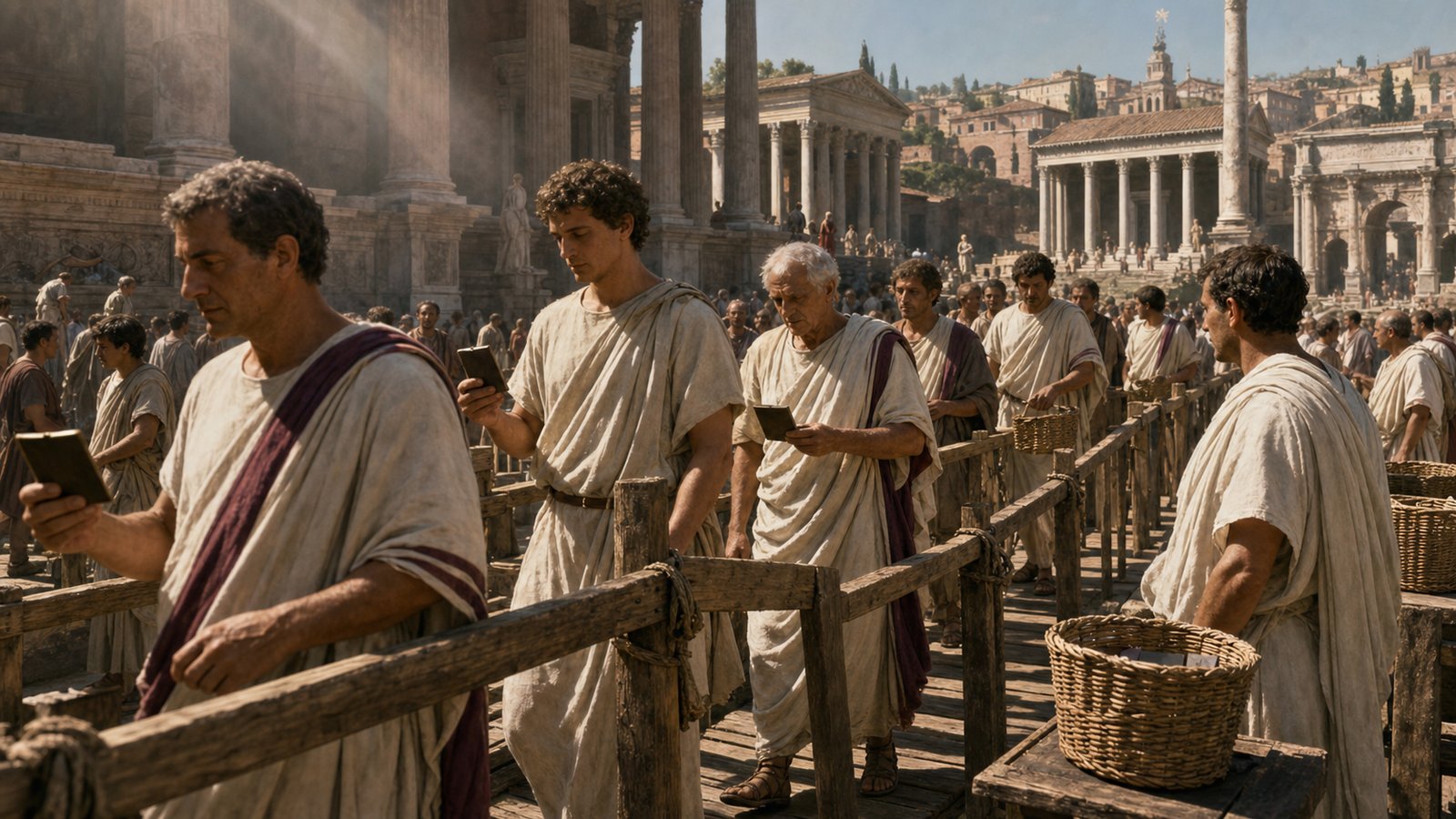
The tablet made choice portable
Tabella, the small tablet, gave the vote a body. A preference that might have been shouted, pressured, or lost in noise could be marked, carried, and deposited. Privacy and publicity met in the same gesture.
This is the central tension. The voter was visible as a citizen moving through an assembly, yet the mark on the tablet could be less visible than his face. Roman procedure did not erase pressure, but it gave choice a material shield.
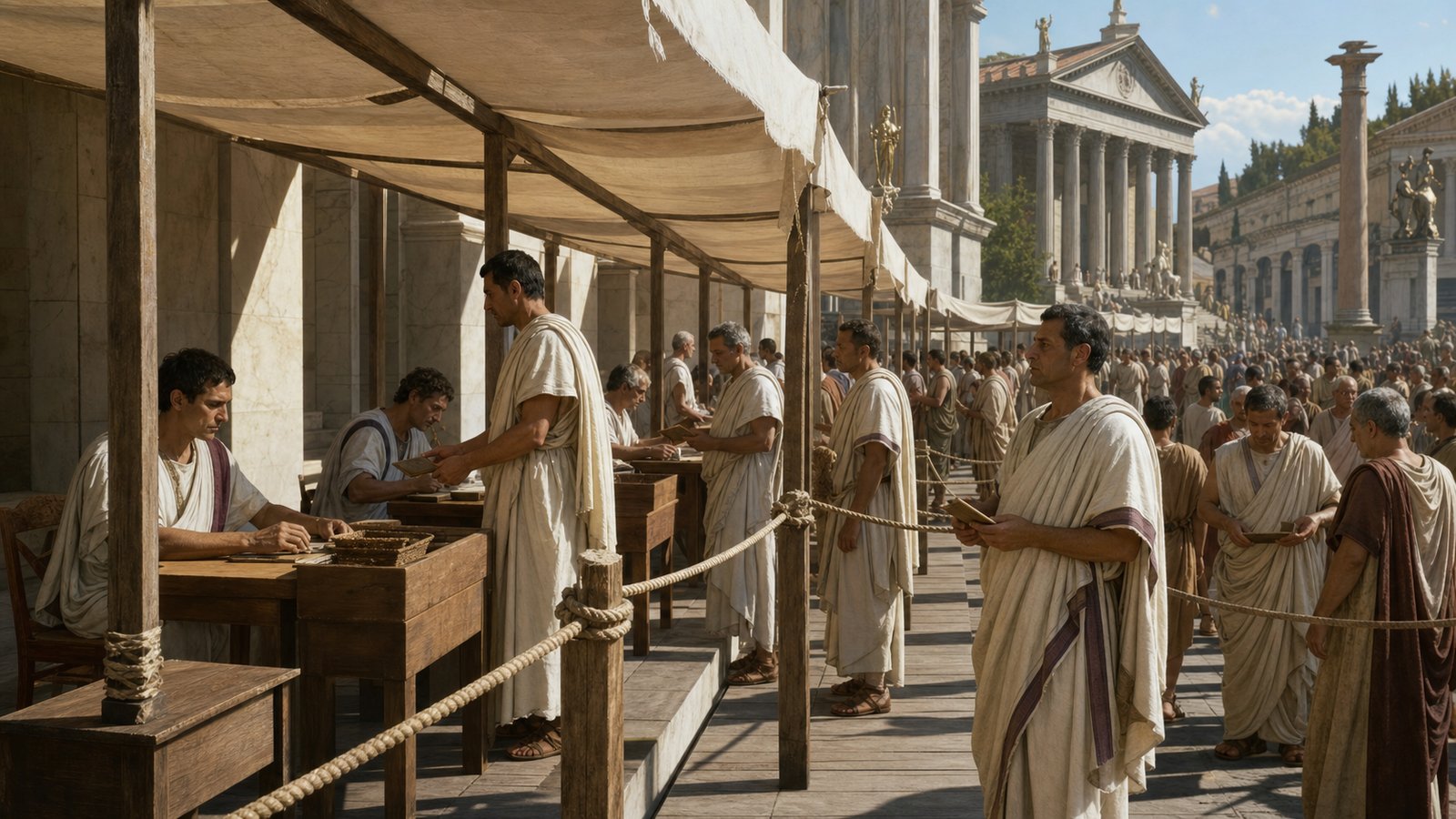
Officials needed witnesses and order
Comitia were assemblies, not abstract institutions floating above the city. They required place, sequence, officials, and witnesses. A result gained force because people could see that the city had gone through recognizable motions.
That recognition links this article to Roman public notices. In both cases, authority depended on more than a decision. It depended on the public form in which the decision appeared.
Counting was a civic performance
Suffragium, the vote, sounds like a simple political unit, but the unit had to be produced. A crowd does not automatically become a count. Bridges, baskets, tablets, and clerks helped transform presence into number.
The result was not only mathematical. It was theatrical in the sober Roman sense: a shared procedure taught people where legitimate power came from and how it moved from bodies into records.
Procedure made politics harder to deny
A voting bridge could not make Roman politics fair by itself. Status, patronage, wealth, intimidation, and habit still mattered. Yet the apparatus mattered because it made the election something people could witness, remember, and dispute.
The bridge made elections visible by giving choice a route. It did not solve every struggle over power. It showed that power had to pass through a scene the city could recognize.
The physical details are easy to underestimate because they are small beside speeches, laws, and factions. But politics often depends on humble objects. A tablet carries a mark. A basket receives it. A bridge controls the body that carries it. A clerk turns movement into record.
The Roman world knew many forms of public display: standards, arches, inscriptions, calendars, and rostra. Voting bridges belonged to that same family of visible authority, but with an important difference. They displayed participation rather than conquest.
A citizen crossing the bridge did not need to be famous. His importance came from being one more countable body in a recognized civic sequence. That is a quieter kind of visibility than a triumph, but it is still political.
The bridge also managed suspicion. In any election, people ask whether a result is real. A watched procedure cannot eliminate suspicion, but it gives suspicion something concrete to examine: who crossed, who collected, who counted, and where the tablets went.
The same logic appears in Roman calendars. Public order becomes stronger when it is attached to visible routines. People do not merely obey an idea; they learn the places, objects, and sequences through which the idea operates.
The bridge therefore shows Rome at its most procedural. Instead of imagining politics only as speeches by great men, we should picture wood underfoot, hands on tablets, baskets waiting, and a crowd watching the small choreography of decision.
There is a human drama in that choreography. A voter could be seen by patrons and neighbors while still guarding the precise mark he made. He moved through a public crowd toward a private sign, then released that sign into a public count.
The material process also made the assembly more memorable. People could later say not only that a faction won, but that the voting had happened through the familiar apparatus. The result attached itself to a witnessed event.
That event had limits. Women, enslaved people, foreigners, and many others stood outside the formal citizen body. The bridge made citizen choice visible precisely by marking who was allowed into the sequence and who remained outside it.
For those inside the sequence, however, the bridge made citizenship feel bodily. Political identity was not only a legal label. It was the experience of waiting, moving, marking, crossing, and being counted among others.
The scene also turned time into pressure. A crowd had to wait its turn. Officials had to keep the line moving. The count could not exist until enough small acts had been performed in order. Public decision required patience as well as conviction.
This is why the voting bridge deserves a place beside more monumental Roman objects. It was temporary, practical, and easy to remove, but it helped create one of the most important public illusions of civic life: that a large city could speak through ordered individual acts.
The illusion mattered even when politics was messy. The more contested the outcome, the more important the visible form became. A vote with no recognizable procedure would dissolve into rumor; a vote through bridges and tablets at least offered a public trail.
Roman voting bridges made elections visible by forcing power to move slowly enough to be seen. The citizen crossed, the tablet traveled, the basket received, the clerks counted, and the city could imagine that a crowd had become a decision.
The smallness of the bridge is part of its lesson. Rome often made large claims through repeatable objects: a milestone on a road, a stamp on a brick, a wax seal on a document, a tablet in a voter’s hand. None of these objects ruled alone, but each helped public power become something people could locate.
The bridge also helped separate procedure from pure spectacle. An assembly could be loud, partisan, and intimidating, yet the act of crossing gave the vote a narrower channel. Political energy had to pass through a designed bottleneck before it could become an official number.
In that sense, the voting bridge shows the Roman instinct for making authority walk through things. The decision did not descend from the sky. It moved along wood, through hands, into containers, and finally into the record that let officials say the assembly had spoken.
Sources & Further Reading
- Smith Dictionary, Comitia
- Smith Dictionary, Suffragium
- Smith Dictionary, Tabella
- Smith Dictionary, Pons
- Smith Dictionary, Tabulae