
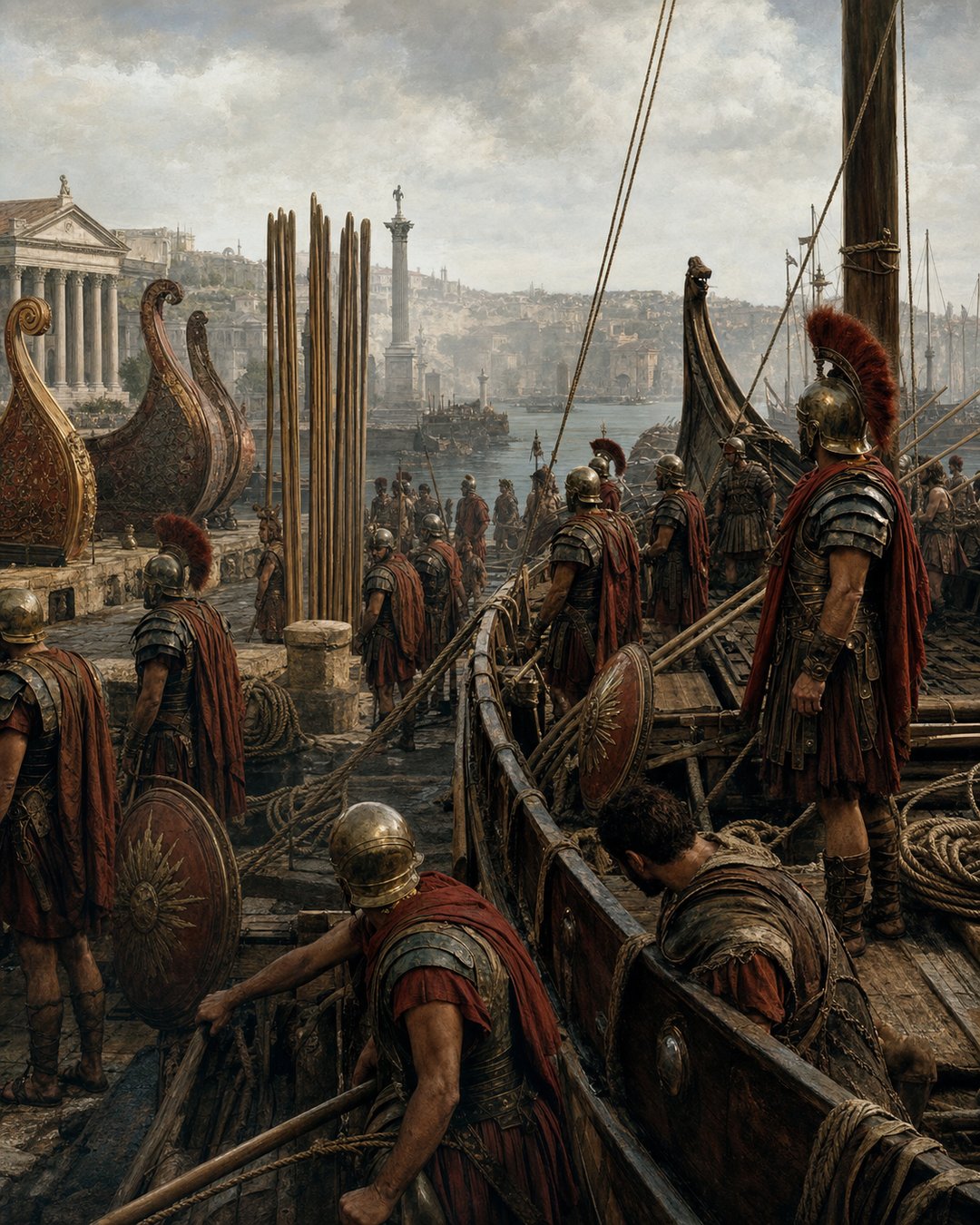
Naval victory is difficult for a land city to remember. The battle happens beyond the Forum, beyond the citizen crowd, beyond the daily routes of most people who will later speak about it. Rome solved that problem in a characteristically physical way. It brought the sea back as an object.
Roman ship prows made naval victory public because captured parts of ships could be fixed into civic space. The rostra turned distant water, rowing, impact, and capture into something a crowd could stand beneath while listening to politics.
The prow made the battle touchable
Rostra was named from captured ship prows, and that origin matters because a prow is not a vague symbol. It is the front of a vessel, the part associated with approach, collision, and danger. A captured prow brings the violence of sea battle into view.
Picture the mini-scene: bronze-dark curves, ropes, oars, veterans in the crowd, and a platform where the memory of ships frames the speaker. The sea is absent, but the trophy insists that the victory was real.
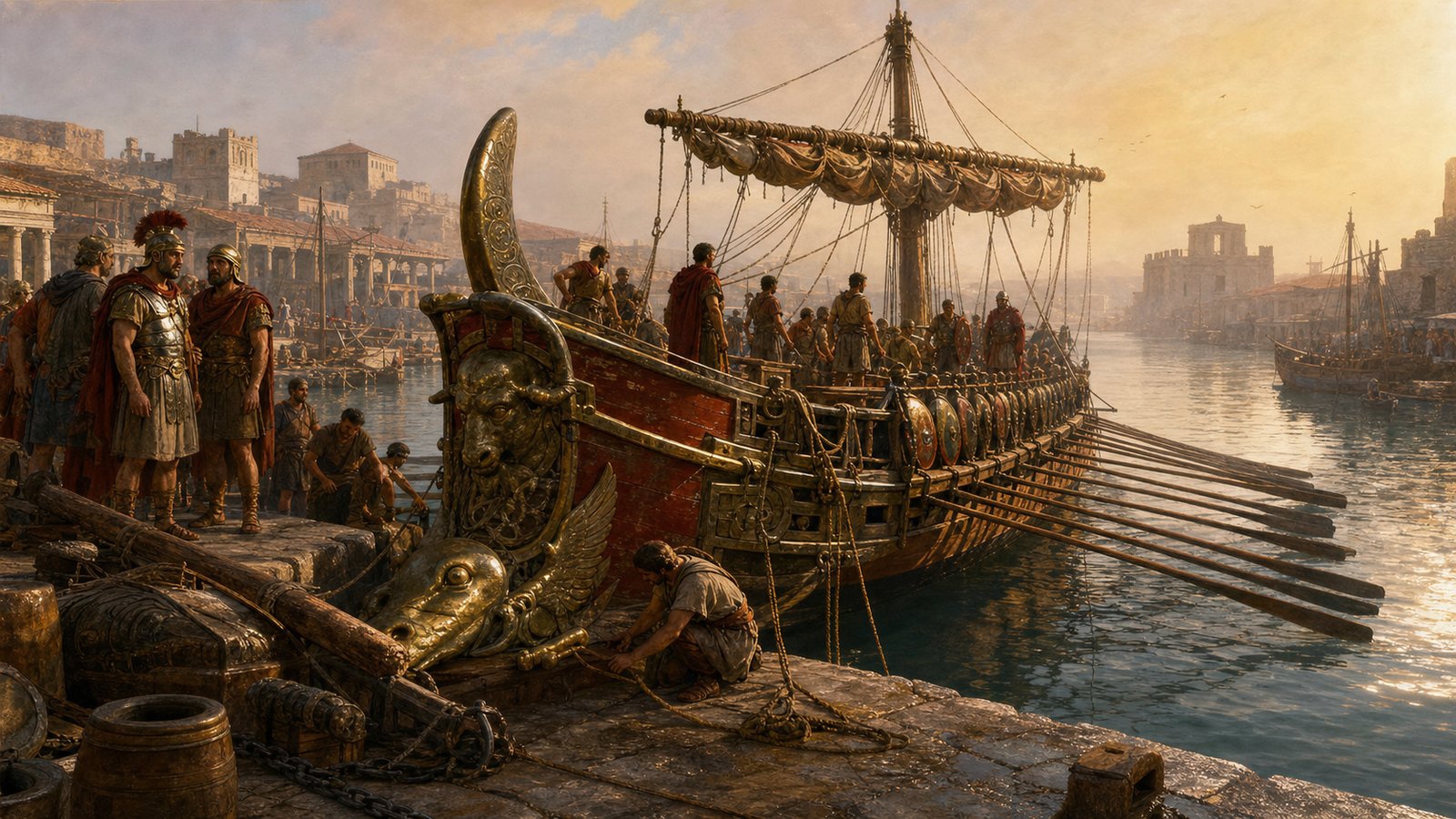
Spoils moved enemy power into Roman space
Spolia, spoils, worked by relocation. An enemy object lost its first meaning and gained a Roman one. What once belonged to an opponent now helped Rome tell a story about control, survival, and superiority.
This is why trophies were not only decoration. They were evidence placed in public. A citizen did not have to see the battle if the city could show him what the battle had delivered.
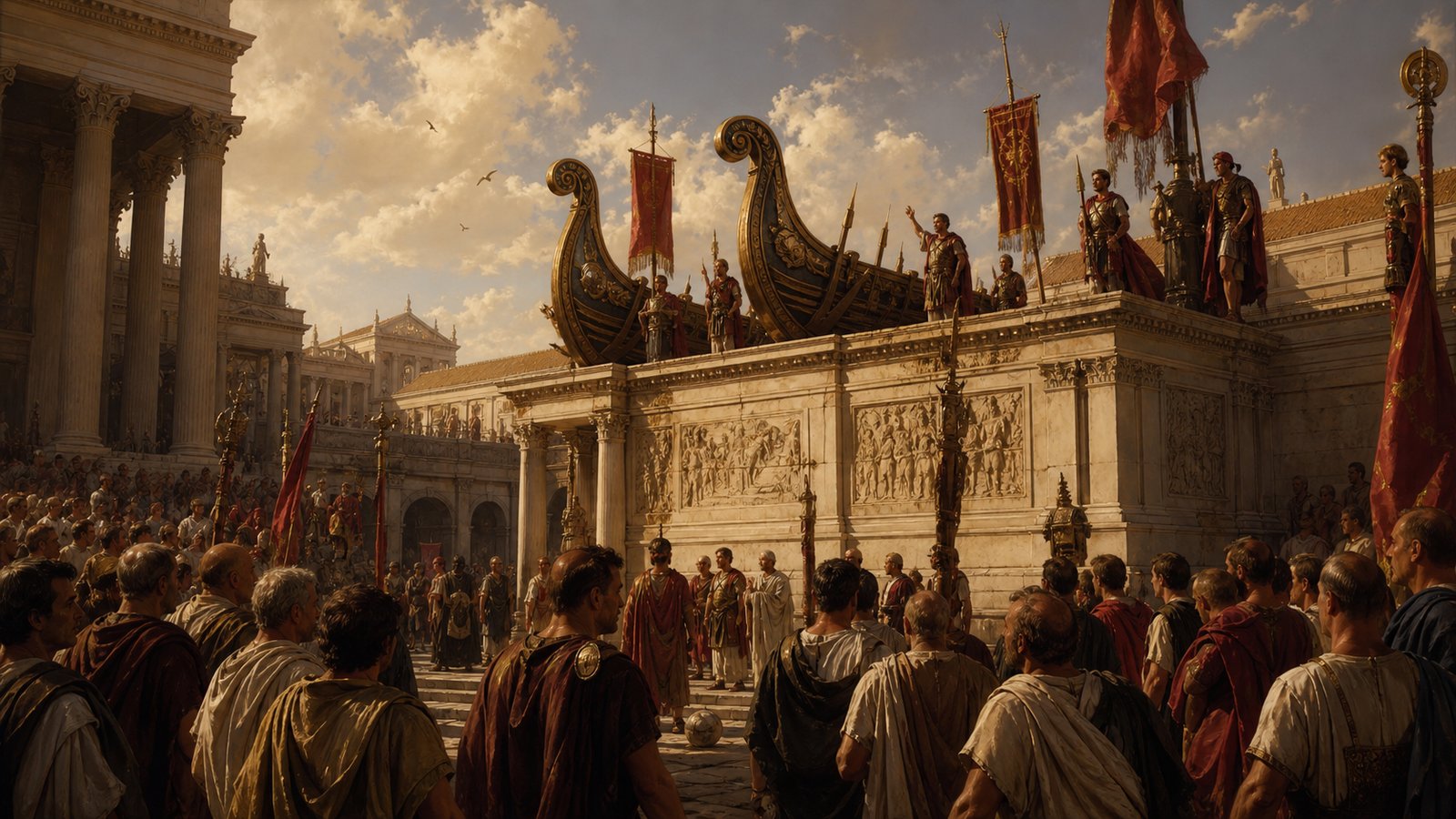
Naval war needed many invisible workers
Navis reminds us that a ship was a system of labor. Rowers, sailors, marines, pilots, carpenters, rope handlers, harbor crews, and commanders all made naval action possible. A prow trophy condensed that whole system into one visible fragment.
The fragment was powerful because most of the labor had disappeared. Oars stopped moving, orders ended, the harbor changed, bodies were gone, but the captured prow remained as a durable sign of the work.
The rostra joined speech to conquest
The platform mattered. A ship prow displayed in a storehouse would say one thing; a ship prow built into the rostra said another. It connected victory to public speech, law, persuasion, and crowd attention.
A speaker addressing the people beneath naval trophies did not need to explain every battle. The architecture already whispered that Rome had beaten enemies at sea and carried the proof into the center of civic life.
Sea power became civic memory
The deeper point is that Rome made distant force local. Naval victory happened elsewhere, but memory had to live where citizens gathered. Ship prows allowed the city to make waterborne success part of its daily visual language.
That visual language was not neutral. It taught people where to look for Roman power: not only on roads, walls, and standards, but in trophies fastened to the stage of public words.
The corona navalis, a naval crown, belongs to the same world of recognition. Sea service could be honored, ranked, and remembered. Rome did not let maritime labor vanish entirely into distance; it gave some of it names, awards, and objects.
The captured prow also changed scale. A whole battle is too large to hold in the mind. A prow is small enough to display, yet suggestive enough to evoke ships, crews, splintered wood, shouting, water, and fear.
This compression made public memory efficient. Rome could not replay every naval battle for every citizen. It could keep the trophy where political life continued and allow the object to do quiet work each time people gathered.
The rostra was therefore more than a convenient platform. It was a mnemonic machine. Its name and decoration helped speech take place inside a frame of remembered conquest. Public argument unfolded under reminders that Rome had already forced enemies to yield.
There is a hard edge to this. Spoils humiliate as well as commemorate. A captured prow declares that an enemy ship no longer belongs to its first world. It now serves Rome by telling Rome’s version of the encounter.
For citizens who never sailed, the trophy offered a way to imagine naval power without understanding all its technical details. They could see the curved front of a ship and know that something from the enemy’s sea force had been made Roman.
That mattered because Rome’s identity was often told through land: roads, camps, walls, farms, colonies, and marching armies. Ship prows widened the story. They said that Roman public life could absorb the sea too.
The image also reveals how victory display and politics fed each other. A speaker could borrow authority from trophies; trophies could gain new relevance from the speeches delivered around them. Each crowd renewed the connection.
Naval war itself remained dangerous, technical, and dependent on weather and skill. A trophy did not simplify the sea. It simplified memory. It gave the city a hard object where a complicated event could settle.
That object could outlast the men who had rowed, commanded, or watched the fight. Children might see the prow without knowing every name attached to it, yet still absorb the lesson that Roman victory had a shape and a place.
This is why ship prows belong with coins, arches, standards, and inscriptions. They converted action into public evidence. They made power repeatable by giving it a visible form that did not need the original event to remain present.
Roman ship prows made naval victory public because they solved a problem of distance. The battle was over the horizon, but the proof could stand in the Forum. The sea had gone quiet, but the captured front of the ship kept speaking.
The display also made naval power available to ordinary civic memory. A citizen did not need to understand currents, rams, rigging, or rowing cadence to recognize that enemy ships had been reduced to trophies. The complicated event became a visible claim.
That claim could be renewed whenever the crowd gathered. Each speech delivered near the rostra reactivated the trophies, and each glance at the prows made political speech seem to happen under the shadow of past victories.
The prows therefore turned movement into permanence. Ships were built to travel, fight, and decay, but the captured fragment was fixed into the city. Rome transformed a mobile weapon into stationary memory.
There is also a human contrast inside the display. The men who rowed and fought were mostly absent from the trophy, but their labor survived in the object that had once cut through water. Public memory often preserves a fragment while hiding the bodies that made it meaningful.
That makes the rostra both impressive and selective. It announced victory clearly, but it did not tell every cost. It turned war into a civic backdrop, making the crowd feel continuity where the original event had been confusion, noise, and danger.
The effect was strongest because the trophy met people during ordinary political life. Citizens did not have to attend a triumph to encounter naval victory. They could meet it while listening, waiting, arguing, voting, trading rumors, or simply crossing the Forum.
Sources & Further Reading
- Smith Dictionary, Rostra
- Smith Dictionary, Navis
- Smith Dictionary, Spolia
- Smith Dictionary, Corona