
News becomes powerful when people know where to find it and who else has seen it. In Rome, information did not have to wait for a modern newspaper to become public. It could be posted, announced, copied, discussed, and tied to the places where civic life already gathered.
Roman public notices made news official because display changed information into a shared fact. A decision placed on a board near a public route did more than inform one reader. It created witnesses, repetition, and an argument about authority.
A notice needed a place
Tabulae and albums point to a practical truth: written information needed a surface. A board, tablet, or whitened panel could hold a decision in place long enough for more than one person to see it.
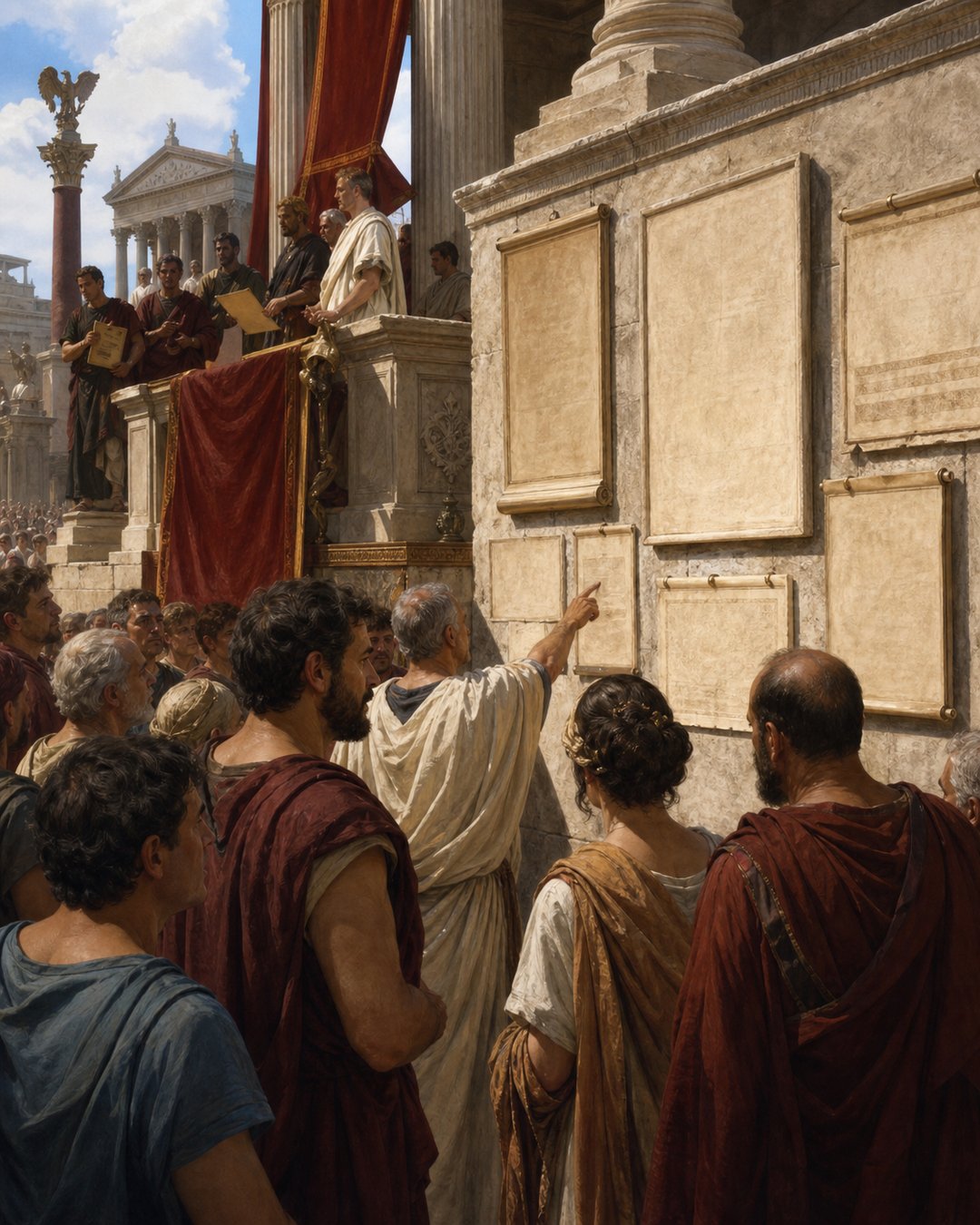
Imagine a Forum wall in daylight. Citizens lean toward a board, a scribe stands nearby with tablets, and a passerby repeats one line to someone behind him. The news is not private anymore because the place has made readers into a crowd.
Calendars made time public
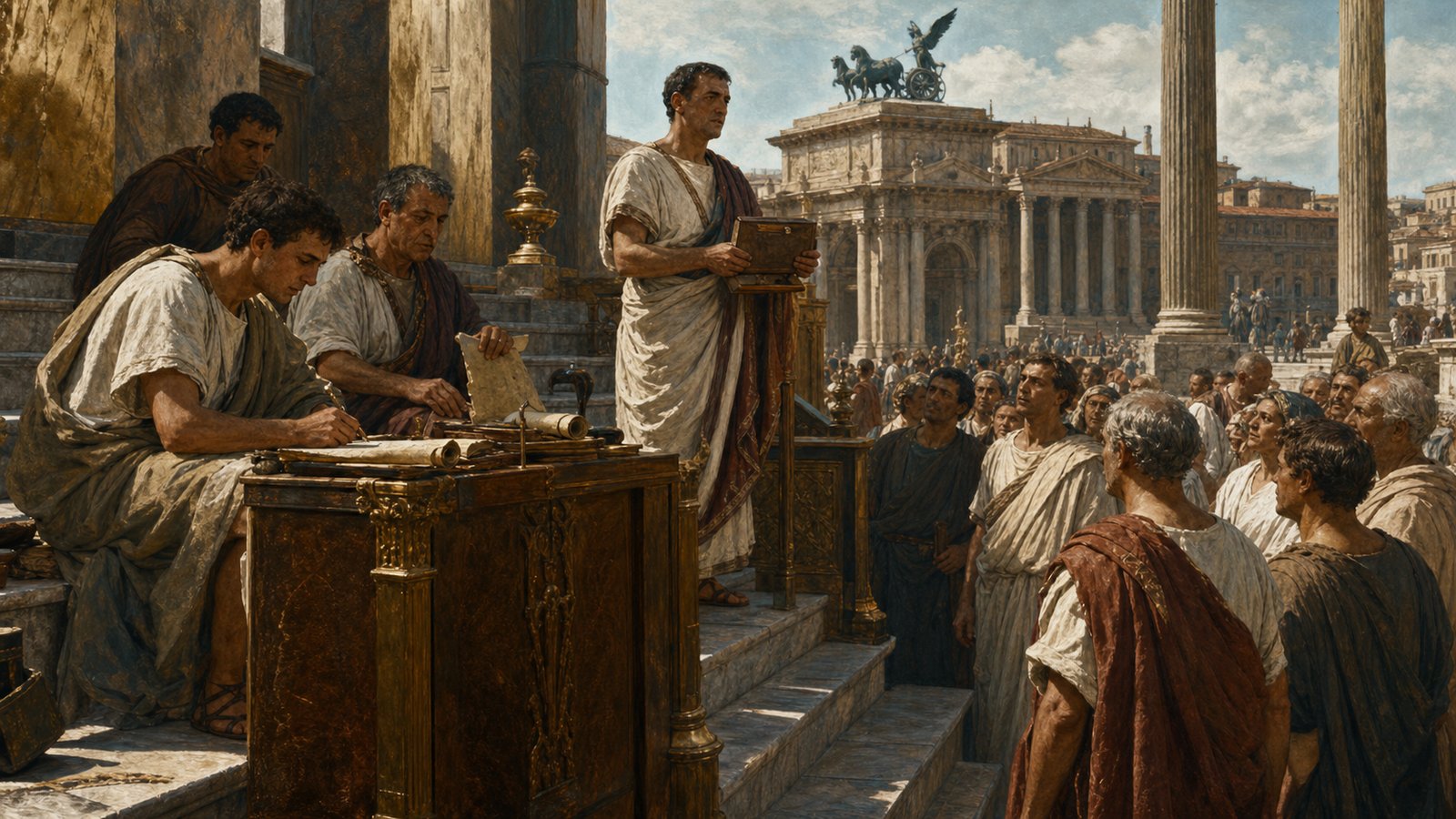
Fasti were not merely lists. They organized time, days, duties, memory, and expectation. When authority controls the calendar, it controls more than dates; it controls when public life knows itself to be open, closed, sacred, available, or remembered.
This is why posted time matters. A calendar turns the future into a civic surface. People can point to it, plan around it, and argue from it. Official time becomes visible before the day arrives.
Market days carried information farther
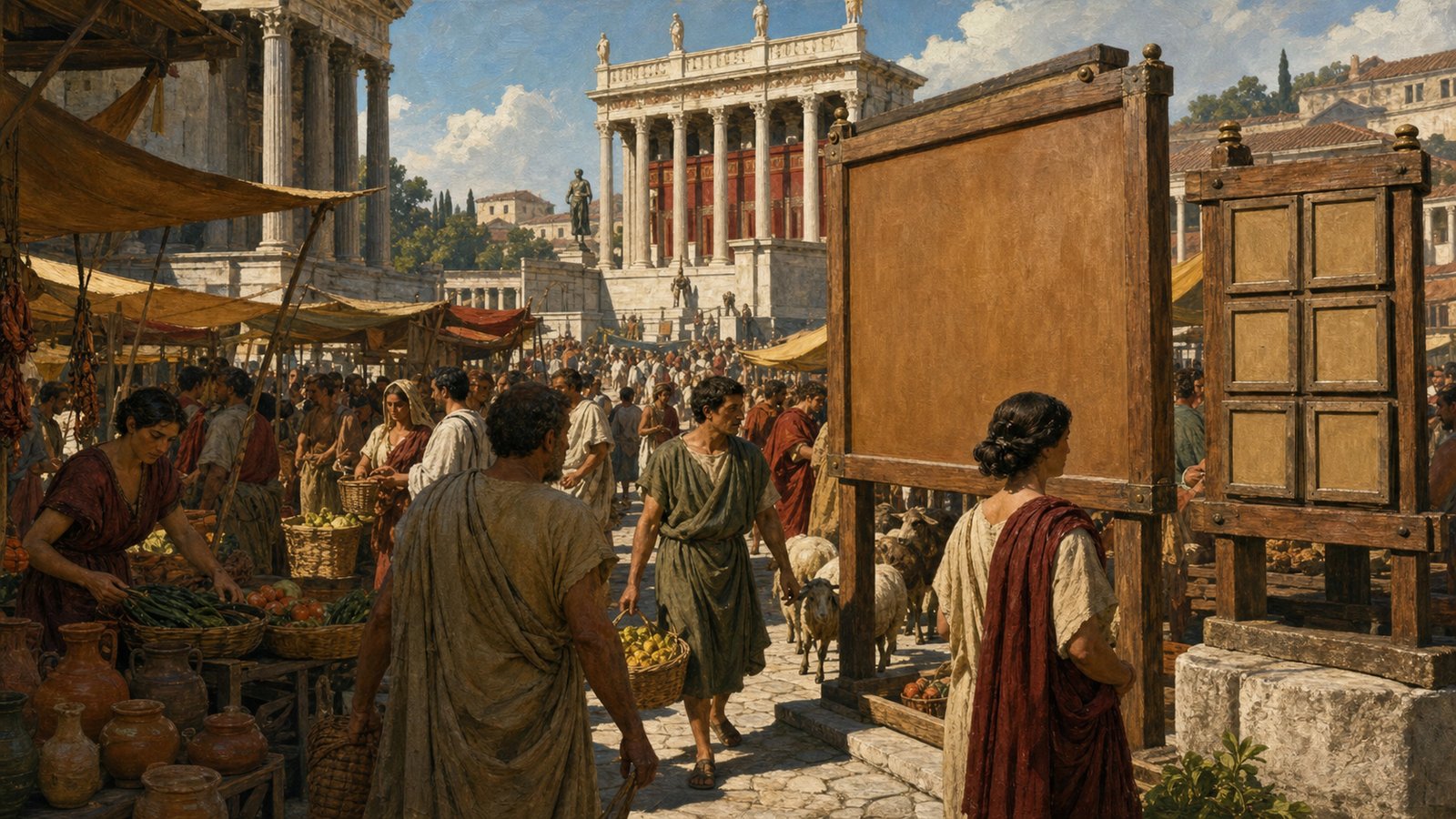
Nundinae, recurring market days, gave notices an audience that was already moving. Farmers, traders, buyers, debtors, neighbors, and strangers met for exchange, and information traveled with them when they left.
A posted notice on an ordinary empty day is one thing. The same notice on a crowded market day becomes a seed scattered through conversation. People carry the news home because they were already gathered for other reasons.
The rostra made announcement theatrical
The rostra was a platform of speech and memory, and its setting matters. A public decision spoken or displayed near such a place borrowed the energy of the crowd. Authority became something bodies faced together.
The Forum did not make every reader equal, and literacy was not evenly shared. But public placement still mattered because reading could become listening, summary, rumor, and repetition. A board could speak through people who had read it.
Official news depended on witnesses
The deeper mechanism is not paper or ink. It is witness. A notice becomes official when enough people can say not simply that they heard a story, but that it was placed where the city expected authority to appear.
Roman public notice culture shows a practical intelligence about legitimacy. Information has to be visible, repeatable, and socially located if it is going to govern behavior.
This does not mean Rome had modern transparency. Power could mislead, omit, delay, and intimidate. But even imperfect display changes the game. A public board creates a place where memory can gather and where silence becomes harder to maintain.
The physical detail matters. A notice is not an idea floating through the air. It is a surface with people around it, shadows passing across it, fingers pointing, and voices turning written lines into public speech.
The blank boards in the image are deliberate for our purposes, but the historical point is exactly the opposite: Roman authority understood that public information needed material form. A board could make the invisible decision stand still long enough to be encountered.
Calendars sharpened this effect because they connected information to rhythm. People did not only ask what had happened. They asked when business could be done, when a day was marked, when a public pattern returned, and what memory belonged to which date.
Market days supplied a different rhythm. Nundinae made information mobile by bringing people into contact. The road, the stall, the price, the debt, and the rumor belonged to the same day of movement.
A notice also created inequality. Some people read directly; others listened; some heard a summary distorted by interest or fear. Public display did not erase hierarchy. It gave hierarchy a place to operate in the open.
The rostra intensified that openness. A platform named from captured prows already carried conquest into speech. When announcements clustered around such spaces, news entered a theatre of power, memory, and civic expectation.
The important point is that official information needed a recognized route. If people did not know where authority appeared, each message would arrive as only another rumor. Display gave news a home address.
That home address helped the city govern distance. A person who saw a notice could retell it to someone who had not. A market visitor could carry it outside the Forum. A household could plan around a date it did not personally negotiate.
Roman public notices therefore remind us that news is never only content. It is also placement, timing, audience, trust, and repetition. A decision becomes durable when people know where it was made visible.
This is why the ordinary board deserves attention beside emperors, armies, and laws. The board connected decision to witness. It turned authority from something issued somewhere into something that could be encountered in a specific public place.
The result was a city where information moved through stone, wood, plaster, voice, crowd, and calendar. Rome did not need a press to understand that public facts require public habits. It needed boards, days, platforms, readers, listeners, and the expectation that official news should have somewhere to stand.
A posted notice also changed responsibility. Once information was placed in a recognized public setting, ignorance became harder to claim and easier to contest. People might still miss the message, misunderstand it, or distrust it, but the city had created a visible reference point.
This visibility was a form of discipline. It taught citizens to connect authority with certain places and routines: the Forum, the calendar, the market day, the board, the platform. News became official partly because people learned where official news was supposed to appear.
The system also made memory cumulative. One notice could be replaced by another, but the habit of checking, hearing, and repeating remained. Public information was not a single event. It was a civic practice refreshed by each new board, date, and crowd.
The public notice also made disagreement more concrete. People could dispute interpretation, fairness, or enforcement while pointing back to the same visible source. The board did not end argument; it gave argument a shared object.
That shared object mattered in a city of unequal access. A magistrate, trader, client, freedman, visitor, and household servant did not meet information in the same way, but public placement allowed news to move across those differences by sight, voice, and repetition.
For that reason, official display was one of Rome’s quiet technologies of rule. It did not conquer like a legion or impress like an arch, yet it helped turn decisions into public routines that people could organize their days around.
Sources & Further Reading
- Smith Dictionary, Fasti
- Smith Dictionary, Nundinae
- Smith Dictionary, Rostra
- Smith Dictionary, Tabulae
- Smith Dictionary, Album