
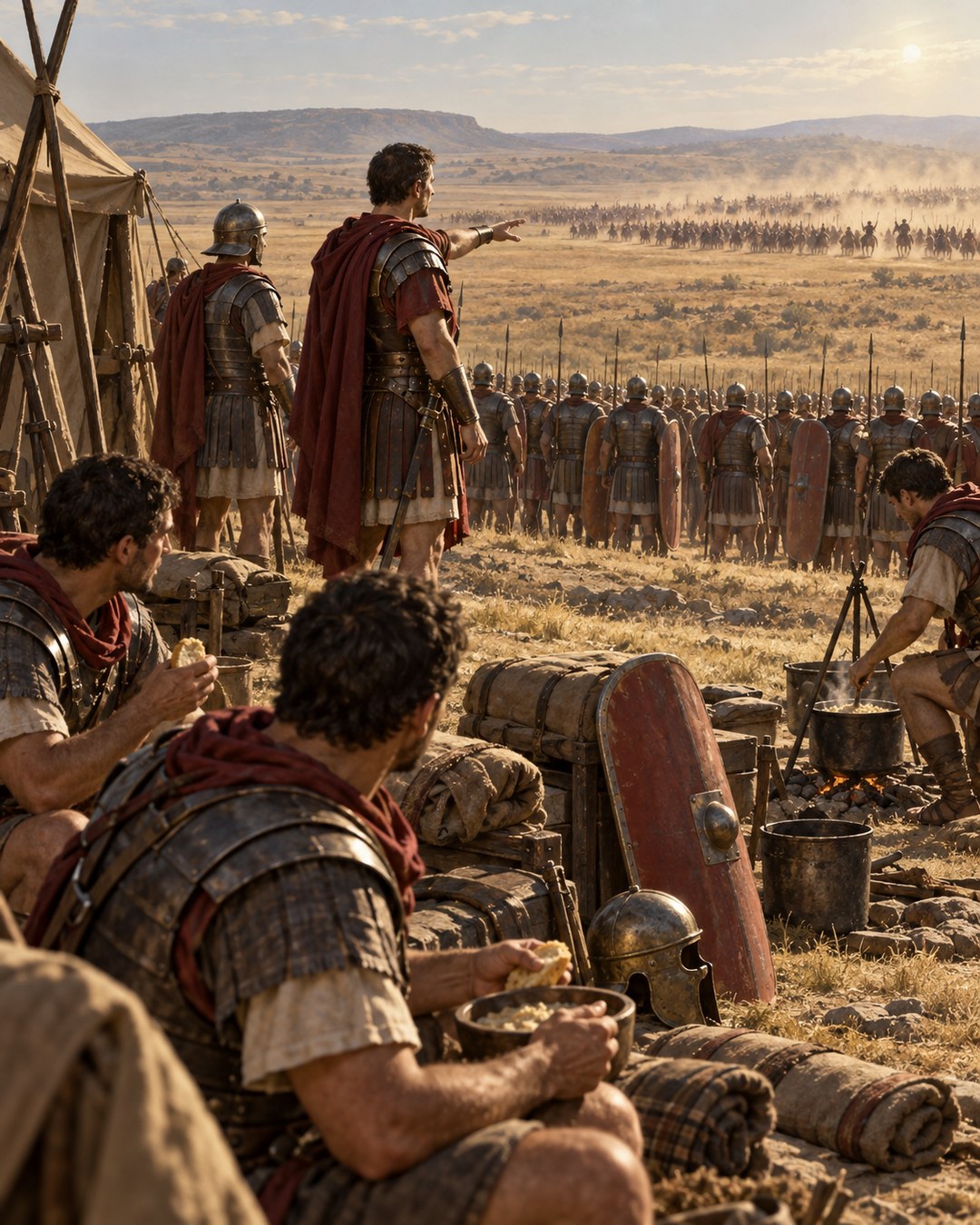
The enemy could see the Roman line waiting in front of its camp.
What they could not avoid was the ground between them. By the time they crossed it, the sun, wind and dust were waiting too.
Frontinus preserved Marius’s plan as a sequence in which breakfast and direction mattered before weapons did.
One Army Ate While the Other Prepared to Walk
Frontinus begins with a decision that sounds ordinary: Marius fixed a day for battle. A chosen day allowed preparation to become part of the design rather than a hurried response to an enemy’s movement.
He first “fortified” his soldiers with food. The word matters because nourishment appears in the account as military preparation. Men expected to stand, advance, keep formation and fight needed usable strength at the appointed hour.
The source does not provide a menu, so there is no reason to invent one. Its point is simpler. Marius did not treat eating as background routine. He made sure that his side entered the encounter fed.
He then stationed the army in front of its own camp. The line did not spend the opening phase marching out across the whole field. It took position close to the place where supplies, rest and organization had been available.
That economy of movement created the first imbalance. Both armies would eventually occupy the same battlefield, but they did not pay the same physical price to reach the meeting point.
Roman training could make extraordinary demands on bodies. The double-weight wicker shields used in recruit training prepared men for effort under load. Marius’s arrangement addressed a different question: why spend trained strength on avoidable steps immediately before combat?
Food and position worked together. A meal without saved movement could be burned away on approach. A short approach without food could leave rested legs attached to an underfed body. The design joined the two.
Choosing the day also put the sequence on a clock. Food had to be taken early enough to support the men but not so early that the benefit had faded. The line had to form before the opponents committed to crossing. Marius’s decision joined a calendar choice to bodily readiness.
The camp mattered as more than scenery behind the ranks. It marked the side that had already completed its immediate movement. From the enemy’s perspective, the Romans were visibly established while the road to contact still lay ahead.
The Empty Interval Became a One-Sided Cost
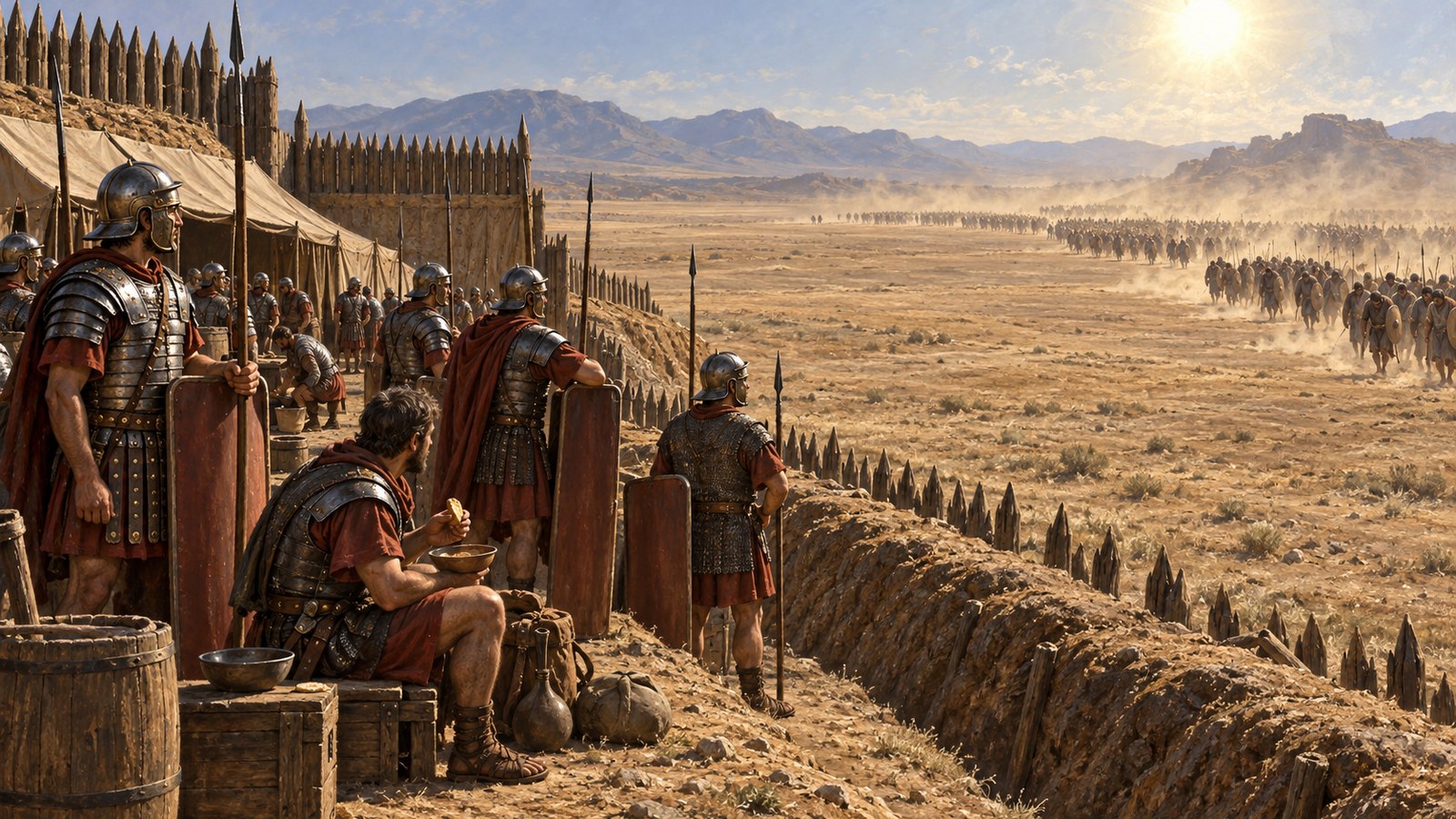
The opposing army had to cover the distance between the lines. Frontinus says Marius intended that march to exhaust it. Empty ground became a resource because only one side was required to consume it.
A battlefield map can make an interval look neutral: a blank strip separating two blocks. For the people crossing it, the strip had duration, heat, dust, equipment weight and the pressure of maintaining order while an enemy watched.
The longer approach also delayed relief. Men could not simply wander forward at individual pace, stop when tired or spread out wherever walking was easiest. They had to arrive as an army capable of acting together.
Frontinus does not give the interval’s measured length or describe the enemy’s formation. His claim is nevertheless specific. Marius placed his troops so that the other army would be “used up” by marching before it met the Roman line.
This was not a hidden pit or mechanical trap. The opponents could see the distance, but withdrawing from a battle they had come to fight carried its own consequences. Obvious terrain can still constrain choices.
The arrangement resembles a tax collected in fatigue. Every pace transferred a little advantage to the stationary line. Roman soldiers paid with patience; their opponents paid with effort.
The enemy still possessed agency. It might slow the approach, refuse the engagement or seek a different direction. Frontinus’s example assumes that the desire or pressure to fight kept the army moving across the offered space. A stratagem often worked by making the opponent’s most likely choice expensive.
That explains why simple distance could belong in a commander’s toolkit. Marius did not manufacture the plain. He assigned different roles to it: protective depth behind a waiting line for one army, and a compulsory approach for the other.
Elsewhere, obstacles physically stopped a charge. close-set stakes defeated scythed chariots by denying clear lanes. Marius used no barrier in this account. The open lane itself did the wearing down.
Sun, Wind, and Dust Completed the Alignment
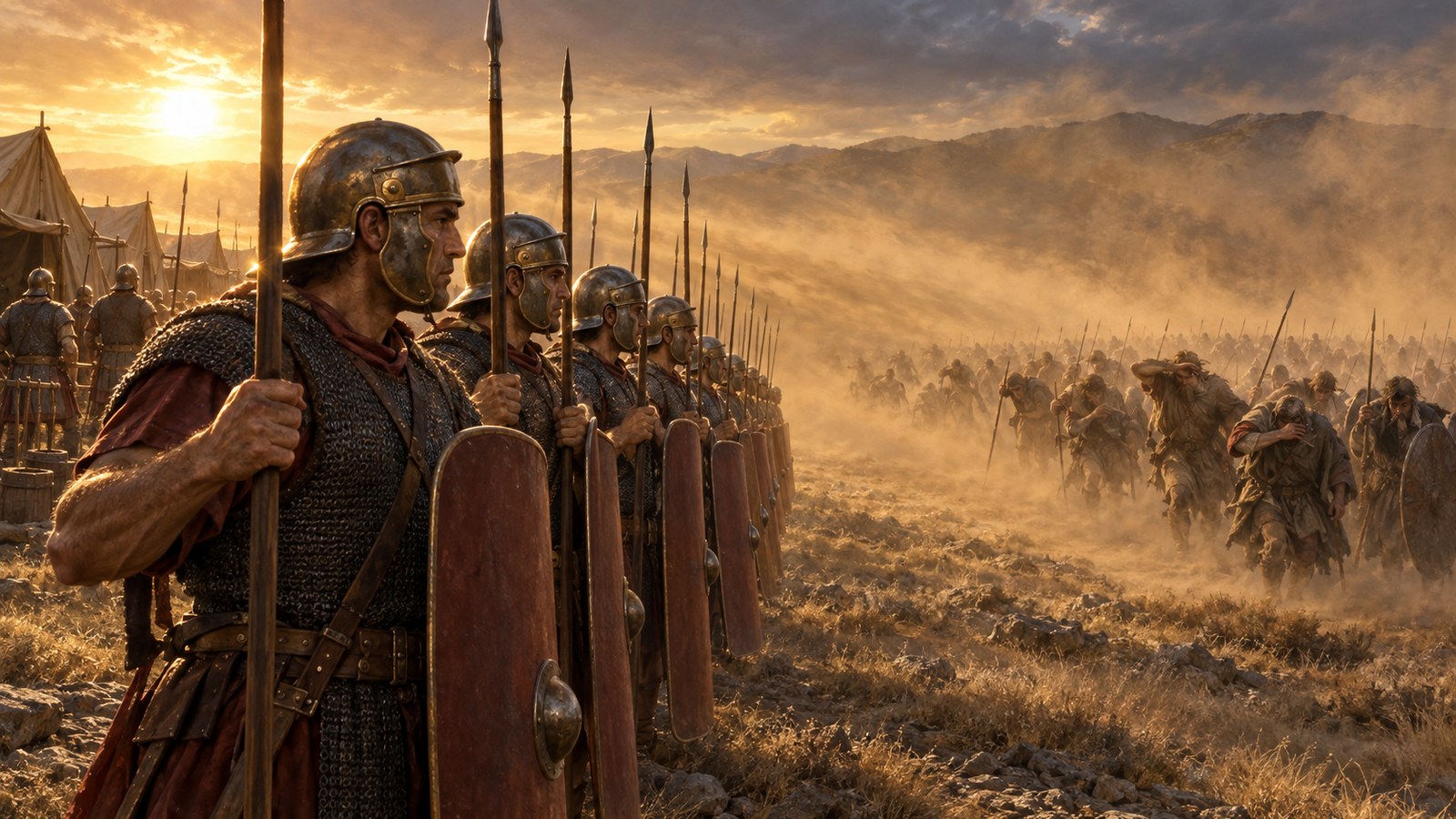
When the enemy had crossed, Marius imposed what Frontinus calls another embarrassment. He arranged his battle line so that the opposing troops faced the sun, wind and dust.
Orientation converted shared weather into unequal weather. The sun shone over the whole field, but glare depended on where a man looked. Wind crossed both lines, but it carried dust toward one set of faces and away from the other.
Dust could sting eyes, dry mouths and reduce the clarity with which men saw signals, ground and nearby bodies. Frontinus does not itemize those effects, so they should remain practical possibilities rather than added claims about the battle’s exact course.
What the source does assert is that the enemy confronted all three conditions. They had already marched. Now their direction made the atmosphere itself another burden.
The order is central. Marius did not merely notice a dusty wind at the last instant. In Frontinus’s telling, feeding, stationing, forced approach and orientation belong to one plan. Each stage preserved his own side’s readiness or reduced the other side’s.
The same breeze was not inherently Roman. If the line faced the opposite way, it might become a Roman problem. Command meant arranging bodies in relation to conditions that no commander controlled.
Sun, wind and dust were also linked. Glare narrowed comfortable vision. Wind determined where the loosened surface traveled. Marching feet could keep supplying more dust to the air through which following ranks advanced. The source names the combined exposure even though it does not describe each rank’s experience.
There was no need for the dust to blind every opponent completely. Irritation and uncertainty could matter at the exact transition from movement to formation, when tired men needed to see the ground, maintain spacing and understand what stood before them.
That is why the stratagem is more than a colorful anecdote about dust. It shows reconnaissance becoming schedule and geometry: know the field, choose the day, place the line and make the approach occur on unfavorable terms.
The Battle Began before the Lines Touched
Frontinus writes compact examples for readers interested in command. His compression leaves many details unstated, and it should not be expanded into a complete reconstruction of the campaign.
Within that limit, the mechanism is unusually clear. Marius’s men received calories and saved movement. The enemy expended movement and then received glare, wind and dust.
No single element guarantees victory. Fed troops can break. Tired troops can endure. Weather can shift, and a visible plan can prompt a countermeasure. Frontinus offers a stratagem, not a physical law.
He also offers the episode without casualty totals, speeches or a dramatic duel. That absence directs attention away from heroic personalities and toward preparation. The important actions are mundane enough to disappear from a triumphal painting: feeding, waiting, watching and facing the right way.
For a commander, these actions required information. He needed to judge the likely enemy movement, the usable frontage and the direction of the conditions. The plan’s elegance came only after someone observed the field accurately.
Its force lies in accumulation. A commander did not need one miraculous device if he could add several modest disadvantages before contact. The difference between fresh and tired, clear-eyed and squinting, could be built from ordinary conditions.
The account also changes what counts as battlefield action. Feeding troops is logistics. Choosing a line is geometry. Waiting near camp is restraint. Forcing an approach is pressure. Together they become tactics.
Marius’s opponents met more than a formation. They met the distance they had crossed, the energy they had spent and the weather in their faces.
Roman steel arrived last in Frontinus’s sequence. The plan had already been fighting for some time.
Sources
Frontinus, Stratagems, book 2, section 2.8.