
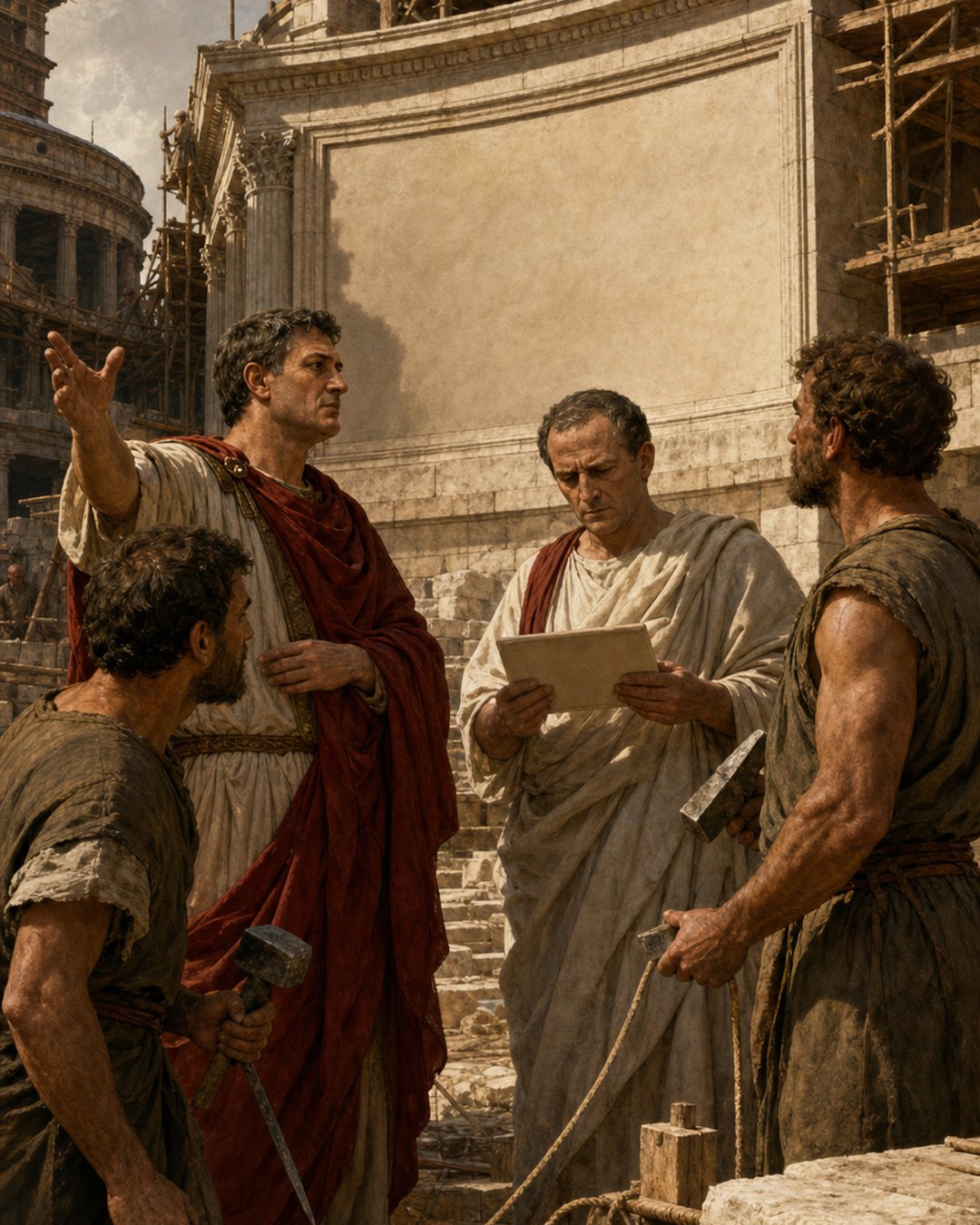
Pompey had conquered armies, crossed seas and accumulated honours. Four letters on a theatre still presented a problem he did not want to decide alone.
The inscription was meant to record his third consulship. The grammatical dispute turned on the ending of one Latin word: should the monument say tertium or tertio? Learned Romans defended both forms. Pompey referred the question to Cicero, whose reputation made an answer valuable and dangerous.
Aulus Gellius preserves Cicero’s solution. Do not carve either ending. Stop after the first four letters shared by both forms. The abbreviation communicated the honour while concealing the disagreement.
It was an elegant act of political editing, but stone did not freeze it forever. Gellius says the theatre’s stage wall later fell. When builders restored it, the old verbal compromise disappeared. Three incised lines represented the third consulship instead. Grammar had been translated into marks.
A private letter opened a public dispute about office
Gellius begins far from Pompey’s monument. Writing from Athens to a friend in Rome, he said that he had now written for the third time and used tertium. His friend replied with a question: why not tertio?
The inquiry quickly moved from correspondence to magistracy. Which form should describe a man who had been consul three times? The friend had heard a learned Roman prefer tertio and quarto consul. He also supplied examples from the historians Coelius and Quintus Claudius.
Gellius answered by calling on Marcus Varro. This was partly scholarship and partly social positioning. He considered Varro more learned than Coelius and Claudius together, and a quotation allowed him to respond without conducting a long-distance duel with a man reputed to be learned.
The episode already contains the machinery that later troubled Pompey. Grammatical forms were supported by authorities, literary examples and living reputations. Choosing a word could imply that one respected expert understood Latin and another did not.
That pressure intensified when the surface was not a letter but a monument. Correspondence could be corrected or explained. Carved stone presented one form to the city as if the argument had ended.
Varro made order and repetition point in different directions
Varro’s distinction depended on what the number was counting. To be made praetor quarto meant to stand fourth in an order, after three people chosen before. To be made praetor quartum meant to hold the praetorship for a fourth time.
The two forms therefore answered different questions. One located a person within a sequence of people. The other counted repeated occasions in the career of one person. A monument listing Pompey’s honours needed the second meaning: the office had returned to him for a third term.
Varro supported his preference with Ennius, who had used quartum for a fourth consulship. He also mocked Pompey’s caution. By refusing to finish the disputed word on the theatre, Pompey had avoided the choice rather than displaying grammatical courage.
Yet Varro’s joke understates the stakes. The line belonged to the same monumental world explored in Vitruvius’s account of bronze resonators in stone theatres. Architecture organized sight, sound and memory for a large audience. An error above such a space would not remain a private slip.
Pompey’s offices were political facts, but their wording was linguistic craft. The inscription had to compress a career into a durable formula. When experts disagreed over that formula, stone turned philology into public risk.
Cicero solved the ending by refusing to carve it
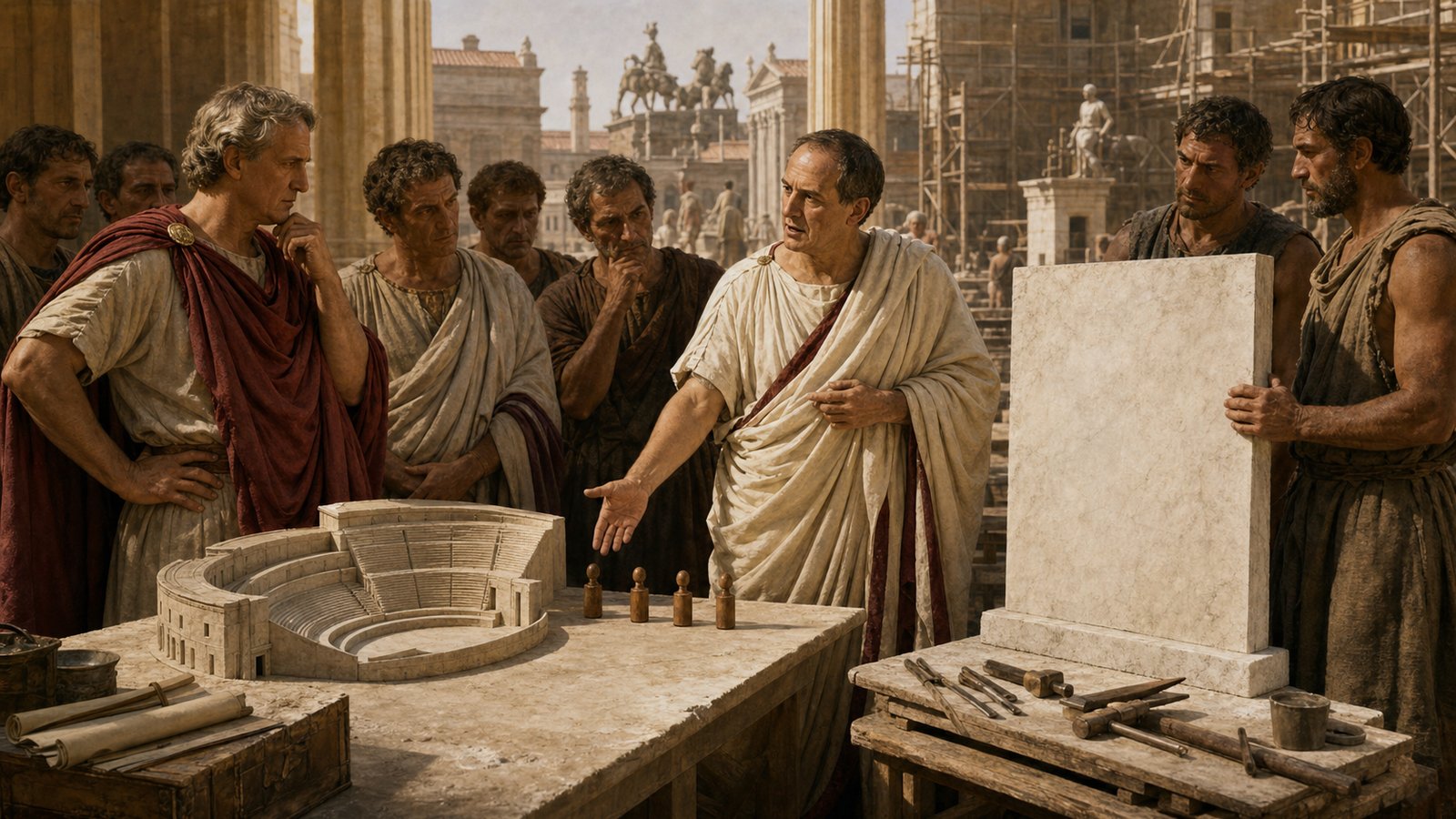
Gellius draws the fuller story from a letter by Tiro, Cicero’s freedman and close literary associate. Pompey was preparing to dedicate the temple of Victory whose steps formed the theatre. The question of tertium or tertio reached the learned men of Rome, and they divided.
Pompey then asked Cicero to decide which form was more correct. The request sounds flattering, but Gellius emphasizes Cicero’s reluctance. A judgment on grammar could look like a judgment on the scholars themselves. To reject an opinion was to risk humiliating the men attached to it.
Cicero advised Pompey to carve neither whole word. The mason would stop after the first four letters, before the endings separated. Viewers could understand the intended honour, while each side of the dispute could mentally complete the abbreviation in its preferred way.
The solution worked because abbreviation was not silence. Context did the remaining labour. Pompey’s name and sequence of honours told readers that the four letters referred to a third consulship. The missing ending removed only the contested evidence.
This was more than clever punctuation. Cicero protected three reputations at once. Pompey avoided a potentially mocked inscription. The rival scholars were not publicly overruled. Cicero escaped becoming the visible author of either camp’s defeat.
Four shared letters made ambiguity useful
Ambiguity often looks like a flaw in official language. Here it became the instrument that allowed the inscription to function. The monument needed to communicate rank, not settle every grammatical controversy in Rome.
The first four letters formed common ground. They carried enough information for recognition and too little for faction. The device resembles a political compromise in which all parties accept the operative result while declining to endorse one another’s reasoning.
That economy suited monumental display. Roman inscriptions routinely reduced names, offices and formulas, relying on readers who knew the conventions. The broader culture of carved identity appears in the inscriptions that made ordinary Roman lives visible. Pompey’s case shows abbreviation used not only to save space but to manage disagreement.
The story also exposes a limit of “correct Latin” as a single settled object. Gellius could prefer Varro and still preserve evidence for the rival usage. Learned authority was plural. Authors, historians and speakers supplied competing precedents, while usage continued around them.
Cicero did not prove that both endings meant exactly the same thing. He designed a surface on which the difference no longer had to be displayed. The monument became socially precise by remaining grammatically incomplete.
A fallen wall replaced the compromise with three lines
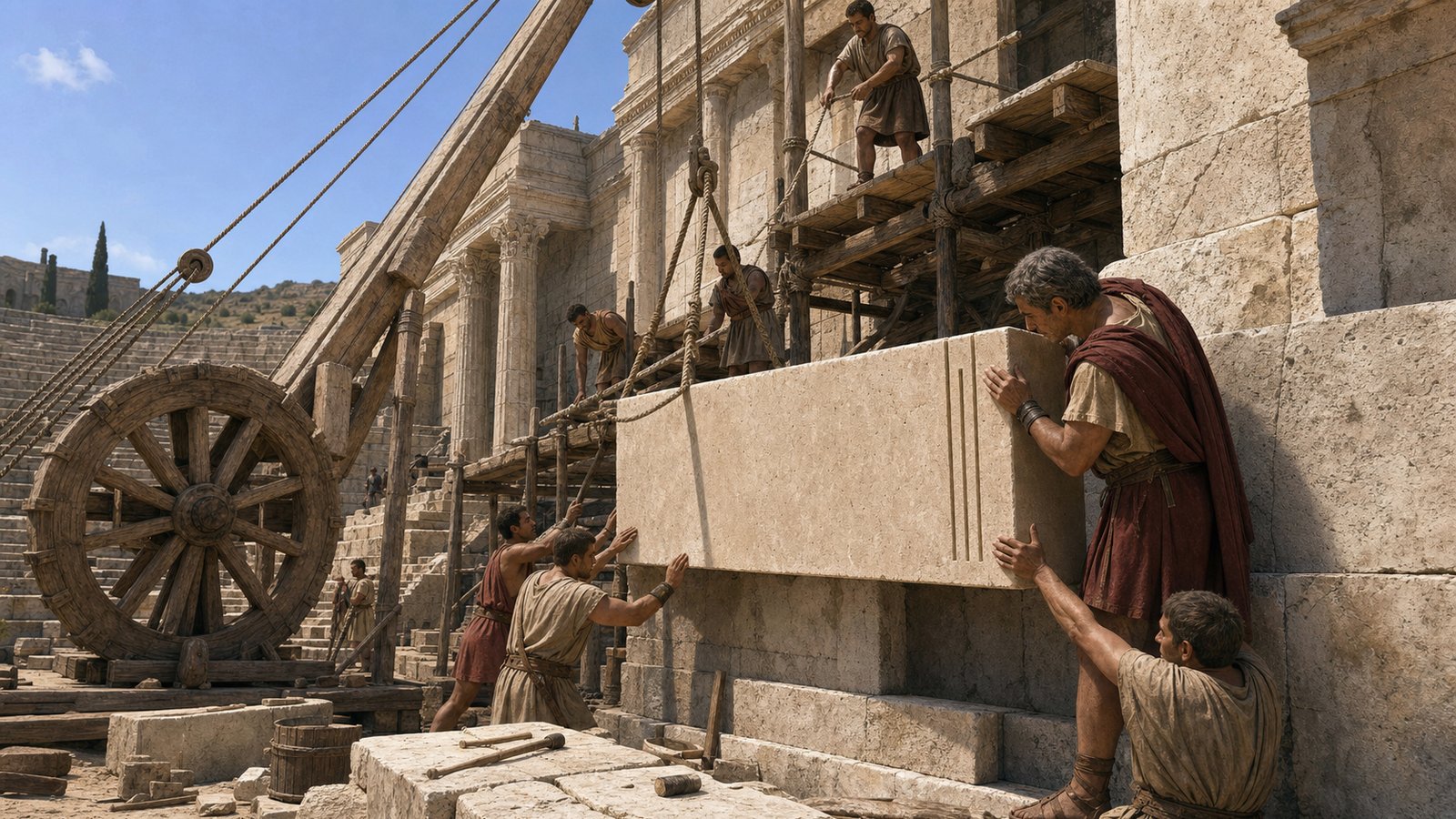
Gellius visited the question after the physical monument had changed. He says the form described by Varro and Tiro was no longer visible on that same theatre. The back wall of the stage had fallen and was rebuilt many years later.
The restorers did not reproduce the four-letter abbreviation. They indicated the third consulship with three incised lines. A disputed word had become a set of strokes, moving the count from grammar toward visual notation.
The change did not erase Pompey’s honour. It preserved the number while discarding the mechanism Cicero had devised to express it. Restoration could therefore maintain political memory without copying every feature of the earlier fabric.
Gellius’s observation is unusually valuable because it follows an inscription through two states. First came the elite debate and cautious carving. Then structural failure forced a new campaign of building. The replacement answered the old question by stepping outside it.
Stone is often treated as the opposite of revision, but Pompey’s theatre demonstrates otherwise. Walls fall, masons recut and later authorities decide what deserves reproduction. A monument is durable only through episodes of repair that can alter its language.
Four letters once let Cicero avoid naming a grammatical winner. Three lines later made the quarrel unnecessary. Pompey’s third consulship survived both devices, while Gellius preserved the fragile human negotiations behind what looked like permanent public certainty.
Sources
Aulus Gellius, Attic Nights 10.1