
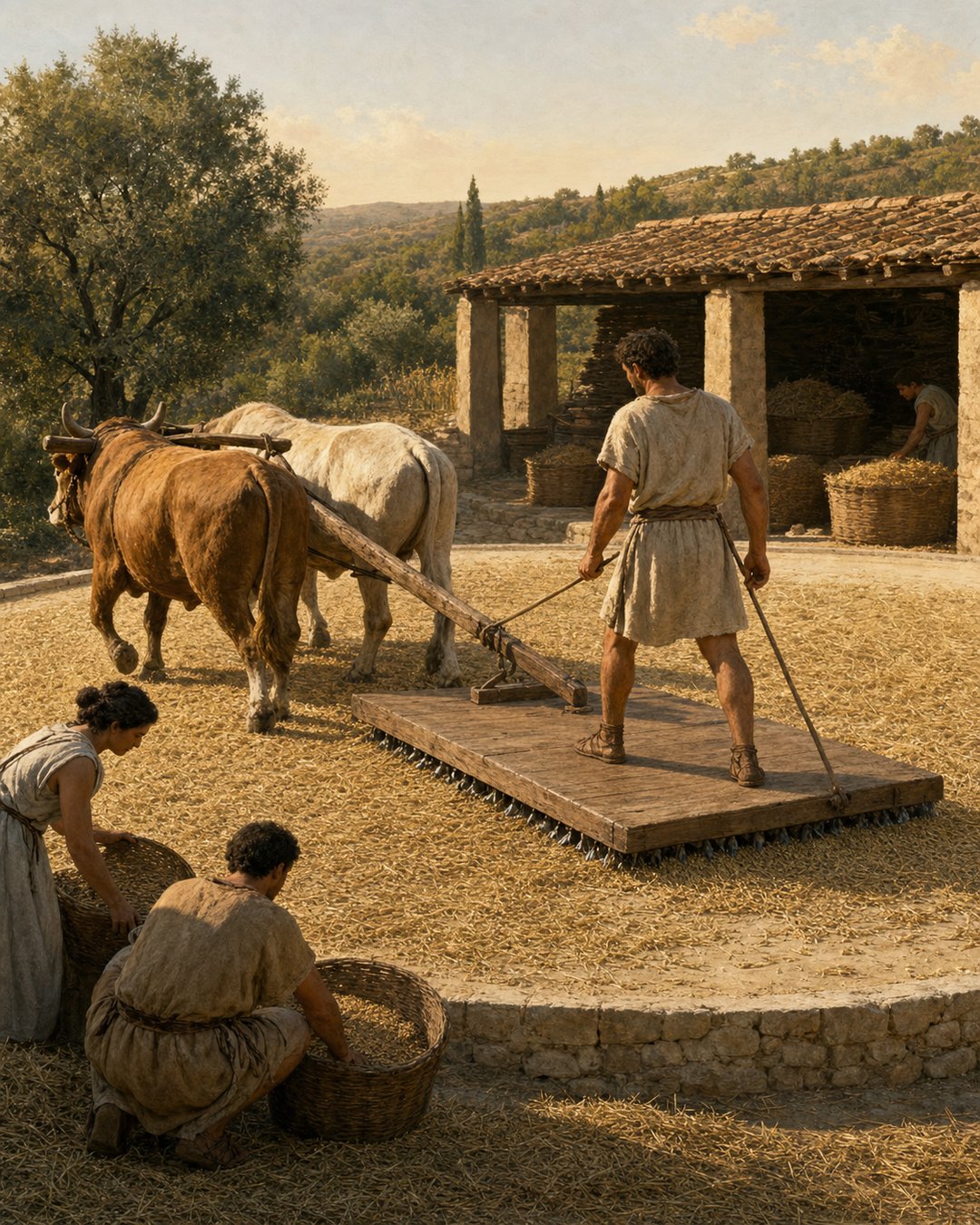
The grain reached the farmyard still fastened to ears, mixed with straw and vulnerable to a change in the sky. It left as heavy kernels gathered in baskets. Between those states stood a round patch of engineered ground.
Varro treats threshing as a chain of decisions. The crop had to arrive in the right form. The floor needed wind, drainage and a surface that would not swallow kernels. Workers reserved the best ears for seed. Steers then dragged rough boards, pulled a toothed cart or walked the grain loose under their hooves. Only after that could a gentle breeze carry the light fragments away.
No single device explains the result. Architecture, animal power, human timing and the different weights of grain and chaff all had to cooperate. The threshing floor was where a standing crop became food, seed and stored value.
Varro’s practical sequence also makes harvest labour visible. It was not completed when a blade cut the stalk. Reaping delivered material to another workplace, and that workplace had its own geometry, hazards, regional machines and weather limits.
Three harvest routes converged on one working floor
Varro begins before the threshing itself. He lists three ways farmers cut grain, each of which determined what arrived at the floor. In Umbria, workers used a hook close to the ground and laid bundles down. They later cut the ears from those bundles, carried the ears away in baskets and left the straw for stacking.
In Picenum, a curved wooden handle ended in a small iron saw. It caught and removed bunches of ears while the standing straw remained to be cut later. Around Rome and in many other places, a worker held the top with the left hand and cut the stalk through the middle. The upper portion travelled with the ear; the rooted lower portion waited in the field.
These methods did not merely offer three versions of the same gesture. They divided the plant differently. One sent bundled material onward, another removed ears, and another carried the upper stalk. The threshing floor therefore received products already shaped by regional tools and labour choices.
Varro gives one blunt measure of the workload. On easily worked land, reaping one iugerum was approximately a day’s work for one man, and that estimate included carrying the ears to the floor. Transport was part of harvest, not an afterthought.
The earlier cutting stage is easier to picture beside the curved blade that gathered a Roman harvest. Varro extends that scene beyond the field. A cut only moved the crop into the next process; it did not yet release clean grain.
A round crown turned weather into drainage
The floor itself needed a deliberate site. Varro places it on somewhat elevated ground where wind could sweep across it. Its size followed the harvest. A small crop did not need a monumental yard, while a large one could not be processed efficiently on a cramped surface.
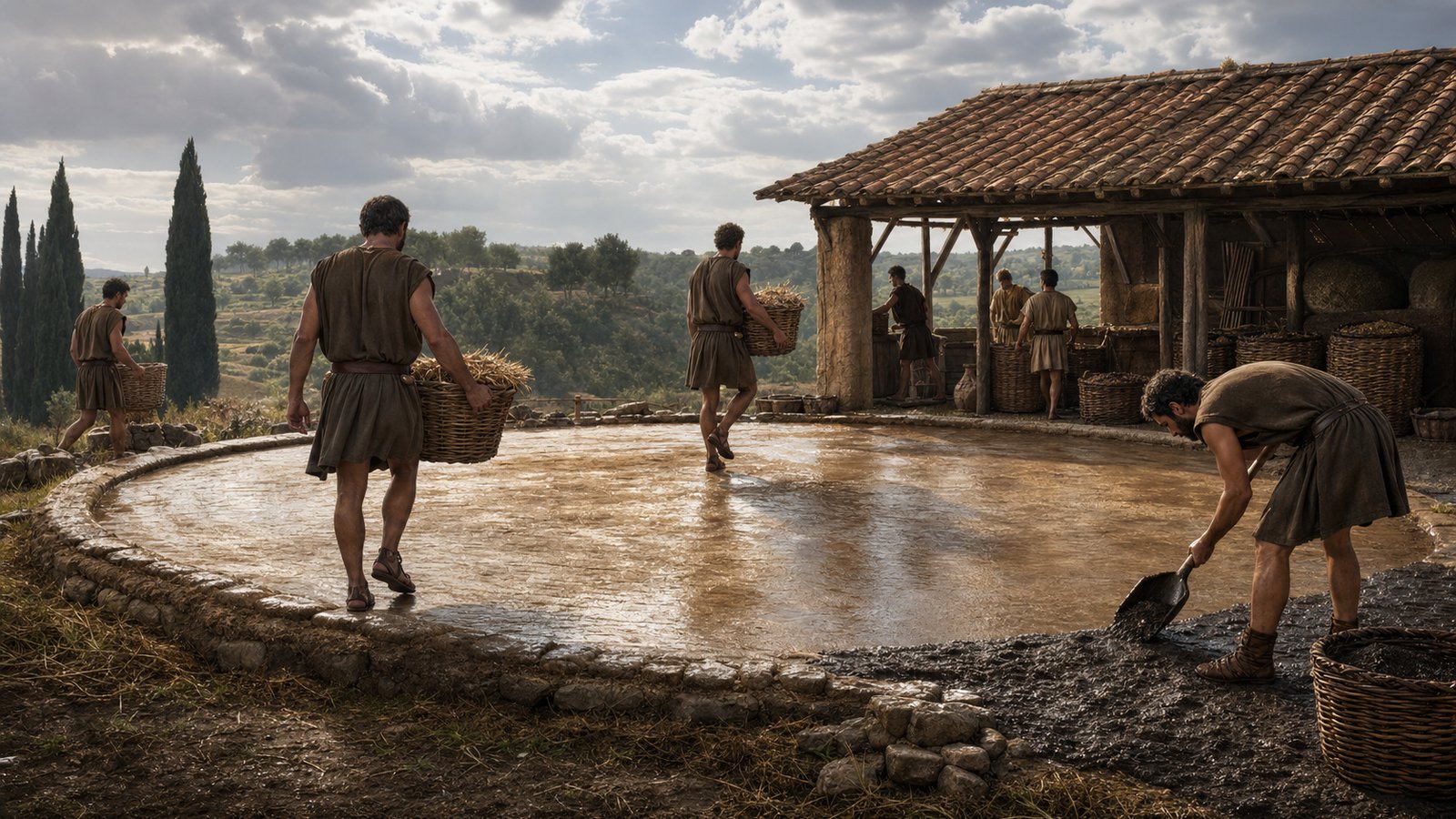
He preferred a circle with a slight rise at the centre. If rain came, water should not stand among grain and dust. From the crowned middle it could run outward along the shortest route to the circumference. Geometry translated a shallow slope into rapid escape.
The surface had to be firm as well as shaped. Packed earth was useful, but clay could crack under heat. Those fissures created several losses at once: kernels could disappear into them, water could enter, and mice or ants could find a path. The floor was not a neutral background. Every gap competed with the people trying to retain the crop.
Varro says farmers commonly spread amurca, the watery dregs left by olive pressing, over the floor. In his account it acted against weeds, ants and moles. A waste stream from one agricultural process became surface treatment for another. The same material appears in Varro’s instructions for using olive dregs against frost, but here its job was to defend grain at ground level.
Other farms paid for hardness with stone or paving. The Bagienni went further and roofed their floors because rainstorms often arrived during threshing. In hot country where the floor stayed uncovered, Varro wanted a shelter close by so workers could leave the sun at midday without abandoning the site.
Steers supplied pressure in three different forms
Before the mass was threshed, the largest and best ears were separated for seed. The instruction interrupts the mechanical sequence for a biological reason. If everything went under hoof and sledge together, the farm would lose the chance to choose the strongest-looking material for the next sowing.
One threshing method yoked steers to a broad sledge. Varro describes a board roughened with stones or iron. A driver or a heavy weight rode on it while the animals dragged it over the ears. The board did not cut like a sickle. Its repeated weight and hard underside broke the attachment between grain and ear.
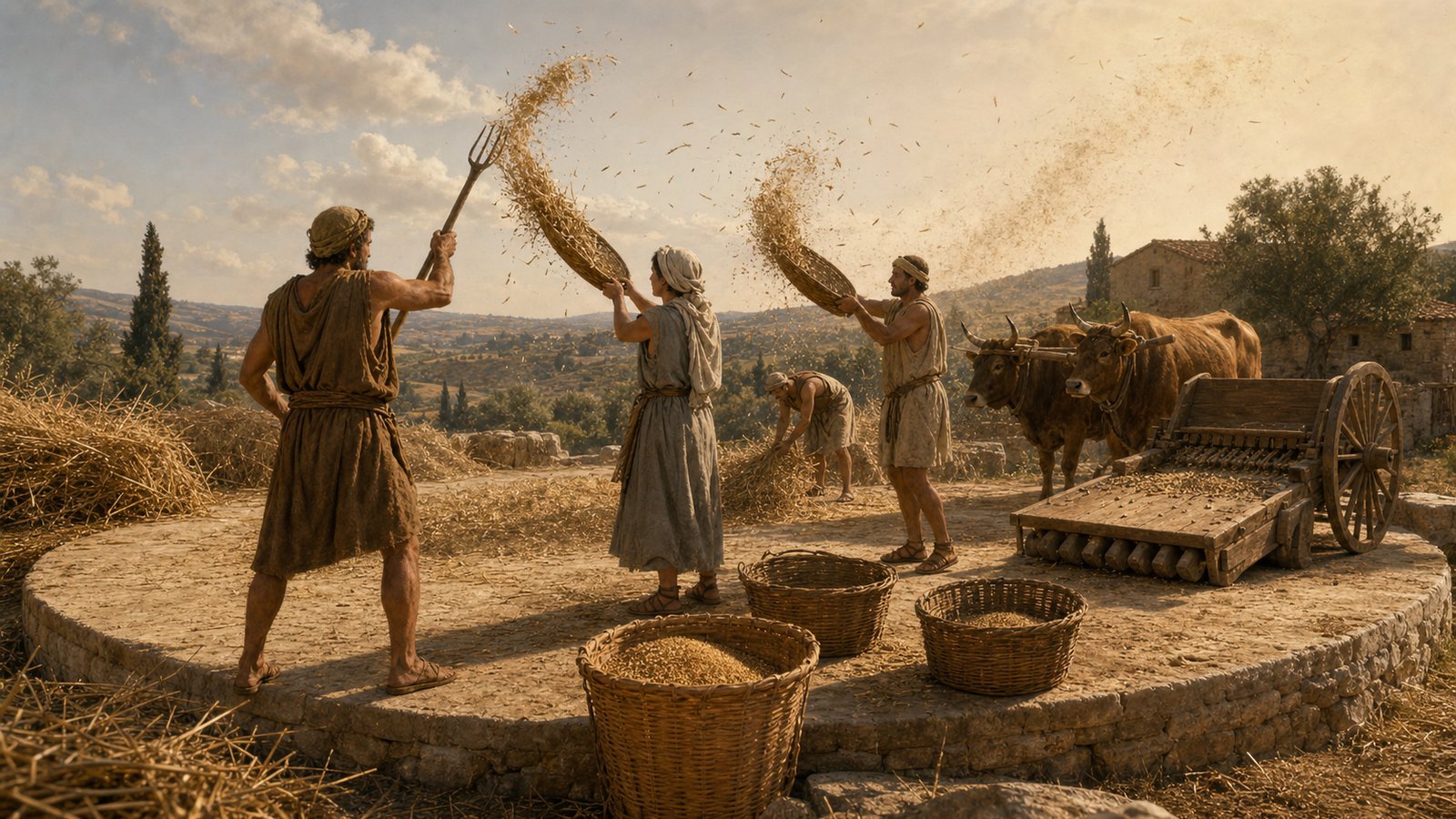
Another machine transformed dragging into rolling. The so-called Punic cart had a toothed axle set on low wheels, with the driver sitting above and guiding the steers. Varro associates it with Hither Spain and other regions. The detail resists the idea of one uniform “Roman” farm tool. A reader in Italy could be told that a recognizable machine belonged especially to landscapes farther west.
A third method needed no specialized cart. Cattle entered the floor and were driven around with goads. Their hooves did the separating. The animals still supplied the power, but the surface received it directly rather than through a weighted board or toothed axle.
All three methods depended on controlled repetition. The steers had to cross the material enough times to free kernels without turning the whole floor into an unmanaged mixture. Driver, weight, route and floor condition determined what animal strength accomplished.
A gentle wind performed the final sort
Threshing loosened the grain, but it did not leave a basket of clean kernels. The floor still held pieces of ear and straw. Varro’s final separator had no axle or blade. Workers waited for a gentle wind.
Using winnowing fans or forks, they tossed the threshed mass upward from the ground. The lightest material moved beyond the floor. Varro names the fine refuse and chaff as acus and palea. The grain, heavier than both, dropped back and came clean to the basket.
The adjective “gentle” matters. The process used a difference in weight, but it also required a wind that removed light fragments without carrying valuable kernels out of reach. The elevated site chosen before threshing now revealed its second purpose. It had provided exposure all along for this final stage.
The floor thus joined two opposite forms of control. Its packed, treated ground prevented matter from escaping downward. Its open, windy position allowed selected matter to escape sideways. Kernels were conserved because cracks were closed; chaff was removed because air could cross freely.
Even the harvest’s remains entered an economic calculation. Varro says gleaning might be leased, loose stalks gathered by the farm’s own workforce, or sparse leftovers pastured when hiring labour would cost more than the recovery. The process ended not with absolute cleanliness but with a decision about when further collection stopped paying.
That closing calculation connects the dusty floor to larger stores such as the granaries that made surplus visible. Storage depended on what happened first: separating seed, keeping rain out, driving pests from the surface, freeing kernels and letting the wind take only what was light.
Varro’s harvest scene is therefore neither a pastoral pause nor a catalogue of quaint tools. It is a conversion system. Baskets, slopes, olive dregs, oxen, stone, iron and moving air each handled a different risk between field and store. The farm secured its grain by making those parts meet on one carefully built circle.
Sources
Varro, De Re Rustica 1.50–53