
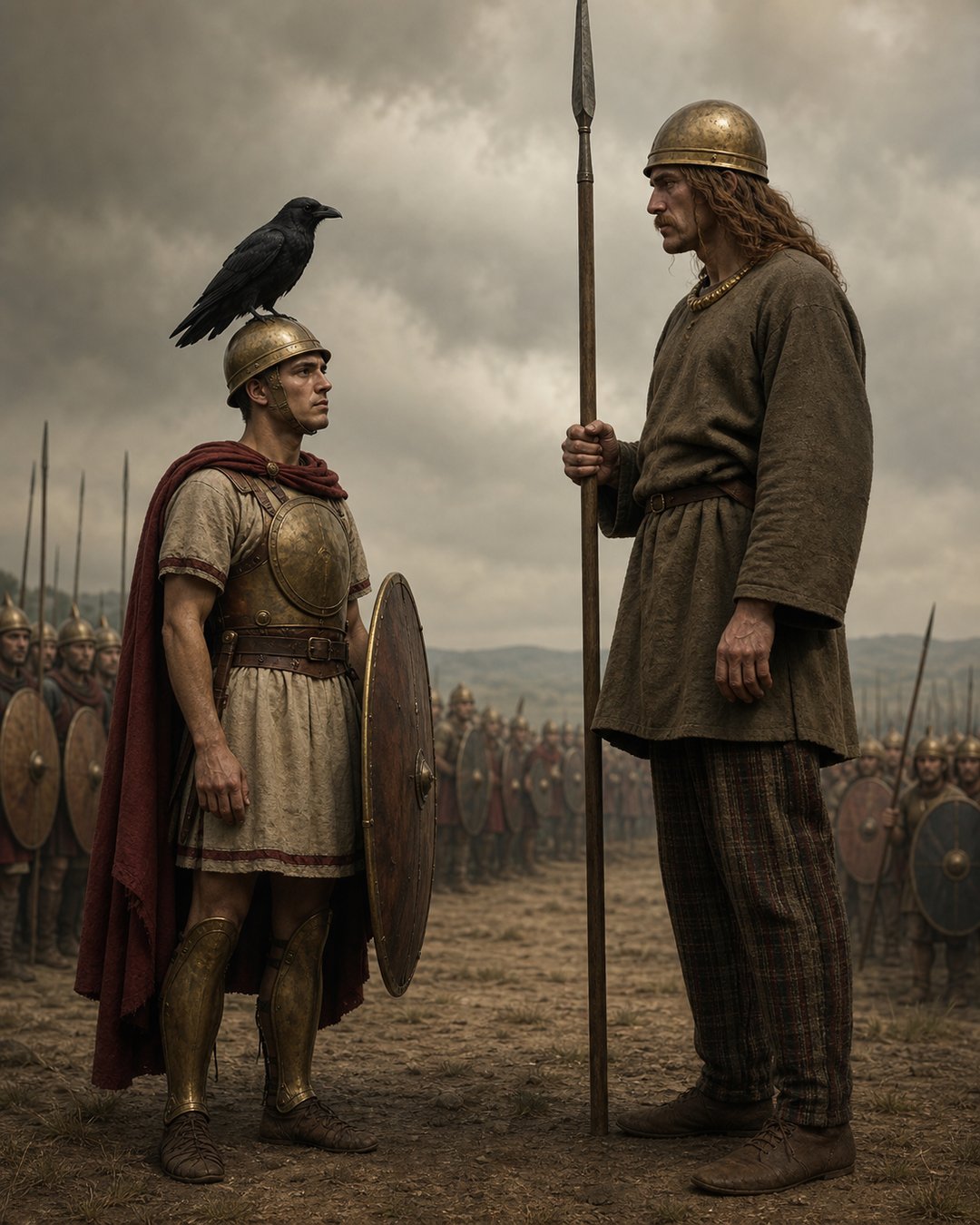
A giant Gallic warrior stepped out before two armies with gold flashing on his armor. He flourished a spear, looked across the Roman line, and challenged anyone willing to meet him. The consuls were already troubled by the enemy’s strength and numbers. For a moment, Gellius says, Roman soldiers wavered between fear and shame.
Then the young military tribune Valerius asked permission to fight. As the two men closed, a raven appeared, settled on the Roman’s helmet, and attacked the Gaul’s face. It clawed his hand, beat wings across his eyes, and returned to its perch. Valerius killed the challenger before both armies.
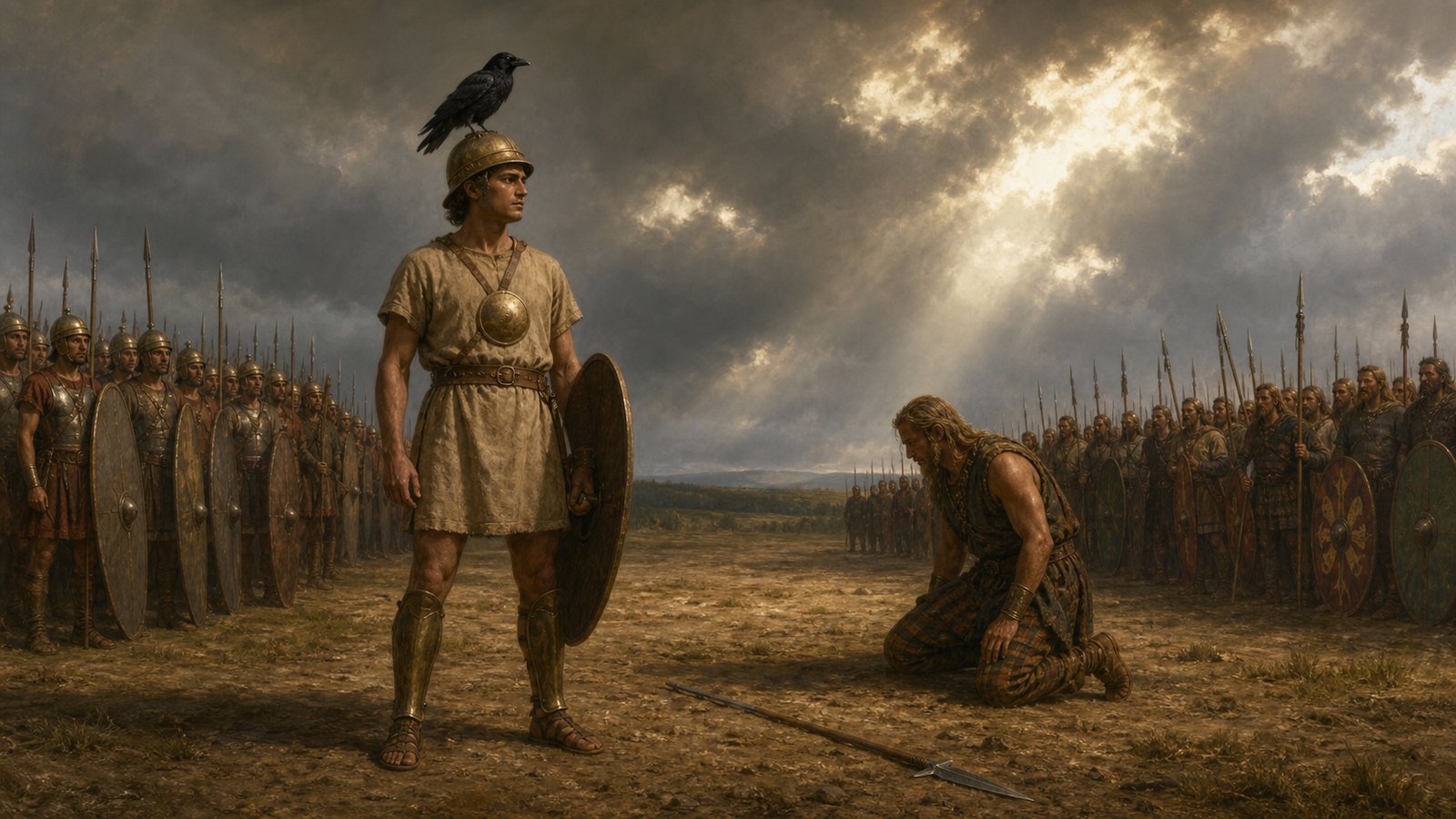
The victory gave him more than applause. The bird entered his name: Corvinus. Centuries later, Augustus placed his statue in the new imperial Forum with a raven above its head. A brief disruption in a duel had become a family identity, an annalistic story, and finally a public image in stone.
One Challenge Concentrated the Fear of Two Armies
Gellius places the encounter in the consulship of Lucius Furius and Appius Claudius, when large Gallic forces occupied the Pomptine district. His focus is not a complete campaign narrative. He narrows the field until collective war is represented by one conspicuous body walking into the space between armies.
The Gallic leader’s appearance does political work inside the tale. He is enormous. His armor gleams with gold. His long strides, spear, and contemptuous gaze convert material display into intimidation. He does not merely offer combat; he surveys the Roman army as though no equal stands within it.
The Roman reaction makes the insult effective. Gellius describes hesitation suspended between fear and shame. Fear recognizes the challenger’s physical danger. Shame comes from being watched while nobody answers. With both lines assembled, refusal would become a public fact that every survivor could remember.
Single combat is therefore more than a contest of strength. It creates an audience and a compressed verdict. One fall can be interpreted as evidence about courage beyond the two participants, even though an army’s real capacity never depends on one body alone. The challenger attempts to turn spectacle into advantage before the battle has properly unfolded.
Permission Made Valerius Brave Without Making Him Reckless
Valerius does not simply rush forward. He first obtains the consuls’ permission. Gellius calls his advance bold yet modest, a careful pairing that shapes the Roman hero. Courage lies in accepting danger; discipline lies in keeping that courage inside command.
The detail prevents the duel from becoming private vanity. A military tribune belonged to a hierarchy and carried responsibilities beyond his own reputation. By asking first, Valerius allows the consuls to judge whether one man’s display serves the army or endangers it.
Permission also turns the encounter into an authorized Roman answer. The Gaul issued a personal challenge, but Valerius meets him as a tribune released by commanders to act. His body enters the space between the armies while institutional order remains behind him.
That balance resembles other Roman stories in which a controlled gesture matters as much as physical force. The soldier marked by an opened vein shows command judging bodily conduct through discipline. Valerius’s story rewards the opposite combination: initiative that first acknowledges authority.
The Raven Attacked the Mechanics of Combat
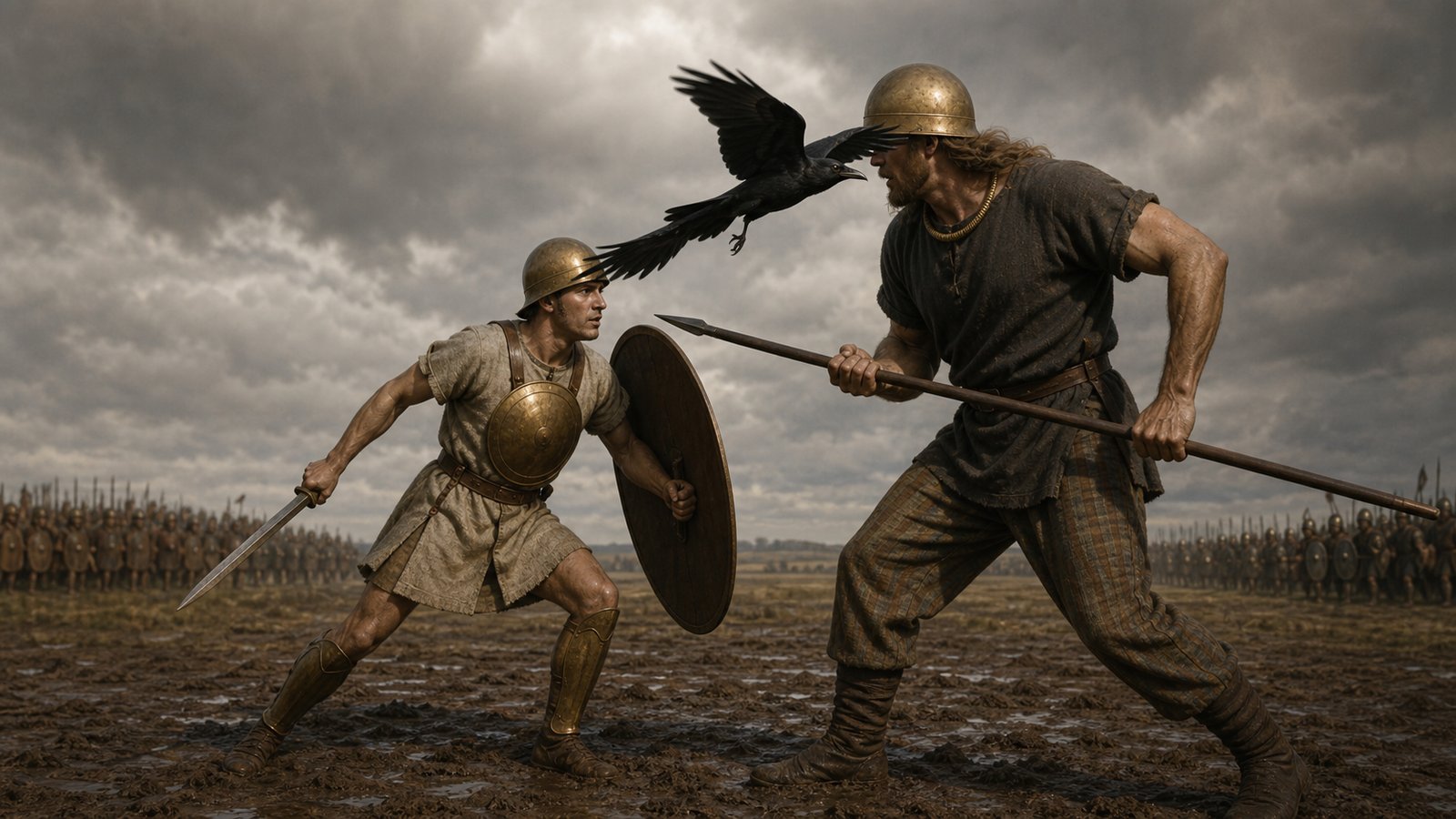
The bird arrives only when the men have met, halted, and begun to engage. Gellius calls its appearance a manifestation of divine power, but his description of the help is strikingly physical. The raven does not deliver an abstract omen from a distant tree. It interferes with the challenger’s body.
Its target is the face and eyes. Wings obstruct sight at the moment vision must track spear point, footwork, and the Roman opponent. Claws tear the hand that holds or guides a weapon. The attack breaks concentration while preserving Valerius’s ability to move.
The helmet provides the mechanism’s fixed point. After harassing the Gaul, the raven returns to Valerius’s head. It can launch again from above the Roman’s line of sight without becoming a second opponent he must avoid. The repeated movement creates a visible alliance: bird and tribune separate, strike, and reunite.
Gellius still gives Valerius his own valor. The raven defends and disrupts; the Roman must exploit the opening, survive the weapon, and finish the combat. The story does not replace the warrior with a miracle. It makes supernatural favor legible through a small tactical advantage.
This is also why the scene remained easy to picture. A vague promise of divine support can fit countless victories. A black bird perched on one helmet while beating at another man’s eyes has a clear silhouette. The same image could pass from speech to annal, from surname to statue.
Corvinus Turned an Intervention into an Identity
Valerius won the surname Corvinus from the raven. Naming converted a moment into something that could follow him after the battlefield. The duel no longer needed to be retold in full whenever the name appeared; the bird sat inside the verbal label.
Gellius begins by claiming that the well-known historians did not vary in telling the event. That agreement is part of his presentation, not modern proof that every detail occurred exactly as narrated. It tells us how strongly the story’s components had settled into literary memory: giant challenger, authorized tribune, sudden raven, impaired sight, Roman victory, new name.
The date contributed another anchor. Gellius places the fight 405 years after Rome’s founding, conventionally 349 BC. A marvel attached to a consular year and a known commander could occupy civic chronology rather than floating in an undefined heroic past.
The surname also gave descendants and readers a reason to preserve the tale. Family names often invite explanations, and a bird-assisted duel is more memorable than an ordinary linguistic derivation. Each explanation renewed the connection between battlefield courage and apparent divine favor.
Augustus Put the Bird Back Above Valerius
Augustus later had a statue of Corvinus erected in his Forum. A raven figure appeared on the statue’s head, recalling the position it held at the duel. The monument therefore did not merely label Valerius with an inscription. It reconstructed the story’s decisive arrangement.
The Forum gathered exemplary Romans into an imperial setting. Corvinus’s presence allowed Augustus to present earlier courage as part of the history culminating in his own public space. The old republican warrior became both an ancestor of Roman greatness and a selected exhibit within a new political landscape.
The bird made the statue readable at a glance. Readers can compare the gilded horses later raised above Trajan’s Forum, where captured wealth and elevated sculpture carried victory into architecture. Corvinus’s raven was smaller, but it performed a similar mnemonic task: an object above a figure told viewers how military fame had been earned.
Across the story, scale repeatedly reverses. A huge warrior threatens an army; a small bird unsettles the huge warrior; one victory creates a long name; one compact image survives into a monumental Forum. The raven’s power lies partly in that reversal. It lets Roman memory explain how disciplined courage overcame terrifying size without making size irrelevant.
Gellius preserves the chain rather than asking readers to separate battlefield report from marvel. Two armies watched, a surname remembered, historians repeated, and Augustus displayed. Whether approached as annalistic tradition, family legend, or political monument, the tale shows how Rome made a victory durable: attach it to an image no listener could confuse with another fight.
Sources
Aulus Gellius, Attic Nights, Book 9, chapter 11.