
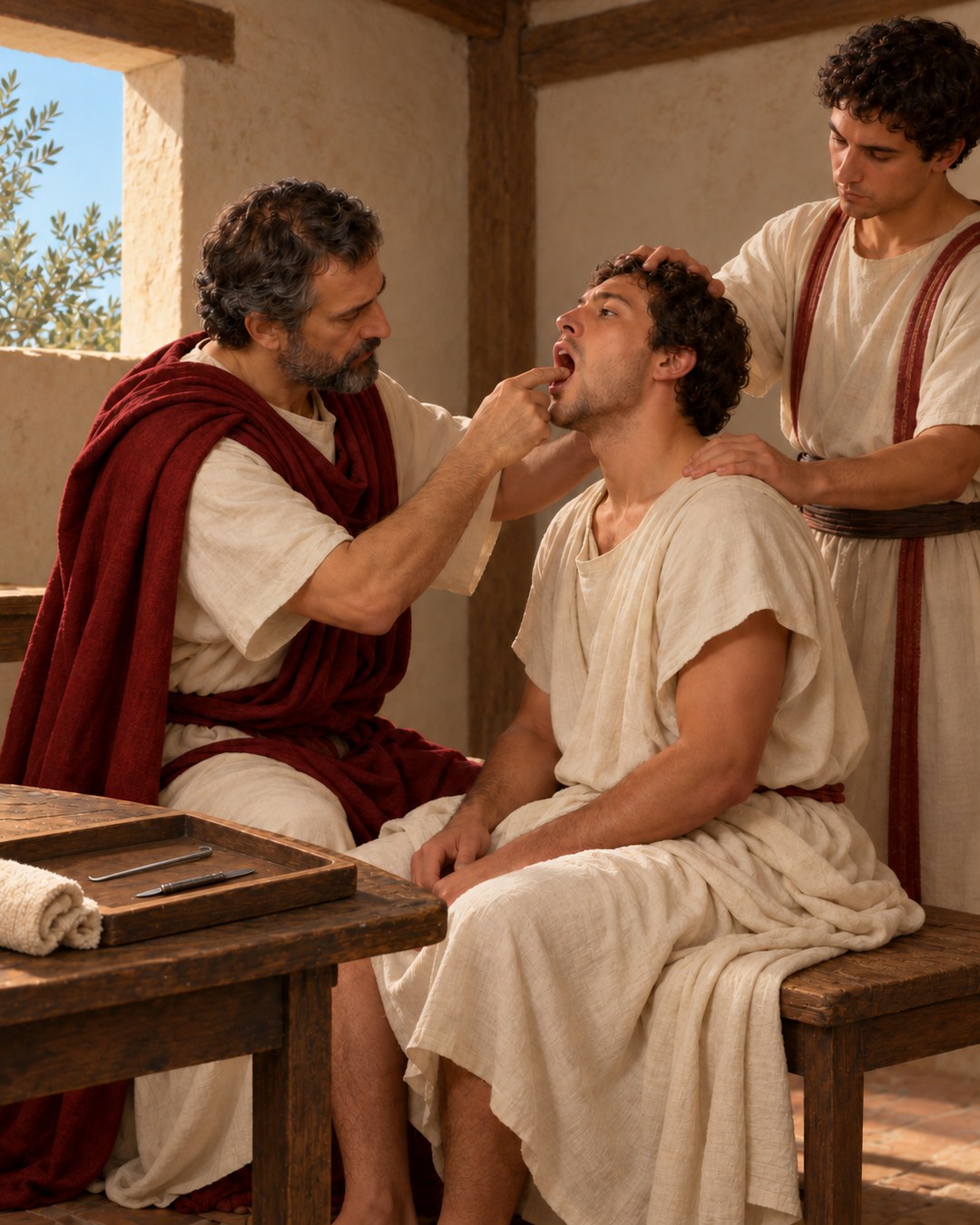
Celsus begins his tonsil operation without a blade. When inflammation had left a tonsil hardened inside a thin covering, he told the practitioner to work around it with a finger and draw it out. Hook and scalpel entered only if that first separation failed.
The order matters. Ancient surgery is often remembered through its instruments, but this passage is organized by escalation. Touch tests the tissue. Resistance changes the plan. Cutting creates a hollow that must be washed and managed for bleeding. The operation is brief on the page because each sentence carries a decision.
The condition had to become a surgical object
Celsus is not describing every sore throat. His subject is a tonsil hardened after inflammation, a structure he says the Greeks called an antias. The earlier illness had changed the tissue enough to make removal conceivable.
He also identifies a thin tunic around it. That covering supplies the logic of the first manoeuvre. If the surgeon could separate the hardened tonsil from around its boundary, the object might come free without an incision through the same path.
The text does not provide a modern diagnosis, anaesthetic plan or infection model. Reading those into it would hide its actual strengths and limitations. Celsus offers a tactile description and a sequence based on what the hand encounters.
His broader account of surgery begins with disciplined bodily qualities. Celsus’s ideal surgeon required a steady, skilful hand as well as sharp sight and resolve. The tonsil instruction shows why: the hand is not merely holding a tool. It is gathering information before one is used.
A finger tested the line of separation
The practitioner was to scratch or loosen around the tonsil with a finger and draw it out. The action required access inside the mouth, controlled pressure and confidence about where the tonsil ended. A rough gesture would defeat the point of choosing the least cutting route first.
This stage combined diagnosis with treatment. If the covering yielded and the mass detached, the finger had demonstrated that a hook and scalpel were unnecessary. If it remained fixed, resistance became evidence for escalation.
Celsus does not say that finger removal was painless or safe by modern standards. He gives no sedation in this instruction, and the mouth could move, gag and bleed. The method’s significance lies in relative invasiveness inside his own sequence, not in any claim that it was gentle.
The passage also resists the idea that ancient practitioners always reached immediately for dramatic metal instruments. They possessed hooks, forceps and scalpels, but the best first instrument here was living tissue capable of feeling another tissue’s edge.
Hook and scalpel answered resistance
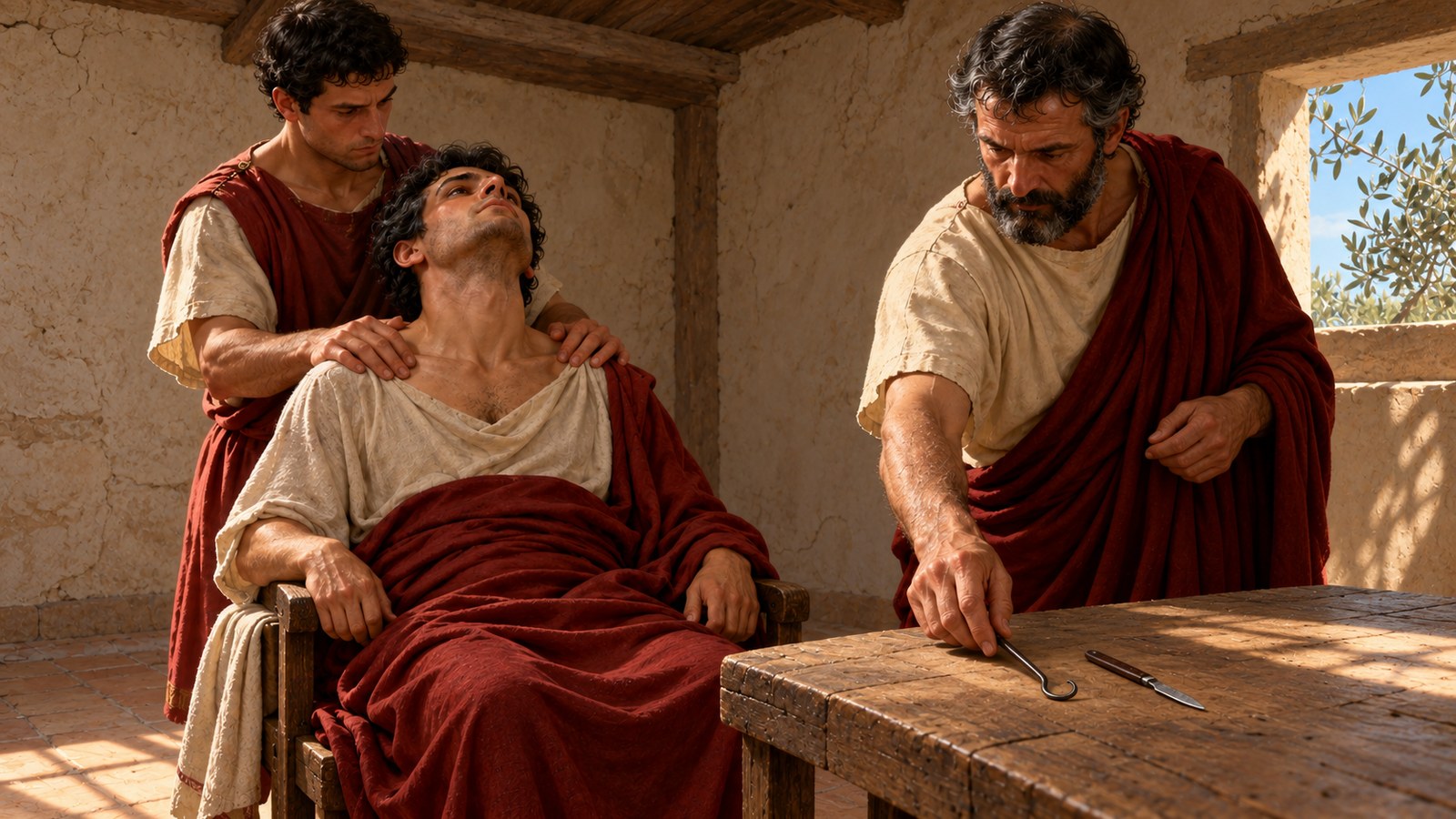
If the tonsil could not be detached with the finger, Celsus directed the surgeon to seize it with a hook and cut it away with a scalpel. The two tools divided the work. One created traction; the other separated what traction exposed.
That relationship is mechanically important. Cutting inside a deep, wet space becomes more controllable when the target is held. The hook did not replace judgment. It made the boundary more available to the blade.
The scene should not be confused with later tonsillectomy equipment or modern operating conditions. Celsus’s compact instruction belongs to a world without those systems. It records an operation that depended heavily on positioning, visibility, assistance and the operator’s hands, even when he does not narrate every practical difficulty.
Another Celsian procedure used an instrument to set a safe stopping point. The collared tube used to drain abdominal fluid limited how far metal entered the body. In the tonsil passage, there is no collar. Control comes from traction, sight and the surgeon’s sense of the tissue plane.
Vinegar and bleeding began the second task
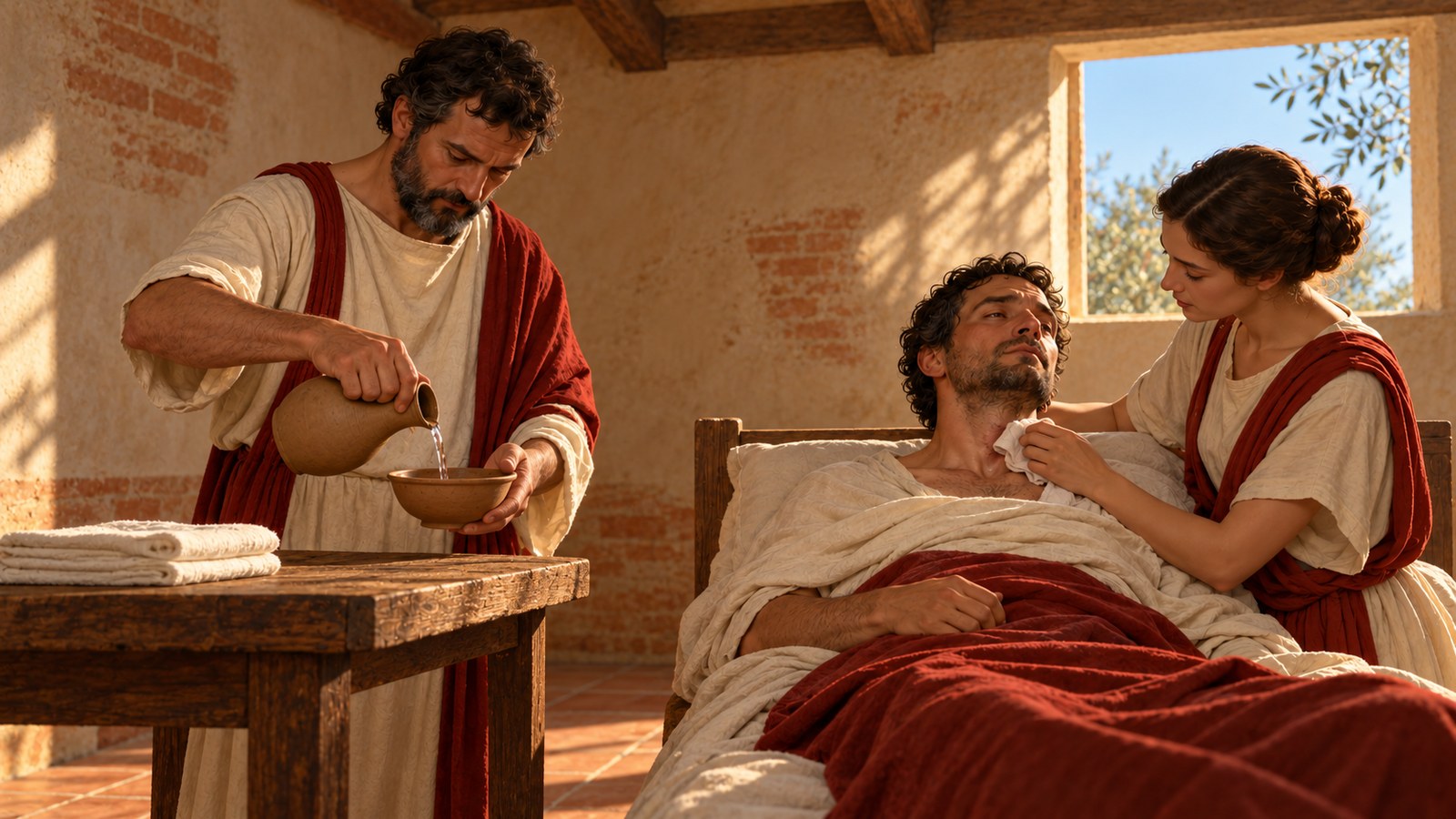
Removal did not finish the operation. Celsus says the remaining hollow should be swilled with vinegar. It was then smeared with something intended to check the blood. The site left by extraction became a new wound requiring its own management.
His wording makes aftercare immediate. The practitioner does not leave after the decisive cut. Washing and a styptic application belong to the same procedure because the risk created by success begins at once.
Celsus does not identify the blood-checking substance in this short paragraph. It would be wrong to choose one from elsewhere in his work and pretend that this line named it. The secure evidence is functional: he expected an application aimed at controlling bleeding.
The hollow also explains why the sequence could not be reduced to “pull out the tonsil.” Anatomy remained after the object had gone. An operation changed the body’s surface, and the text marked that transition by changing verbs—from loosening and cutting to washing and smearing.
Nearby tissue followed different rules
Celsus turns next to the uvula and immediately warns against treating neighbouring structures as interchangeable. An elongated uvula that was inflamed, painful and dusky red should not be cut, he says, because much blood commonly flowed. Appearance and inflammatory state converted a possible operation into a prohibition.
When inflammation was absent and the uvula was thin, pointed and white after being drawn down by phlegm, cutting could be considered. The practitioner grasped it with small forceps and left below the instrument only the part judged useful. Afterward, Celsus applied the same care he had described for the tonsil wound.
The following tongue-tie operation adds another boundary. The tongue tip was grasped and the membrane beneath cut, but nearby blood vessels had to be protected. Celsus then records uncertainty: many patients spoke after healing, yet one person gained tongue movement without gaining speech.
That unsuccessful case is the passage’s most durable caution. Celsus says medicine may have a rule for what should be done without possessing a rule for the result. His tonsil sequence is confident, but not limitless. Finger, hook, scalpel, vinegar and styptic form a practical order; they do not turn the throat into a predictable machine.
The operation survives because it makes decisions visible. Start where anatomy offers a separable covering. Escalate only when resistance requires it. Treat the wound created by removal. Reassess the rules when the tissue changes. Celsus’s brevity is not emptiness. It is a chain of thresholds held together by the surgeon’s hand.
The sequence also gives the assistant and patient a changing practical problem, even though Celsus does not spell out their roles here. Finger separation, hooked traction, a cut and immediate washing require different kinds of stillness and access. We should not invent a complete operating-room scene, but the transitions themselves show why coordination mattered in a confined space.
Vinegar belongs at the point where the target has become a cavity. That does not make it a modern antiseptic protocol, and the text should not be praised with knowledge it did not possess. Celsus’s own claim is narrower: rinse the hollow, then apply something that checks blood. Its value as evidence is the explicit continuation from extraction to wound care.
Finally, the neighbouring uvula and tongue passages prevent overconfidence about reusable technique. The same region can offer a thin tunic, dangerous inflamed tissue or blood vessels that must be spared. The hand learns a boundary in one operation and must begin judgment again in the next. Procedure is structured, but structure does not eliminate anatomical difference.
That is the deeper function of the finger-first instruction. It is neither a curiosity nor proof of timeless sophistication. It shows a practitioner sorting options with the sensory tools available to him, then accepting a new burden of risk each time the operation moves from separation to cutting and from cutting to wound care.
Sources
Celsus, On Medicine, 7.12.2–4.