
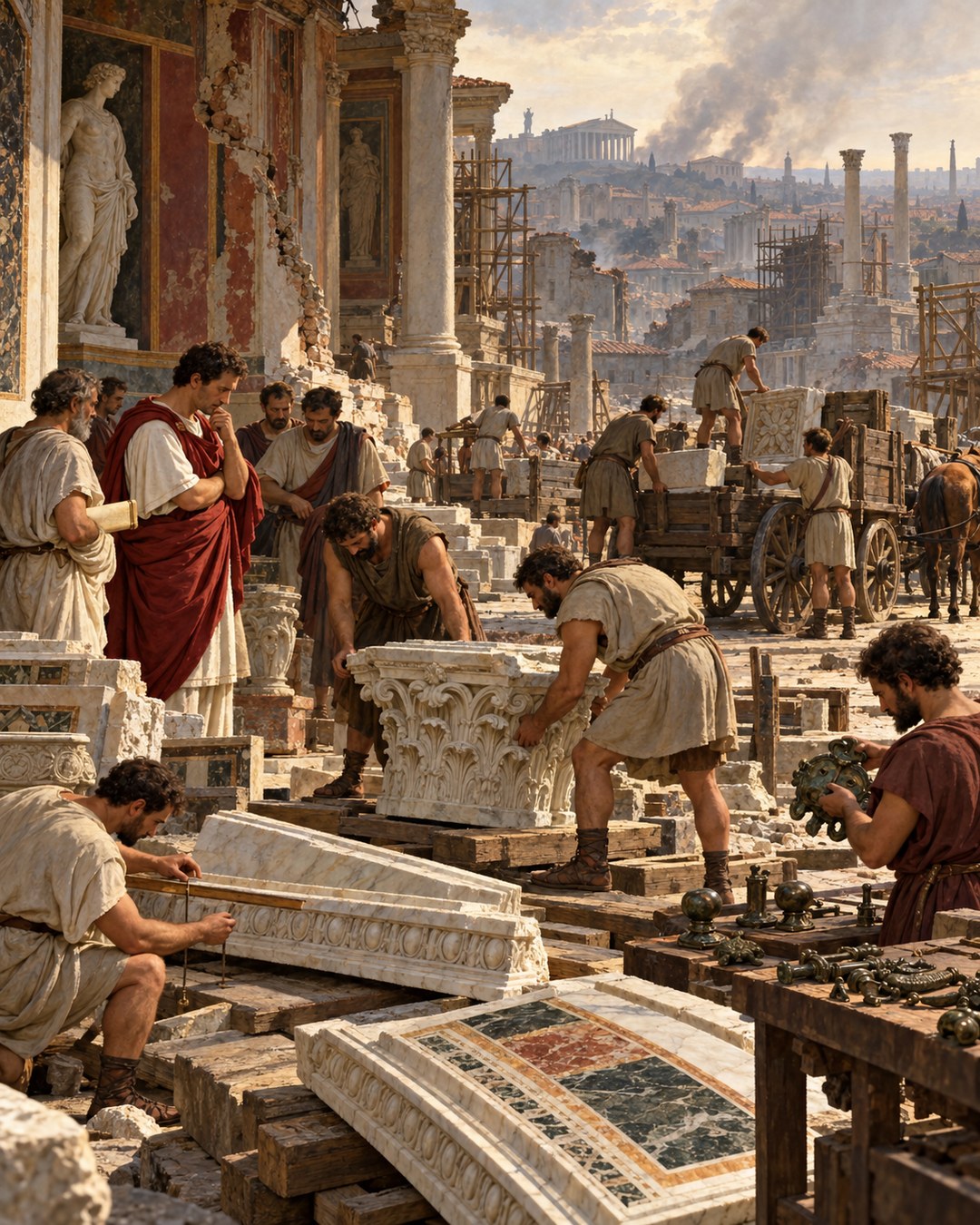
Rome burned for three days and three nights. In Campania, cities lay buried after Vesuvius. A severe epidemic added a third emergency. Suetonius compresses all three into one passage, then slows down long enough to show Titus assigning different people and different property to the work.
Former consuls, selected by lot, were sent to relieve Campania. Estates whose owners had died without heirs were redirected toward the buried cities. At Rome, the ornaments of imperial villas were set aside for public buildings and temples, while equestrian supervisors were appointed to hurry reconstruction.
The account is flattering, but it is not vague. Its praise depends on movement: officials out of Rome, heirless property into Campanian rebuilding, decoration out of private imperial residences, and managers onto urban worksites.
Three disasters demanded more than one imperial gesture
Suetonius names eruption, fire, and plague together because they define the pressures of Titus’s short reign. Yet the remedies are not interchangeable. A buried city, a burned capital, and an epidemic each require a different administrative answer.
For the public, Titus offered consolation through edicts and aid within his means. That sentence establishes the emperor’s posture, but the following details establish the machinery. Relief is divided among regions, kinds of loss, and ranks of official.
The Campanian problem began with destroyed communities and dead property holders. The Roman problem involved public buildings and temples in the capital. The plague, by contrast, drew remedies from both ritual and medicine. Suetonius may admire the same emperor in all three cases, but he does not pretend that one donation solved them all.
This is important because ancient disaster narratives easily collapse into character sketches. A good ruler is generous; a bad ruler is indifferent. Here generosity leaves an administrative trace. Someone had to identify estates without surviving heirs, direct their value, supervise construction, and distinguish what belonged to Campania from what belonged to Rome.
Titus’s response also sits against an established public image. The emperor who sent Berenice away despite their attachment could be presented as sacrificing private desire to public expectation. Suetonius uses a similar grammar after the disasters: imperial possessions become available when public necessity presses.
That does not make the biography a neutral audit. Suetonius selects details that support his portrait. The passage tells us what the author wanted readers to see as exemplary rule, not the full budgets, disputes, delays, and local negotiations behind reconstruction.
Campania received commissioners and the property of the dead
For Campania, Titus chose commissioners by lot from former consuls. Their status mattered. Ex-consuls had held Rome’s highest regular magistracy; sending men of that standing advertised that provincial relief was not being delegated to minor clerks.
Selection by lot also spreads the decision beyond a simple personal favourite. Suetonius does not explain the size of the commission, its exact jurisdiction, or how long it served. He preserves rank and method because those details make the response look public and ordered.
The most arresting resource was property left by victims who had no surviving heirs. Instead of letting those estates disappear into an undifferentiated imperial reserve, Titus applied them to rebuilding the buried cities, at least in Suetonius’s account.
That measure ties loss to place. Wealth made ownerless by the eruption remained connected to the communities the eruption had destroyed. It is not modern insurance, and the text does not describe compensation to individual survivors. It is a transfer from interrupted households toward urban recovery.
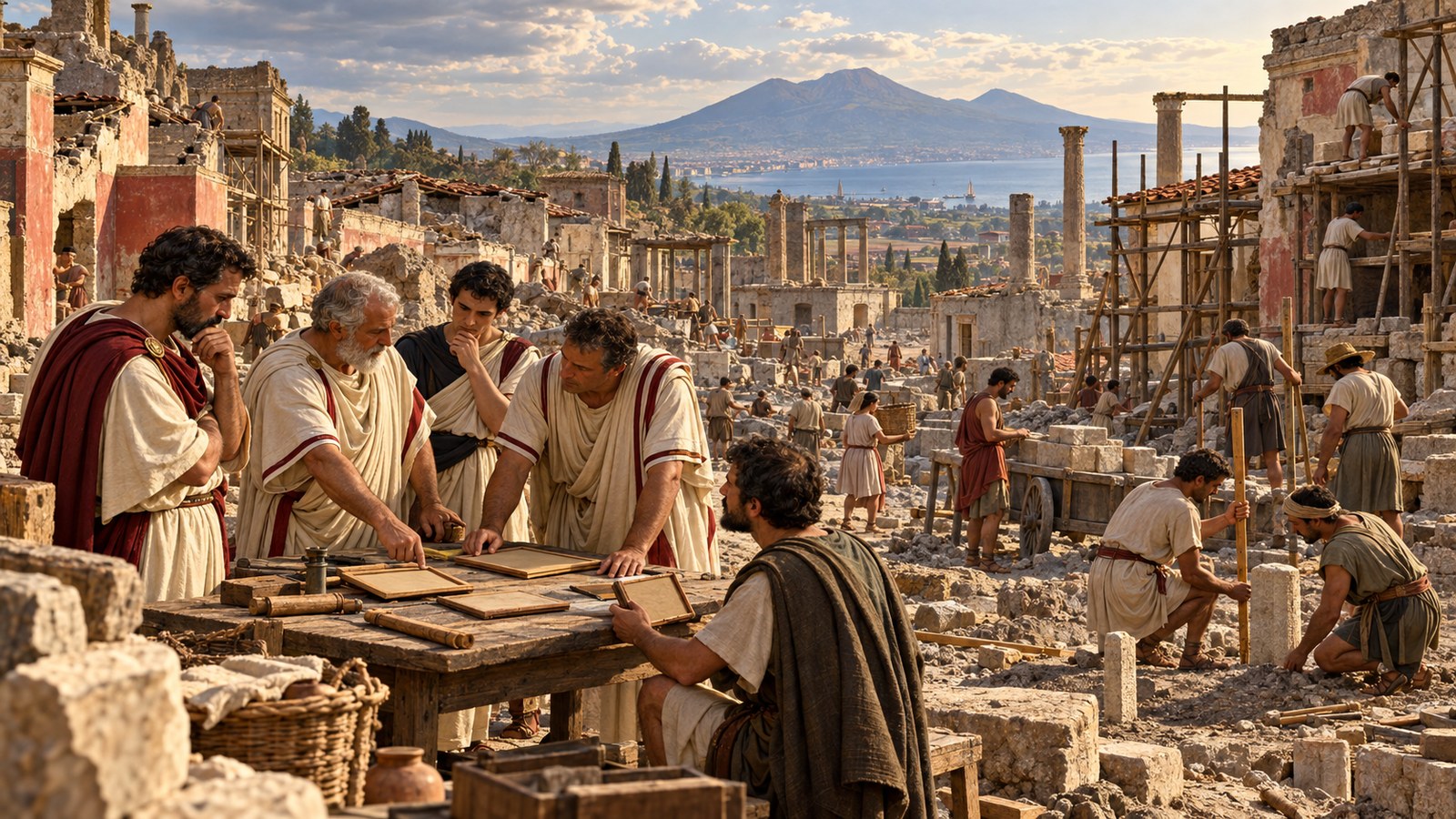
The practical work would have been formidable. Property had to be identified, claims assessed, and usable value separated from land or buildings inside the disaster zone. Suetonius gives none of those procedural steps, so they should not be invented. His narrower statement is still revealing: inheritance status became part of reconstruction finance.
The choice complements rather than repeats Pliny the Elder’s seaborne rescue during the eruption. That earlier action belongs to the immediate emergency. Titus’s commissioners and redirected estates belong to the longer problem of what happened after surviving communities faced buried streets and broken civic institutions.
Relief therefore had a chronology. Rescue could save people in hours. Rebuilding required administrators, lawful possession, and sustained expenditure. Suetonius’s compact paragraph bridges those phases without telling us that either was simple.
Rome’s fire reached into the emperor’s own villas
When the narrative turns to the fire at Rome, Suetonius gives Titus a brief cry: “I am ruined.” The phrase presents public damage as personal loss. More consequentially, it is followed by the decision to set aside the ornaments of his villas.
Ornaments were not structural beams waiting in a warehouse. They represented finished, prestigious material associated with imperial residences—objects and architectural decoration that could be reused, reassigned, or converted in the effort to restore public buildings and temples.
The measure made hierarchy visible in reverse. Ordinarily, marble, sculpture, metalwork, and skilled labour could flow toward an emperor’s residences. Under emergency conditions, Suetonius depicts the current running outward, from villas toward civic and sacred fabric.
We should not assume every ornament was physically nailed into a replacement temple. “Set aside” describes dedication of resources more securely than it describes the final journey of each object. Some pieces may have been reused; others may have supplied value or material. The biography does not itemize them.
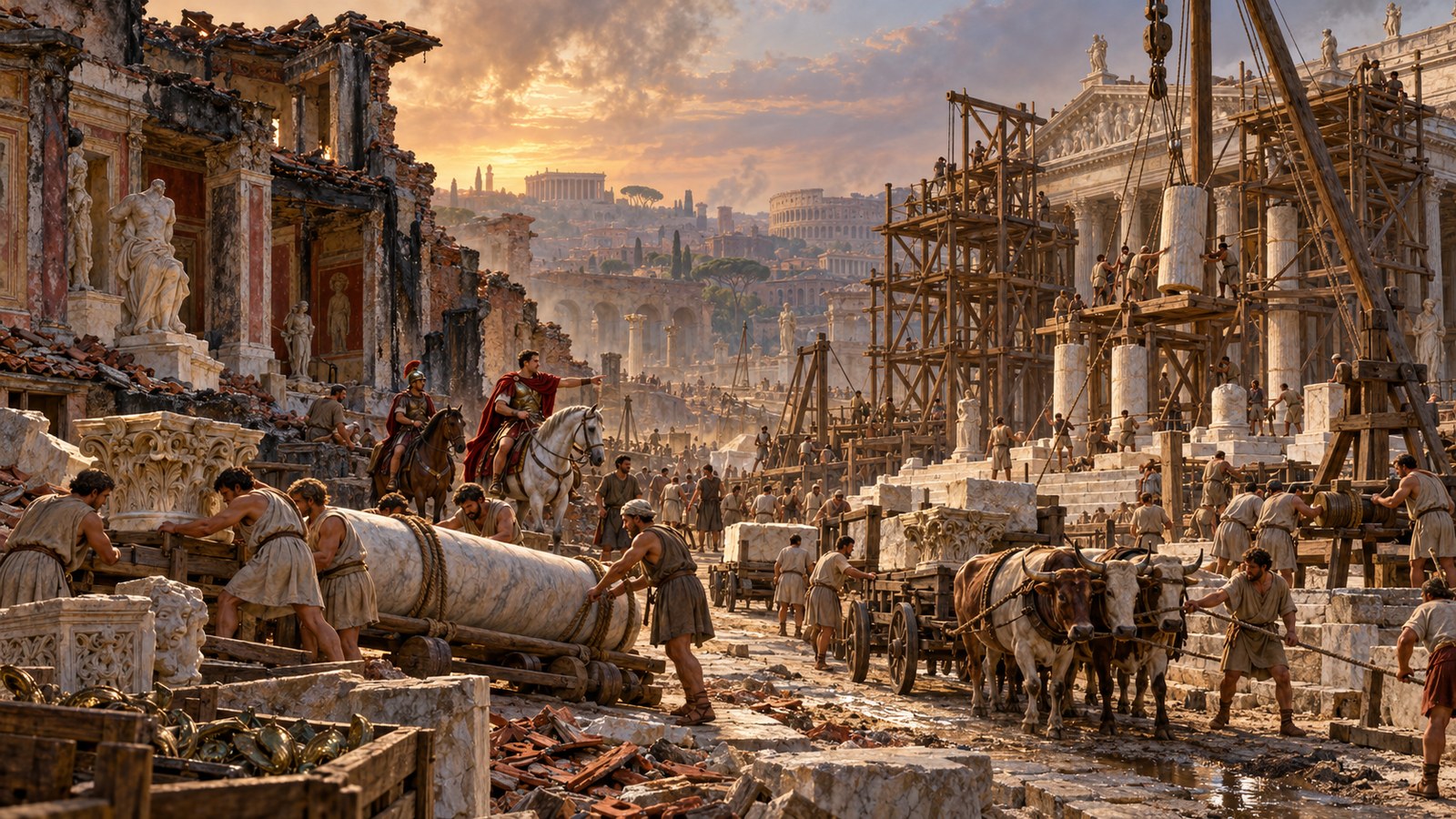
Titus then put several men of equestrian rank in charge so the work would proceed faster. The pairing is deliberate: material without management would sit idle, while supervisors without resources could issue orders but not restore roofs, porticoes, or sanctuaries.
Equestrians occupied a rank below senators but supplied many imperial administrators. Their appointment suggests an executive layer distinct from the ex-consular commission sent to Campania. Rome’s rebuilding was not merely announced; it was assigned to managers whose speed Suetonius emphasizes.
The decision also complicates the polished cultural image in the story of Titus imitating handwriting. Skill at leisure belongs to the private emperor. Here the contents of private villas become a public reserve, and administrative rank matters more than cultivated performance.
Suetonius turned emergency logistics into a claim about rule
The plague closes the cluster of disasters. Suetonius says Titus tried every kind of aid, human and divine, and searched out sacrifices as well as medicines. The wording reflects an ancient response in which ritual and treatment could operate together rather than as mutually exclusive choices.
Unlike the rebuilding measures, the plague response is broad. No named physician, drug, sanctuary, or mortality figure appears. That difference warns us not to pretend the evidence is equally precise across all three emergencies.
The strongest reconstruction claims are the ones attached to concrete transfers and appointments. Ex-consuls went to Campania. Heirless estates supported buried cities. Villa ornaments were reserved for Roman public buildings and temples. Equestrians took charge for speed.
Each detail transforms imperial virtue into an allocation problem. Who has authority? Which property can move? Where should it go? Which rank can push the work forward? Suetonius answers in emblematic scenes rather than administrative files, but those scenes are specific enough to reveal his standard for a ruler.
That standard is not simply spending more. Titus is praised for making imperial loss public: “I am ruined,” then the villas surrender their ornaments. The statement and the action turn damage to the city into damage to the household at the top.
There are limits to the portrait. We do not learn whether displaced people received housing, how construction contracts were awarded, or how Campanian communities argued over the heirless estates. We also cannot measure how much was rebuilt before Titus died.
Still, the passage offers more than a slogan of benevolence. In a few lines it separates immediate consolation, regional relief, property transfer, material reuse, project supervision, ritual, and medicine. Disaster government appears as several linked decisions made under pressure.
The villa ornament is the most memorable object because it crosses the boundary between imperial possession and public need. Suetonius makes that crossing carry the moral weight of the reign: luxury could remain behind guarded walls, or it could enter a burned city as an emergency building fund.
Source: Suetonius, Life of Titus, 8.3–4.
Sources
Suetonius, Life of Titus 8.3–4.