
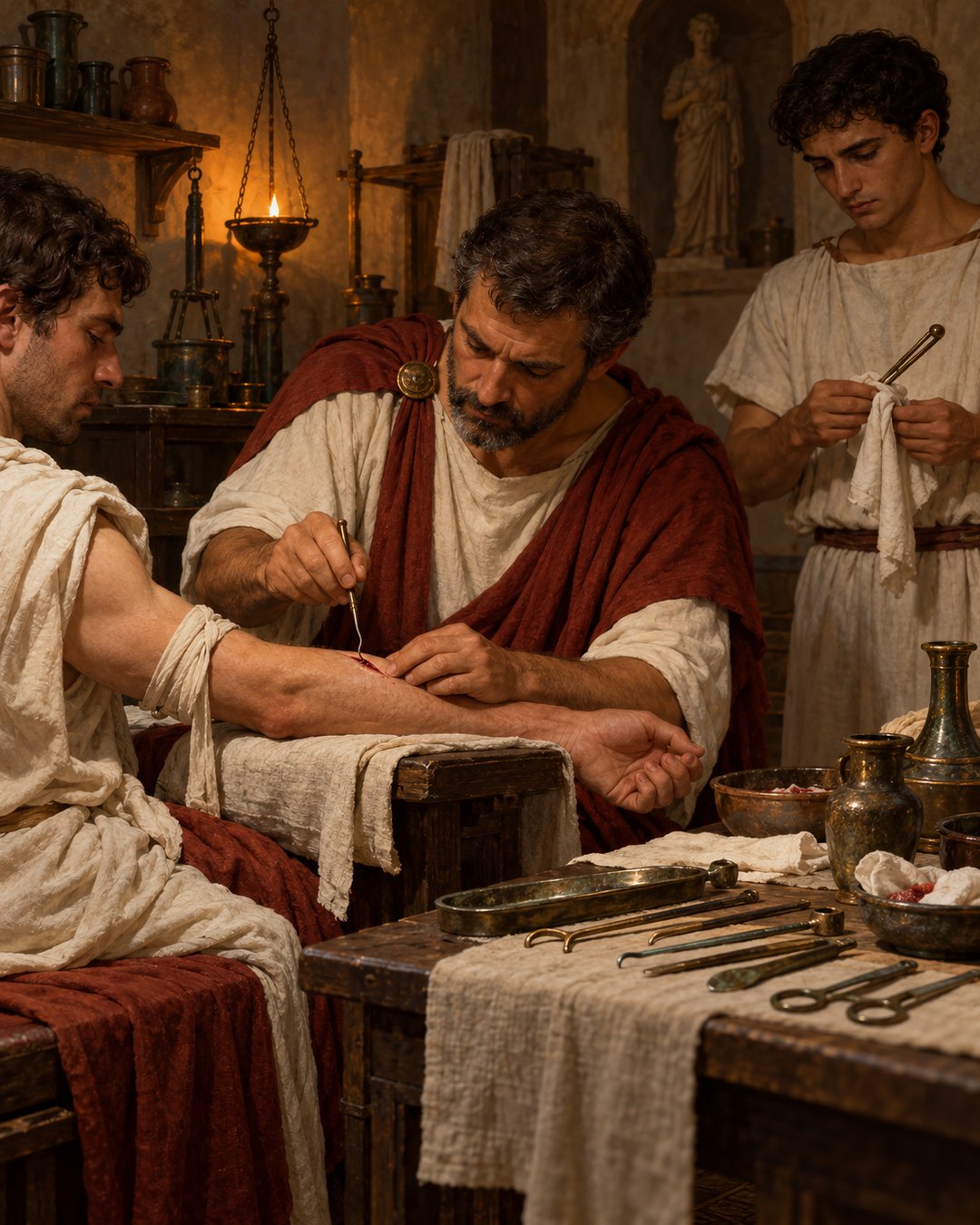
A Roman surgical instrument in the London Museum is easy to overlook. It is a copper-alloy shaft only 116 millimetres long and 4 millimetres wide. At one end is a sharp hook. The museum identifies it as a curette or hook used by surgeons to pull back the edges of wounds and incisions, hold tissue in place, or raise tissue that was about to be cut away. Its narrowness was not incidental. The instrument made a difficult part of an operation possible: keeping a small, slippery target under control while another action took place.
That is a more revealing way to read the object than treating it as a miniature version of a modern tool. The hook did not diagnose, anaesthetise, disinfect, or heal. It solved a limited mechanical problem. The surgeon needed access, tension, and a steadier field. A point that could catch tissue and a stem slim enough not to crowd the wound turned one hand into a temporary assistant.
The instrument began with a problem of access
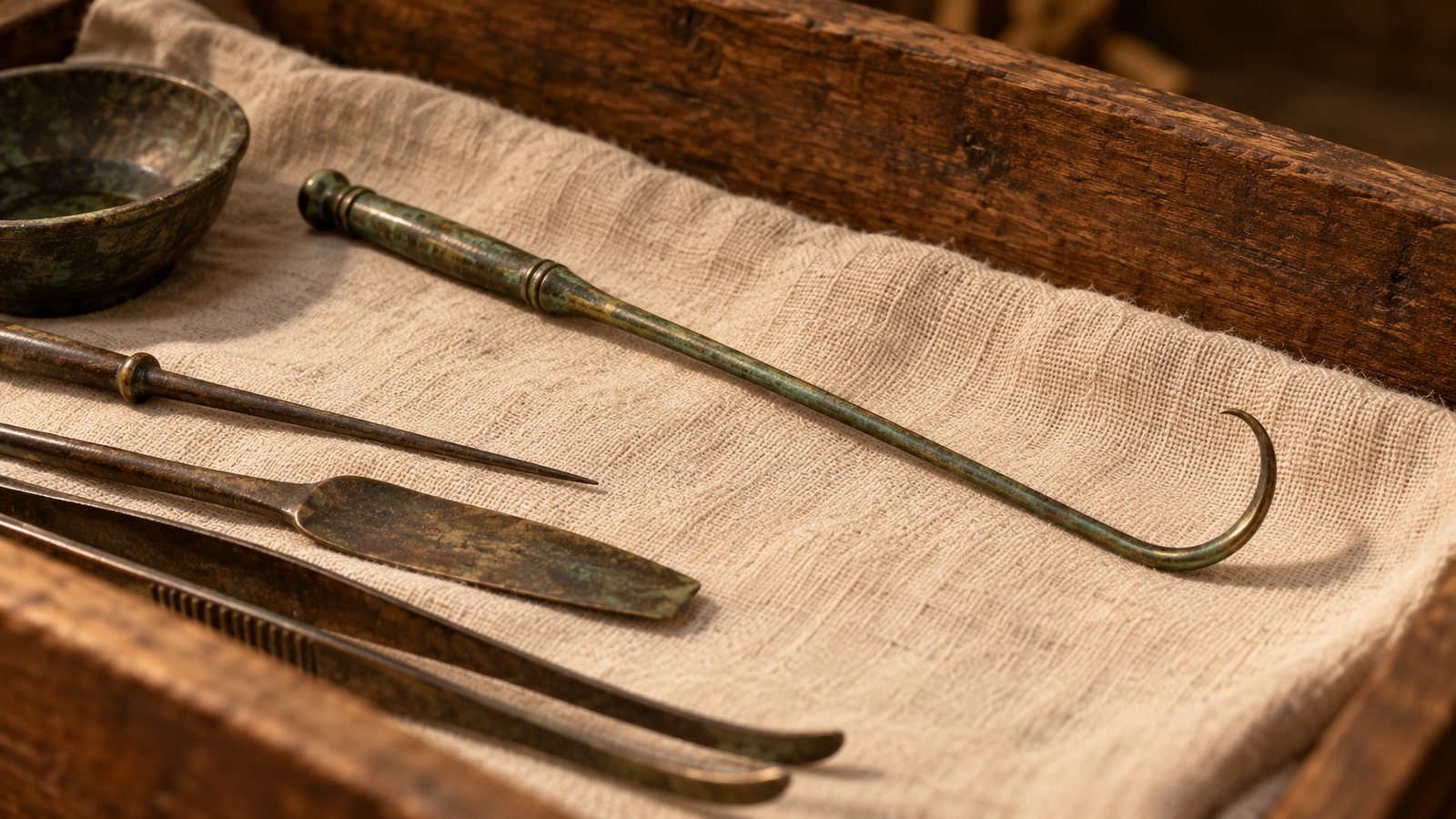
The museum’s description gives the hook three closely related jobs. It could pull back the edges of a wound or surgical incision. It could hold those edges in place. It could also raise tissue so that it could be cut out. Each job depended on the same physical action: a sharp end caught material that fingers could not grip precisely, while the long narrow shaft kept the operator’s hand outside the immediate working space.
The dimensions make the scale tangible. At 116 millimetres, the tool was a little longer than a hand is broad. Its 4-millimetre width left little bulk between the surgeon and the tissue. That combination offered reach without turning the instrument into an obstruction. A broad implement might push an incision wider simply by entering it. This hook could apply force at one small point.
The object therefore records a sequence rather than a single dramatic gesture. First came an opening, whether an existing wound or an incision. Then an edge or growth had to be caught. The hook drew it back, kept it raised, or exposed a boundary. Only then could another instrument or hand perform the next task. Roman surgery was not only a collection of blades. It also required tools that arranged the body for a blade.
A hook could make one pair of hands behave like two
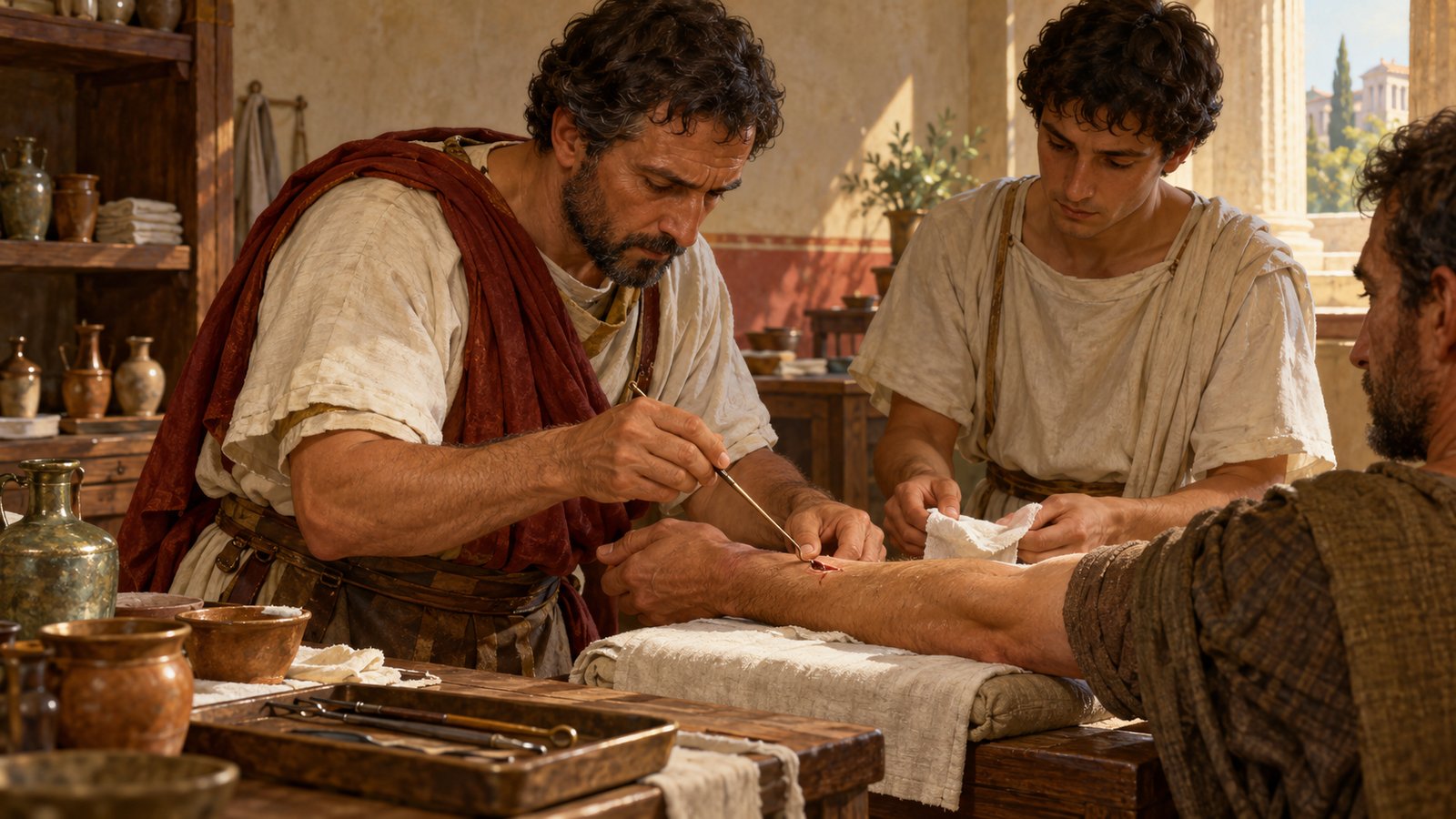
Holding is an active part of a procedure. Tissue moves when it is pulled, released, cut, or pressed. Fingers can block the view, lose purchase, or place the hand too close to the cutting edge. The London hook changed those conditions. Its point concentrated the grip; its shaft carried that grip back to the operator.
This helps explain why the catalogue describes both pulling and holding. Pulling creates exposure, but exposure disappears if the tool slips or the hand relaxes. Holding preserves the working space long enough for the procedure to continue. The instrument did not remove the need for judgement. It translated that judgement into controlled tension.
A related Lost Eagles article on Roman tweezers shows another way metal narrowed the hand’s action. Tweezers pinch between two arms. The surgical hook worked differently: it caught from one side and relied on traction. The contrast matters because Roman instrument makers were not merely making “small tools.” They were selecting different mechanical answers for different kinds of contact.
Copper alloy also mattered to the surviving object’s form. The catalogue identifies the material without claiming an exact recipe. What can be said securely is that a metal shaft could be made narrow, continuous, and pointed. The result was reusable hardware whose useful shape depended on the relationship between hook, stem, and hand.
The catalogue names the conditions surgeons treated
The museum connects instruments of this kind with the removal or treatment of abnormal growths, tumours, fistulas, and haemorrhoids. Those examples should not be flattened into one operation. They identify situations in which tissue might need to be exposed, lifted, held, or separated. The hook’s value lay in being adaptable to that recurring need.
An abnormal growth could present a boundary that had to be raised before cutting. A fistula involved an abnormal passage whose tissue might need careful access. Haemorrhoids presented another confined area where a bulky hand would be especially awkward. The object does not tell us which patient encountered this particular hook, and the collection record gives no findspot. It instead preserves the type of control Roman practitioners sought.
That distinction is important. The instrument is evidence for a surgical capability, not a complete case history. We cannot recover the patient’s pain, the room, the outcome, or the identity of the operator from this piece alone. We can recover the mechanical intention. A sharp hook was designed to engage tissue; a narrow shaft allowed access; a hand supplied tension; another action followed.
Roman medical work also existed alongside domestic preparation of remedies and measuring. A separate article on a compact Roman multi-use utensil shows how small implements could gather several daily functions into portable form. The surgical hook went in the opposite direction. It was specialised around one family of motions, and that specialisation made its purpose legible even when its personal history is gone.
Its limits make the evidence stronger
The catalogue dates the object broadly as Roman. It records no named maker and no related person, event, or place. Those absences prevent a neat story about a famous physician. They also keep attention on what the metal itself can support.
The 116-by-4-millimetre proportions describe an instrument built for fine access rather than leverage over a large distance. The sharp hook indicates engagement rather than blunt pressure. The listed uses—retracting wound edges, holding them, and raising tissue for removal—fit those physical features. Form and function reinforce one another without requiring an invented scene.
There is also a quiet lesson in the tool’s modesty. An operation can fail because the decisive cut is wrong, but it can also fail because the target cannot be seen, isolated, or kept still. The hook addressed that preliminary problem. It made space and maintained it. In doing so, it converted exposure from a moment into a condition the surgeon could use.
The object’s record quality is listed by the museum at 80 per cent, a reminder that catalogues openly preserve uncertainty as well as information. The material, measurements, type, and described uses provide a firm core. The missing biography of the object remains missing. Responsible reconstruction stops at that boundary.
What survives is enough to change the scale at which Roman surgery appears. Instead of beginning with a grand theory of medicine, begin with four millimetres of copper alloy. A point catches. A shaft holds. A wound edge moves aside. The next hand can work. The instrument’s achievement was not spectacle but controlled access inside the smallest and most difficult part of the procedure.
The three actions in the catalogue also form a useful progression. Pulling back creates a view. Holding preserves that view. Raising tissue prepares it for removal. The hook could participate at each stage without becoming the cutting instrument itself. Its purpose was to manage the relationship between target, space, and hand.
That separation of tasks is what makes the object technically expressive. A blade is designed to divide. This hook was designed to catch and maintain. Roman practitioners understood that cutting safely required more than a sharp edge; it required a way to present the intended tissue while keeping the surrounding area out of the path. The copper-alloy shaft embodied that supporting task.
Sources
London Museum, “Curette, hook” collection record.