
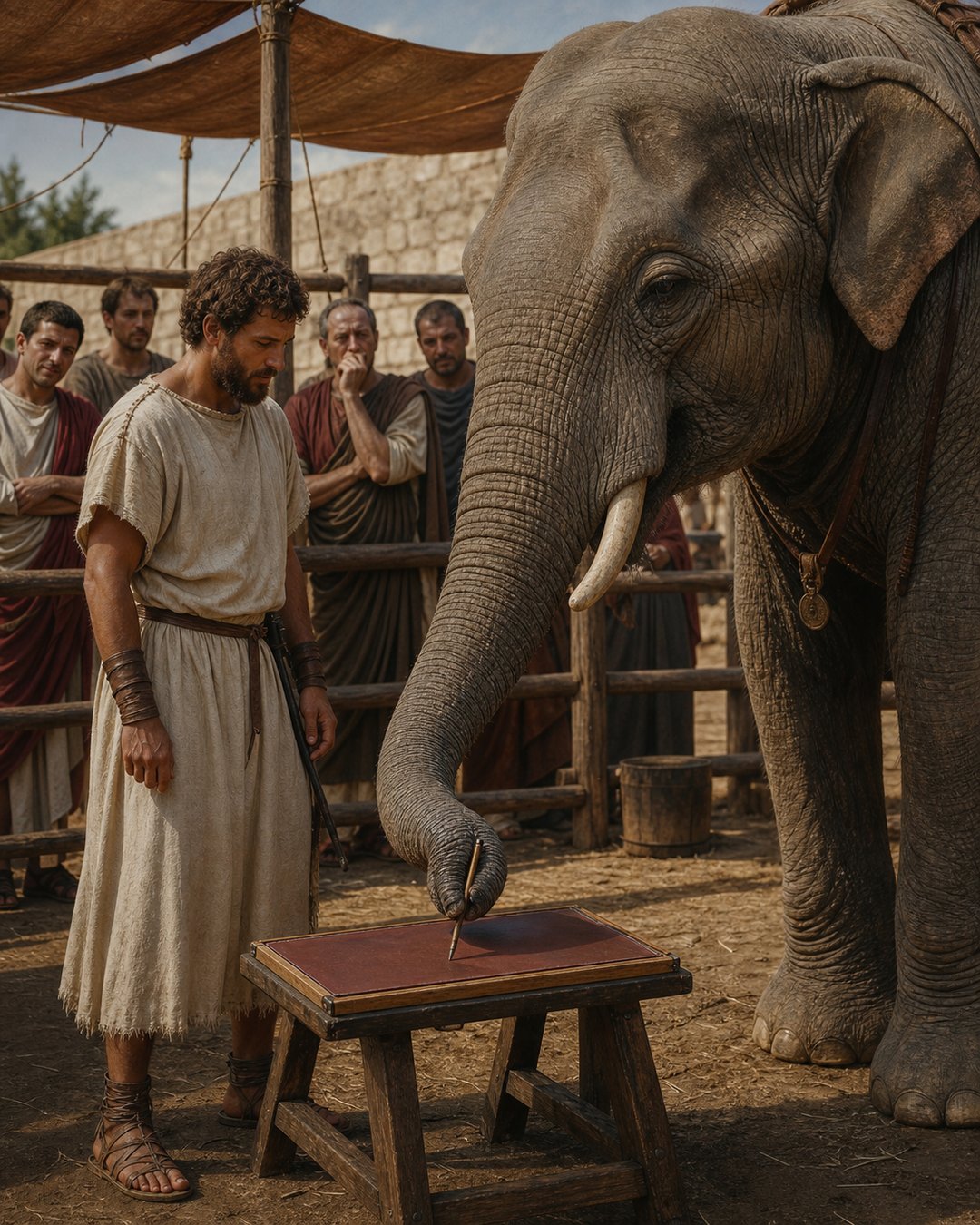
An elephant stood over a writing surface and traced a sentence in Greek.
Pliny the Elder attributes the report to Mutianus, a man who had been consul three times. The animal supposedly wrote in the first person that it had made the inscription and dedicated Celtic spoils. In the same chapter another elephant rehearsed a difficult lesson at night, trained animals negotiated a rope, and a group at Puteoli backed down a landing platform from a ship.
These stories are not a modern experiment in animal cognition. They are literary reports, some openly marvellous, transmitted through named and unnamed observers. Their value lies partly in the tests they choose. Roman readers were invited to recognize intelligence through memory after punishment, disciplined balance, symbolic marks and movement adapted to fear.
Pliny’s sequence therefore asks a question larger than whether one sentence was really written. What behaviour could make an animal seem to cross toward human skill? The answer joined training and wonder so tightly that performance itself became an argument.
Pliny began by placing elephants near human reason
Book 8 opens with a hierarchy. Pliny calls the elephant the largest land animal and the one nearest to humanity in intelligence. He credits it with understanding speech, obedience to commands, memory of learned duties, pleasure in affection and praise, and a sense of religious wonder.
These are authorial claims, not neutral observations. They prepare the reader to interpret everything that follows. A trained action is not presented merely as a trick; it becomes evidence for a pre-existing portrait of the elephant as thoughtful, dutiful and socially responsive.
Pliny’s categories also resemble qualities admired in people under authority: memory, obedience, ambition and disciplined conduct. The elephant appears intelligent partly because its behaviour can be read through Roman moral language.
War elephants made size and fear into tactical forces. Pliny’s opening takes a different route. The animal’s imposing body remains, but attention shifts from what it does to an enemy line toward what it can learn from a trainer.
This framing is essential. Without it, a rope act might remain circus spectacle and a backward walk simple avoidance. Inside Pliny’s chapter, both are recruited into a cumulative case about capacity.
A punished pupil supposedly practised after dark
The first training story is intimate. One elephant was slower than usual to learn and was frequently struck. Later it was found repeating or rehearsing the lesson at night. Pliny presents private practice as a sign that instruction continued after the trainer had gone.
The account depends on interpretation. We are not told what the lesson was, how the night behaviour was observed or how closely it matched daytime training. The older translation itself notes the difficulty of knowing what demonstrated rehearsal. A careful reader should preserve that uncertainty.
Even with those limits, the story reveals the moral shape Pliny gave learning. The animal failed, suffered correction and then worked alone. Improvement was imagined through effort rather than automatic instinct. The elephant became a pupil.
The violence should not disappear behind the charm of the anecdote. Training relied on coercion, and the marvellous result was inseparable from punishment. Roman admiration could focus on the animal’s perseverance without questioning the conditions imposed by human entertainment.
Memory linked the scene to Pliny’s opening. The elephant did not merely react in the moment; it supposedly retained an unfinished demand and returned to it. Night transformed repetition into apparent intention.
Rope work made bodily control look like calculation
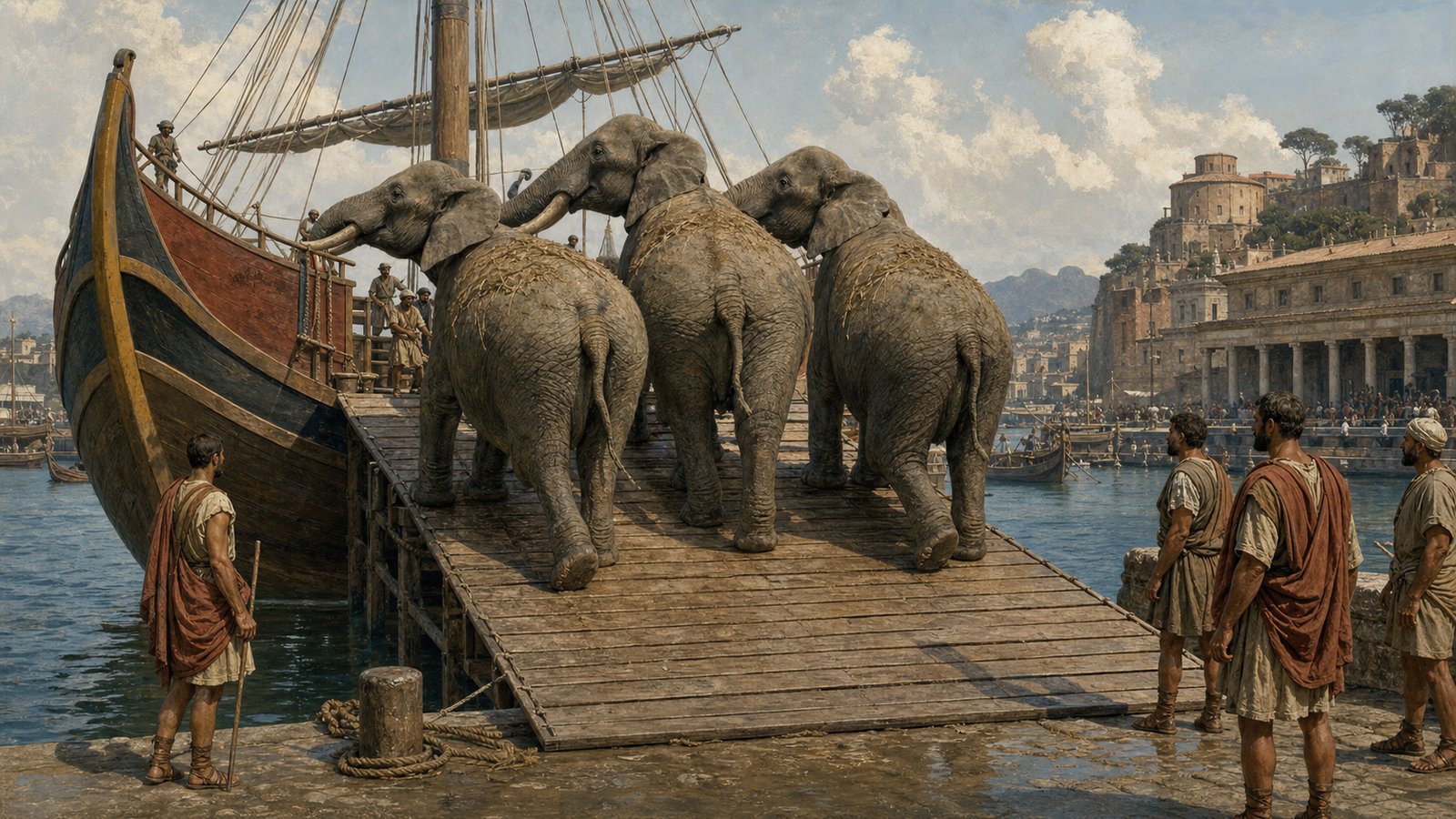
Pliny next says an elephant could walk backward on a tight-rope and descend it head first. The image is extreme: a massive animal placing weight along a narrow support while reversing ordinary orientation.
Ancient spectacle trained animals to perform actions far removed from their natural setting. Arena displays converted distant creatures into demonstrations of control. Rope work intensified that claim by making mass appear precise and obedient.
Balance alone does not prove the philosophical qualities Pliny lists. Yet to an audience, controlled movement under a command could resemble comprehension. The trainer gave a signal, the body followed an improbable path, and repeated success suggested learned sequence.
The backward direction is important because it appears again at Puteoli without the same theatrical setting. On the rope it showed mastery over a taught routine. At the harbour it became a response to an alarming view. Similar movement could be interpreted as obedience in one scene and improvisation in another.
Pliny does not explain the construction of the rope apparatus, safety measures or duration of training. Supplying those details would turn a compact ancient claim into modern stage engineering. The secure point is that he considered directional balance worth placing among signs of docility.
Greek letters made training enter the human archive
The writing report carries the highest symbolic charge. Mutianus said an elephant had learned to trace Greek letters. Pliny preserves a sentence: “I have myself written these words, and have dedicated the Celtic spoils.”
The sentence is almost playfully self-verifying. Its content declares the act that produced it. If an elephant traced marks prepared by training, the words told viewers to treat those marks as authorship. The inscription performed the argument it made.
Pliny names Mutianus and notes his three consulships. Rank does not prove an extraordinary event, but it shows how the text builds credibility. The report is not left as something an anonymous crowd once heard; it is attached to a socially weighty transmitter.
We should distinguish tracing from composing. Pliny says the animal was taught the letters and gives the formula it reproduced. Nothing in the passage shows that the elephant invented the sentence, understood the dedication or used Greek language independently. Training may explain the sequence without human-style literacy.
That distinction does not empty the scene of meaning. Guiding a stylus through ordered forms would still require learned motor control. For Roman readers, writing was a particularly potent boundary marker because it left a durable result. A balancing act vanished when it ended; an inscription could be shown.
At Puteoli, backward movement answered fear
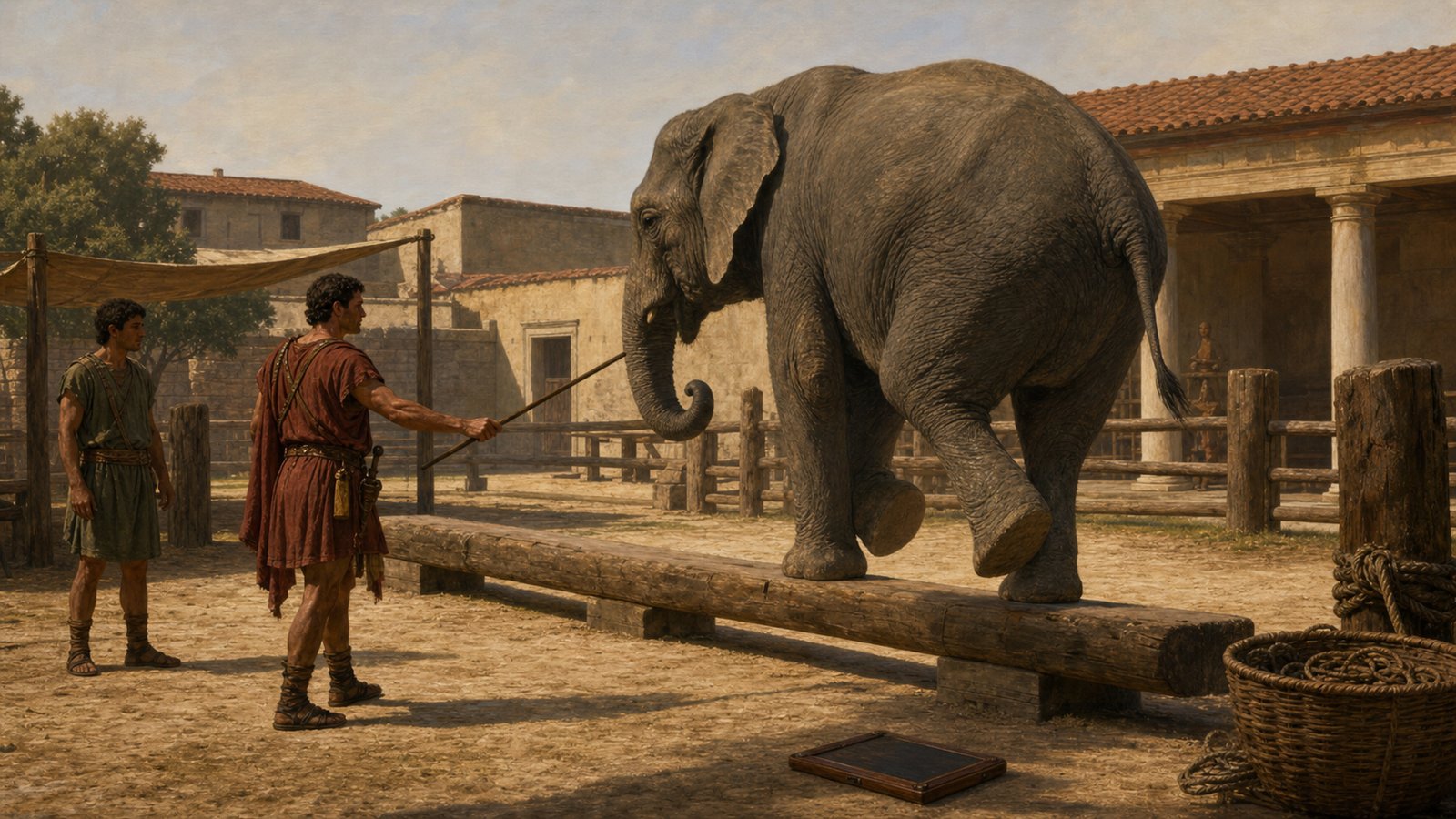
Mutianus also claimed personal witness to elephants landing at Puteoli. They had to cross a long platform from ship to shore and were frightened by its visible extent. According to Pliny, they descended backward, deceiving themselves about the distance.
The explanation is anthropomorphic: it assigns the animals a strategy for managing what they saw. Yet the observed behaviour, if accurately reported, differs from the writing act. No trainer’s sentence is involved. The animals altered orientation around a threatening path.
Transport itself gives the story a hard physical setting. Elephants had been moved by sea to an Italian port; vessel, platform, handlers and shore created a narrow transition. The animal celebrated in spectacles first had to survive the logistics that delivered it.
The backward descent echoes the rope performance but changes its narrative engine. One action displays a rehearsed command; the other appears to reduce fear. Pliny places them together because both make direction seem chosen rather than accidental.
His cluster leaves modern readers with evidence of unequal kinds: a claimed eyewitness landing, a reported writing demonstration, a night lesson with no named observer and a rope marvel. Treating them all as equally verified would ignore the text’s own varied scaffolding.
What unites them is the Roman appetite for animal behaviour that looked legible in human terms. The elephant became pupil, acrobat, writer and anxious traveller. Each role made a different demand on memory or control.
Pliny’s chapter does not settle where training ends and reasoning begins. It shows why that border fascinated him. An immense foreign animal could be made to perform in a Roman system, yet its actions could still surprise observers into imagining an inner life beyond command.
Sources
Pliny the Elder, Natural History 8.1–3