

Cloelia reached Rome alive, and Rome sent her back. In Livy’s story, the young hostage had escaped an Etruscan camp, led other maidens through the Tiber under enemy missiles, and delivered them safely to their families. Yet the peace with Lars Porsenna rested on hostages. Keeping its new heroine would have broken the agreement.
The return transforms the episode. Courage does not erase obligation; it forces both sides to prove what their promises mean. Rome restores Cloelia. Porsenna receives her, praises the act that defied his guards, and sends her home again. He then gives her a choice over other captives.
Livy writes legendary early-Republic history, not an eyewitness report. His narrative arranges exemplary conduct with unusual neatness. That is precisely why the sequence matters. Roman memory did not preserve only a dangerous swim. It preserved an argument that bravery and good faith could magnify one another instead of competing.
The hostage agreement stood behind the river
The setting was a peace forced from Rome. Porsenna had occupied the Janiculum, and the withdrawal of his garrison was linked to the delivery of hostages. Their bodies secured future conduct. A hostage was therefore neither an ordinary prisoner nor a guest free to leave. Escape touched the treaty itself.
Livy places the Etruscan camp near the Tiber. Cloelia, one of the young women held there, deceived the guards and headed a group of maidens. The river was not merely the route home. It was the physical boundary between custody and Roman protection.
The story says they swam while missiles came from the enemy and that every member of the group reached relatives safely. Livy concentrates leadership in Cloelia but does not make her courage solitary. She organizes a collective escape and accepts responsibility for moving others through the same danger.
The crossing belongs to the same narrative world as Horatius holding the bridge and receiving land measured by a plough. River, enemy pressure, and public reward recur. Cloelia’s position differs because she begins unarmed and bound by a diplomatic pledge, then leads people whose safety depends on her route.
Livy’s language should not be flattened into a modern operational reconstruction. He offers no swimming formation, distance, or exact missile type. The concrete claims are narrower: camp near the bank, guards deceived, a group led across, danger from enemy fire, safe arrival. The force comes from the treaty surrounding those actions.

Porsenna demanded one person, not the whole group
When Porsenna learned what had happened, Livy says he first reacted with anger. His envoys demanded Cloelia and treated the others as secondary. The demand identified leadership as the central injury: a guarded pledge had defeated custody and carried companions with her.
Admiration then entered the king’s response. Porsenna reportedly ranked her action above those of Horatius Cocles and Mucius Scaevola, the male heroes already attached to his Roman war. Praise did not make him surrender the legal point. He declared that refusal to return her would count as a broken treaty.
That combination is the hinge of the episode. Porsenna could honour bravery while insisting that bravery had occurred inside a binding arrangement. He promised a second step: if Rome gave Cloelia back, he would return her safely to her friends.
Rome then faced a choice between immediate possession and public faith. It had the escaped hostage within its community and every emotional reason to protect her. Livy nevertheless says the Romans restored their pledge according to the treaty. They returned the person whose achievement they would later monumentalize.
The act places institutional restraint after physical heroism. Cloelia has already crossed the dangerous water; the city must now cross a less visible threshold by yielding her to an enemy’s word. The story makes Roman credibility depend on accepting that risk rather than celebrating first and explaining the broken term later.
Her second release became a reciprocal gift
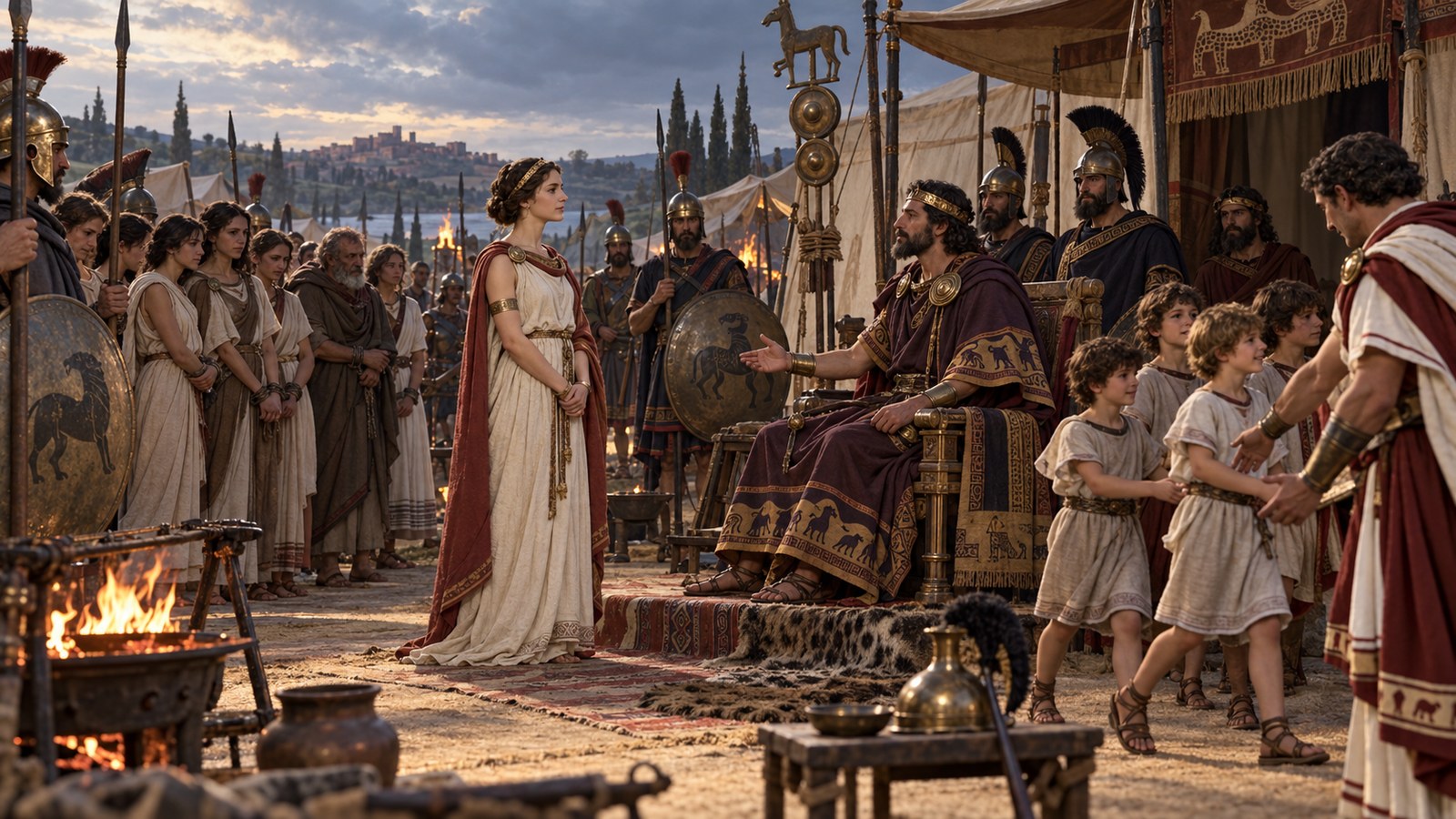
Porsenna kept his promise. Livy emphasizes that merit found not only safety but honour with the Etruscan king. Cloelia’s compelled return did not restore the original condition unchanged. The king received her under treaty and then chose to release her in recognition of the courage that had challenged him.
He added a remarkable privilege: half the remaining hostages could go with her, and she could select them. The person previously treated as an object guaranteeing peace became an agent deciding whose captivity ended. Her authority emerged from the exact sequence of escape, return, and counter-release.
Livy says she chose boys below puberty. The narrative presents them as those most exposed to injury and frames the decision as fitting both maidenly reserve and the hostages’ own judgment. That explanation belongs to Livy’s moral vocabulary, but the selection itself directs reward away from Cloelia’s closest companions and toward a vulnerable group.
The choice also limits triumph. She does not demand every hostage or renegotiate the whole settlement. Porsenna defines a share, and Cloelia exercises discretion within it. Heroic agency remains bounded by the peace that made the hostages necessary.
Women appear elsewhere in early Roman tradition as bearers of civic consequence, but Cloelia receives an unusually public form. Her remembered decision joins bodily risk to judgment about others. The story’s climax is not simply that she survives twice; it is that her second freedom carries additional people through a permission granted by the former captor.
The younger hostages also make the reward legible beyond personal fame. Cloelia could not undo the original diplomacy, but she could alter its human burden. Livy lets her exercise care at the exact moment when king and city have finished proving their own reliability, giving the returned hostage the final consequential decision in the exchange.
A woman on horseback fixed the sequence in Rome
Livy ends with an equestrian statue at the top of the Via Sacra. He calls the honour uncommon, matching an uncommon example of courage. The mounted form placed a young female hostage in a visual language usually associated with military and political distinction.
The location made the story part of movement through Rome. Viewers did not need the whole narrative carved into the monument to confront its inversion: a woman remembered first for swimming appears on horseback. The statue translated dangerous motion through water into controlled public elevation.
That monument belongs beside the contested placement of Horatius Cocles’s statue. In both cases, memory depended on a body fixed in civic space after a story of emergency. Cloelia’s image, however, commemorated someone whose fame passed through enemy recognition and treaty compliance.
Livy’s elegant reciprocity should keep us cautious. Legendary history can sharpen messy events into moral architecture. The account tells us with confidence what later Romans found worth joining: female courage, collective rescue, the return of a hostage, an enemy who honoured merit, protection of the young, and a public statue.
Remove the return and the episode becomes a successful escape followed by diplomatic dishonesty. Remove the escape and there is no reason for Porsenna’s gift. Remove the choice and Cloelia’s agency ends at her own safety. Livy’s version needs every stage because each one changes the meaning of the previous stage.
The river made Cloelia famous, but the road back to captivity made the story Roman in Livy’s terms. Rome surrendered its heroine rather than its pledged word. Porsenna answered restraint with honour. Cloelia then spent the resulting authority on others, and the Via Sacra kept the whole chain visible as a woman seated above the crowd.
Sources
Livy, History of Rome, 2.13.