

Aristotle’s pupils asked for a name before illness made the question urgent beyond repair. Their teacher was nearly sixty-two, weak in body, and doubtful of a long future. The school needed someone who could continue the studies he had begun.
Two pupils stood above the rest: Theophrastus of Lesbos and Eudemus of Rhodes. A direct declaration would elevate one in front of the other. Aristotle promised to decide when an opportunity appeared, then later complained that the wine before him was harsh and unsuitable for his health.
He requested two replacements, one Rhodian and one Lesbian. Both proved good. The Lesbian, he said, was sweeter. Everyone present understood that he had selected a successor as gracefully as he had judged the cup.
The school needed continuity before the teacher disappeared
Gellius frames the episode with bodily weakness. Aristotle was sickly, nearly sixty-two, and possessed little hope of continued life. The disciples’ request was therefore practical rather than ceremonial.
They asked him to choose who would inherit his position and office. Their stated concern was the completion and perfection of studies into which he had already initiated them. A school was not only a gathering around one brilliant speaker; it contained work expected to outlast him.
The wording makes the pupils’ unfinished education part of the succession problem. They do not ask only who deserves an honour. They ask whom they can approach after Aristotle’s final day to carry existing studies onward. The office is defined by continued teaching.
Many capable men were present. Gellius nevertheless isolates two for talent and learning. Theophrastus came from Lesbos, Eudemus from Rhodes. Those origins later give Aristotle the vocabulary for his answer.
The choice carried several risks. Naming one man bluntly could make the other’s rejection the centre of the moment. Refusing to name anyone would leave the disciples without a recognized line of continuity. Delay might become indecision if illness advanced.
Aristotle did delay, but only until an opportunity arrived. The phrase makes timing part of judgment. He did not answer at the instant of pressure; he waited until he could frame the decision in a form suited to the people involved.
This is unlike Titius Aristo’s bedside weighing of prognosis and obligation. Both stories connect illness with deliberation, but Aristotle’s problem concerns what others will do after him. The question is institutional succession.
The pupils also matter as witnesses. The later tasting occurs before the same people who had asked for a master. The answer need not be formally announced if the relevant community can recognize it together.
Two islands entered the room inside two cups
Aristotle next said that the wine he was drinking was harsh, unwholesome, and inappropriate for his health. On the surface, this was a request from a sick man for a better drink.
He specified foreign wine from Rhodes or Lesbos and asked that both kinds be found. The instruction mapped perfectly onto the origins of Eudemus and Theophrastus without yet mentioning either man.
The disciples went, searched, found the wines, and brought them back. Gellius narrates these ordinary actions because the staging had to be completed. A comparison requires both candidates to be materially present.
Aristotle tasted the Rhodian first and called it sound and pleasant. That praise prevents the choice from becoming an insult. Rhodes is not dismissed as bad wine, just as Eudemus is not represented as an unworthy pupil.
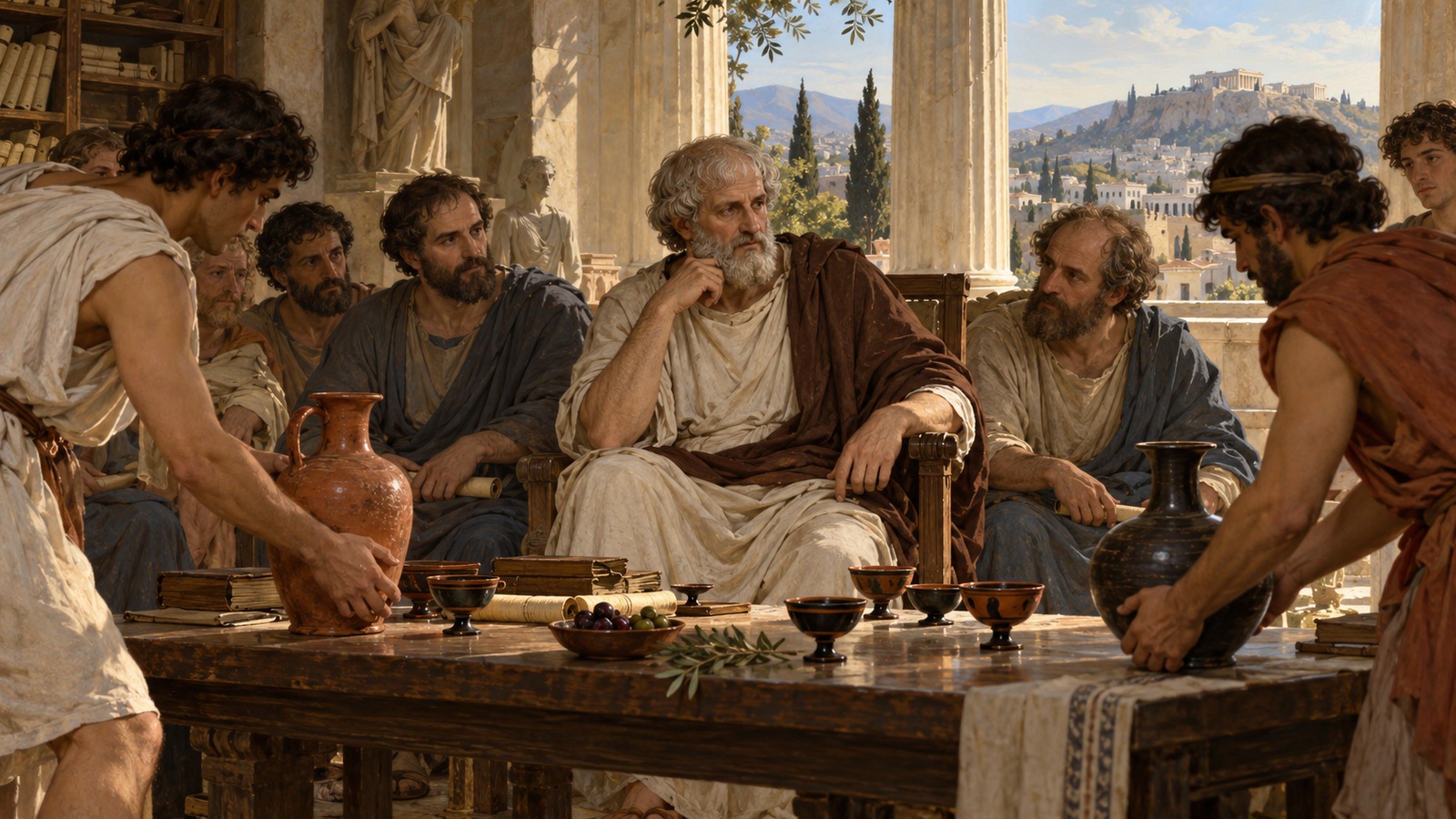
He then called for the Lesbian. After tasting it, he said both were very good indeed, but the Lesbian was sweeter. The comparative does all the work. Excellence is acknowledged on both sides while preference remains clear.
The story does not require secret signals known only to a few. Lesbos and Rhodes were already attached to the two men in the room. Once Aristotle arranged the tasting, the adjectives could not remain merely geographical.
Food and drink often turn social rank visible at table, but this cup carried an office rather than a place setting. The performance remained domestic in scale while deciding who would lead an intellectual community.
A courteous surface carried a binding decision
Gellius says no one doubted what had happened. Aristotle had chosen his successor, not his wine. The indirectness did not produce ambiguity because every element had been aligned beforehand.
This is an important distinction. A vague hint leaves listeners arguing about intention. Aristotle’s device was tactful yet operational. The pupils knew the candidates, knew their islands, remembered their request, and heard a ranked comparison.
The choice also protected the dignity of Eudemus. The Rhodian wine was sound and pleasant. The Lesbian wine won by sweetness, not by exposing a defect in the alternative. Praise remained available to both while leadership went to one.
Theophrastus is then described as distinguished in the fineness of his eloquence and his life. Those qualities fit the manner of the appointment. Gellius presents a refined successor selected through a refined act of speech.
The episode complements Herodes Atticus exposing a philosopher made only of beard and cloak. Herodes strips performance away from empty identity. Aristotle uses performance differently: the small drama of a tasting communicates a real judgment already grounded in talent and learning.
Indirect speech can become evasive when a speaker wishes to avoid responsibility. Here Aristotle remains responsible because the community understands his preference and later acts on it. Courtesy changes the delivery, not the outcome.

The setting also lets Aristotle choose without staging a contest between speeches. The two pupils do not campaign. No vote is recorded. Authority remains with the teacher whose office is about to become vacant.
The school acted on a metaphor after Aristotle died
Aristotle died not long after the tasting. The disciples then became followers of Theophrastus. Their action confirms that the metaphor had crossed into institutional fact.
The story compresses succession into three moments: request, comparison, recognition. First the group identifies the need. Then Aristotle constructs a choice in language. Finally the group follows the selected man when the vacancy arrives.
What survives in Gellius is not an administrative charter. It is an anecdote about tact. Yet the anecdote takes administration seriously. A school’s continuity depends on a decision being understood by those who must carry it forward.
The wine matters because it supplies both cover and precision. Aristotle can speak as a connoisseur while naming the islands that distinguish the candidates. “Sweeter” sounds modest beside a grand declaration, but within the prepared scene it becomes decisive.
No one is said to challenge the result. That unanimity belongs to Gellius’s telling and should not be expanded into invented debates or private reactions. The passage gives us recognition, death, and adherence to Theophrastus.
The old teacher therefore exercises authority one final time by controlling tone. He does not leave the school a riddle. He leaves it an answer gentle enough to preserve esteem and sharp enough to direct allegiance.
The form also fits the audience. Pupils trained to notice comparison, implication, and exact wording did not need a second explanation. Their shared recognition converted the teacher’s carefully staged sentence into a usable succession.
Lesbian wine did not literally hold office. It carried an island name across the room. Aristotle’s pupils supplied the rest of the meaning, and after his death they made the comparison durable by choosing whom to follow.
Sources
Aulus Gellius, Attic Nights 13.5.