
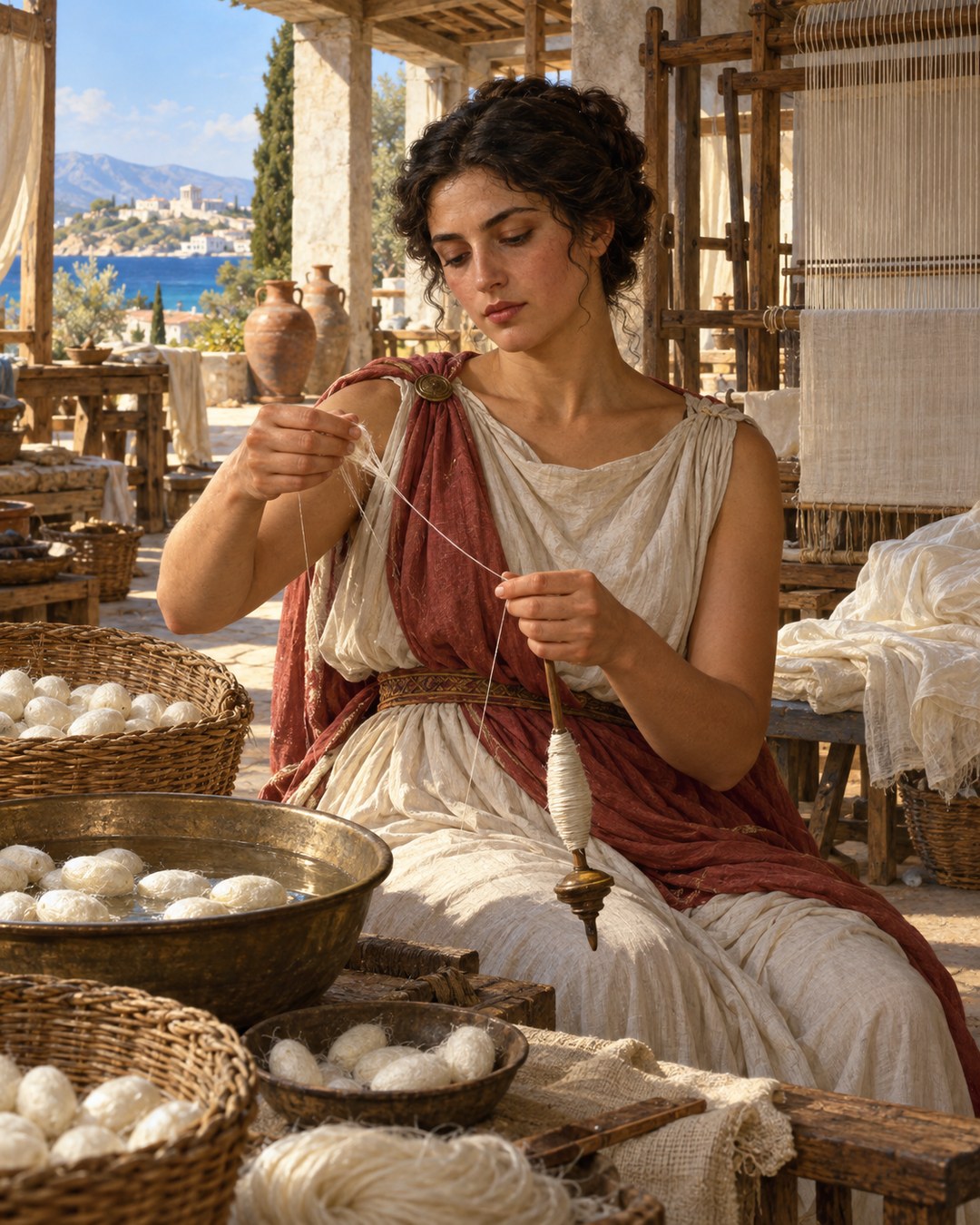
The useful material did not arrive as a neat hank of thread. Pliny the Elder describes an insect web, fine enough to compare with a spider’s work, that first had to be taken apart. Pamphile of Cos received the credit for discovering how to unravel it and spin the loosened filaments into cloth.
His few sentences move from natural history to workshop practice and then to Roman unease about luxury. A horned grub changes form through named stages; the insect makes its web; an artisan reverses that construction; and the resulting Coan garment becomes famous for revealing nearly as much as it covers.
The story is not a complete history of Eurasian silk. It is a compact Roman account of one material and one credited woman. Read closely, it preserves the difficult middle between finding a filament and wearing a finished dress.
A horned grub passed through four named forms
Pliny begins with the animal rather than the loom. He distinguishes this creature from another already discussed, then describes a relatively large grub with two striking horns. It becomes a caterpillar before moving into stages he calls bombylis and necydalus.
The old vocabulary does not map tidily onto every modern entomological label. The safest reading follows the observed sequence without pretending that Pliny supplied a laboratory taxonomy. His point is transformation: one body repeatedly changes before producing the material people prize.
He assigns six months to the passage into the silk-producing creature. Whether that duration fits a particular modern species is a separate question. Inside the passage, it gives production a biological calendar. Cloth begins with waiting for an animal’s life cycle.
The web is compared with a spider’s. That comparison tells a reader what its fineness and structure looked like, but the web was not yet a usable woven textile. Nature had arranged the filament in one form; workshop skill had to rearrange it in another.
This is a different material history from the repeated combing that reduced fifty pounds of flax. Flax fibres are cleaned and aligned from a plant stalk. Pamphile’s credited process begins by undoing an insect construction.
Pliny gives no dimensions for the web, no temperature for treating it, and no count for the finished thread. Those absences matter. They prevent a modern reconstruction from being smuggled into an ancient sentence that records stages and reputation rather than a full recipe.
Unravelling turned a web into a supply of thread
The decisive verb is unravelling. Cutting or tearing the web into loose fluff would destroy much of the advantage of a continuous filament. Pamphile’s achievement, as Pliny frames it, was recognizing that the web could be drawn apart in an orderly way and then spun into material for weaving.
That makes taking apart a form of manufacture. The insect has already joined the filament into a protective structure. The artisan does not imitate that structure; she patiently reverses it, preserving enough continuity to create a new one.
Pliny pairs unravelling with spinning. The first action releases the material, while the second manages it as thread. Only after both can the loom produce a stable surface large enough to become clothing.
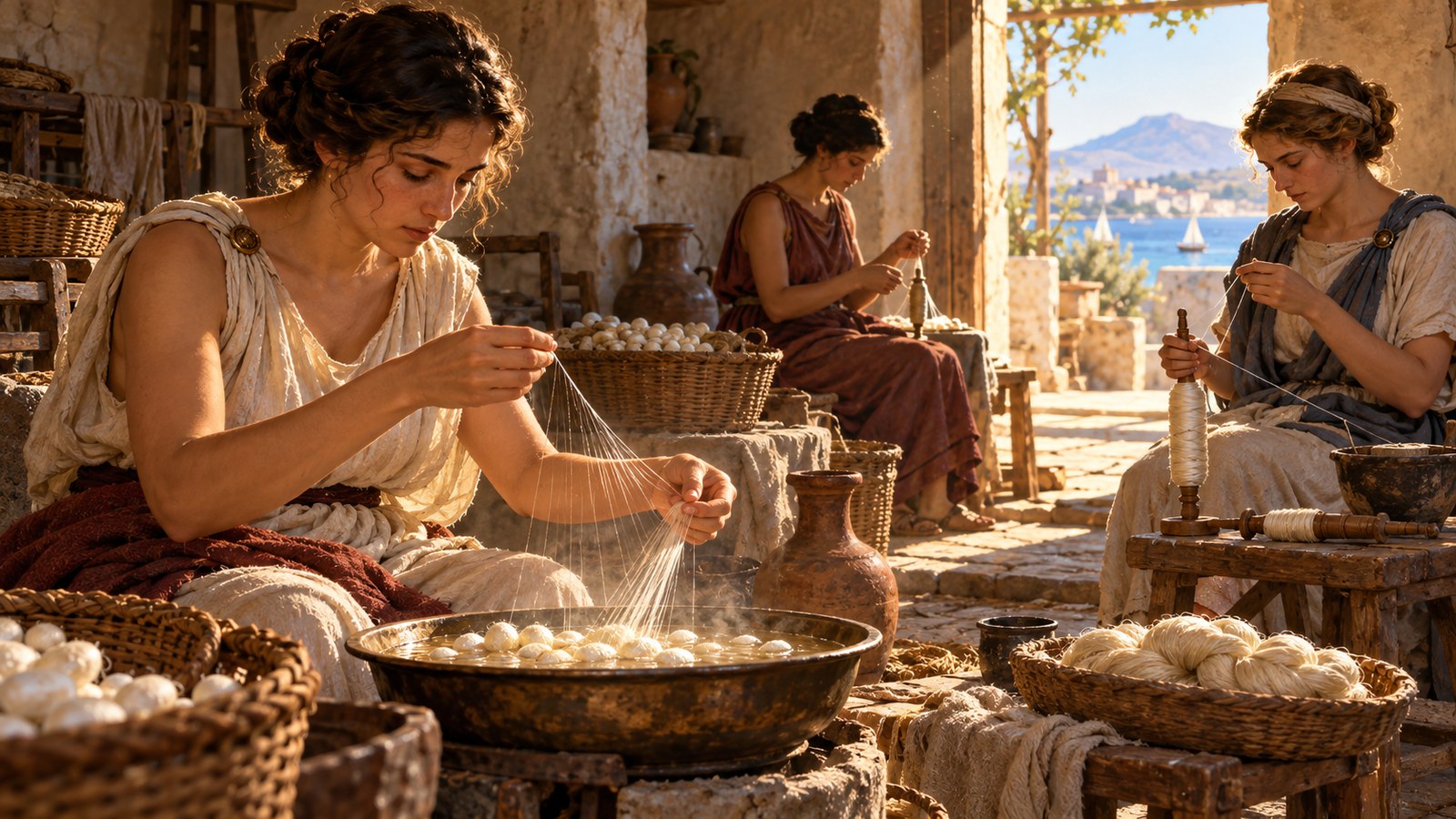
A workshop built around such work would depend on attention more than brute force. Fine filament catches, tangles, and disappears against the wrong background. Hands, light, spindle, and a clean working surface become parts of the same process.
Pliny names Pamphile and also names her father, Platea. That double identification gives the discovery a social address: a particular woman in a particular island community, not an anonymous marvel drifting in from the edge of the world.
Credit in ancient technical writing can simplify a longer collective history. Other workers must have raised, gathered, prepared, spun, and woven material. Still, the named attribution is valuable because it makes female technical knowledge visible where craft descriptions often erase individual hands.
Cos converted workshop knowledge into a luxury reputation
The material became costly women’s clothing, which Pliny calls bombycina. The garment’s name keeps the insect in the vocabulary even after every visible trace of larva and web has vanished into thread.
Cos mattered as more than a point on a map. The translator’s note associates early Roman silk dresses with the island and describes them as Coan clothing. A local manufacturing reputation could travel farther than the workshop itself.
The same note says some dresses were dyed purple or enriched with gold stripes. Those additions belong to the edition’s explanatory note rather than Pliny’s short central claim, but they help explain how an already delicate textile could acquire further layers of expense.
A fine transparent cloth also demanded decisions at the loom. Sparse structure makes every uneven thread and mistake more visible. The garment could look effortless only because fibre preparation and weaving had been tightly controlled.
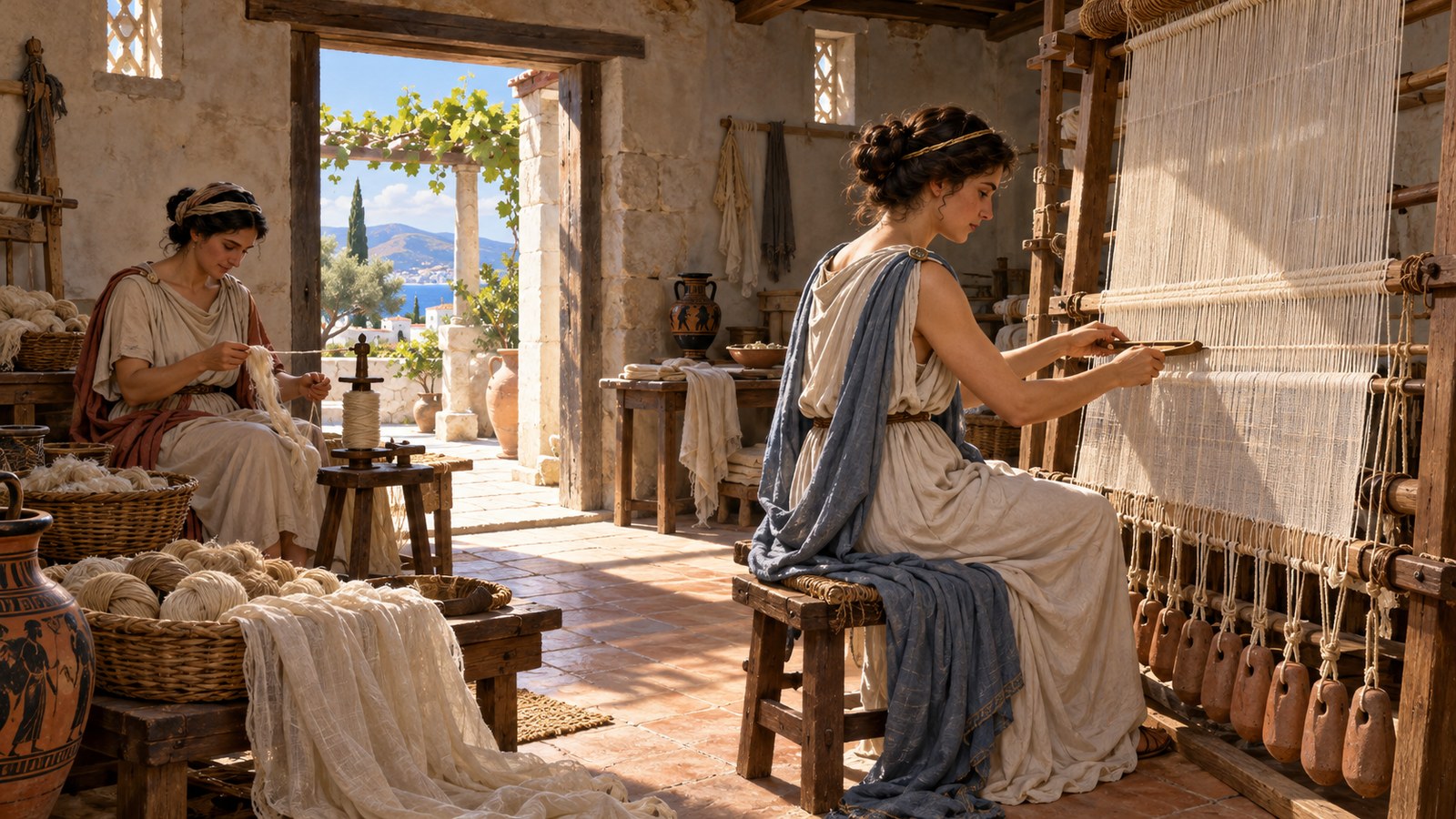
The transformation resembles the staged labour behind Roman purple dye. In both cases, elite display hides an awkward chain of biological material, patient handling, and specialist judgement.
Yet silk is not simply another colour applied to familiar cloth. Its fineness changes what a garment can do with light and skin. Material structure itself becomes the visual effect.
A transparent dress turned technique into a moral argument
Pliny closes with a barb. Pamphile deserves credit, he says, for clothing that covers a woman and at the same moment reveals her. The sentence praises invention and condemns its social result without separating the two.
That reaction is evidence of success. A fabric must have been recognizably different for transparency to become the feature around which moral criticism gathered. Roman luxury writing often converts technical novelty into a story about discipline, gender, and excess.
The criticism can distract from the process it follows. Before a dress could provoke anyone, an insect had to complete its transformations, a web had to remain usable, a worker had to locate its filament, and another had to spin and weave it without losing the effect.
Pliny does not describe who gathered the webs, how many were needed, how the workers were organized, or what a garment cost. He also does not settle how the Coan process related to imported silks elsewhere. Those are limits of the evidence, not invitations to fill the gaps with confident detail.
The contrast between web and dress also helps explain why Pliny placed the story in natural history. The workshop does not merely decorate a substance found in the landscape. It interrupts an animal sequence and redirects its product into human use. Biology and manufacture overlap at the moment of collection.
That overlap imposed limits. Workers could not demand filament before the creature made it, and a damaged web reduced what could be recovered. Production began with observation: knowing the relevant stage, recognizing usable material, and separating it without turning fine strands into a knot.
Cos supplied a setting in which that fragile knowledge could become repeatable. A single successful experiment would not sustain a clothing reputation. Other hands had to learn the order of gathering, unravelling, spinning, and weaving well enough for customers to associate the island with a recognizable cloth.
The passage consequently holds two kinds of authorship. The insect authors the first structure without intending a garment. Pamphile authors a method by reading that structure against its original purpose. Her craft depends on nature but is not a passive copy of it.
What survives is a compact chain of conversion. The creature builds; Pamphile unbuilds; the spindle gives order to what has been released; the loom makes a surface; and Roman observers turn that surface into an argument about luxury.
The named inventor stands at the chain’s hinge. Her insight was that a finished natural structure could become raw material again. Coan silk began, in Pliny’s telling, when someone looked at a web and saw a thread waiting to be recovered.