
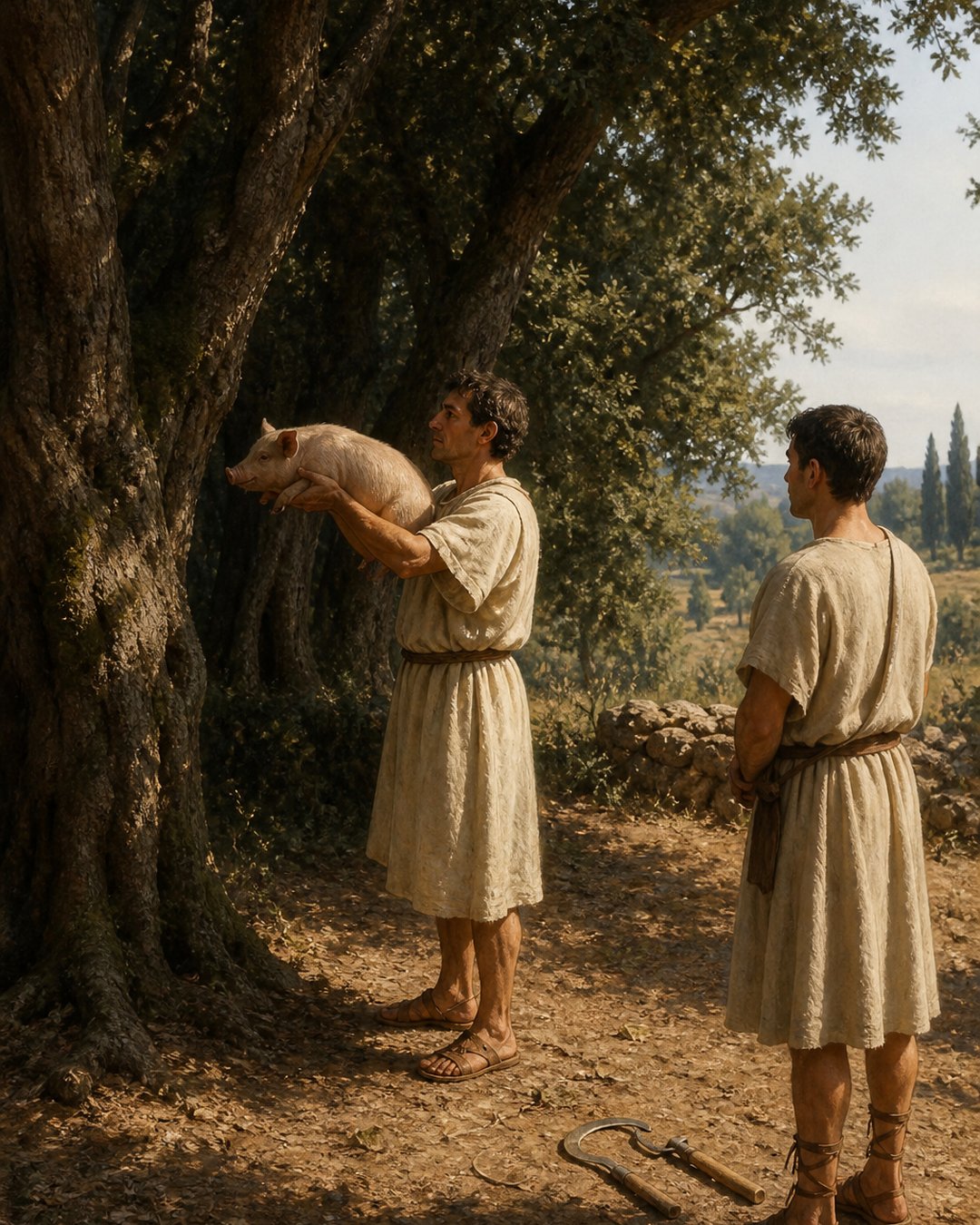
Before anyone thinned a sacred grove, Cato the Elder required a pig and a spoken formula. The speaker addressed “whether thou be god or goddess” to whom the grove belonged, acknowledged that deity’s right to the offering, and asked that the cutting be rightly done.
The words did more than apologize for damaged trees. They named the work, covered both the landholder and a person acting at his command, extended the request for mercy to house, household, and children, and closed by asking the unseen recipient to accept the pig for that exact purpose.
Then the rules tightened. If cleared ground was to be cultivated, a second sacrifice was needed with an added phrase. While work continued, a rite had to occur somewhere on the land every day. Miss one day—or let a public or domestic feast intervene—and the offering had to begin again. Cato preserved not a vague mood of reverence but a procedure with scope, continuity, and reset conditions.
The Formula Began by Admitting What the Farmer Did Not Know
Cato labels the passage a Roman formula for thinning a grove. That introduction matters. He does not improvise a private speech for one anxious owner. He gives reusable words and actions to be observed when a particular kind of land work approaches a sacred place.
The first uncertainty appears in the address: “whether thou be god or goddess.” The formula does not require the worker to settle the recipient’s identity before acting. It instead makes uncertainty explicit while still treating the dedication as real. Someone holds a claim over the grove even if the human speaker cannot name that power more precisely.
This is a practical response to incomplete religious knowledge. Silence would leave the act unaddressed; confident invention would pretend to know more than the worker knew. The paired address creates room for correct observance without a fabricated name. Its caution is built into the grammar of the prayer.
The grove itself remains the fixed reference. The god or goddess is identified through dedication to that place, not through a guessed biography. That relationship lets the speaker direct the offering toward the proper holder by pointing, verbally, to the sacred ground about to be altered.
Roman religion often attached action to a carefully defined setting. The Arval Brothers’ old song within their sacred-grove ritual shows another case in which place, performance, and inherited words reinforced one another. Cato’s formula is smaller and agricultural, but it shares the insistence that work around a grove was not religiously neutral.
A Pig Defined the Price and Purpose of the Cutting
The required offering was a pig. Cato does not leave the object open for the landholder to choose after judging convenience. The animal and the purpose arrive together: a pig is offered for thinning this sacred grove. Specificity keeps the rite attached to the work it authorizes.
The prayer also acknowledges that receiving such a sacrifice is the deity’s right. That phrasing reverses any suggestion that the farmer is buying unrestricted control. He approaches a place already encumbered by a sacred claim and performs an obligation before changing it.
“Thinning” deserves equal attention. The stated action is not an abstract wish for prosperity. It concerns physical intervention among trees. Branches or trunks will be cut; the appearance and use of the grove will change. The prayer places that intended disturbance before the divine recipient rather than hiding it beneath general goodwill.
The speaker asks that the act may be rightly done. Cato does not explain every criterion contained in “rightly,” and we should not invent them. The formula itself supplies the secure components: the correct offering, the stated task, the addressed holder of the grove, and the request that performance proceed properly.
The scene therefore joins matter and language. The pig is not interchangeable with the prayer, and the prayer is not a substitute for the pig. One is presented; the other identifies why it is presented and what act is expected to follow. Together they turn an impending cut into a declared transaction.
Delegated Labor Still Remained Inside the Request
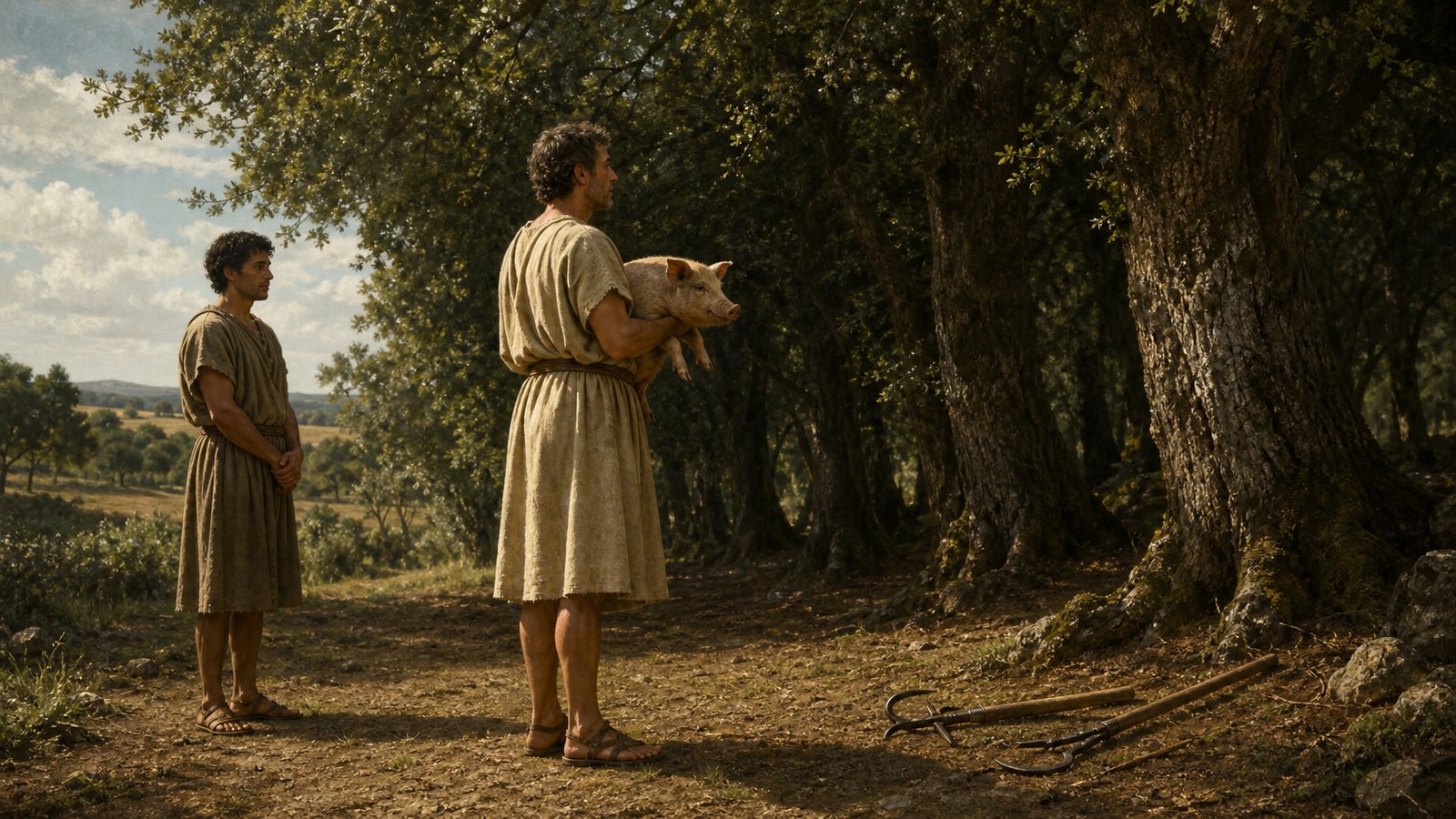
Cato anticipates that the person speaking may not perform every stroke. The formula asks that the thinning be rightly done “whether I or one at my bidding do it.” This short clause brings delegated labor inside the ritual’s scope instead of letting responsibility vanish when work passes to another pair of hands.
That detail makes the passage especially useful for understanding an agricultural estate. Commands can travel from owner or manager to worker, but the sacred problem stays attached to the action. The prayer covers the speaker’s own performance and work ordered by the speaker as two routes to the same alteration.
The request for mercy widens in the opposite direction. It begins with the speaker and extends to house, household, and children. The formula therefore maps both sides of responsibility: downward toward the person who may execute the command, and outward toward the domestic group for whom the speaker seeks protection.
Cato does not name the laborer, quantify the grove, or tell us how many trees were involved. Those absences should remain visible. What he does give is a structure in which delegation does not cancel accountability. “At my bidding” preserves the link between order and act.
That link differs from the boundary made by a founder’s plough in the ritual that separated Rome’s walls from its gates. There, lifting and lowering the implement marked different kinds of urban space. Here, a verbal clause reaches across different human agents so the same grove-thinning purpose remains intact.
Cultivation Triggered a Second and More Exacting Cycle
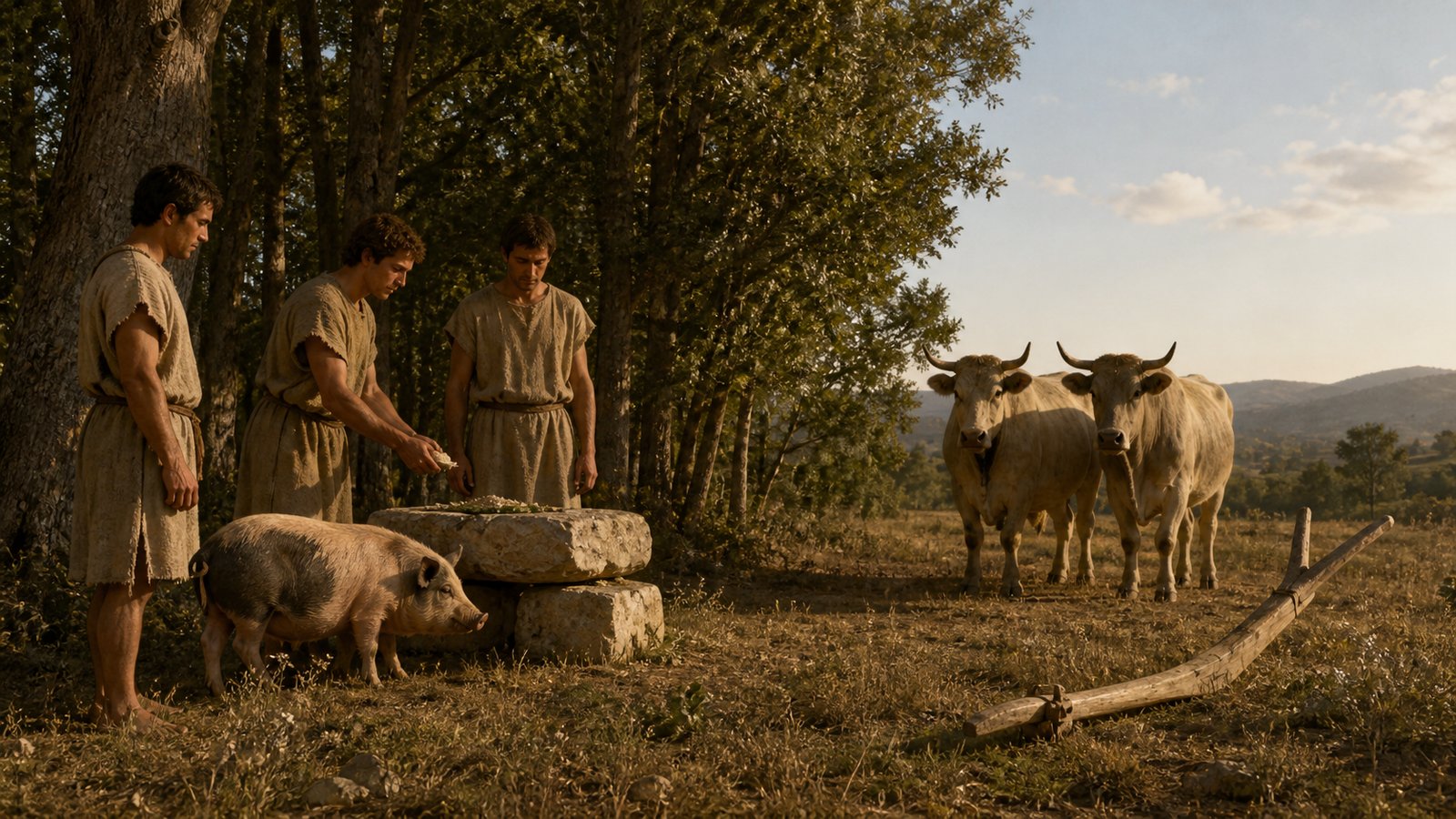
Cutting growth did not automatically authorize what came next. Cato says that anyone wishing to till the ground must offer a second sacrifice in the same way, adding the words “for the sake of doing this work.” The change of purpose requires a renewed performance.
The distinction separates opening the grove from converting its ground into worked land. Thinning removes or reduces vegetation; tillage directs the soil toward another use. Even when one task follows naturally from the other in an agricultural plan, Cato’s procedure does not collapse them into a single permission.
The added phrase is brief because the formula already carries the recipient, offering, speaker, household, and request for right performance. What changes is the declared work. The ritual is repeated, then adjusted so its scope reaches the next physical operation.
This purpose-by-purpose structure prevents a broad reading of the first pig as payment for whatever the landholder later decides to do. The initial offering belongs to thinning. Cultivation activates another requirement. The procedure expands only when the stated task expands.
Cato follows with a demanding continuity rule. So long as the work continues, the ritual must be performed every day in some part of the land. The wording connects observance not merely to the first ceremonial moment but to the duration of the agricultural operation.
“In some part of the land” keeps the daily act spatially tied to the property without requiring us to imagine an unsupported fixed altar or identical work point. Cato gives a location category, not a detailed stage set. The land under alteration remains the field within which continuity is maintained.
A Missed Day Reset the Procedure
The final rule makes time decisive. If a day is missed, a new offering must be made. An earlier performance does not remain indefinitely available as ritual credit. Continuity can lapse, and a lapse requires renewal rather than an argument that the original words should still count.
Public and domestic feast days produce the same result. They interrupt the sequence even though they are not ordinary neglect. Cato groups deliberate pauses imposed by festival calendars with a missed day because the operational consequence is identical: before the work proceeds under continuous authorization, another offering is needed.
This creates a striking calendar inside the grove. The relevant unit is one day. Work and observance advance together; interruption separates what came before from what comes after. The farmer must know not only which task is underway but whether the chain of days has remained unbroken.
The following chapter broadens the view without erasing the distinction. Cato gives a separate formula for purifying land, orders a suovetaurilia to be led around it, and addresses instructions to a man named Manius. That neighboring procedure confirms how agricultural writing could preserve named actors, routes, animals, purposes, and exact verbal cues as parts of rural management.
It would be misleading to reduce the grove passage to either bureaucracy or fear. Cato presents sacrifice and prayer as religious acts, yet he records them with the same attention to sequence that makes the book useful for work. Purpose must be named. Agency must be covered. A changed task requires another rite. Daily continuity must be maintained.
The grove formula survives because it captures a boundary under pressure. A landholder wants branches cut and soil worked; the place is already dedicated; the deity may not be securely identified; labor may be delegated; the calendar may interrupt. Cato’s answer is a repeatable chain that acknowledges every one of those complications before work continues.
Sources
Cato the Elder, On Agriculture, chapters 139–141.