
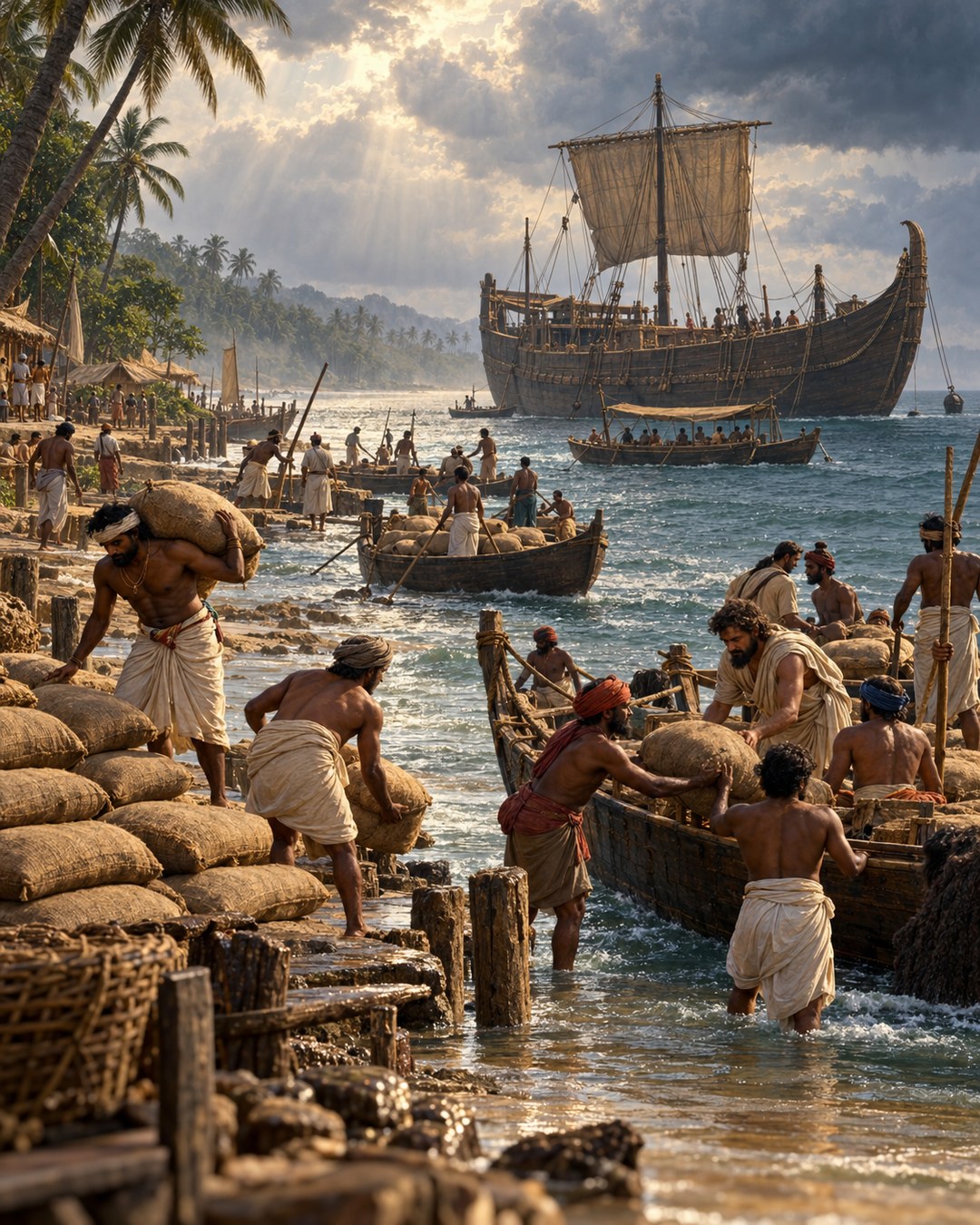
A large ocean-going ship could reach the pepper markets of south India and still be stopped by the last river. At Nelcynda, the waterway was full of shoals and its channels were unclear. Outward-bound vessels dropped toward Bacare at the mouth and loaded in the roadstead instead.
The Periplus of the Erythraean Sea places this local manoeuvre inside a much larger commercial world. Ships crossed from Arabia and Egypt; coin, metal, glass, coral, and wine moved east; pepper, pearls, ivory, textiles, aromatics, stones, and tortoise-shell moved outward.
Yet the ocean route did not erase geography near shore. Cargo had to move between an inland royal market, a shallow river, a mouth village, and ships waiting beyond unreliable channels. The final miles could reorganize the whole voyage.
Nelcynda was inland even though its trade faced the ocean
The guide names Muziris and Nelcynda as leading markets after Naura and Tyndis. They were connected by coastal and river travel, but they did not belong to the same political authority.
Muziris lay in the kingdom of Cerobothra and stood twenty stadia up a river from the shore. The text says ships from Arabia and Greek-speaking traders crowded there.
Nelcynda lay roughly five hundred stadia away by river and sea and belonged to the Pandian kingdom. It stood much farther up its river—about one hundred and twenty stadia from the sea.
Those distances matter because a “port” can be a network rather than one quay. The market where goods were assembled, the river channel that carried them, the mouth where ships waited, and the offshore roadstead could be separate working places.
The kings of both market-towns lived inland. Political centres therefore did not need to sit at the anchorage. Authority, collection, and exchange reached the coast through routes whose vulnerable points were rivers and mouths.
This arrangement differs from Barygaza’s use of royal fishermen as pilots through dangerous tides. There, specialist local guidance brought ships through a difficult approach. At Nelcynda, the guide describes ships dropping to another loading place because the shoaled river channels were not clear.
The comparison shows why “Indian Ocean trade” is too broad to explain port work. Every coast imposed a different final problem. Open-sea sailing delivered a vessel to a region; local knowledge and infrastructure determined whether it could reach cargo.
Bacare turned a river obstacle into a loading sequence
Bacare stood at the mouth of Nelcynda’s river. Outward-bound ships dropped down there and anchored in the roadstead to take on their cargoes.
The reason follows immediately: shoals crowded the river and the channels were unclear. A heavily laden large ship had more draft and less room for error than a small local craft. Loading beyond the worst reach reduced the burden carried through shallow water.
The text does not describe the lighters, rafts, warehouses, labour gangs, or sequence of weights used to transfer goods. It would be tempting to fill the gap with a modern port diagram, but the evidence here is narrower. Market, mouth village, roadstead, and loading are explicit; the exact equipment is not.
Still, cargo had to bridge the distance somehow. Pepper and other goods assembled near Nelcynda could not teleport to the roadstead. River boats, porters, pack animals, or combinations of them must have connected stages, though this passage does not choose among those possibilities.
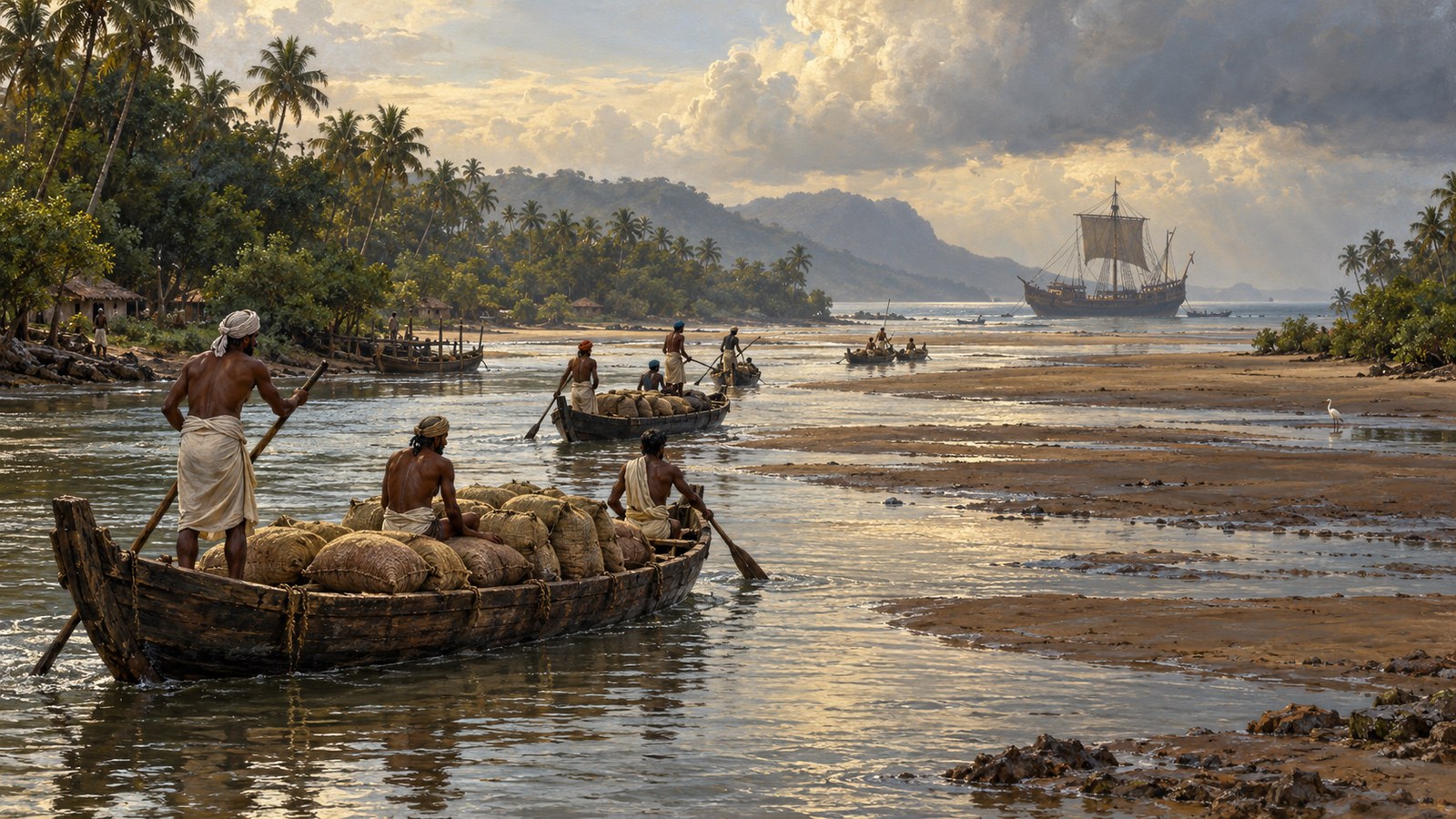
The outward direction is significant. The guide specifically says ships dropped down to Bacare on the voyage out and loaded there. A vessel might reach the commercial district in a lighter condition, but the full export cargo changed what water it could safely cross.
A roadstead is exposed compared with a sheltered inner harbour. Wind, swell, anchors, boat handling, and timing all become part of loading. The Periplus does not dramatize those risks; it records the workaround as practical knowledge for mariners.
Bacare therefore was not a rival market accidentally mentioned beside Nelcynda. It served as the seaward hinge of the route. The river’s defect gave the mouth village its commercial role.
Pepper’s bulk justified large ships and complicated the last mile
The guide says large ships came because pepper and malabathrum existed in great quantity and bulk. That sentence joins demand to hull size. Valuable cargo did not always mean compact cargo.
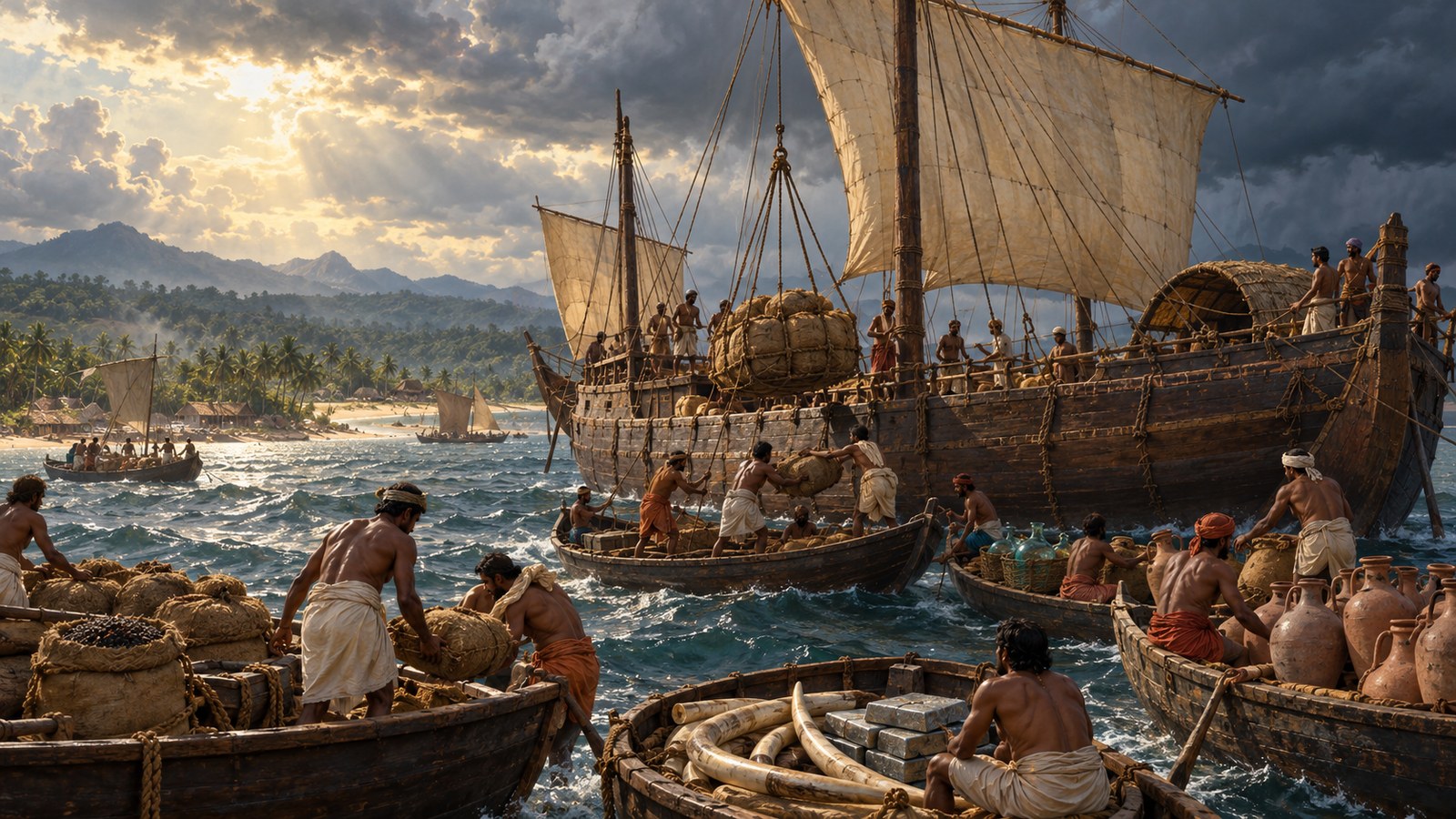
Pepper was produced in quantity in the district called Cottonara near these markets. It travelled alongside fine pearls, ivory, silk cloth, spikenard from the Ganges, malabathrum from inland, transparent stones, diamonds, sapphires, and tortoise-shell.
This list mixes bulk with high-value goods. A ship might carry sacks that occupied substantial space together with small objects whose value was concentrated. Loading plans had to accommodate both without the text giving us a surviving manifest for one voyage.
Imports were equally varied: coin, coral, crude glass, copper, tin, lead, figured linens, antimony, pigments, and a limited amount of wine. Wheat appears with a useful qualification. It was brought for sailors and was not traded locally.
That detail makes the crew visible. Long-distance commerce carried its own consumers. Food occupying ship space could be essential to the voyage without entering the market as merchandise.
The variety also explains why a contract or cargo label alone cannot capture the port. The Muziris loan document traces finance across two oceans; the Periplus passage here traces the physical arrangement that let goods reach a ship.
Finance and handling meet at the roadstead. A cargo can be pledged, valued, and taxed only if it survives the movement from inland producer to river market, through shallow water, into transfer craft, and aboard the ocean hull.
The monsoon crossing still depended on a July departure
Ships bound for these markets left Egypt in the favourable season around July, which the guide identifies with the month Epiphi. Seasonal wind turned a vast crossing into a planned route rather than an endless coastal crawl.
The next section credits Hippalus with recognizing how to set a course across the ocean by understanding ports and sea conditions. The southwest wind also bore his name in the account.
Earlier voyages, the guide says, had used smaller vessels and followed the shores of the gulfs. Later ships could start from Arabian points and hold a direct course far from land.
That transformation is easy to make the entire story. A bold ocean crossing feels more consequential than a shoal near a river mouth. The Nelcynda passage corrects the scale of attention.
Monsoon knowledge solved the open-water leg, not every approach. A ship could cross hundreds of miles on a favourable wind and still depend on a modest village because its cargo market stood upriver behind uncertain channels.
Season also tightened loading. Missing the useful wind could cost far more than a day. Goods, crew provisions, local boats, and the roadstead operation had to converge while departure remained practical.
The guide does not give a timetable for pepper coming from Cottonara or malabathrum from the interior. It does show layers of movement: inland production, royal market, river descent, roadstead loading, ocean departure.
Each layer could become a bottleneck. Crop availability affects quantity. Political boundaries affect access. Shoals affect draft. Weather affects anchorage. Monsoon timing affects the crossing.
Nelcynda and Bacare make ancient trade look less like a line drawn between Rome and India and more like a chain of negotiated surfaces. The strongest link on the open sea did not remove the weakest channel near shore.
The pepper sacks waiting at Bacare had already crossed one logistical threshold. Once aboard, they would cross another. The shoals explain why those thresholds could not be collapsed into a single port call.
Source: Periplus of the Erythraean Sea, 54–57.
Sources
Periplus of the Erythraean Sea 54–57.