
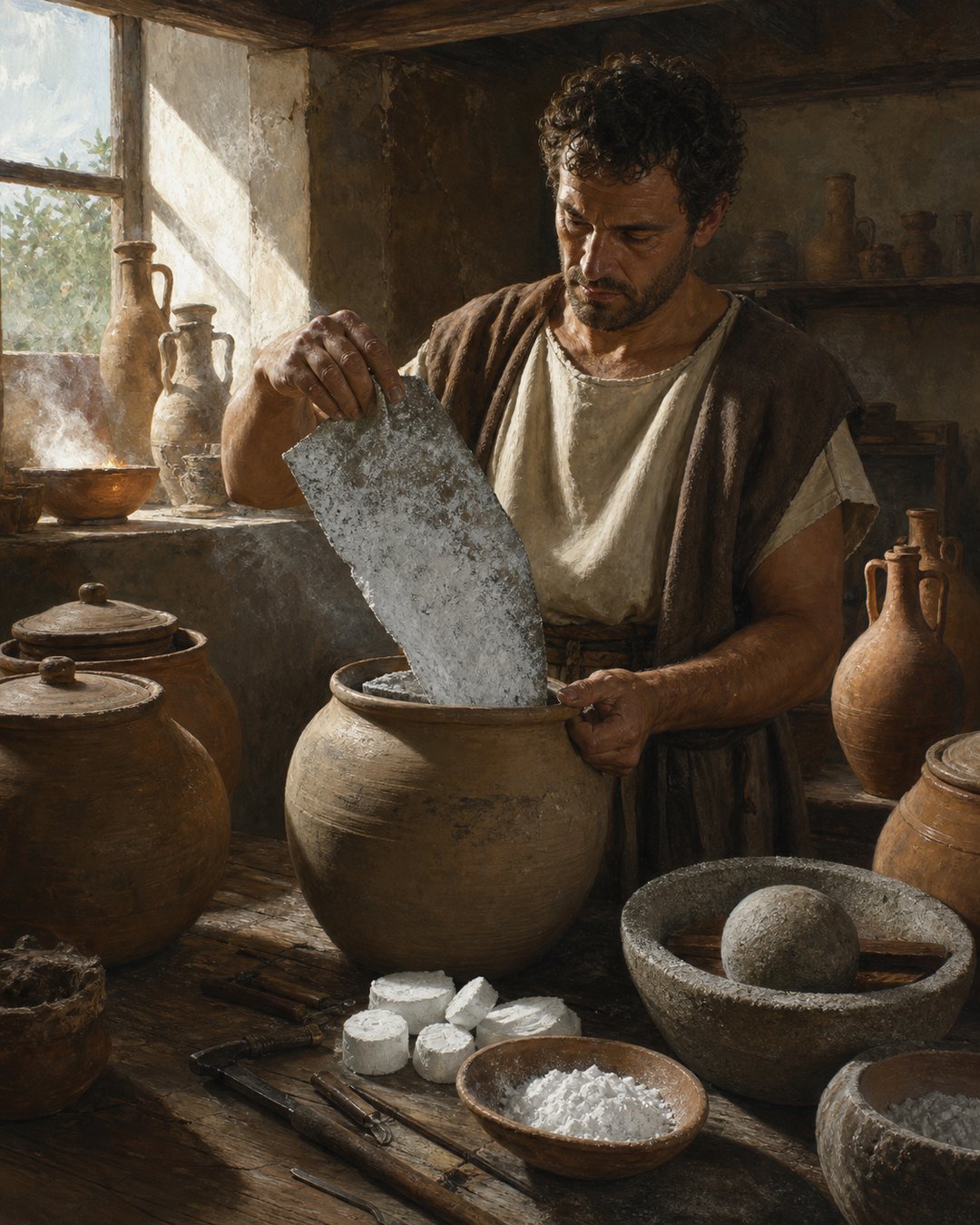
The lead did not need to touch the vinegar. Ancient instructions put the metal above it, closed the jar, and waited. When the vessel reopened, the dull surface carried a pale material that could be scraped away, washed, ground, formed into small cakes, and dried.
Vitruvius and Pliny describe versions of this craft while discussing colors and metals. Their accounts turn white pigment into a workshop sequence: arrange liquid and lead, trap the vapor, harvest corrosion, clean it, reduce it, and repeat. The important tool was not only a jar or scraper. It was the managed air between acid and metal.
The result was ceruse, or white lead, a valued pigment and a dangerous substance. Pliny calls it deadly poison. Reconstructing the process therefore reveals both control and exposure: craftspeople understood how to make a consistent material by accelerating change on lead, while working close to substances whose harms were real.
The Workshop Built a Small Atmosphere in Each Jar
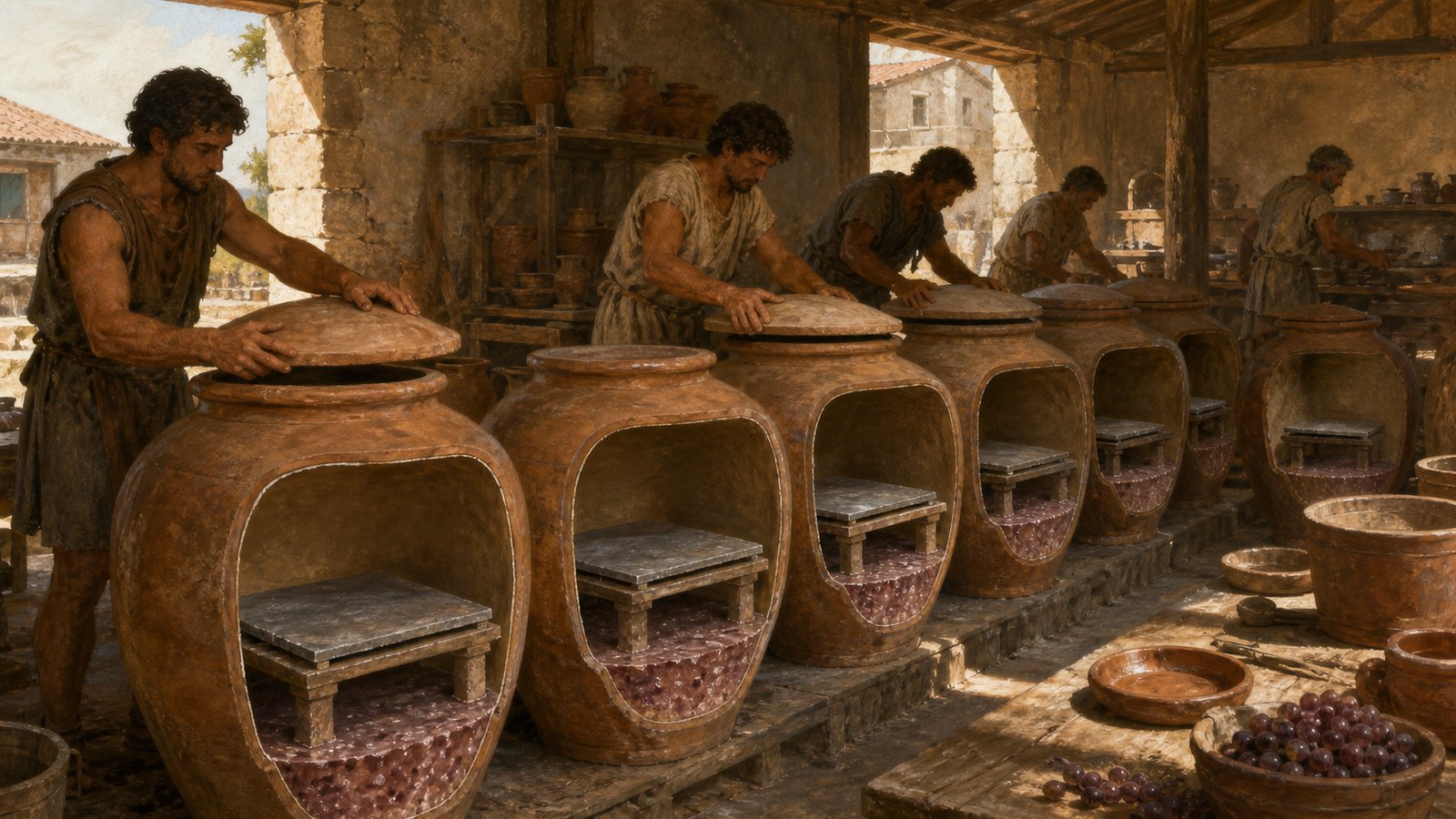
Vitruvius places a noted method at Rhodes. Vine branches went into jars and vinegar was poured over them. Lead rested above this mixture. The vessel was then closed, so the metal occupied the same confined atmosphere as the acidic material without lying in the liquid.
That arrangement separated two jobs. The lower part of the jar generated vapor. The support kept the lead in the active space and left its surface available for later removal. A lid turned an ordinary container into a reaction chamber.
The method depended on time rather than flame. Vitruvius says the jars were opened after an interval and the lead was found changed into white lead. His wording compresses the workshop labor, but the physical arrangement is precise enough to show intention. Liquid below, metal above, and enclosure were not incidental storage choices.
Roman crafts often made containers control processes that the eye could not follow continuously. The sealed jar here differs from the cellar vessels in which old wine thickened and changed. A wine jar preserved and matured its contents. The pigment vessel brought separate materials into contact through the atmosphere between them.
Before opening, the craftsperson could not watch every patch form. Repetition supplied knowledge: proportions, spacing, closure, season, and waiting time could be adjusted by results from previous batches. The jar made invisible vapor operational.
Vinegar Changed the Surface Without Drowning the Metal
Pliny’s account makes the agent explicit. Fine lead material was placed above strong vinegar, and he credits the vinegar’s vapor with the resulting deposit. Another method put lead plates over vessels containing grape skins and covered them.
In both versions, the craft was based on proximity rather than immersion. Submerging a sheet would make the liquid-metal boundary harder to inspect and the product harder to remove cleanly. Suspending it exposed a broad surface to vapor and let the changed layer remain accessible.
The lead was both raw material and reusable working surface. Its exterior changed first. The pale product could be separated while metal remained beneath, ready to return to the vessel. That encouraged cycles rather than a single dramatic conversion of a whole sheet.
Vinegar and grape residue also linked pigment production to familiar agricultural materials. Nothing about a jar, press residue, or sheet of lead announced a brilliant white color by itself. The color emerged from arranging them so that ordinary sour vapor worked steadily against metal.
This was controlled corrosion. Ancient writers did not describe it in modern chemical language, and the process should not be rewritten as if they did. Yet their practical distinction is clear: the desired substance formed where vapor acted on lead, and the workshop was designed to collect that surface change.
Scraping Turned Corrosion into a Batch
Once the vessel was opened, the pale layer had to leave the lead. Pliny says it was scraped off. The scraper marked the transition from reaction to manufacture: a change attached to metal became loose pigment material that could be measured, cleaned, and combined.
Scraping also created a quality problem. Too shallow a pass left useful material behind. Too deep a pass could mix metallic fragments with the product. A stable sheet and a controlled hand mattered even though neither receives a long literary description.
The work was repetitive. Plates could carry uneven patches because vapor, condensation, distance, and surface condition varied inside a vessel. The craftsperson needed to inspect edges and centers, remove what had formed, and decide whether the lead should return for another cycle.
That rhythm resembles other Roman surface crafts without sharing their exact purpose. In the sulfur treatment used on costly cloth, fumes acted where liquid washing alone could not. White-lead manufacture went further: vapor did not merely clean a surface. It created the material the workshop intended to sell or use.
A row of jars could stagger production. Some remained sealed while others were opened and scraped. That possibility follows from the described apparatus rather than from a recorded factory plan, so it should remain an inference. What the sources establish is the repeatable unit: vessel, acidic material, elevated lead, cover, delay, and harvest.
Washing and Grinding Made the White Usable
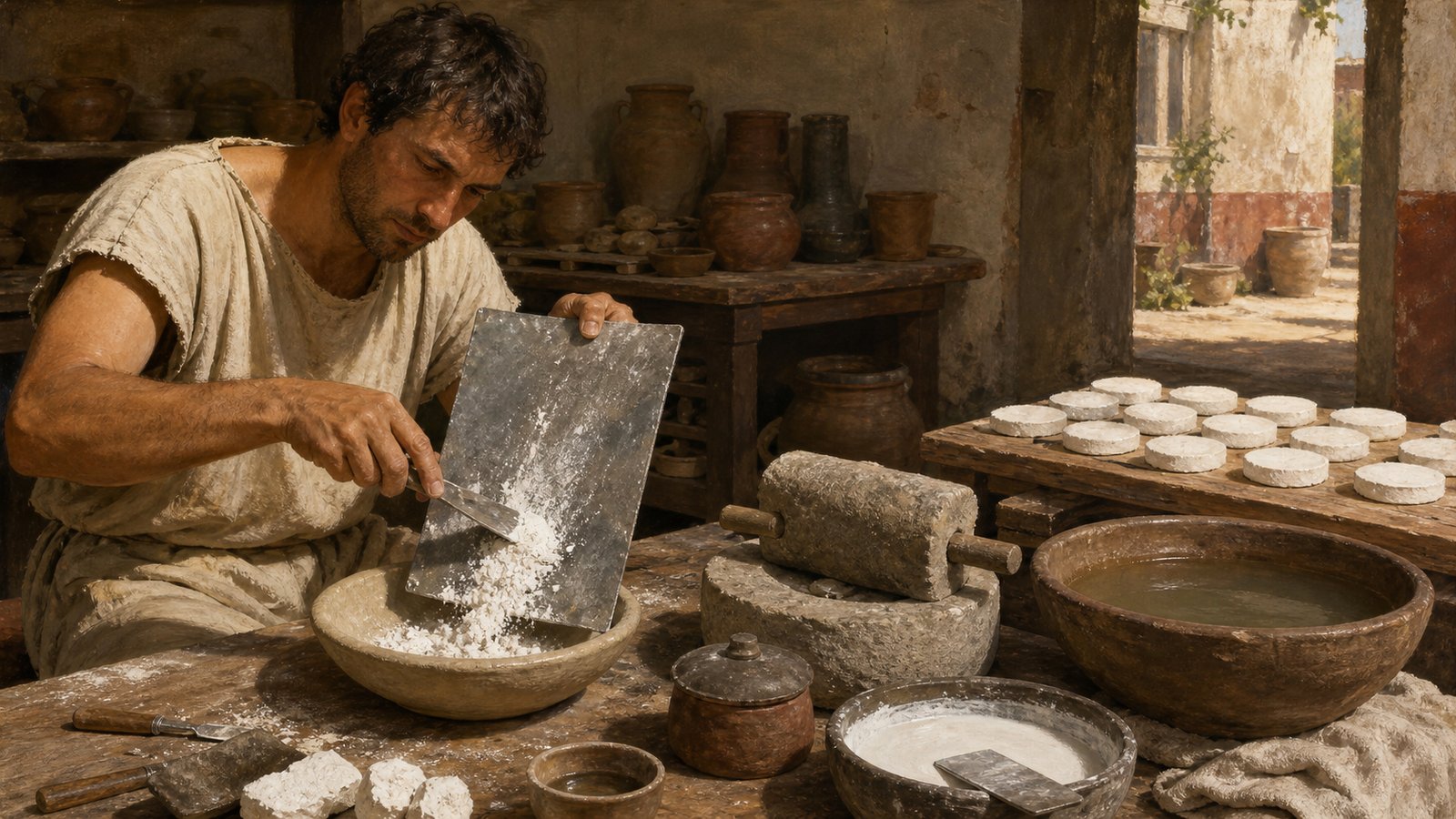
Freshly scraped material was not yet a finished painter’s color. Pliny says workers washed it, ground it, and divided it into small cakes. Each step reduced a different uncertainty left by the vessel.
Washing could separate soluble residue and loose contamination from the pale solid. Grinding broke irregular scrapings into a more uniform powder. Forming cakes gave the material a manageable shape for drying, storage, transport, and later preparation.
Pliny specifies summer sun for drying the cakes. Sunlight and warm air removed moisture without putting the white product directly into a furnace. A wet paste became a stable workshop output that could be counted and moved.
The chain shows why the pigment cannot be identified only with the moment lead turned pale. Corrosion created the substance, but finishing created the commodity. A painter needed material that dispersed predictably, not curls from a metal sheet or damp scrapings carrying vinegar.
Roman color therefore depended on labor before it reached a wall, panel, or decorative surface. The final white concealed its own origin. Nothing in a smooth layer of paint necessarily revealed grape residue, sealed jars, dull lead, repeated scraping, stone grinding, and cakes laid in summer sun.
Heat Could Push the Same Material Toward Red
Pliny connects white lead with another transformation. Ceruse placed in earthen vessels and heated while being stirred changed color and produced a red pigment. The white product was not an endpoint fixed by nature. It could become feedstock for another controlled process.
The apparatus now changed. The first stage avoided direct heating and used enclosed vapor. The later stage used heat, ceramic vessels, and agitation. A workshop could therefore direct related materials by choosing atmosphere first and fire afterward.
Stirring mattered because heat had to reach the batch without leaving one part unchanged and another overworked. The action kept the powder moving while the color developed. As with scraping, a simple hand movement carried technical judgment that a short recipe can easily hide.
This sequence also makes specialization plausible. Making white lead required handling metal and corrosive vapor; converting it required controlled firing; preparing paint demanded mixing and application. One person could know several stages, but the material passed through tasks with distinct risks and skills.
The red conversion should not distract from the central invention. Before the furnace could alter white lead, craftspeople had to manufacture that white reliably. Their solution was to make corrosion productive and repeatable inside common ceramic forms.
A brilliant color carried a poisonous cost. Pliny calls ceruse a deadly poison. That warning belongs beside the technical description, not after it as a modern moral attached from outside. A Roman author who recorded the manufacturing process also recognized grave danger in the material.
The source does not provide a modern workplace study or quantify exposure. It does show why opportunities for contact multiplied. Workers handled lead, opened vapor-filled vessels, scraped dry or damp deposits, washed them, ground them, shaped cakes, dried them, and sometimes heated the finished product.
Every stage that improved the pigment also moved it closer to hands and air. Grinding increased fineness. Drying made storage easier. Heating created another color. Technical success and bodily risk occupied the same bench.
The craft’s achievement remains substantial. Roman pigment makers used vessel geometry and process order to turn an unremarkable sheet into a bright prepared material. They recognized that vapor could do work, that the surface could be harvested repeatedly, and that washing and grinding determined usefulness.
White lead looked clean because a workshop managed dirt, acid, metal, moisture, and time with care. Its brightness was not simplicity. It was the visible end of a hidden atmosphere—and of a dangerous chain of skilled decisions.
Sources
Vitruvius, On Architecture, 7.12. Pliny the Elder, Natural History, 34.175–176.