
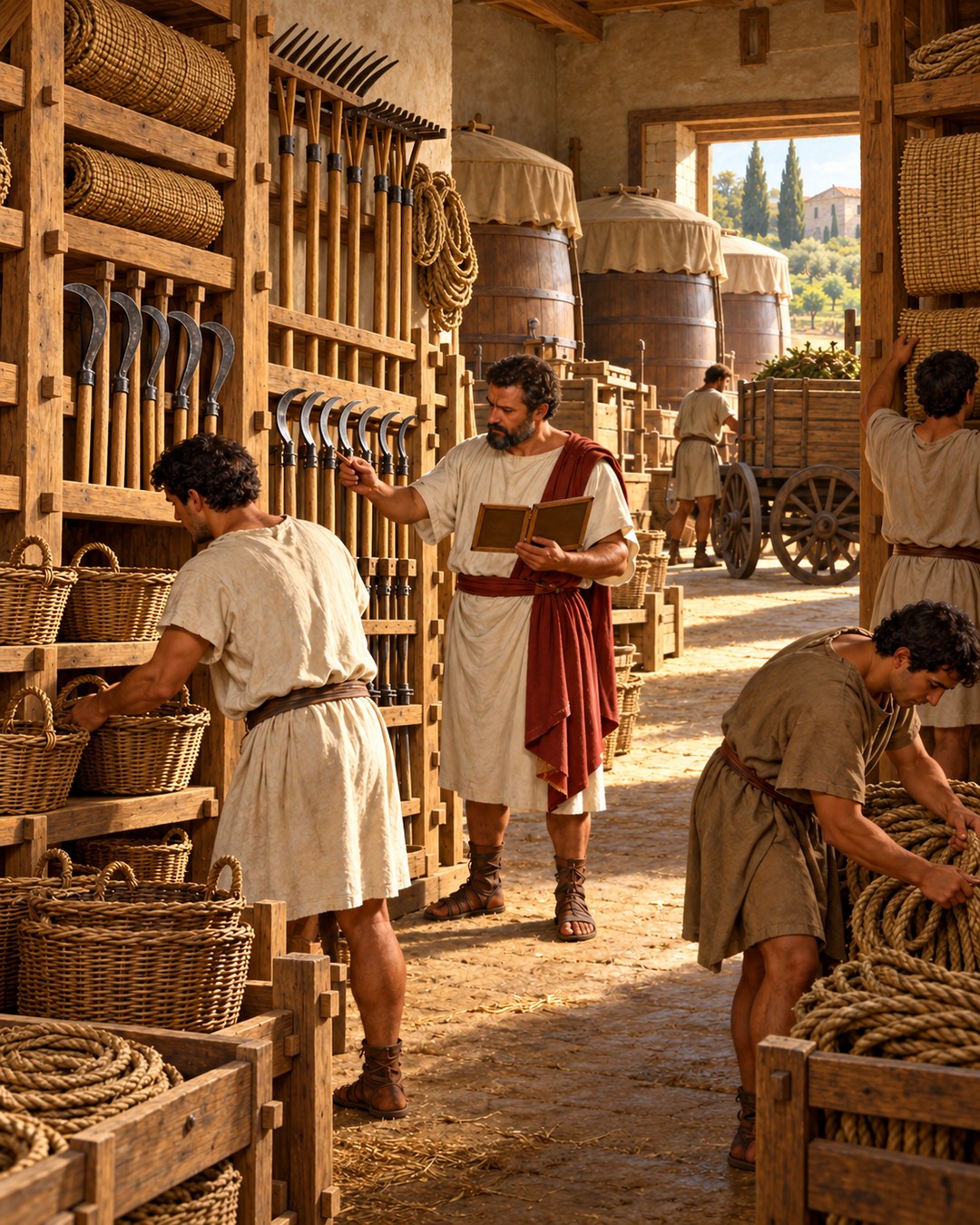
A basket did not speak, but Varro still gave it a place in the farm’s organization. He called baskets, jars, tools, and related objects the “mute” equipment of agriculture, distinguishing them from people and animals without treating them as an undifferentiated heap.
Some of this equipment should never reach a market. Wood, withes, hemp, flax, rush, palm fiber, and bulrush could become baskets, rakes, ropes, cordage, and mats on the estate. Other goods had to be bought, but utility, quality, distance, and price—not display—were supposed to govern the purchase.
Acquisition was only the beginning. Cato’s schedules matched equipment to acreage and storage to marketing choices. Varro then added inventories, assigned places, locks, and visibility. Profit leaked whenever an object was bought badly, sized badly, stored badly, or allowed to disappear between seasons.
The first purchase test was whether the farm could make it
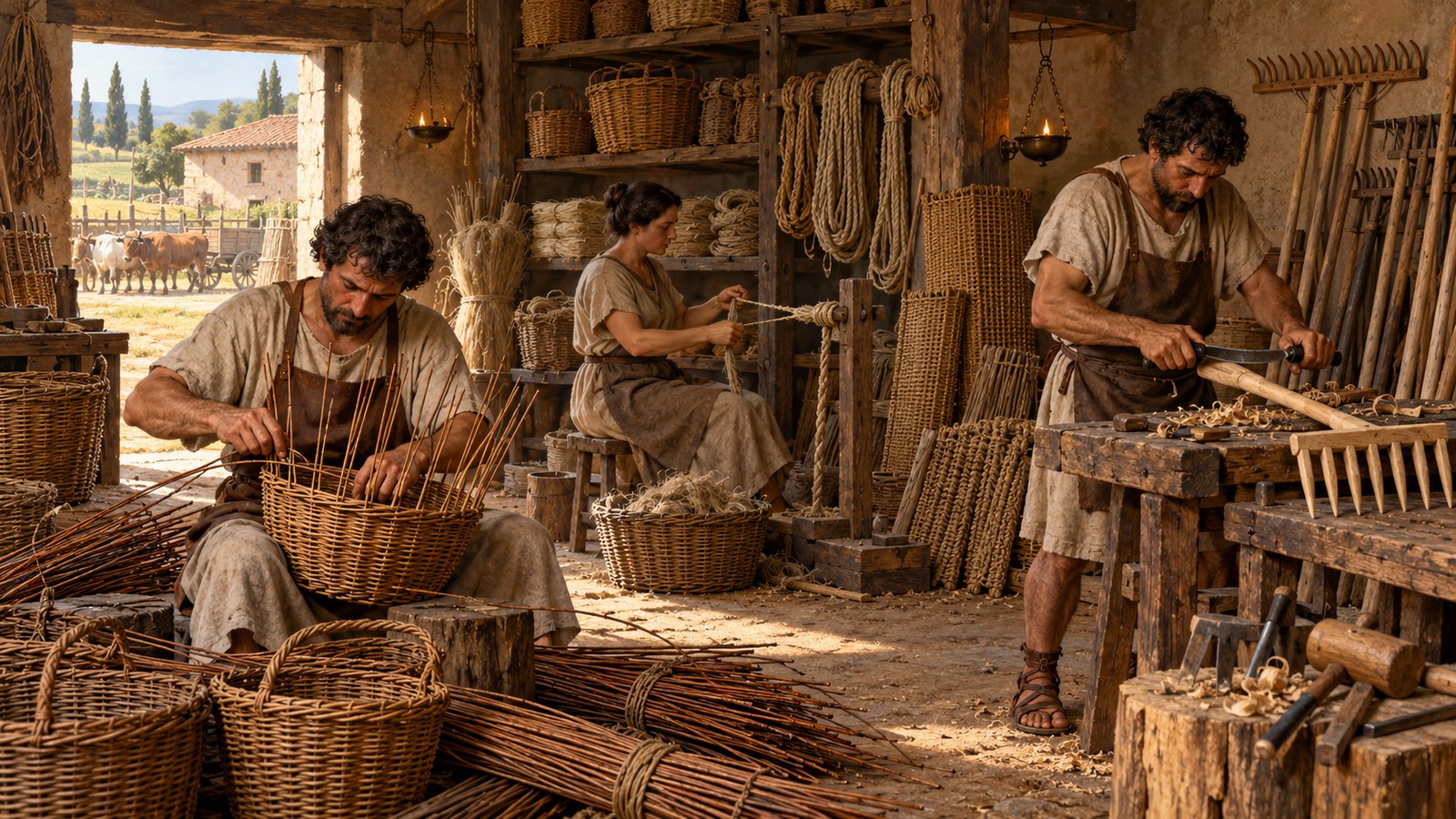
Varro advises against buying what can be raised on the land or made by its workers. He names hampers, baskets, threshing sledges, fans, and rakes among the wooden or wicker goods that an estate might produce.
Fiber crops expanded the list. Hemp, flax, rush, palm fiber, and bulrush supplied ropes, cordage, and mats. The fields therefore produced not only food and sale crops but parts of the farm’s operating kit.
Local manufacture reduced cash outlay and transport, yet it was not free. Cutting withes, retting or preparing fiber, twisting cord, weaving baskets, and shaping wood consumed skilled time. A poorly made hamper could break under fruit and destroy more value than it saved.
The rule worked best for recurring, repairable objects whose materials and knowledge already existed on the estate. A broken basket could yield its pattern to the next maker; a specialized metal fitting might still justify an outside workshop.
Varro makes that distinction explicit for unavailable goods. Buy them for usefulness rather than show, seek good quality, purchase nearby, and pay the lowest price consistent with the requirement. Cheapness alone was not the policy.
Nearby supply mattered because transport added cost and delay. A replacement needed during harvest might be worth more than an identical object arriving after the crop had spoiled. Distance altered the effective price.
This system differs from the specialized ropework that carried a ship’s rig. Varro’s farm cordage served more ordinary cycles of tying, carrying, covering, and repair, where local materials could often answer the need.
Acreage turned a tool list into a capacity plan
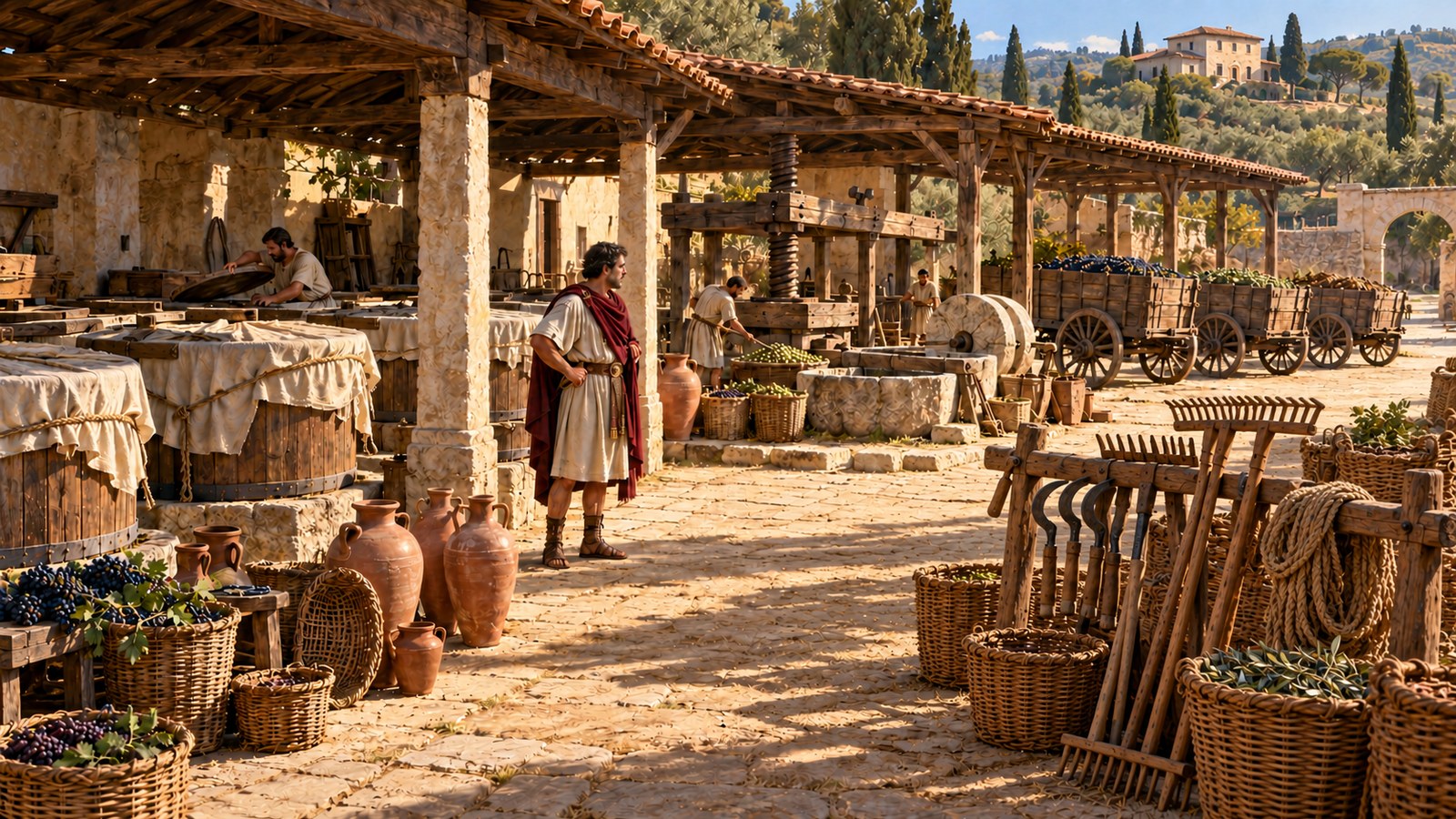
The kind and number of objects depended on the farm’s size. Varro quotes Cato’s schedule for 240 iugera of olive land: five complete sets of pressing equipment along with vessels, three large carts, six ploughs and ploughshares, four manure hampers, and specified iron tools.
The exact list should not be copied onto every estate as if acreage were the only variable. Soil, slope, distance, crop variety, labor, and the length of harvest changed how rapidly equipment had to move. Varro elsewhere criticizes fixed ratios when local conditions differ.
But a numerical schedule forced the owner to confront bottlenecks before the crop arrived. One press serving too much fruit would leave olives waiting. Too few carts would strand loads away from the processing area. A spare plough could preserve work when a beam or share failed.
Redundancy therefore was not necessarily luxury. Several complete pressing sets allowed parallel work and reduced dependence on one point of failure. The cost of idle equipment had to be weighed against the cost of an entire harvest queueing behind a breakdown.
Cato’s forty vine-pruning hooks, five rush hooks, three tree hooks, and ten bramble hooks make specialization visible. All cut plants, but edge, shape, reach, and workload differed enough to justify separate counts.
The list connects with the forty cutting tools assigned to Cato’s vineyard workforce. Here, however, the important point is not one implement’s form. It is how a management text translated crop area into a complete operating inventory.
Eight hundred cullei bought freedom from one market day
For a vineyard of one hundred iugera, Cato specified three pressing sets and vats with covers capable of holding eight hundred cullei. Varro notes that other authorities proposed smaller numbers.
He explains the high capacity as a marketing defense. If the farm could store the wine, the owner was not forced to sell the entire vintage every year. Older wine might command more than new, and the same wine could receive different prices at different times.
Storage equipment therefore changed bargaining position. A producer without enough sound containers faced a deadline set by fermentation and space. A buyer who knew that deadline could offer less.
Capacity brought costs of its own. Vats and covers occupied space, demanded cleaning, and tied up materials and capital. Leakage or contamination could turn stored value into loss. The option to wait was valuable only when the containers remained serviceable.
The number eight hundred should not be converted casually into a guaranteed annual yield. It belonged to a prescriptive schedule and may include margin. Its significance lies in the connection Varro draws between physical capacity and timing the sale.
That connection complicates the idea that farm equipment merely assisted production. Containers influenced when the product entered the market. A covered vat could exercise economic leverage without moving.
Lock, place, and sight kept seasonal equipment from vanishing
Varro wants the owner to keep a complete inventory both in town and on the estate, while the overseer keeps the working record on site. The duplicate viewpoints created a basis for comparison.
An inventory without assigned storage was weak. Tools should remain near the farmstead, each in its own place. A missing object was easier to notice when an empty position replaced it.
Lock and key protected what could be enclosed. Items too large or awkward for locked storage should remain in sight as far as possible. Varro emphasizes objects used only at intervals, including vintage baskets.
Seasonal tools presented a particular danger. During harvest they filled the yard; afterward they could disappear into sheds, corners, loans, or private use for months before the next demand exposed the loss.
Varro’s sharpest observation is that objects seen every day run less risk from a thief. Visibility created informal counting. A cart beside a familiar wall or baskets stacked under a known bay became part of the repeated visual field; absence interrupted the pattern.
This did not eliminate theft, and the text reflects an unequal estate where managers monitored both goods and workers. Locks and inventories served ownership under that hierarchy. They also reveal that losses inside the farmstead were expected enough to shape layout and routine.
The “mute” equipment was consequently surrounded by human speech: lists, orders, purchase judgments, handovers, and explanations for absence. Objects could not report misuse, so the system made place and visibility speak for them.
Varro’s policy is coherent because its stages reinforce one another. Local manufacture makes common items repairable. Rational purchase protects quality where the farm cannot supply itself. Capacity planning prevents crop bottlenecks and forced sales. Inventory and assigned storage preserve the equipment until its next use.
A Roman estate did not become efficient by filling a shed with tools. It became more reliable when each object had a reason for being acquired, a workload it could actually serve, and a place where its disappearance would be noticed before the harvest asked for it again.
Sources
Marcus Terentius Varro, On Agriculture, 1.22.