
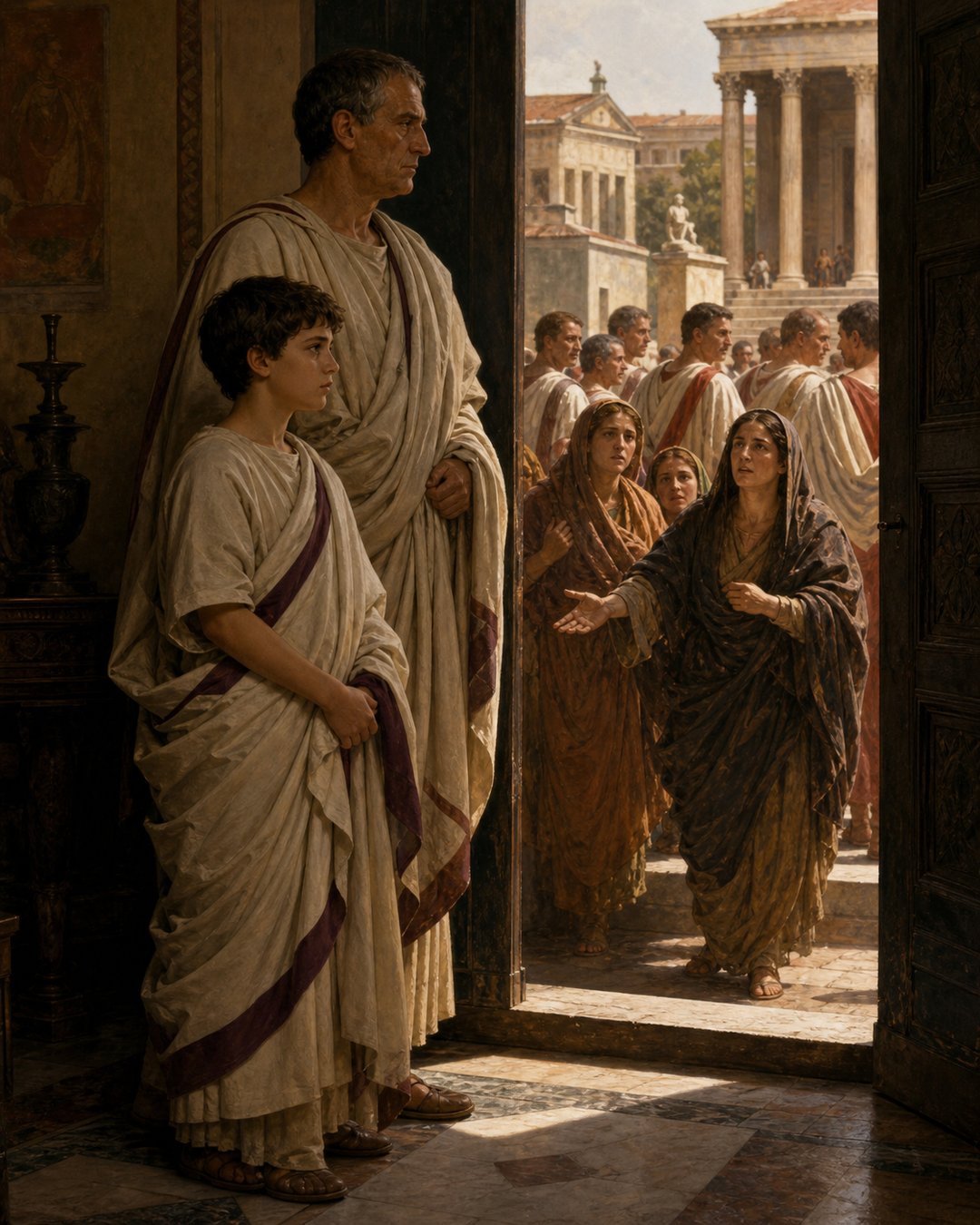
The Senate had ordered silence. A matter of considerable importance had been discussed, postponed until the next day, and sealed against conversation until a decision was reached.
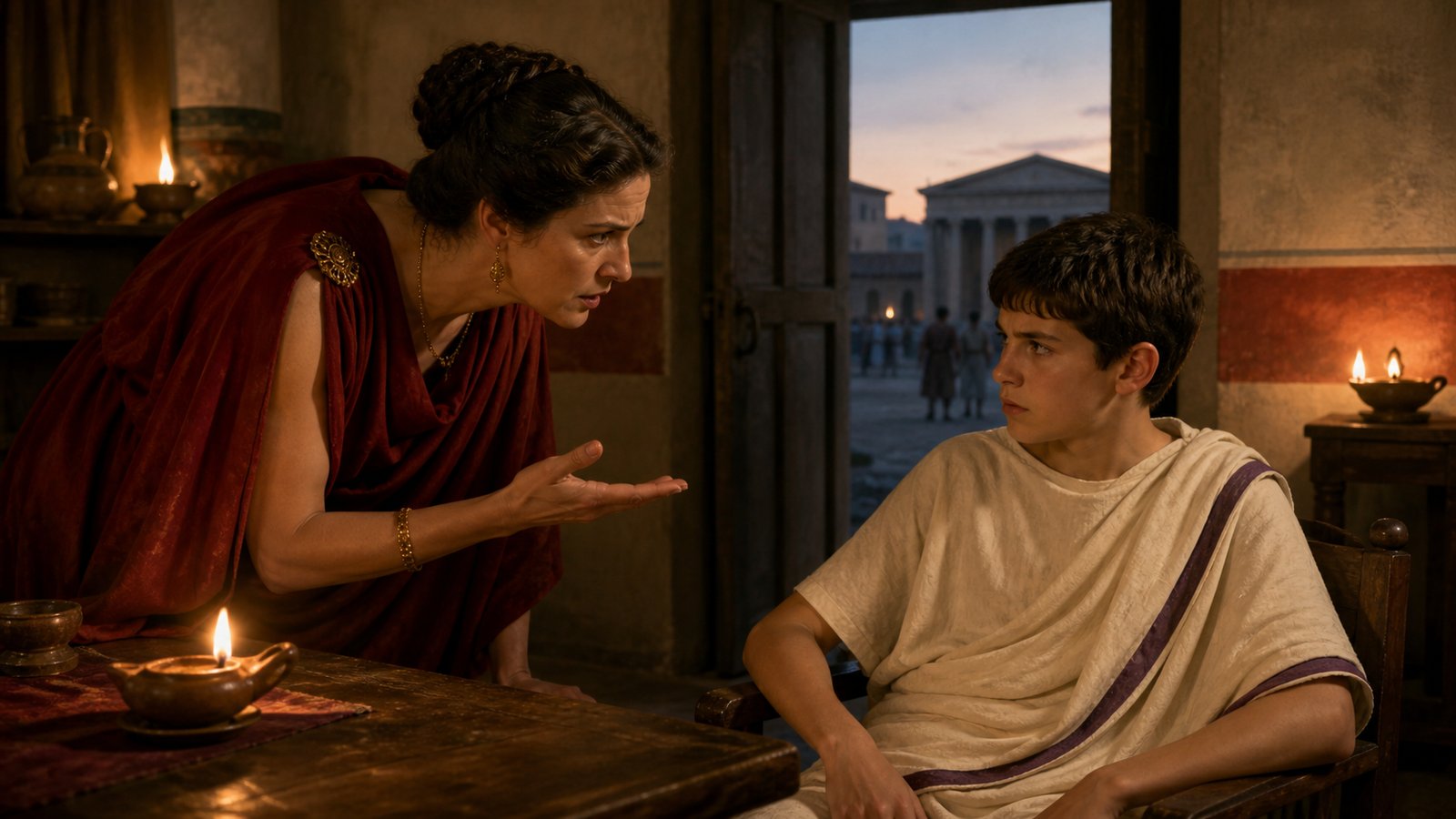
Yet one person carried that secret out of the chamber: a boy. Young Papirius had entered with his father under a custom that, according to Aulus Gellius, allowed senators to bring under-age sons into the house. At home, his mother wanted to know what the Fathers had debated. Papirius refused. She pressed harder.
So he gave her a secret that did not exist. The Senate, he said, was deciding whether one man should have two wives or one woman should have two husbands. By the following morning, a crowd of matrons had reached the Senate, pleading with tears for the second arrangement.
The joke produced more than embarrassment in Gellius’s tale. Papirius explained the chain of events in the middle of the house, won praise for cleverness and loyalty, and became the exception to a new boundary: no other boys were to enter with their fathers. A private test of discretion had changed who could cross a public door.
A later writer preserves an older story at second hand
The source asks for caution before it invites amusement. Gellius says Marcus Cato had told the Papirius story in a speech against Galba. He praises the charm and brilliance of Cato’s version, but adds that he did not have the book when dictating his extract. What survives in Attic Nights is therefore what Gellius calls the bare tale, not a quotation of Cato’s language.
That framing matters. The episode is a literary anecdote transmitted through a later author, and its polished sequence has the economy of a story designed to demonstrate character. A secret is imposed, domestic pressure tests it, a witty lie creates a civic disturbance, and the boy’s explanation earns both honor and an institutional response. The source does not provide a date, identify the real subject under debate, or preserve the wording of a Senate decree.
Gellius nevertheless anchors his account in recognizable Roman distinctions. Papirius is under age. His father belongs to the Senate. The boy still wears the purple-bordered toga associated with freeborn youth, while his presence inside the chamber depends on his father’s office. Age, dress, family and political access meet in one small figure.
The result is not a general portrait of Roman childhood. It is a story about unusual proximity to government. Most children could not hear an unresolved senatorial debate. Papirius could because elite education, in this telling, included watching institutions from within rather than learning about them only afterward.
That proximity resembles, but does not repeat, the etiquette that made Fabius honor the office held by his own son. There, family rank yielded to a magistracy once father and son met in public. Here, family connection opened the chamber first, then the chamber’s need for secrecy narrowed the privilege.
The real subject vanished behind a household question
Gellius deliberately withholds the Senate’s actual business. He calls it important, says discussion was postponed, and records the vote against disclosure. The missing subject makes the command itself the center of the scene. Papirius knows something his mother cannot know yet, and the story measures him by what he does with that imbalance.
His first response is simple: it is a secret and he cannot tell. The refusal does not end the exchange. Gellius says the secrecy increased his mother’s curiosity, while the boy’s continued silence made her question him more pressingly and urgently. The pressure comes through repeated conversation, not force or an official interrogation.
Papirius then protects the true debate by inventing another with enormous domestic consequences. He says the Fathers are considering whether the state would be better served by permitting one man two wives or one woman two husbands. The alternatives are neatly balanced and impossible to hear as remote administrative detail. They carry the Senate straight into marriage and household status.
The fiction works because it is specific. A vague evasion might invite another question. Papirius supplies a complete pair of choices, attaches them to the advantage of the state, and makes a decision appear imminent. His mother does not merely believe that senators discussed marriage. She believes one of two rival arrangements may become public policy.
Nothing in Gellius says Papirius predicted the exact reaction. Calling the lie clever does not establish that he planned a crowd at the Senate door. The supported point is narrower: under insistence, he substituted a memorable false subject while retaining the real one. The tale’s next movement belongs to those who heard his invention.
A rumor crossed the city faster than the senators did
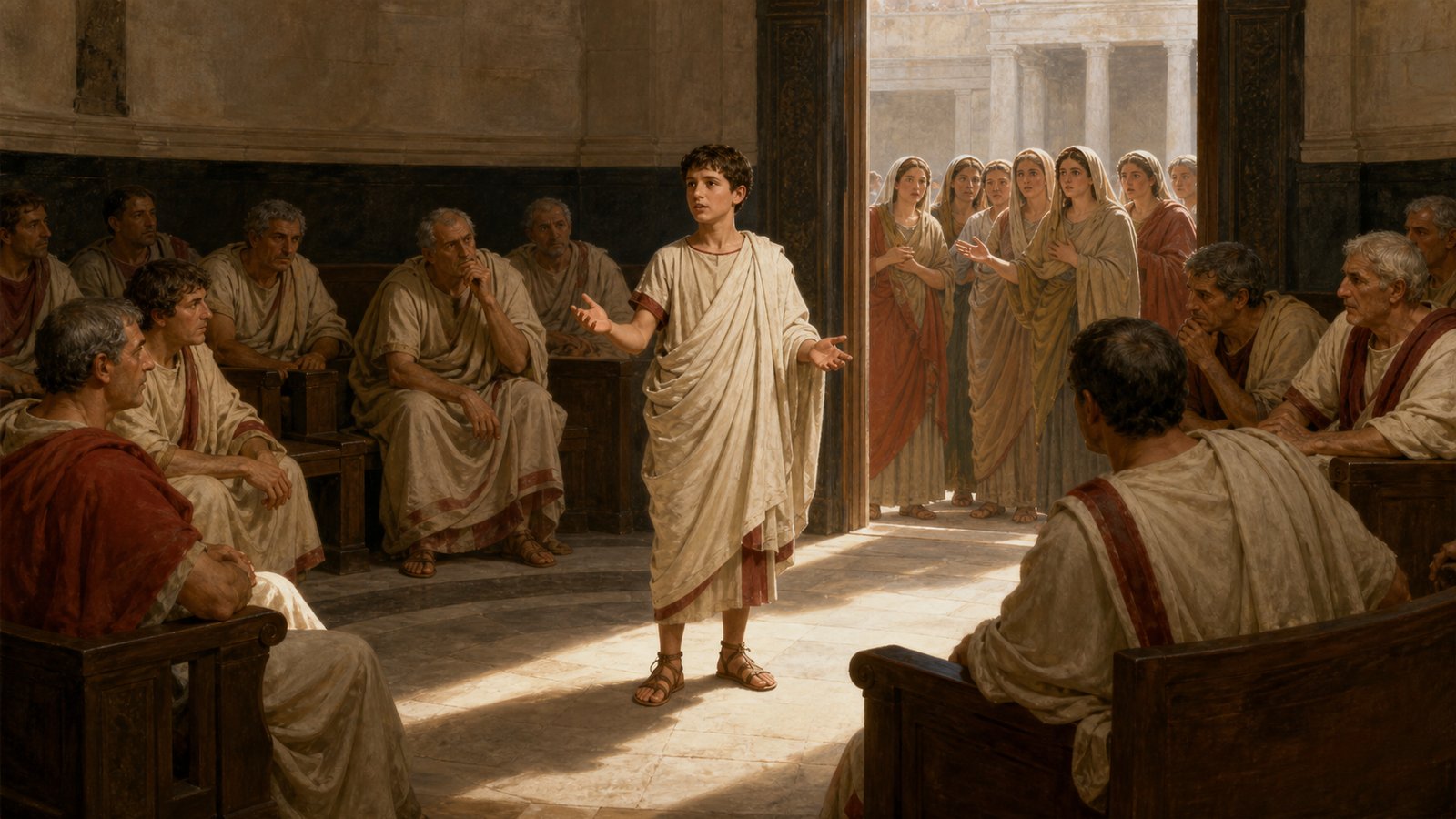
Papirius’s mother is panic-stricken in Gellius’s narration. She rushes from the house and tells other matrons. By the next day, private alarm has become collective action. A crowd arrives at the Senate with tears and entreaties, asking that one woman be allowed two husbands rather than one man be allowed two wives.
Their preference follows directly from the choices Papirius invented. Gellius gives no speeches to individual women and no count for the crowd. He does make their arrival visible to senators entering the house. The Fathers encounter a demand about an agenda they never set and cannot initially explain.
This is the physical hinge of the story. The boy brought genuine information from chamber to household but did not disclose it. His false information then moved in the opposite direction, from household conversation to a public gathering at the chamber. Secrecy held at the level of content while confusion multiplied at the level of action.
Rome’s political information did not always remain confined to the Senate. Caesar’s daily records put public business on display through a very different mechanism: deliberate publication. The Papirius anecdote turns on the interval before a decision, when senators had explicitly ordered that one matter should not circulate.
The matrons are not portrayed as discovering an official notice. They act on a report carried through trust between households. Their tears give the false debate a public body. What began as one mother’s question now obstructs the ordinary meaning of the Senate’s entrance, because every arriving senator must wonder why this particular demand is waiting there.
Gellius calls their behavior strange from the senators’ viewpoint, but the reader knows its logic. The women possess a false premise supplied with official authority. Within that premise, urgency is reasonable: waiting for the supposed decision could mean accepting the less favorable option.
Papirius turned confession into a new boundary
Papirius ends the confusion by stepping into the middle of the house. He recounts what his mother demanded, what he answered, and how the incident unfolded. His success depends on full disclosure now. Silence protected the true debate at home; a precise public explanation protects his own loyalty once the invented debate reaches the Senate.
The sequence separates discretion from permanent muteness. Papirius knows when not to reveal the chamber’s business and when to reveal his own actions. Gellius makes both speech and silence part of the same judgment. The Senate pays homage to the boy’s cleverness and loyalty rather than punishing the disruption produced by his lie.
But praise for Papirius does not preserve the old custom for everyone else. The Senate allegedly votes that boys should no longer enter with their fathers, making Papirius the sole exception. The response treats the episode as proof that even successful discretion had depended too heavily on one child’s judgment under household pressure.
The rule therefore closes a route while honoring the person who exposed its risk. Papirius keeps access because he passed the test. Other sons lose access because the institution no longer wishes to repeat it. The anecdote converts individual virtue into evidence for a general restriction.
That pattern differs from the courtroom boundary later attached to Afrania’s name. Gellius’s boy is celebrated, not condemned, and his exception survives the closing rule. Yet both stories attach a person to a limit on who may appear within an institutional space, turning remembered conduct into an explanation for procedure.
Finally, Gellius links the surname Praetextatus to the purple-bordered toga Papirius still wore. The garment marks the age at which he kept the Senate’s confidence. His distinction is not that he behaved like a senator in miniature; it is that, while visibly still a youth, he managed the dangerous passage between chamber, home and public crowd.
The lost debate never returns. Its absence is the point. What Gellius preserves is the architecture around it: a privileged threshold, a command of secrecy, a mother’s insistence, a fiction vivid enough to mobilize a crowd, and a boy whose explanation allegedly shut the Senate door behind him.
Sources
Aulus Gellius, Attic Nights 1.23