
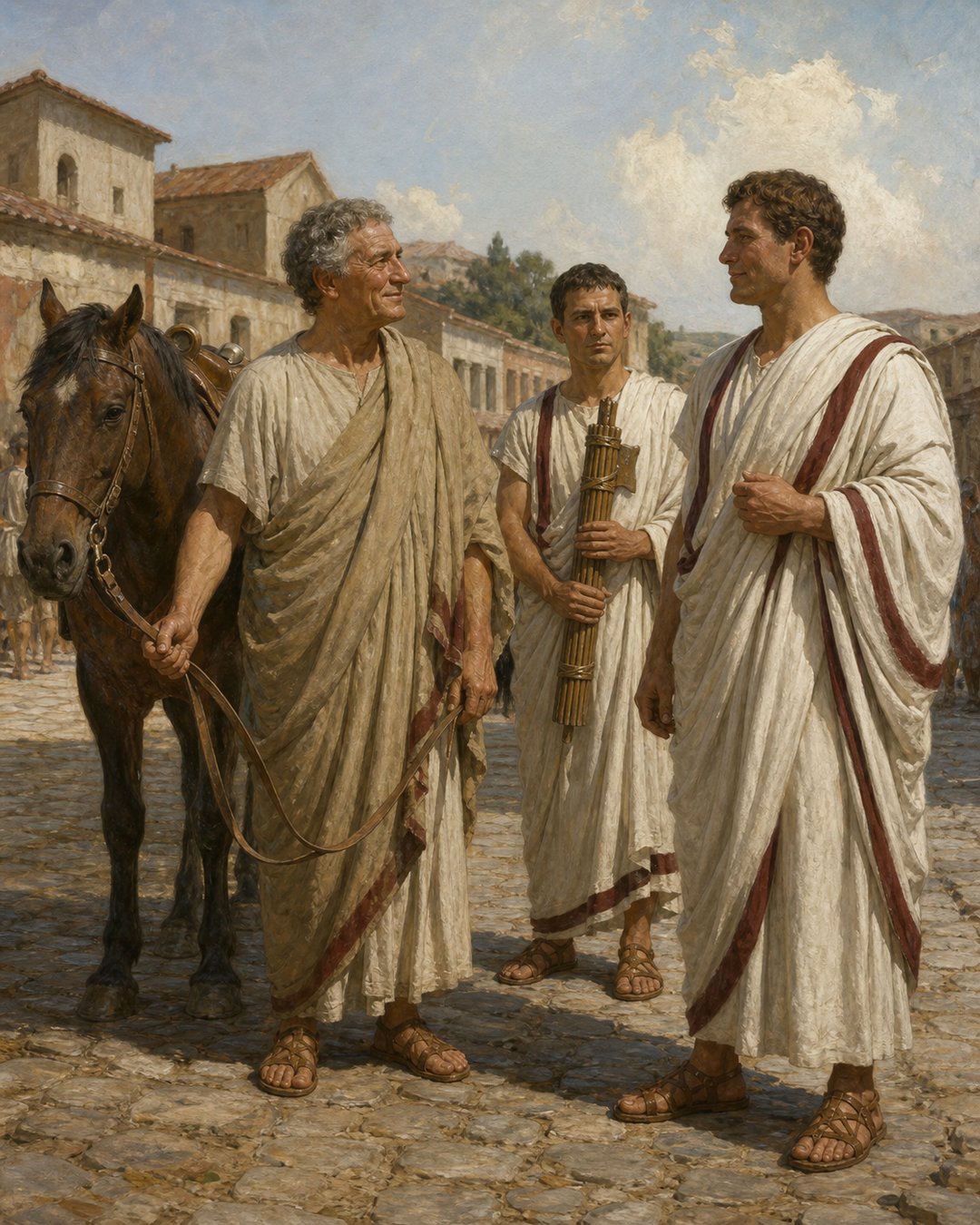
The proconsul remained on his horse as he approached a Roman consul. Nobody immediately told him to get down.
The hesitation was understandable. The rider was Fabius Maximus, a former consul and the father of the magistrate in front of him. The lictors knew father and son lived in complete harmony. Household respect, seniority and public rank all seemed to point in different directions.
Then the younger Fabius asked, “What next?” A lictor understood, ordered the proconsul to dismount, and the father obeyed. Instead of taking offense, he warmly praised his son for asserting authority bestowed by the Roman people.
Aulus Gellius preserves the episode from the annalist Claudius Quadrigarius. It is compact enough to resemble a family anecdote, but every movement is political. Horse, lictor, command and dismount turned an invisible hierarchy into a scene that everyone could read.
The meeting began with several valid kinds of precedence
The younger Quintus Fabius Maximus had been elected consul alongside Tiberius Sempronius Gracchus, who was holding the office for a second time. His father had been consul in the previous year and now held proconsular authority.
This was not a confrontation between office and obscurity. Both men carried public distinction. The father also possessed the social claim of age and parenthood. When he remained mounted, his gesture could be read as paternal precedence rather than simple contempt.
The lictors’ uncertainty reveals the problem. Quadrigarius says they knew the two men lived in complete harmony and therefore did not presume to order the father down. Their knowledge of the household softened their enforcement of public ceremony.
That softness created a visible gap. If the father rode straight up while everyone else deferred, spectators could read the consul’s authority as secondary inside his own family. The son did not need a feud for the scene to become damaging. Affection itself could blur the office.
Roman status depended on such readable arrangements. The curule chair made rank visible through a piece of folding furniture. Here elevation on horseback and standing on the ground carried their own message. Bodies occupied a hierarchy before anyone explained it.
Two words forced the lictor to choose a rule
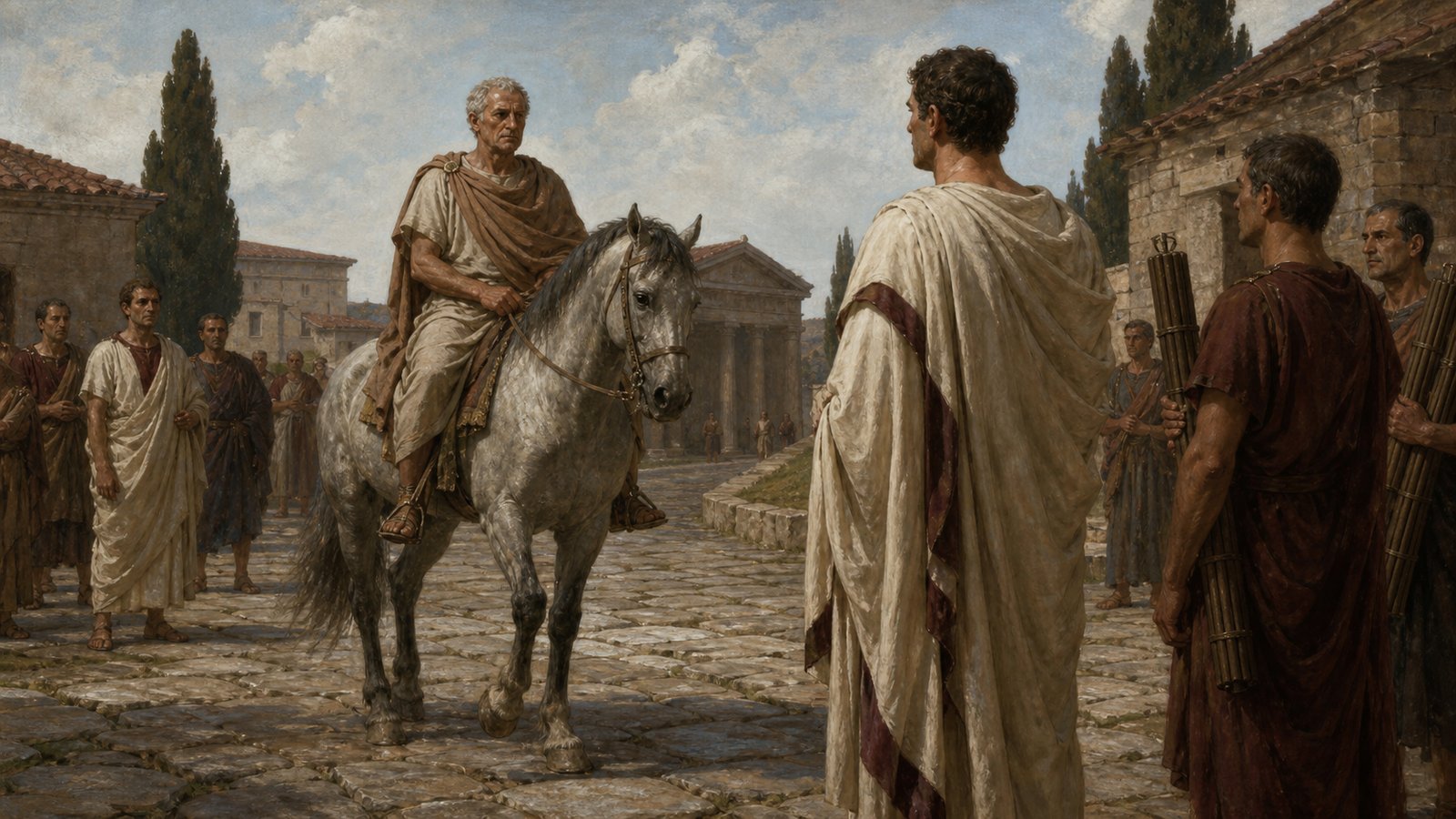
As his father drew near, the consul asked, “What next?” The question was brief because the missing act was obvious to the trained attendant. The lictor immediately ordered the proconsul to dismount.
The son did not deliver a speech about constitutional principle. He activated the officer whose job was to give public force to consular presence. That division of action mattered. The consul indicated that protocol must continue; the lictor issued the command; the father complied.
Lictors were not decorative companions in this scene. Their hesitation had suspended the expected order, and their renewed action restored it. The attendant stood between personal sensitivity and institutional clarity.
The tiny question also protected the son from overacting. He did not insult his father or narrate the older man’s mistake. “What next?” told the lictor to complete a sequence already understood by everyone present.
The episode belongs with the twelve lictors who made a consul’s authority legible in motion. Their value lay not only in carrying symbols. They regulated approach, cleared ambiguity and converted office into behavior around the magistrate.
Dismounting made obedience physical
Fabius obeyed. That one action prevented the incident from becoming a contest between paternal dignity and a son’s public command.
Dismounting changed the geometry of the encounter. The father surrendered the height and momentum of the horse. He accepted that the consul’s office determined the formal terms of approach even when the officeholder was his own child.
Quadrigarius does not describe anger, delay or argument after the order. The clean obedience is essential to the moral shape of the anecdote. The father could have claimed that a former consul and current proconsul deserved latitude. Instead, he confirmed the rule by following it.
Roman authority often depended on people who recognized limits without requiring force. A lictor could command, but the ideal result was voluntary compliance by someone important enough to make that compliance meaningful.
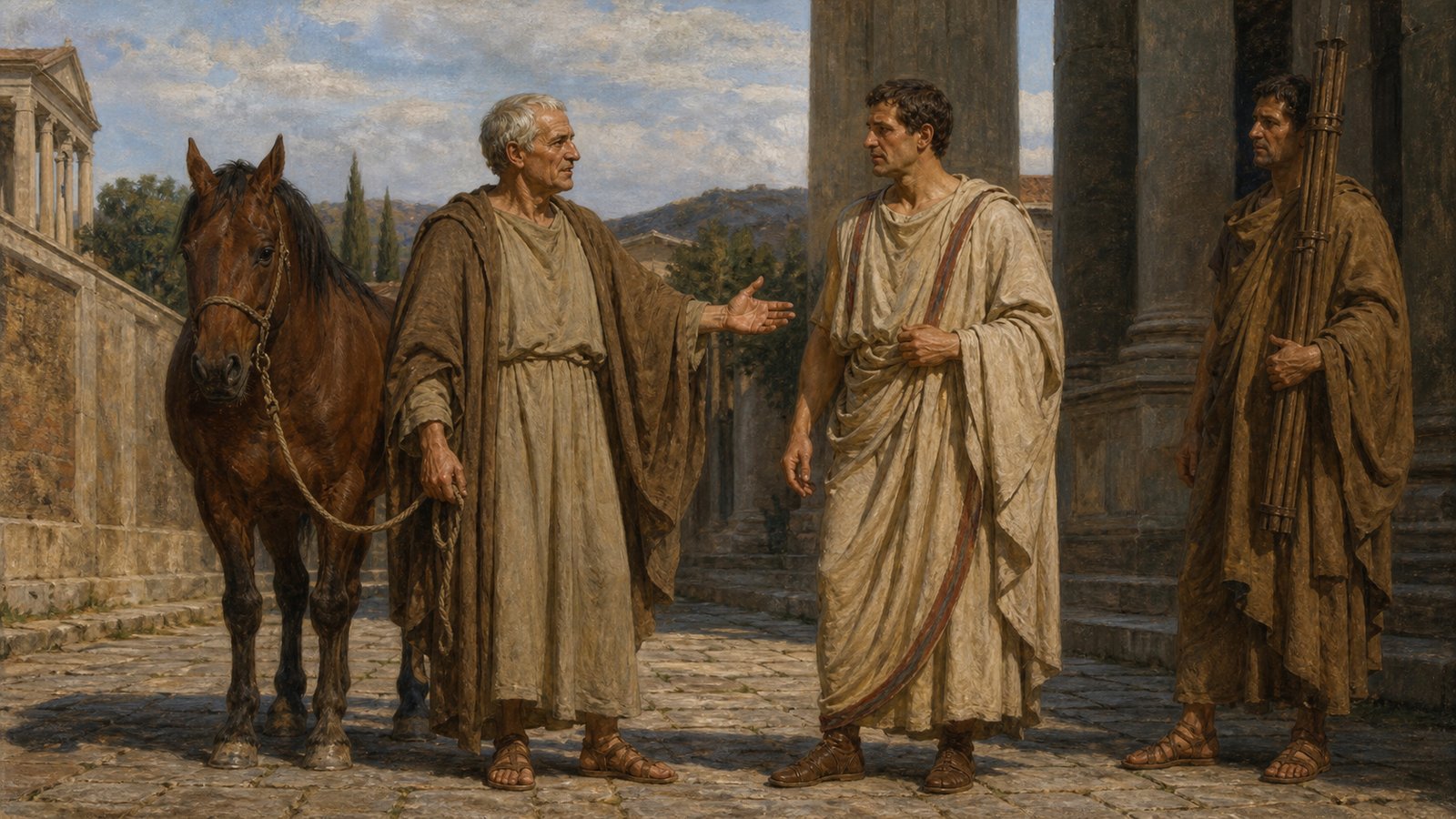
The horse therefore did more than decorate an elite meeting. While Fabius remained mounted, family seniority overshadowed the present magistracy. Once his feet reached the ground, public office stood above the private relation for the duration of the encounter.
The father’s praise completed the constitutional lesson
Fabius did not merely accept the correction. He warmly commended his son for asserting the authority he held as a gift of the people. Those final words move the story beyond etiquette.
The son’s claim did not rest on being the stronger personality in the family. It came from election. The Roman people had placed him in an office, and the father praised him for refusing to let household hierarchy diminish that public grant.
This is why the anecdote can celebrate both men. The younger Fabius shows steadiness without theatrical aggression. The older Fabius shows respect for an institution even when its protocol temporarily lowers him before his own son. Harmony survives because both recognize which identity governs the moment.
The scene also offers an elite family an attractive public image. A powerful house could be suspected of treating magistracies as private possessions. Quadrigarius instead shows a father insisting, through praise, that the office belonged to the civic order that bestowed it.
That does not make Roman politics free of dynastic power. Father and son had both reached the consulship in consecutive years, an extraordinary concentration of distinction. The anecdote answers that fact by staging submission to office rather than entitlement through blood.
Compare the Senate debate over admitting provincial elites, where Roman authority also had to define who could occupy a public role. The Fabius meeting asks a different question: once the role is granted, will even the holder’s father behave as though it matters?
The answer arrives without punishment. A question, a command, a dismount and a commendation complete the sequence. Each participant does exactly enough to repair the ambiguity.
Quadrigarius’s scene lasted only moments, but its political grammar was precise. Family affection explained the pause; it did not decide the outcome. The lictor served the consul, the father came down from the horse, and the elder Fabius praised a son who remembered that his authority came from beyond the household.
Gellius places the quotation inside a wider discussion about the etiquette owed when fathers and sons hold different kinds of distinction. That frame matters. The anecdote was not preserved merely because a famous man once climbed down from a horse. It served as a worked example for resolving competing duties: respect age and kinship, but do not let either erase the public office that organizes the encounter.
The passage is equally careful about what it does not claim. It offers no hostile words between father and son, no punishment, and no lasting rupture. The lictors’ knowledge of their harmony explains why they paused, while the father’s final praise proves that enforcement did not destroy that harmony. Protocol succeeds because it clarifies roles without requiring private affection to disappear.
Sources
Aulus Gellius, Attic Nights 2.2, quoting Claudius Quadrigarius, Annals book 6