
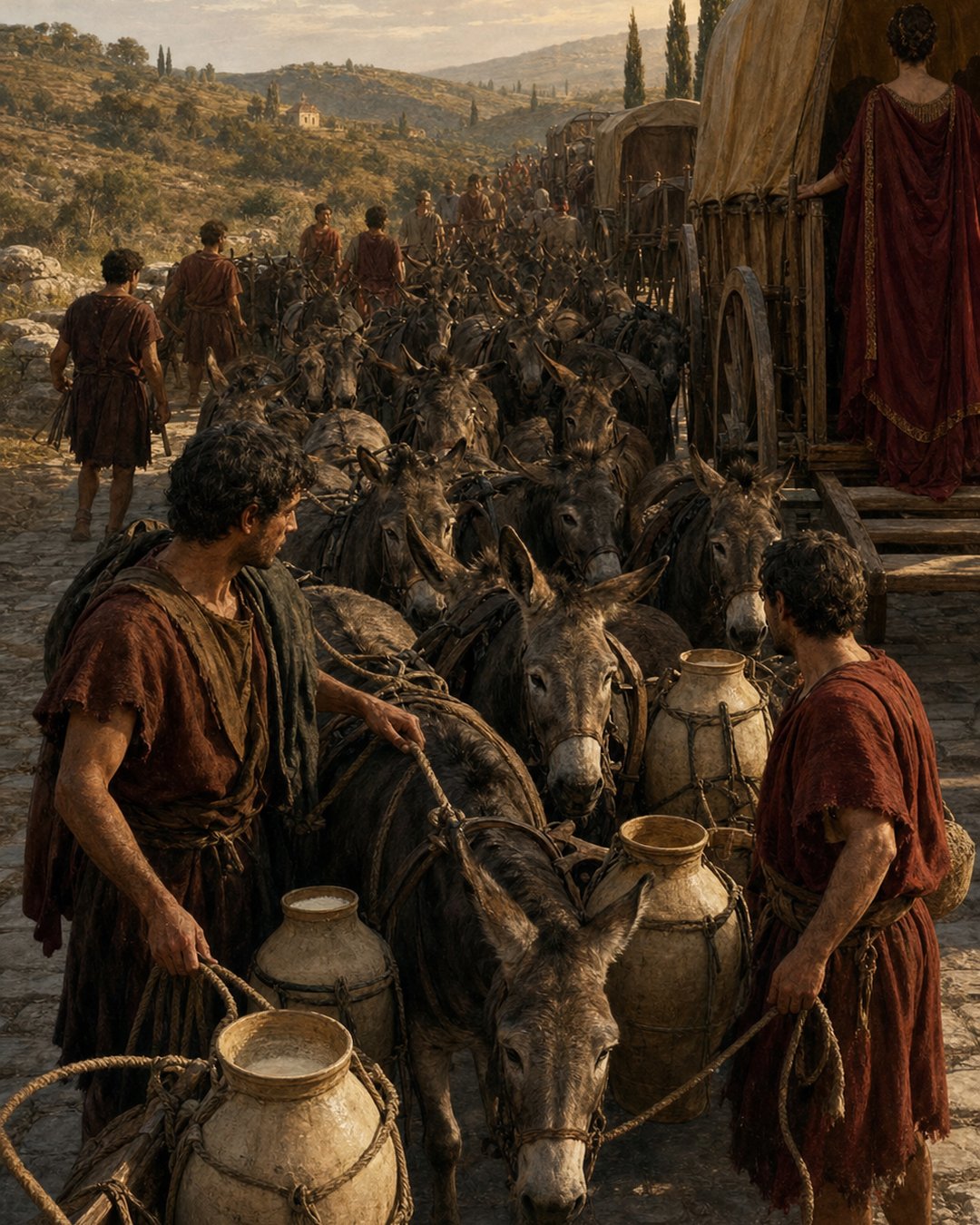
Poppaea’s bath did not fit inside a travelling chest. It walked behind her.
Pliny the Elder reports that Nero’s wife kept five hundred asses with foal in her company and bathed her entire body in their milk. She believed the treatment whitened and softened her skin. The number is startling, but it also exposes something more useful than a familiar tale of imperial excess: the physical supply system hidden inside a beauty ritual.
Fresh milk came from living animals. A full-body bath demanded much more than a small medicinal dose. If the treatment continued while Poppaea travelled, then animals, handlers, fodder, water, shelter and collection vessels had to travel too. What touched one aristocratic body depended on a moving community of labour.
Pliny gives no stable plan, route or daily yield, so those details should not be invented. His report still makes the mechanism unusually clear. The ingredient could not be separated from the herd that produced it. Luxury became visible because its supply chain had hooves.
Pliny placed the anecdote inside a study of milk
The story appears in the eleventh book of the Natural History, not in a court chronicle. Pliny is comparing milk across species: when it appears, how it behaves, whether it coagulates and what people believed it could do. Poppaea enters the discussion as an extreme human use of an animal substance.
He says pregnant she-asses have milk in their udders. He also discusses the first milk around birth and the danger it was thought to pose to the young under rich pasture conditions. Ancient biological explanations are not modern veterinary advice, but they locate the ingredient in a reproductive cycle. The desired liquid was not simply stored wealth; it had to be renewed through animals with foals.
Pliny ranks ass’s milk as especially rich and says it could be used in place of rennet. In the same chapter he contrasts its properties with cow, goat, camel and mare milk. His catalogue moves between nourishment, cheese-making and bodily treatment without drawing a modern boundary between food, medicine and cosmetic.
That context matters because the Poppaea passage is sometimes repeated as though milk were merely a white visual symbol. For Pliny, its physical behaviour was central. Heat thickened it; cold made it serous; different animals produced liquids suited to different transformations. Poppaea chose a substance with a specific place in his material taxonomy.
Roman cosmetics joined minerals, plants and animal products to social display. This case adds scale. Instead of asking what one pot contained, it asks what had to remain alive and mobile so that a treatment could continue.
Five hundred animals turned freshness into an institution
Pliny says Poppaea “always” had the five hundred foaling asses with her. The wording makes continuity the crucial feature. A one-time bath could be assembled for a special occasion. A treatment kept available during movement required repeated coordination.
Milk is perishable. The ancient text does not describe cooling, transport jars or the interval between milking and bathing, and a careful account must stop short of supplying those missing facts. Yet the choice to move the animals solves the central freshness problem more directly than moving a finished reserve would. Production followed the consumer.
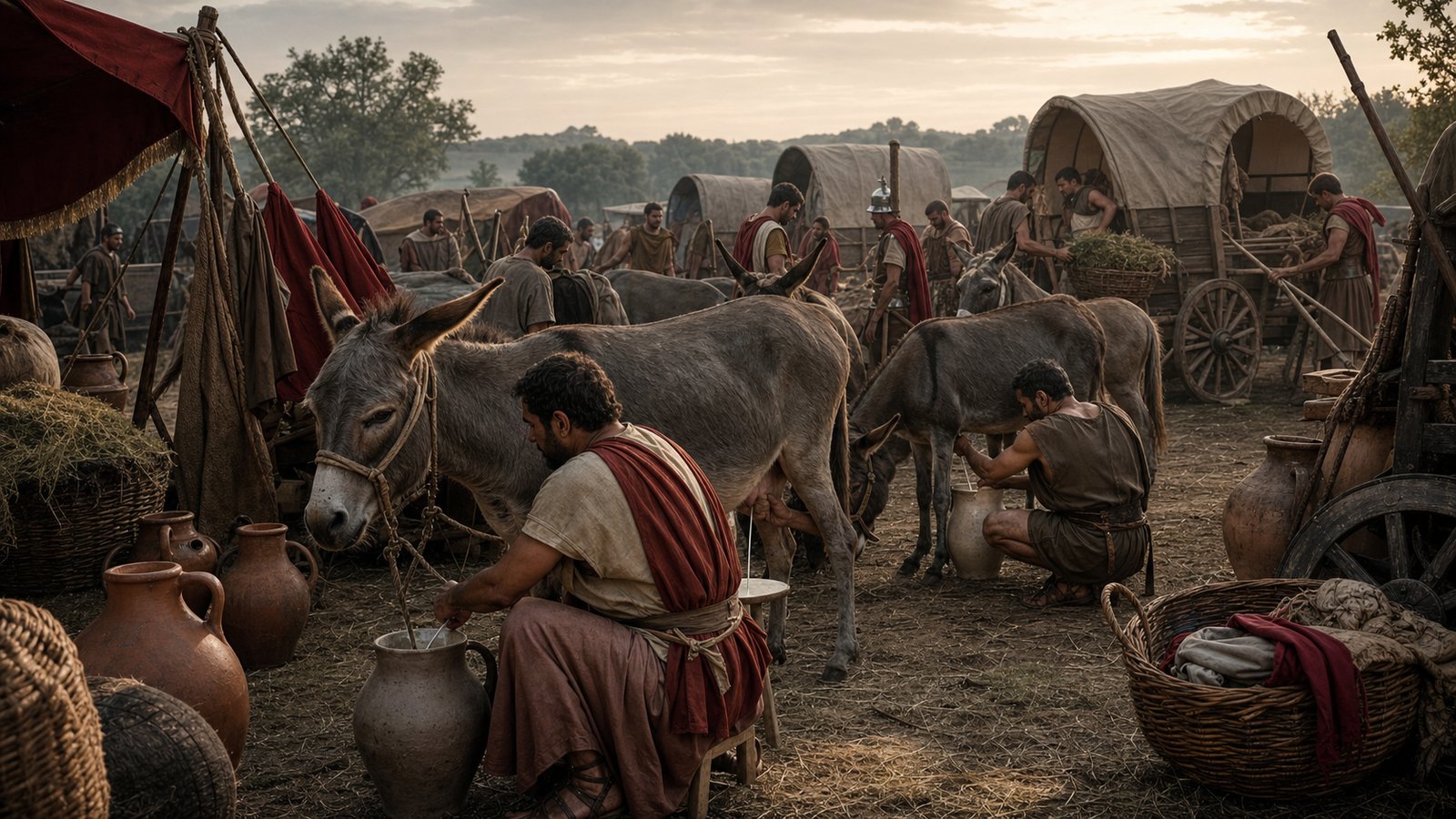
A herd of that size also multiplied ordinary needs. Animals consumed fodder and water; they occupied road and stable space; they required people able to lead, milk and watch them. Pliny does not count those workers, but the animals could not plausibly organize themselves around an imperial journey. The anecdote points outward from one named woman to many unnamed hands.
The convoy would have made private grooming public before the bath began. Travellers, estate staff and urban residents did not need access to Poppaea’s chamber to see the resources attached to her movement. The ingredient announced itself on roads and in courtyards as a mass of bodies.
This is a different form of display from jewellery. A gem concentrates value into something small. Poppaea’s milk dispersed value across maintenance. Its expense lay not only in ownership but in keeping a biological process aligned with one person’s schedule.
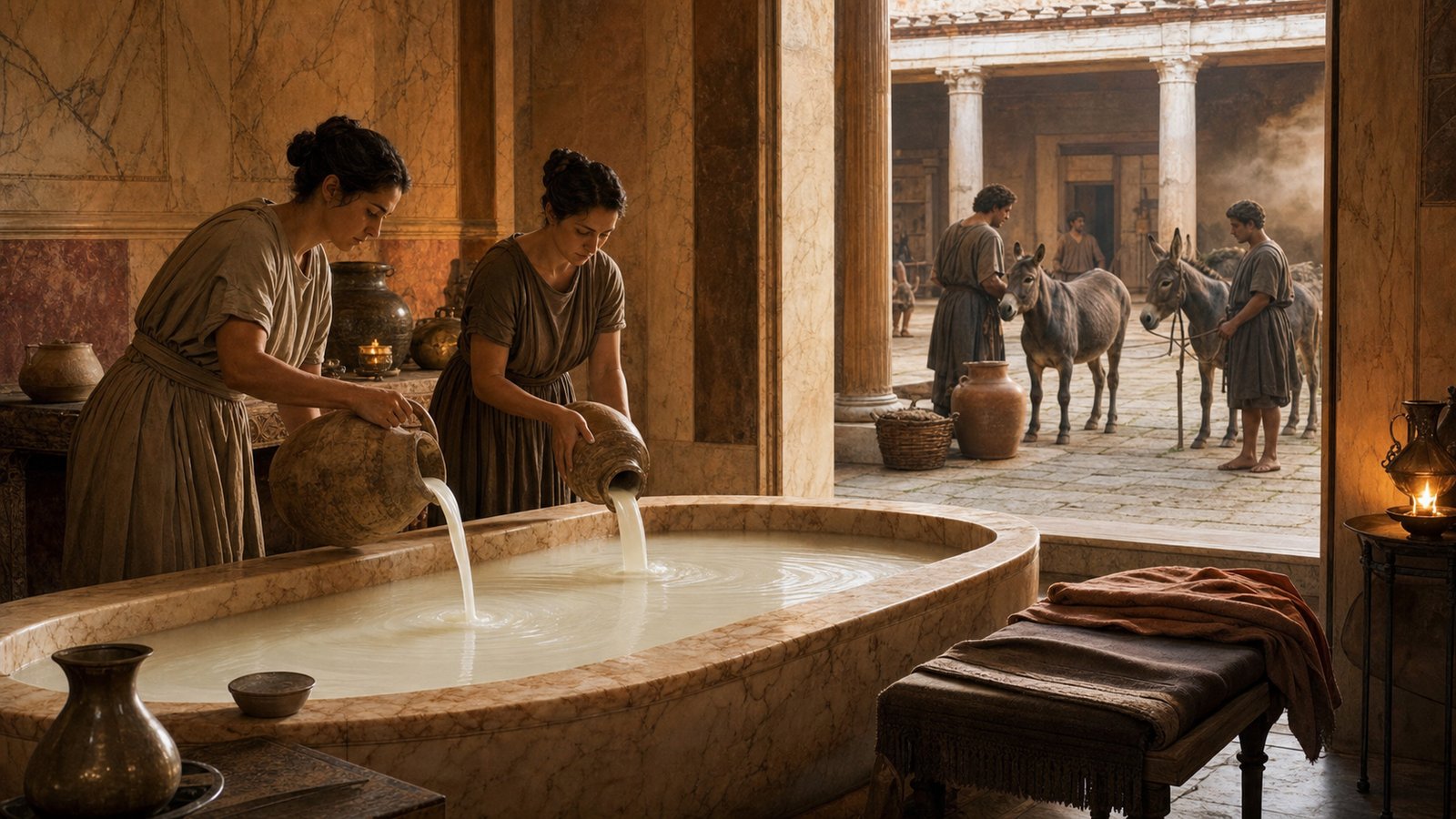
The bath enlarged one claim about skin
Pliny says women believed ass’s milk whitened the skin. Poppaea also thought it added suppleness. These are ancient claims reported by an ancient compiler, not effects readers should accept as clinical findings. Their historical force lies in what people were prepared to organize around them.
The treatment covered her whole body. That detail changes the scale again. A face preparation or spot remedy needs a small quantity. Immersion or extensive washing converts the ingredient into volume, and volume converts animal husbandry into household infrastructure.
Roman bathing already joined architecture, fuel, water and service. Elite baths could turn private ambition into a visible built environment. Poppaea’s treatment added another network before the liquid reached the basin. Ordinary bathing water could arrive through pipes or containers; her chosen additive arrived through a herd.
We should resist making the number prove everything later writers have attached to Poppaea. Pliny offers no description of her mood, no scene of servants ordered about and no account of how onlookers reacted. The secure claims are narrower: five hundred foaling asses accompanied her, she used their milk over her whole body, and she associated it with skin colour and softness.
Those limits improve the story. They move attention away from invented palace dialogue and toward a documented relationship between belief and material burden. A claim about skin could reorganize transport.
The convoy made luxury a problem of coordination
Imperial luxury is often summarized with prices and precious materials. This example has no price in Pliny’s chapter. Its measure is headcount. Five hundred animals reveal expenditure through repetition: repeated feeding, repeated milking, repeated cleaning and repeated movement.
The herd also made substitution difficult. If Poppaea’s preference was specifically ass’s milk, a convenient supply of cow’s milk did not answer it. Pliny’s own chapter distinguishes the properties of different milks. The household had to preserve the identity of the ingredient, not merely produce a pale liquid in quantity.
That specificity joined status to vulnerability. A broken cup could be replaced from stores; a living supply could fall out of sequence with travel, health or season. Keeping five hundred foaling animals close reduced the risk that the regimen would stop, but did so by creating a much larger system to manage.
Pliny may intend the report to astonish. It still records an important truth about Roman elite households: the visible consumer was often the smallest part of the operation. Behind a smooth surface stood agricultural knowledge, animal bodies, service work and transport.
Poppaea’s bath was private at the final moment. Everything needed to make it possible was not. The treatment stretched from pasture to road to courtyard to basin. Five hundred asses turned a beauty belief into logistics, and the logistics are why Pliny’s number remains more revealing than the milk alone.
The contrast with Pliny’s cheese discussion sharpens the point. Elsewhere in the same chapter, milk becomes a product through coagulation and storage. Poppaea’s use kept it tied to immediate bodily treatment instead. The household did not transform the liquid into something durable; it preserved access to production. Her regimen was therefore less an object than a recurring event, rebuilt whenever milkers, animals, vessels and bath met in the same place.
Sources
Pliny the Elder, Natural History 11.96