
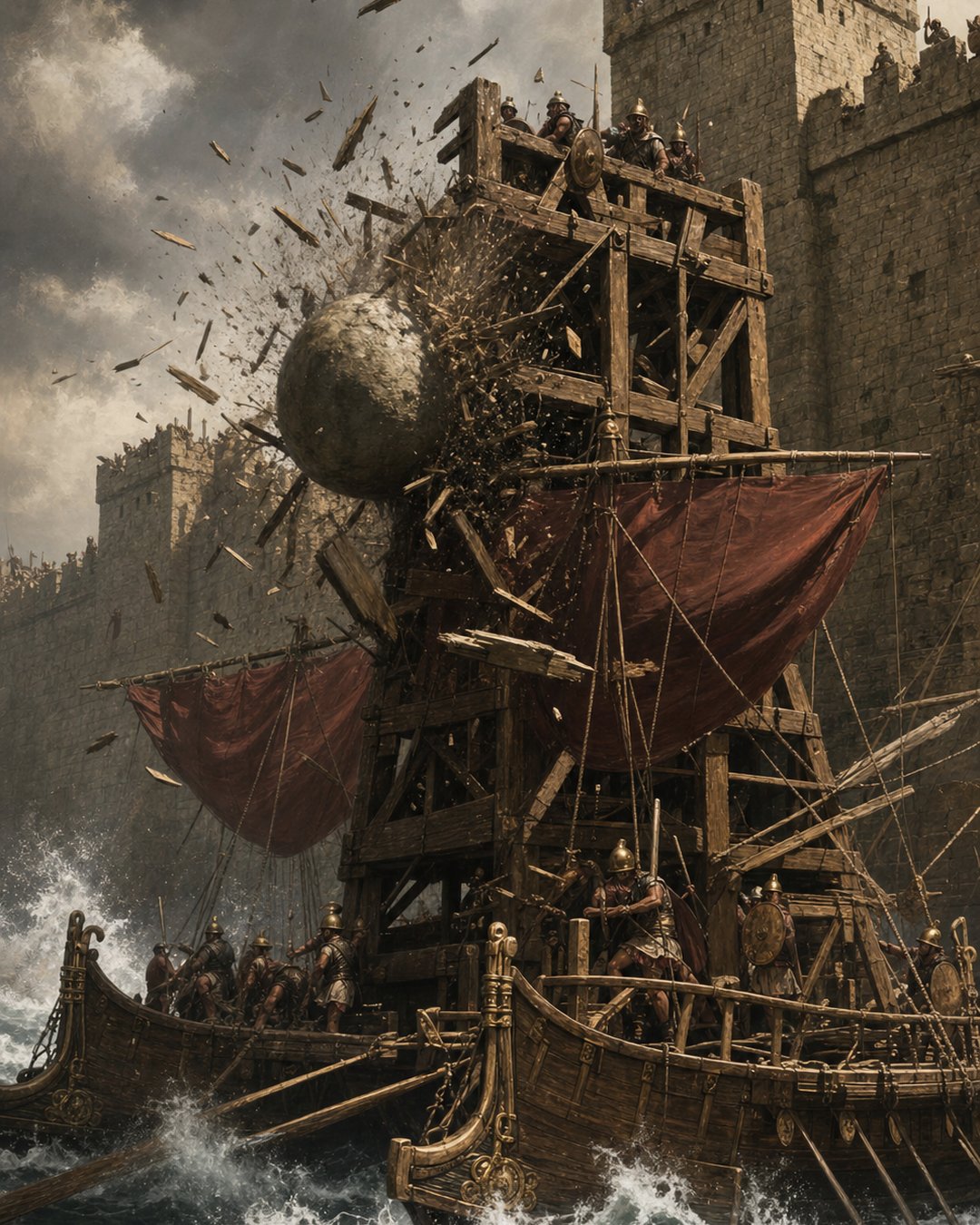
Marcellus brought a wooden assault tower toward Syracuse on paired ships. Plutarch calls the machine a sambuca, after a musical instrument its shape resembled.
Before it reached the wall, a stone weighing ten talents struck it. Then another followed, and another. The blows crushed the engine’s foundation, shattered its frame and shifted it off the platform that held it above the water. Marcellus ordered his ships to withdraw and his land forces to retire.
The scale of the stone makes the episode memorable, but the defence was more sophisticated than one enormous shot. Archimedes had prepared weapons for different distances and approaches. Long-range missiles broke formations and machinery; beams and claws reached ships; small concealed engines covered the ground immediately below the wall.
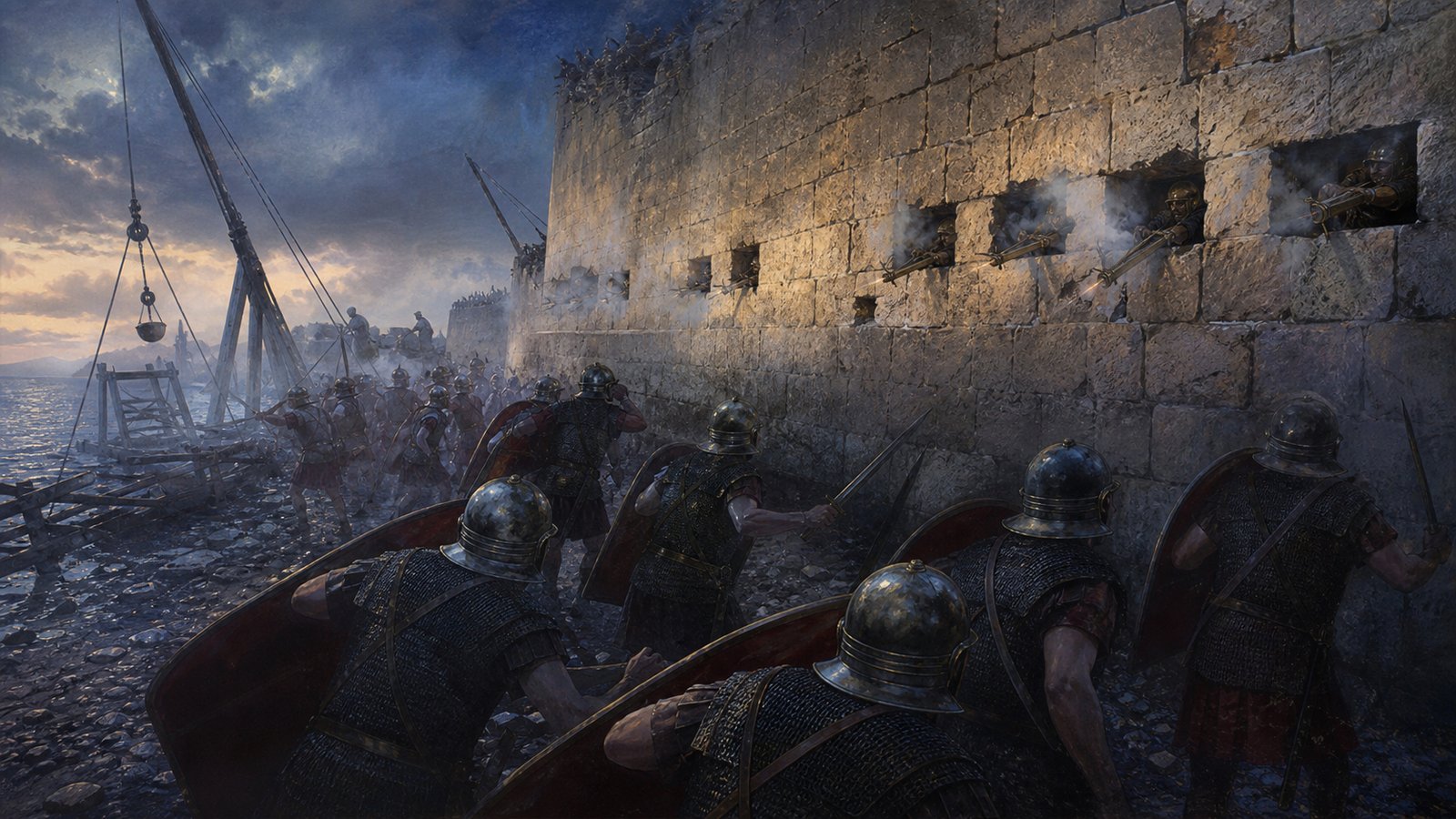
The Romans tried to adapt by moving closer at night, expecting the great projectiles to pass over their heads. That supposed shelter was already covered. Syracuse’s advantage came from overlapping ranges, so that escaping one threat meant entering another.
Eight ships carried Rome’s answer to the wall
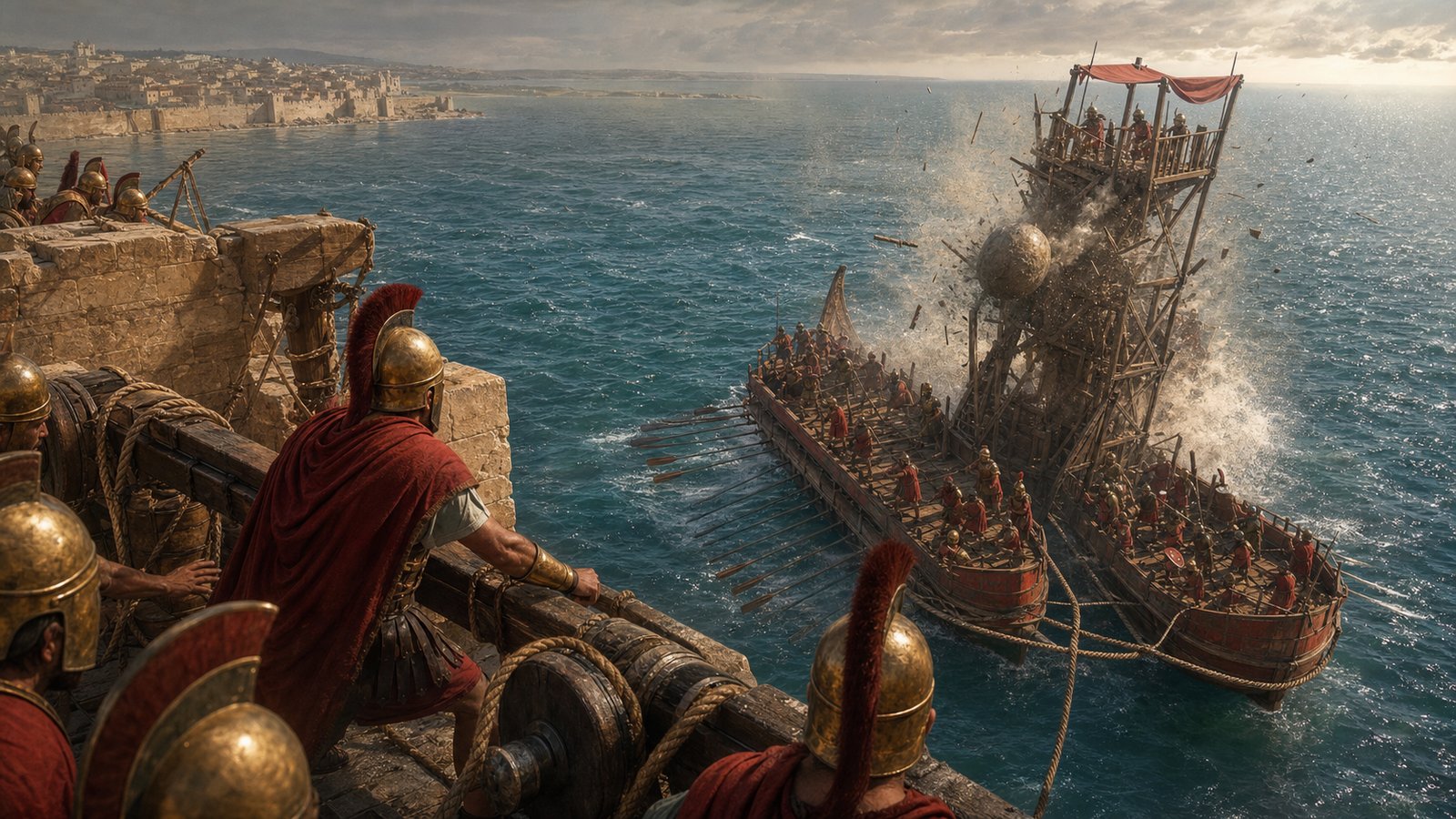
Marcellus attacked Syracuse from land and sea. For the naval approach, Plutarch describes eight ships joined in pairs, their oars removed from the inner sides. A platform across them supported the tall sambuca and the men intended to climb onto the fortifications.
The arrangement converted hulls into a floating foundation. Ships that normally moved independently had to keep position together while carrying a top-heavy structure toward stone walls. Calm coordination mattered as much as courage. A blow against the shared platform threatened the entire assault system.
Pairing the ships solved one problem and created another. The tower gained width and support, but the combined craft could not react like a single light vessel. Steering, wave motion and the strain between hulls all had to remain manageable while men climbed and missiles arrived. Plutarch does not list those stresses as an engineer’s report, yet his description of the shattered base shows why the platform was the vulnerable connection on which every upper part depended.
Marcellus trusted the scale and appearance of his equipment. Plutarch sets that confidence against Archimedes’s preparations. The defender had not improvised after the fleet appeared. King Hiero had earlier persuaded him to apply mathematical thought to practical mechanisms and to design offensive and defensive devices for siege warfare.
Plutarch illustrates that practical turn with a demonstration away from battle. Archimedes used compound pulleys to draw a loaded three-masted merchant ship smoothly toward himself while seated at a distance. The point was not magical strength. An arrangement of ropes and pulleys changed how a small applied force moved a much larger load.
The archive explores another machine attached to his name. The rotating water screw made lifting water a continuous process. At Syracuse, Plutarch’s emphasis is different: prepared mechanisms redistributed force and controlled approach routes under battle conditions.
The wall attacked land formations and ships at once
When the Roman assault began, Archimedes’s engines cast missiles and immense masses of stone against the troops on land. Plutarch stresses noise, speed and weight. The projectiles knocked men down and confused their ranks before they could reach the wall in good order.
At sea, large beams projected outward. Some ships were sunk by weights falling from above. Others were seized at the prow by iron claws or beaks compared to cranes. The devices pulled hulls upward, dropped them stern-first or swung them toward cliffs below the fortifications.
Plutarch’s language is theatrical, and later retellings often isolate a single “claw of Archimedes.” His account actually offers a family of effects rather than an engineering drawing. We should not pretend to know the exact frame, hook geometry or power source. What matters for the narrative is how the attack felt from the ships: sudden purchase from above, loss of level and a hull no longer answering its crew.
The sea wall therefore did more than resist landing ladders. It became an active edge capable of dropping, hooking and redirecting. Roman ships had to face both masonry and machines hidden behind or above it.
Ordinary torsion artillery stored power in twisted fiber. Roman catapults translated wound skeins into missile force. Plutarch does not reduce Syracuse’s arsenal to one engine type. Its power lay in combining projectiles, levers, ropes, beams and concealed positions.
The ten-talent blow found the sambuca’s dependency
The sambuca was still some distance from the wall when the first ten-talent stone arrived. Plutarch then mentions a second and third. Rather than only killing men on the deck, the impacts attacked the machine’s supporting relationships.
The foundation was crushed. The framework broke. The engine shifted from its platform. Those are failures of alignment and load, exactly what a floating tower could least tolerate. A structure designed to lift attackers above the wall became useless if its base no longer held square across moving ships.
We do not need to convert the ancient talent into a single modern weight to understand Plutarch’s claim. Talent standards varied, and the source’s own unit is the fact we possess. The tactical meaning is clear: the missile was heavy enough for repeated impacts to dismantle the approaching system before contact.
Marcellus responded rationally. He pulled the ships back and withdrew the land attack. He then looked for a blind spot. If the ropes of the great engines imparted such force, Roman officers reasoned, perhaps troops directly under the wall would be too close for those missiles to descend upon them.
They chose darkness and proximity as countermeasures. Night could reduce observation, while the wall itself might mask men from weapons designed for distance. The plan treated the defence as powerful but specialized. It failed because Archimedes had already considered the interval.
Small openings denied the refuge beneath the wall
Plutarch says engines adapted to every range had been prepared. Small, closely spaced openings allowed short-range devices called scorpions to fire at troops nearby without exposing the machines. When Romans reached the wall believing themselves unnoticed, stones and arrows met them almost vertically and from many points.
The defence thus changed character with distance. Far away, heavy missiles used room to travel. Near the wall, compact engines used concealment and short flight. The attackers never reached a simple minimum range where Syracuse became passive.
Visibility changed with range as well. A great stone announced itself through noise and impact, whereas the close engines fired through small contiguous openings. Roman troops approaching in darkness hoped to reduce what defenders could see, but the wall’s prepared apertures reduced what attackers could see in return. They entered a zone where the weapons were nearby but their crews remained protected and hard to target.
Psychology followed mechanics. After repeated failures, Roman troops reacted to the smallest visible signs. A rope or piece of timber projecting over the wall could send them fleeing because it might announce another engine. Uncertainty multiplied the effect of the actual machines: every ordinary component became a warning.
Marcellus joked that Archimedes used Roman ships like cups for drawing water and outdid a hundred-handed monster with simultaneous missiles. Then he abandoned direct fighting and depended on a long siege. The shift is the strategic payoff of the range system. Syracuse did not destroy the entire Roman force, but it made assault too costly and unpredictable to continue in the same form.
The ten-talent stone broke a machine. The concealed scorpions broke an assumption. Together with claws, beams and long-range fire, they denied Rome a comfortable distance from which to attack. Archimedes’s defence worked not as one wonder weapon but as a sequence of prepared answers.
Sources
Plutarch, Life of Marcellus 14–17