
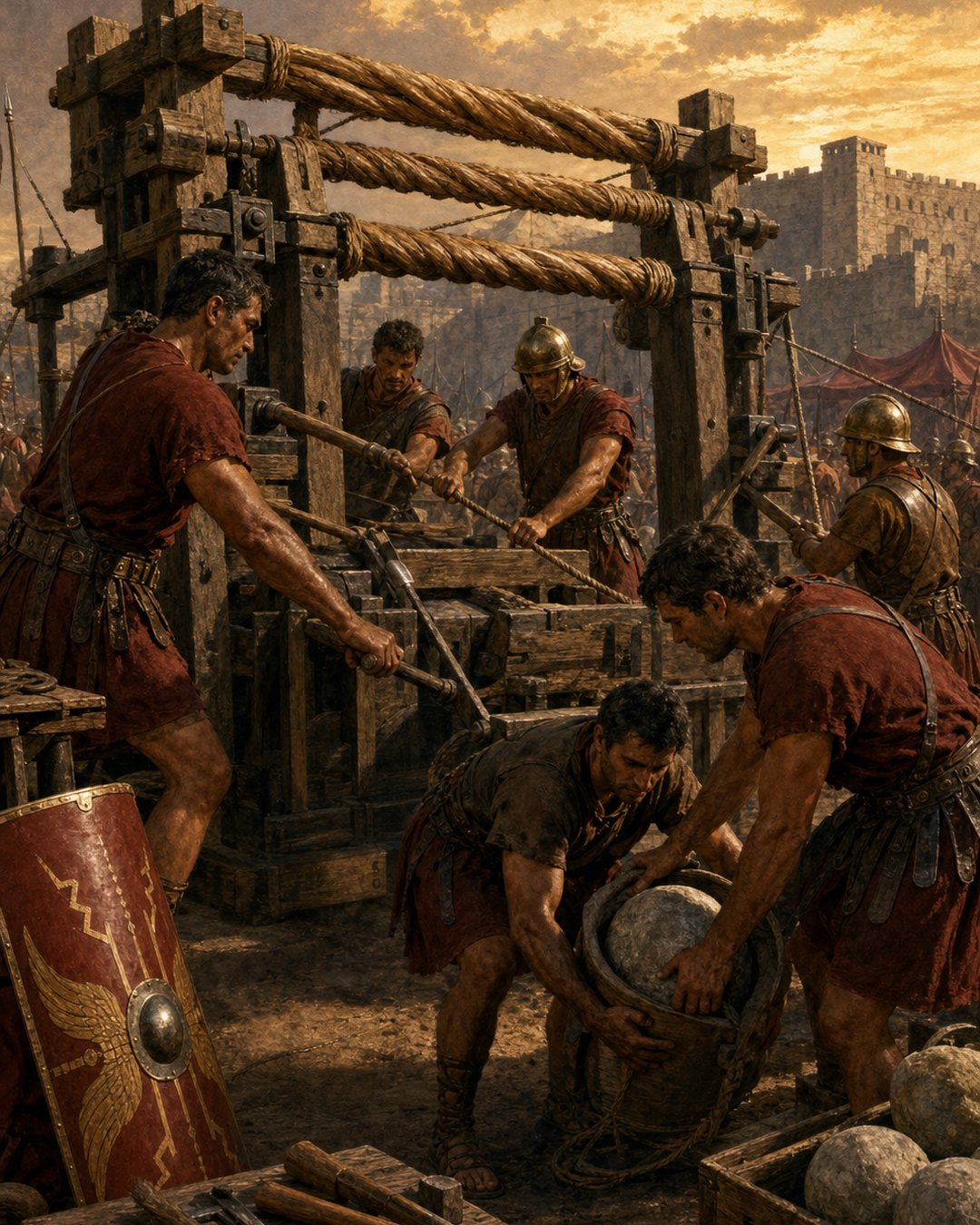
A Roman artillery engine was dangerous before anyone loaded a stone. Its power sat invisibly inside bundles of hair, sinew, thong, or plant fiber that crews had twisted under tension. The timber frame did not create force by size alone. It held a material spring that specialists could prepare, aim, and release.
That is the mechanical heart of the tormentum. Roman siege artillery was not a giant bow and not a primitive cannon. It was a family of torsion machines whose ammunition, proportions, crews, and battlefield jobs differed. Understanding the twisted bundles turns a dramatic launch into a story of measurement, maintenance, and organized labor.
The force began inside a bundle
The Latin name tormentum was connected with twisting. Hair, sinew, leather thongs, and vegetable fibers could be wound into dense elastic bundles. Arms inserted through those bundles resisted being pulled back. When a release let them move, stored strain became the speed of a dart or stone.
This principle separated torsion artillery from a thrown spear, sling stone, or ordinary bowshot. A soldier’s muscle still loaded and tensioned the machine, but the engine accumulated work before the instant of firing. Several men could contribute force that the frame held until one controlled release.
The physical scene was full of small judgments: whether fibers were even, whether damp had changed them, whether both sides pulled alike, and whether the timber accepted the strain. A launch began long before the projectile moved. It began with material prepared to remember twisting.
Ballista and catapult did different work
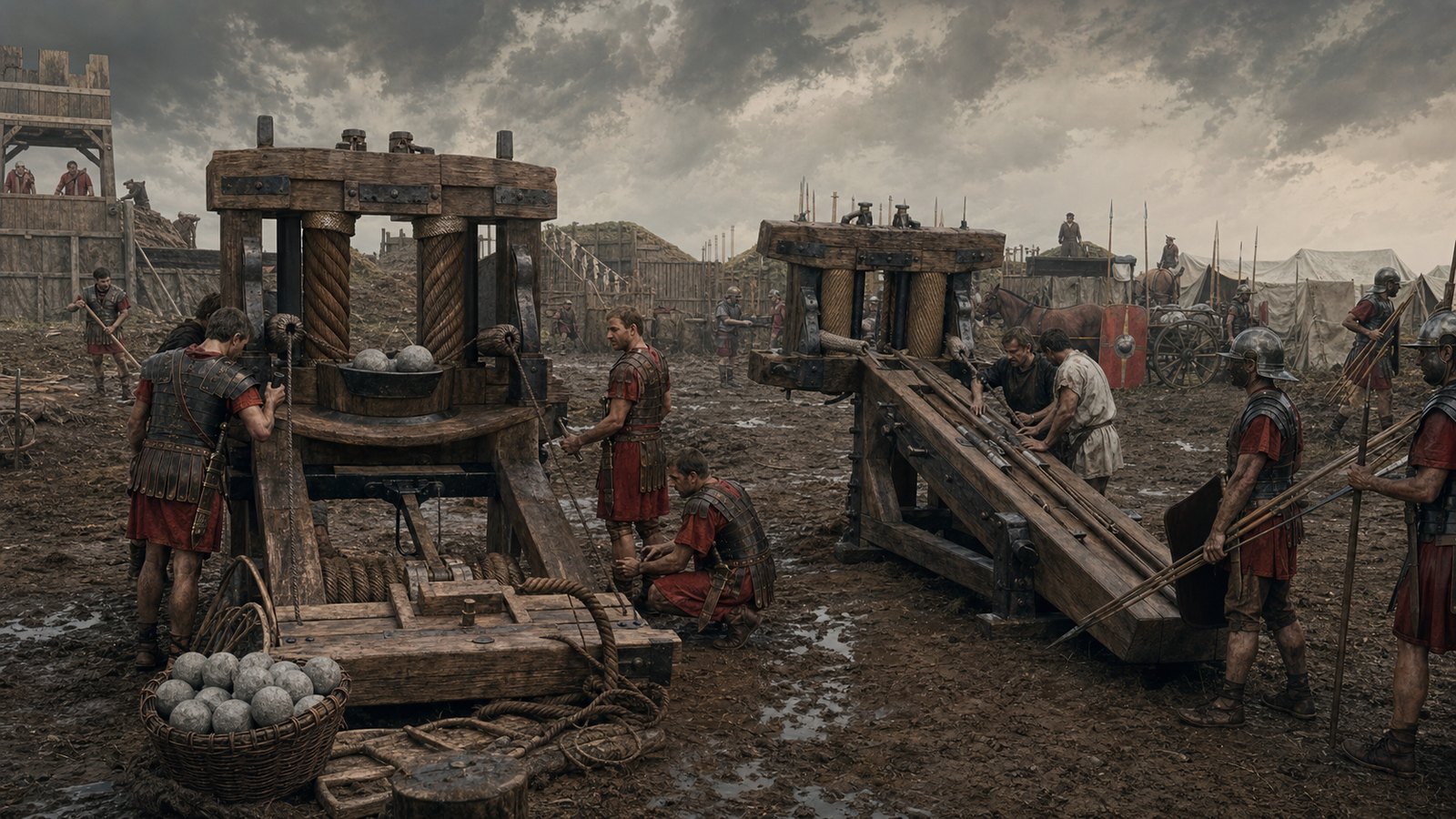
Ancient terminology is not perfectly stable, especially in later writers, but the technical distinction collected in the Tormentum entry is useful. The ballista commonly threw stones and was nearly square. The catapult was longer and projected darts. Shape followed ammunition because a heavy stone and a long bolt required different paths through the frame.
Roman narratives often mention the two classes together because a siege needed both effects. A ram attacked the lower wall. Ballista stones battered battlements. Catapult darts threatened defenders who showed themselves between the parapets. The machines did not replace one another; they divided the problem of a defended wall.
This gives artillery a tactical grammar. A stone could break, scatter, or frighten at a point. A dart could turn an exposed defender into a risk for everyone nearby. The value lay not only in casualties but in changing where defenders could safely stand while other Roman labor approached the wall.
Carthago Nova preserved an arsenal in numbers
When Roman forces took Carthago Nova, Livy’s inventory listed 120 large and 281 small catapults, alongside 23 large and 52 small ballistae. The exact ancient categories deserve caution, but the numbers reveal scale: this was equipment held in families of size, not a single spectacular machine rolled forward for a story.
Small engines greatly outnumbered large ones in that arsenal. Portability, rate of handling, ammunition, and available crews all mattered. A commander choosing positions had to think about roads inside camp, fields of fire, replacement fiber, carpenters, stones, bolts, and the soldiers trained to manage the frames.
The inventory makes artillery administrative. Someone counted each engine, distinguished size, stored ammunition, and knew which parts needed repair. Like military cost recorded in treasury ledgers, torsion power became useful only when the army could account for physical things.
Ammunition determined proportion
Ancient authors described ballista sizes by the weight of stone they threw, from very heavy classes down to a Vitruvian machine using a two-pound projectile. Catapults could be named according to arrow length. The measurement was practical: ammunition gave builders and crews a shared way to connect frame, tension, and expected effect.
Josephus credited ballistae with throws reaching roughly a quarter mile. Such literary performance claims should not be treated as a modern range table, but they show what observers found memorable: a stone arriving from a distance that separated its victim from the crew and mechanism that launched it.
Range alone was not accuracy. Wind, elevation, fiber condition, projectile shape, frame wear, and crew judgment intervened. Repeated fire turned those variables into experience. The balistarius mattered because the machine did not aim itself, correct itself, or explain why yesterday’s setting now sent a stone short.
The balistarii made machinery into a weapon
Sources give artillery specialists the name balistarii. A crew had to move, assemble, tension, load, aim, fire, inspect, and repeat. The engine’s drama can hide those verbs, but each launch depended on them in order. One damaged arm or uneven bundle could turn stored force against the machine itself.
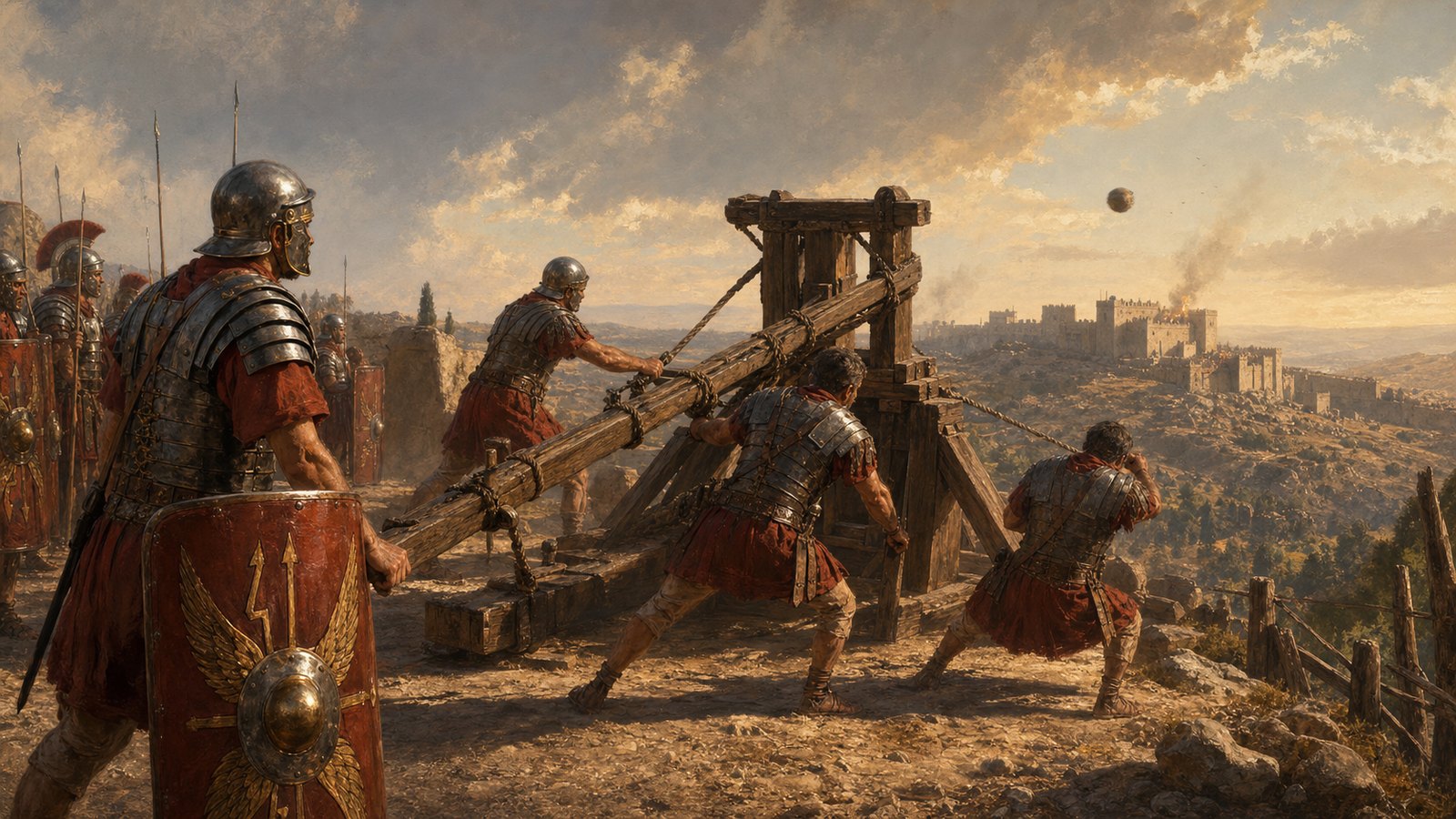
Crews could operate behind an advancing line, where the engine’s range supported soldiers closer to the enemy. That position linked technical labor to battlefield timing. Fire too soon and ammunition was wasted; too late and defenders remained free to disrupt the assault. Artillery needed signals and coordination as much as tension.
This is where Roman artillery resembles the repeated routines of a marching camp. The achievement was not inventing one object and admiring it. It was teaching groups to reproduce a difficult sequence under pressure, then carrying the materials needed to do it again.
Hair could become strategic material
Ancient accounts say that when ordinary torsion material failed, women cut their hair for engine ropes. The stories are emotionally charged and should be read as ancient testimony about emergency and sacrifice. They also expose the mechanism: without suitable fibers, the great timber frame was not artillery at all.
Wood and iron remain visually impressive after two thousand years. Organic bundles usually disappear. That survival bias can make the frame seem like the invention and the fiber like a detail. In operation, the relationship was reversed. The frame controlled force, but the twisted material stored it.
Roman artillery stored violence in rope because empire had learned to organize elastic matter. Its stones and darts began in counting, twisting, balancing, and waiting. The projectile in flight was only the brief visible ending of a much longer process performed by fibers, carpenters, ammunition carriers, and trained hands.
Preparation also shaped the landscape behind the battery. Stones had to be gathered or cut to usable sizes and stacked where loaders could reach them. Long darts needed straight shafts and sound heads. A machine without a local stream of ammunition became an expensive timber obstacle after its first few releases.
Moisture and temperature made the organic core unpredictable. The sources do not give a modern maintenance manual, but the mechanism itself required crews to notice changes in tension and response. A bundle that softened, stretched, or pulled unevenly changed the shot before any enemy action reached the frame.
Moving these engines posed another engineering problem. The largest pieces advertised power but demanded roads, animals, carts, labor, and time. Smaller machines could be more numerous because an army needed force that could arrive, deploy, and survive movement. The Carthago Nova inventory preserves that practical preference in its heavy concentration of lesser sizes.
A successful battery also changed sound. The creak of tension, shouted timing, slap of released arms, and impact beyond the line warned defenders that an unseen crew was repeating a calibrated act. Even a missed stone could alter behavior by making exposed battlements feel temporary.
The machine therefore multiplied Roman organization rather than replacing soldiers. Carpenters made frames, fiber workers prepared bundles, haulers supplied ammunition, specialists adjusted tension, and infantry exploited the danger imposed on defenders. Artillery’s violence looked sudden only from the point of impact; behind it stood a chain of slower occupations.
Sources & Further Reading
- Smith Dictionary, Tormentum
- Smith Dictionary, Arcus
- Smith Dictionary, Funda