
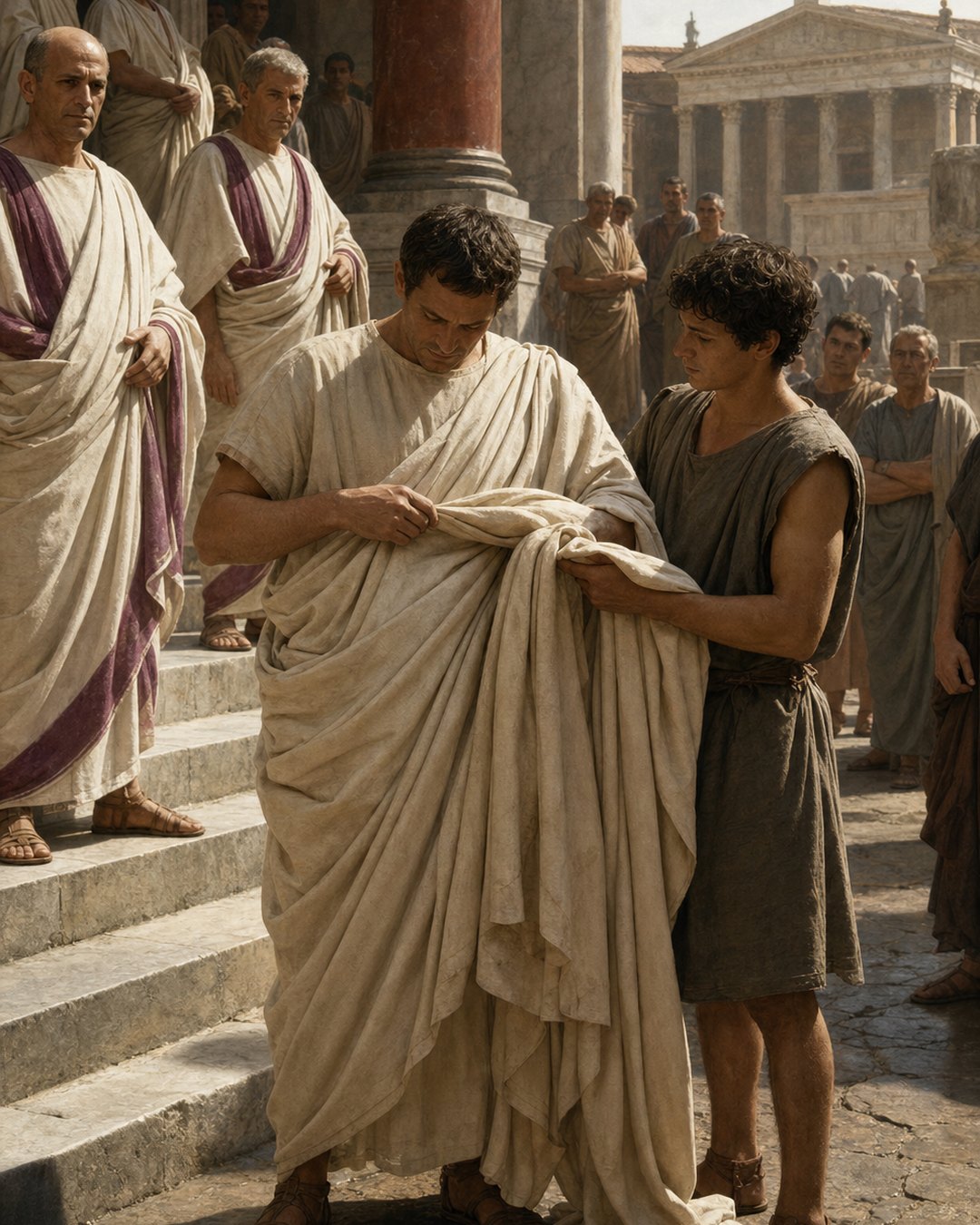
The toga looks effortless in marble because marble cannot complain. On a living body it was a large wool garment that had to be placed, folded, balanced, and carried with care. It restricted the easy movements of work, left its wearer conscious of every shift in the cloth, and made neglect visible to everyone nearby.
Rome turned that inconvenience into a civic signal. A toga was not simply what a Roman happened to wear. It was public dress for courts, patronage, spectacle, and status. Beneath it, tunics and purple stripes sorted bodies further. Before a man spoke, his clothing could announce whether he belonged, what occasion he recognized, and which rank he claimed.
The garment covered a citizen and identified him
Varro connected the name toga with tegere, to cover, and the physical garment justified the derivation. It wrapped the body in a broad field of wool rather than fitting it like a tailored jacket. Roman authors could call their people togati, the toga-wearers, because the outer garment carried an ethnic and civic meaning beyond warmth.
That meaning had boundaries. The evidence collected in the ancient dictionary notes that foreigners and exiles could be forbidden the toga at Rome. Such a rule only works if observers recognize the garment as permission. Cloth became a claim about membership, and the street became one place where that claim could be accepted or challenged.
Tradition linked the toga praetexta, with its bordered distinction, to Etruscan practice. Whether every origin story is exact matters less than the Roman insistence that forms of dress had pedigrees. The garment did not float outside history. It connected a present wearer to offices, ceremonies, and remembered rules.
A public occasion demanded difficult folds
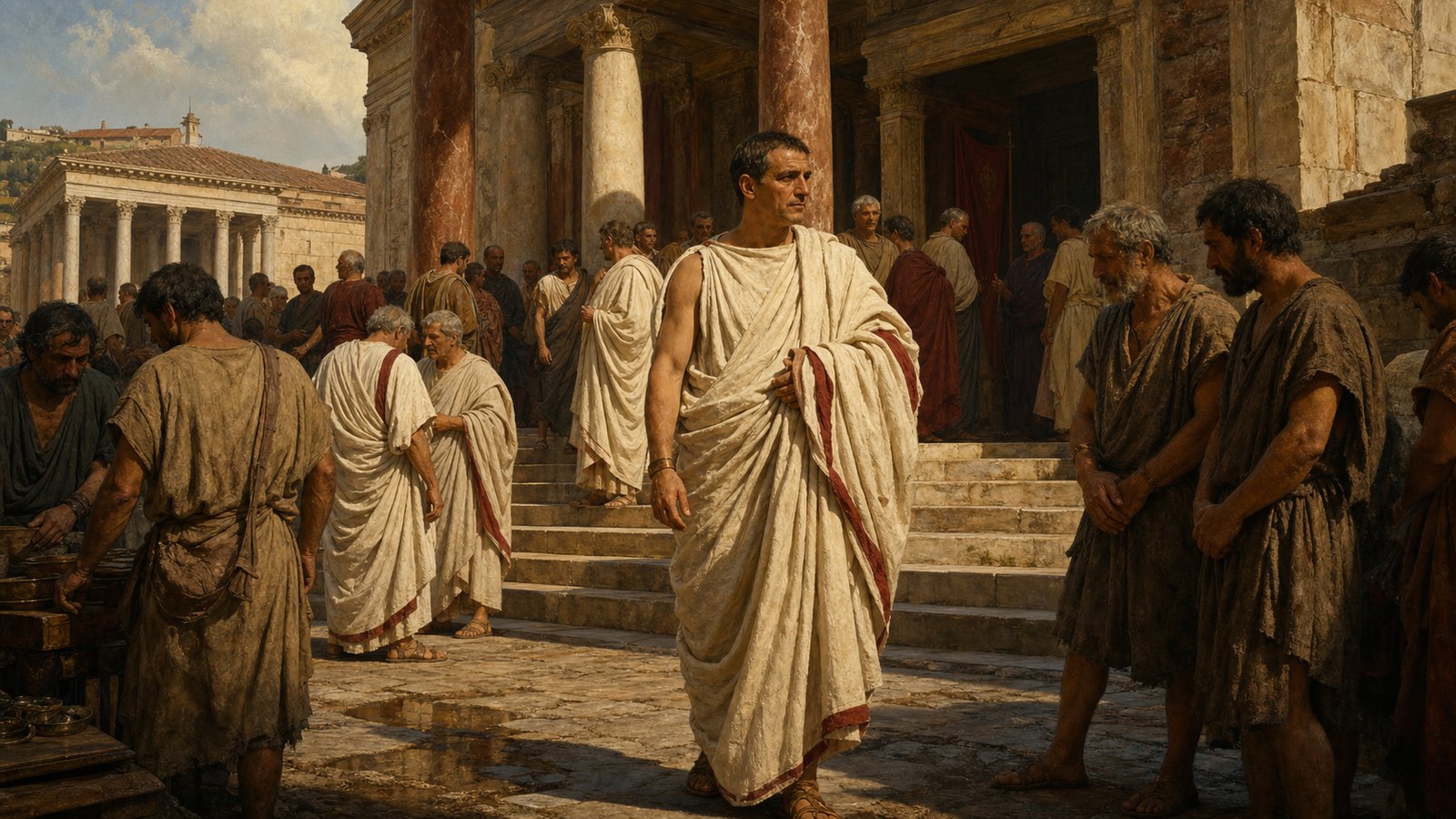
By the imperial period the toga had retreated from ordinary daily use, but it survived where public recognition mattered: courts, client rituals, elite gatherings, theatre, and games under particular conditions. Its decline as work clothing sharpened its role as occasion clothing. A man could be comfortable in a tunic and still need the toga when comfort was not the point.
Quintilian’s instructions preserve a world of arrangement: shape, folds, the front-hanging sinus, and the need to keep the whole composition controlled while speaking. An advocate’s garment could support or undermine his performance. A fold collapsing at the wrong moment was not merely fabric misbehaving; it made discipline look uncertain before judges and spectators.
Picture the court steps at morning. An attendant pulls one edge into line. The wearer frees the arm he will use for gesture. Clients wait while other men pass in plain tunics. No herald needs to explain that this is formal business. The wool has already changed the social temperature of the entrance.
The tunic carried the labor of ordinary movement
Under the toga sat the tunica, a wool garment far better suited to movement. In art, men’s tunics often end above the knee, carry short sleeves, and gather at the waist with a belt. The shape lets legs and arms work. It belongs as naturally to errands, workshops, and travel as the toga belongs to deliberate public appearance.
Early Roman memory imagined the toga worn alone, before the tunic became normal beneath it. Later Romans layered clothing according to weather and position. Suetonius even reports Augustus using four tunics plus an under-tunic in winter. The detail gives the emperor a physical body: cold, layered, and dependent on ordinary wool.
Poor Romans who could not afford the outer garment might appear in the tunic alone and could be described as tunicati. That contrast made economy visible. The absence of a toga did not mean the absence of clothing; it meant the absence of a costly civic surface whose maintenance, draping, and cleanliness demanded resources.
Purple stripes made rank visible at chest height
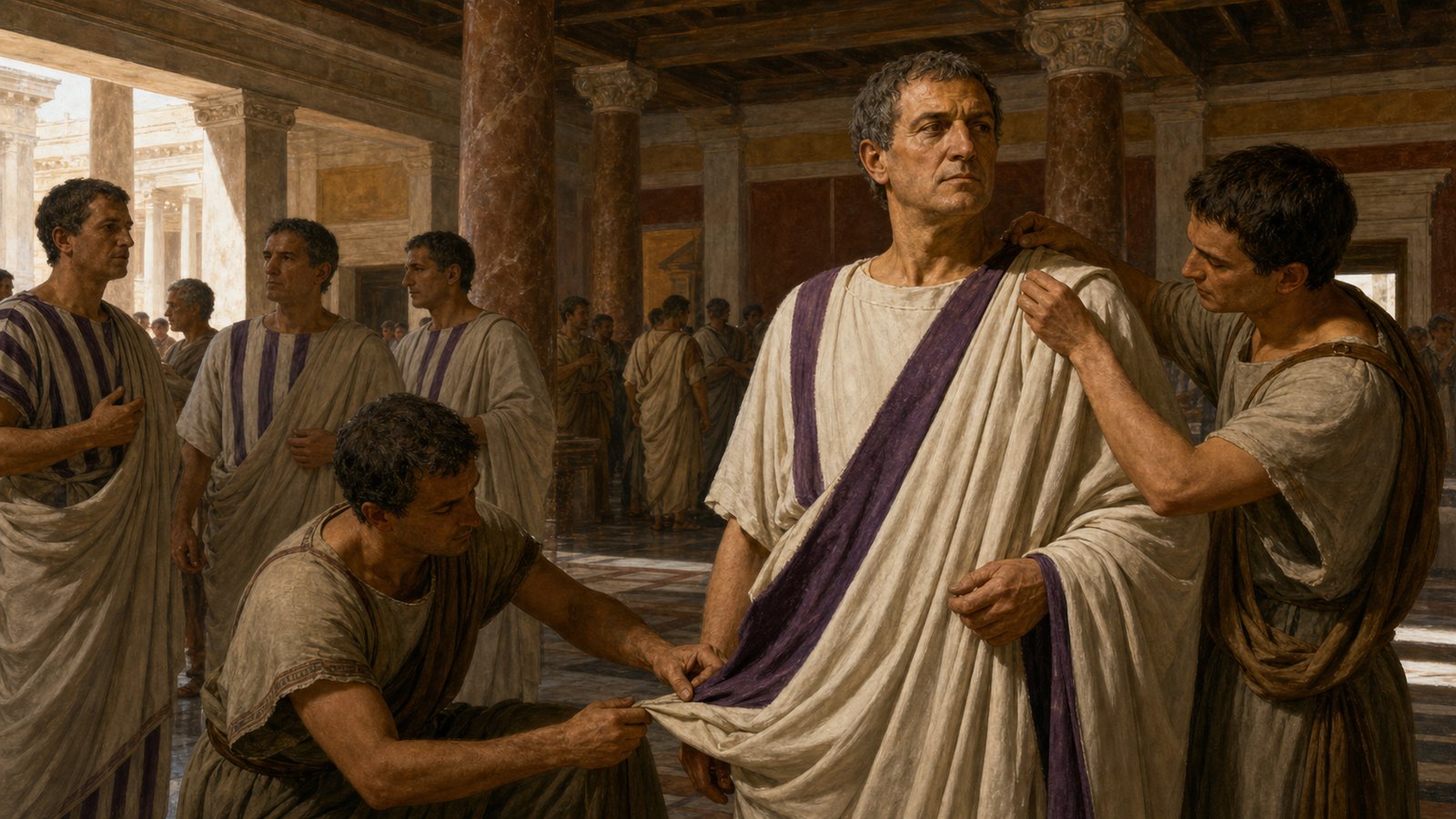
The tunic could also carry office. A broad purple stripe, the latus clavus, ran vertically down the senatorial tunic. Narrower parallel stripes, the angustus clavus, marked equestrian standing. These were not detachable labels pinned on before a meeting. The purple was woven into the garment, making hierarchy part of its construction.
The senatorial tunic was left loose so the broad stripe would lie flat and conspicuous on the chest. That instruction reveals the intended audience. A stripe hidden in folds could not do its work. Rank had to face outward, where another person could read it before deciding how to greet, petition, defer, or compete.
This differed from the portable authority of the curule chair. The chair marked an occupied position in civic space. The stripe traveled on the body. One furnished the magistrate’s place; the other made order visible while its wearer crossed the room.
Dress rules worked because Romans watched one another
A dress code needs no modern rulebook at the door if a community already knows what looks wrong. Toga, tunic, stripe, fold, sleeve, belt, and occasion gave observers many points of judgment. Clothing could be too casual, too ambitious, too old-fashioned, badly arranged, or reserved for a status the wearer did not possess.
That scrutiny explains why the garment’s inconvenience mattered. A toga demanded time and often help. It limited the wearer while displaying that he had recognized the occasion. The effort itself became a form of respect, just as arriving at court or patron’s house acknowledged that the meeting belonged to public ritual rather than private ease.
The same social eye animated ranked seating in the amphitheatre. There, bodies were sorted by place. In civic clothing, they were sorted by surface. Rome repeatedly built hierarchy into things a crowd could see without needing to read.
Marble preserved dignity and hid the struggle
Statues make the toga seem calm because sculptors selected the finished arrangement. They preserve the fall of cloth after the tugging, waiting, and correction have ended. The living process was less serene: weight shifting across a shoulder, an arm managing the front folds, sandals negotiating steps, and wool responding to heat or rain.
That gap between image and use is useful. Roman public authority often depended on making preparation disappear. The viewer saw the composed citizen, not the attendant who had helped him dress. The apparent ease of rank rested on labor, fabric, instruction, and the threat of visible failure.
A toga was Rome’s public dress code because it converted citizenship and occasion into a bodily task. It covered a man, but it also exposed him to judgment. Every fold asked whether he knew the rules, every stripe declared a place in the order, and every plain tunic nearby made the claim easier to see.
The garment also changed gesture. Quintilian’s concern with arrangement belonged to oratory because an advocate had to move an arm without destroying the composition across his chest. Cloth trained the range and rhythm of public performance. A speaker carried not only an argument but a carefully managed surface that could betray haste, vanity, or inattention.
Weather added another test. Wool that looked controlled on dry marble steps could become hot, dusty, or heavy, while the tunic beneath remained the practical layer against the skin. Formal dress asked the wearer to subordinate immediate ease to a shared expectation. That bargain made civic belonging feel physical long before anyone named it as identity.
Cleaning and preparation mattered too. Roman fullers turned stained cloth into a commercial problem, but the toga made the result politically visible. A bright, arranged outer garment advertised resources and attention; grime or collapsed folds threatened the image at the exact moment the wearer sought recognition.
Sources & Further Reading
- Smith Dictionary, Toga
- Smith Dictionary, Tunica
- Smith Dictionary, Clavus Latus