
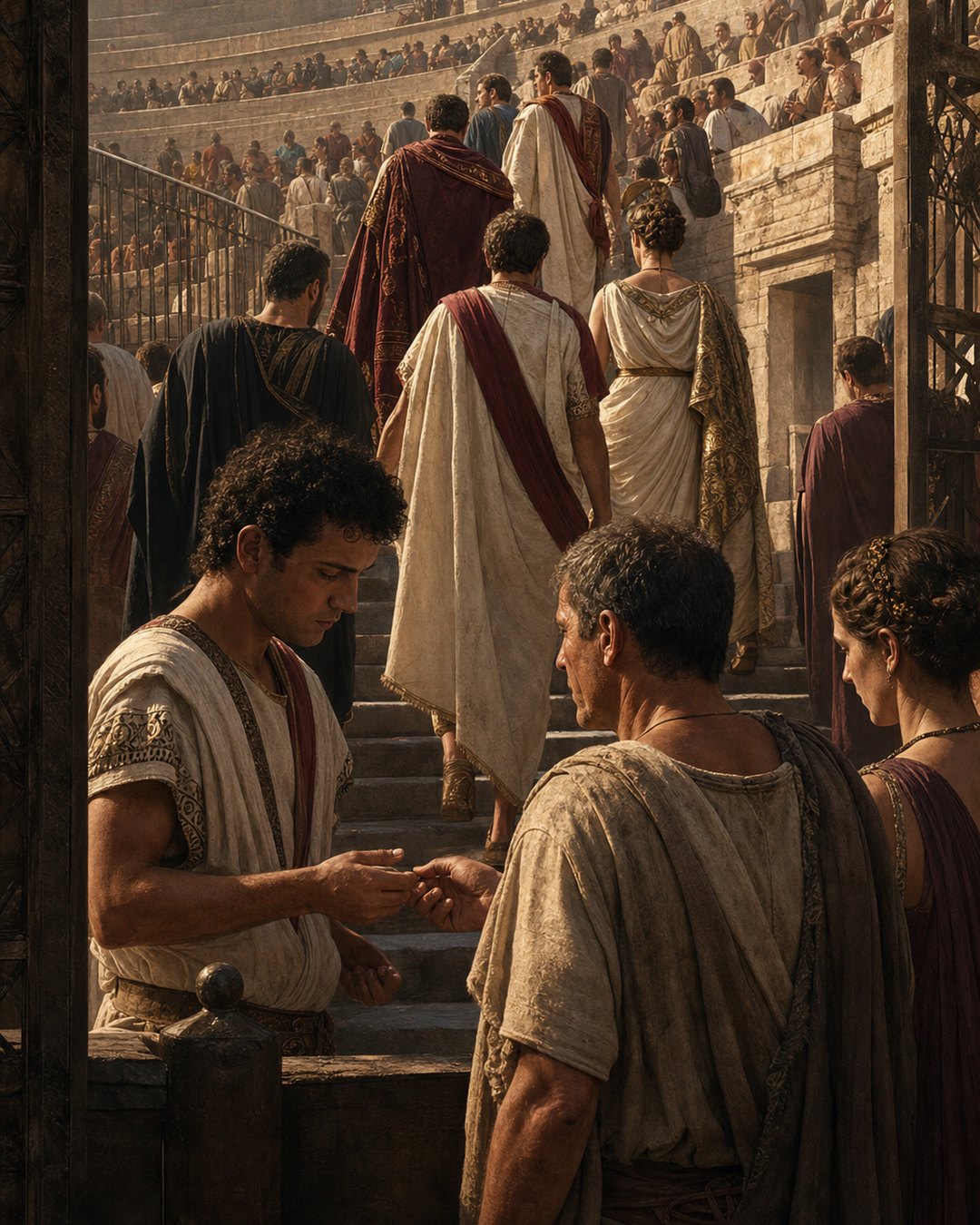
A Roman amphitheater could make thousands cheer at once, but it did not make them equal. The building gathered people together while quietly reminding them that public unity had an order.
Roman amphitheater seating made status visible because entry, passage, and position turned the crowd into a map. Entertainment happened in the arena; hierarchy happened all around it.
The building organized the crowd before the show began
The amphitheatrum was built for spectacle, but spectacle required more than an open space. It needed approaches, stairs, tiers, barriers, and sightlines that could gather bodies without letting them dissolve into confusion.
That architecture did a political job. It made a mass audience look governable. People entered by routes, climbed through passages, and settled where the structure permitted them to settle.
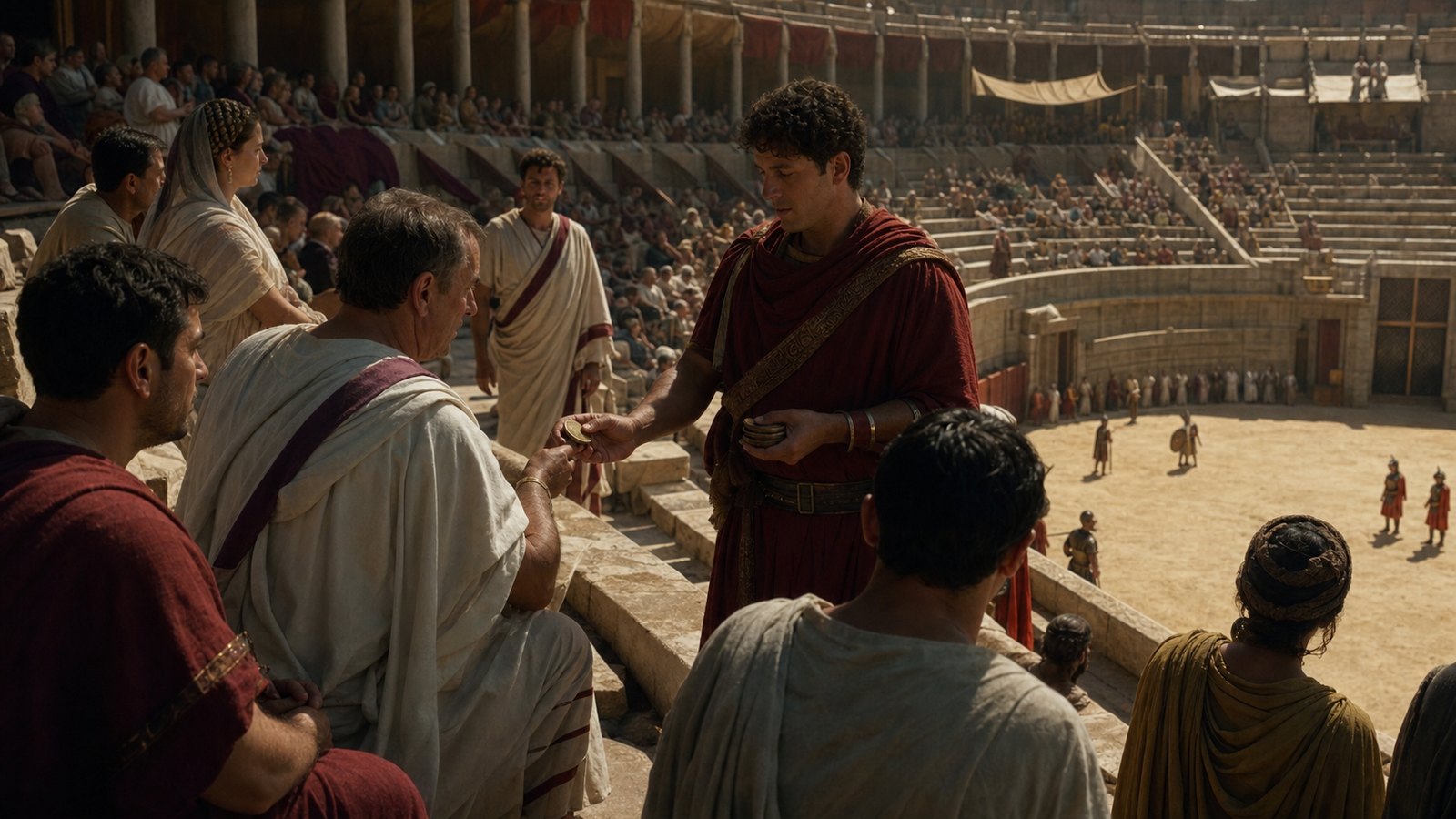
A small token could carry a public instruction
A tessera might be small enough to hold in the hand, but it could turn access into evidence. A token told an attendant that someone had a right to enter, receive, or sit in a particular way.
Imagine the mini-scene at the entrance: dust on sandals, a hand opening around a token, an attendant glancing down, the line pausing for half a breath before the spectator is sent toward a stair. The arena has not yet spoken, but order has.
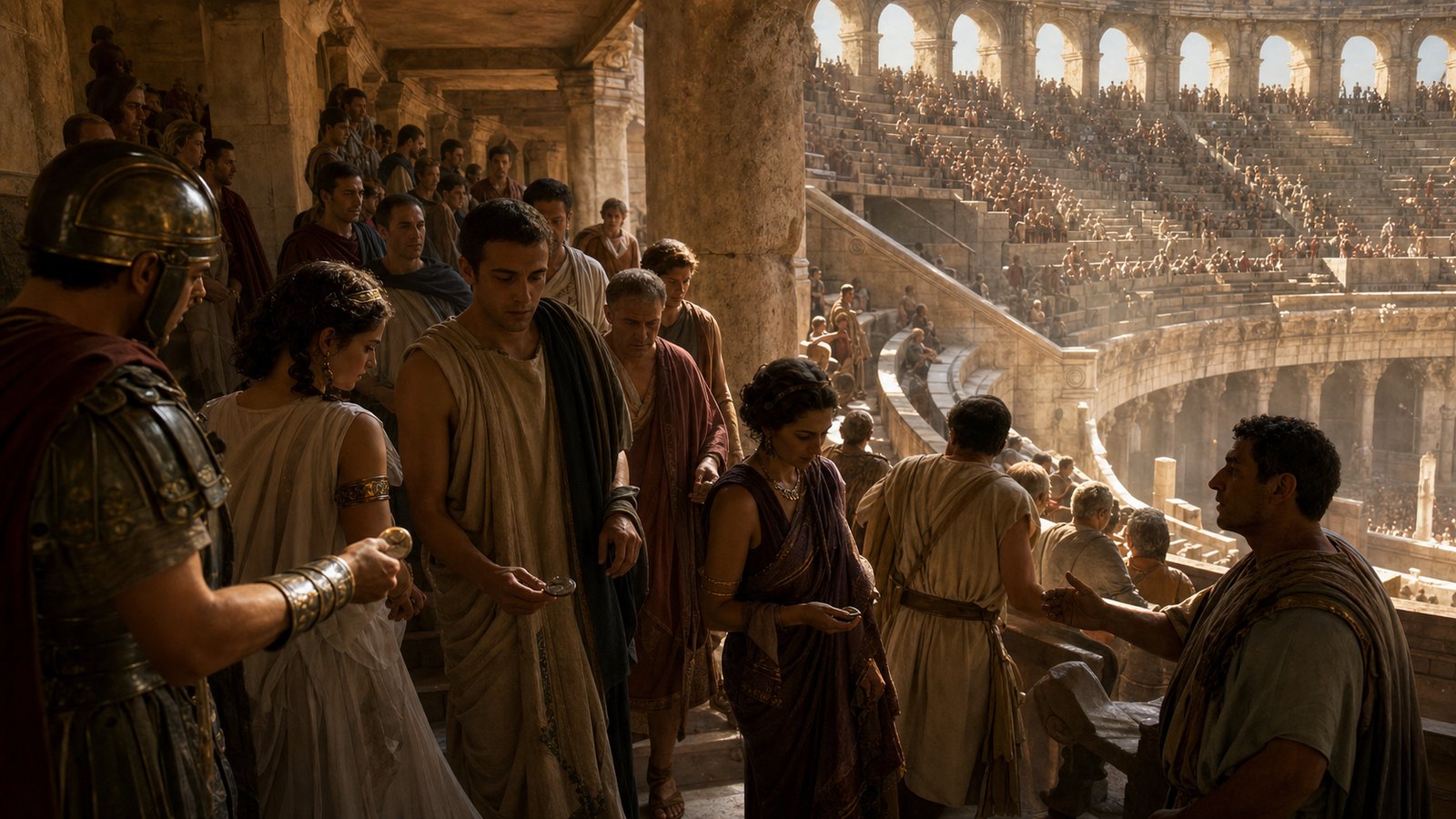
The audience watched itself
The most important view was not always downward toward sand. Spectators could see other spectators: who sat close, who sat higher, who moved through better passages, who waited, and who was checked at the gate.
This made status physical. Rank was not only a title or private reputation. It occupied stone. It could be recognized by distance from the arena, ease of movement, and the social company around a seat.
Entertainment turned order into habit
Because the amphitheater was pleasurable, its order could feel natural. People came for noise, animals, athletes, condemned bodies, skill, danger, and release. Yet they also practiced a civic lesson: public life has places, and places have meanings.
The genius of this arrangement is that it required little explanation once repeated. A person learned where to go because the route, the token, the attendant, and the crowd all taught the same lesson.
Stone made hierarchy durable
A temporary queue disappears. A stone tier remains. Amphitheater seating translated social difference into a form that could be used again and again, event after event.
That did not mean every spectator reflected on hierarchy every time. Most probably wanted the show to begin. But the building kept doing its work anyway, making rank visible while the crowd believed it had gathered simply to watch.
This is why an amphitheater belongs in the history of Roman order, not only in the history of leisure. The arena staged action, but the seating staged society. The whole building made a public argument about where bodies should be.
The forum also reminds us that Roman public life valued visibility. People were used to being seen, noticed, approached, followed, and remembered in shared spaces. The amphitheater intensified that habit by arranging an enormous audience into one curved field of vision.
A token mattered because it made access inspectable. Without it, a claim to place could become a quarrel. With it, the right to move could be checked quickly by someone who did not need to know the whole person.
That speed is important. Large crowds are dangerous when access depends only on argument. Tokens, passages, and tiers made order faster than personal negotiation. They converted rank and permission into a routine that could survive noise.
The result was not merely control from above. Spectators helped enforce the arrangement by recognizing when someone seemed out of place. A crowd that has learned the map can become part of the map’s discipline.
There is a strange intimacy in that. People sharing a spectacle also shared knowledge of separation. They laughed, shouted, gasped, and watched together, but they did so from positions that reminded them how Roman society sorted bodies.
The amphitheater therefore joined pleasure to pedagogy. It taught without a schoolroom. It made hierarchy memorable through stairs, heat, shade, distance, and the visual comparison of one section with another.
A Roman could leave remembering the show, but the body had also remembered the route: where to wait, where to climb, where not to go, who passed more easily, and how public stone could turn social order into common sense.
The practical details made the lesson stronger. A spectator did not need to be told in abstract language that rank mattered; he felt it while moving through the building. The stair, the attendant, the line, and the token each reduced social order to a small bodily instruction.
This also made conflict easier to manage. A person stopped at the wrong passage could be corrected by reference to the route and the token rather than by an argument about dignity. Architecture gave officials a way to turn personal status into operational order.
The arena below made the contrast sharper. Violence, skill, danger, and spectacle were presented as a common Roman experience, while the seating quietly insisted that common experience had graded access. The crowd could be unified by noise and divided by stone at the same time.
For elite Romans, proximity and ease of movement could confirm public standing. For poorer spectators, the building still offered participation, but it often did so from places that taught distance. Inclusion and hierarchy were not opposites here; they were designed to work together.
The amphitheater therefore transformed leisure into a repeated census of visibility. Each event gathered the city, sorted it, displayed it, and let people internalize where they and others appeared inside Roman order.
Even the moments before the spectacle counted. Approaching the entrance, finding the proper passage, and waiting for an attendant meant that the audience encountered order before excitement. Rome made the route into part of the event.
The tessera was especially useful because it reduced a social fact to a thing that could be shown. A person might argue about importance, but a token could be accepted, rejected, or directed. The small object helped the large building operate.
This also shows why Roman public entertainment could support authority without being a simple sermon. People came for release, but the practical management of release still rehearsed obedience, rank, and visibility. The crowd learned order while seeking pleasure.
By the time the arena filled with sound, the seating had already finished its quieter performance. Rome had made a city-sized audience appear arranged, legible, and contained.
The memory of that arrangement could follow spectators home. They had seen who sat above them, below them, beside them, and nearer the action. The spectacle ended, but the social diagram remained available for conversation, envy, pride, and recognition.
That is what made the amphitheater more than a container. It was a civic instrument that turned entertainment into a lesson in place, teaching Roman crowds to experience hierarchy as something built into the pleasure of being together.
Sources & Further Reading
- Smith Dictionary, Amphitheatrum
- Smith Dictionary, Tessera
- Smith Dictionary, Forum