
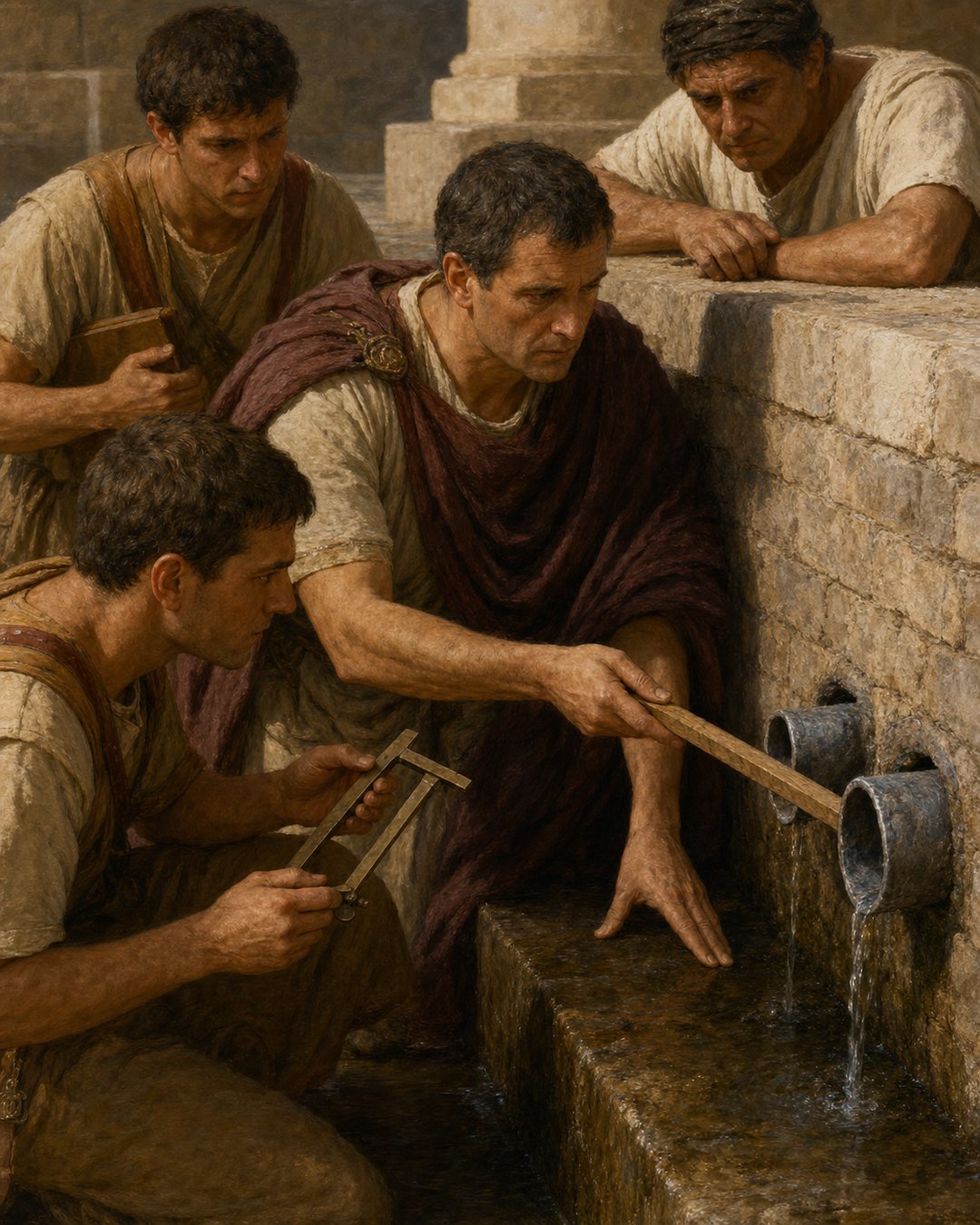
Rome’s stolen water disappeared through openings small enough to hide beneath a street.
When Frontinus audited the aqueduct system, he found discrepancies at every scale. Claudia carried 4,607 quinariae at its intake although official records credited it with 2,855. Before the flow reached a settling reservoir, legitimate grants and secret diversions had already reduced it. Farther inside the city, altered fittings and concealed branches sold public water to private customers.
The fraud did not depend on breaking the monumental arches that still define the aqueduct in modern photographs. It occupied the less celebrated junctions: reservoir walls, bronze outlets, lead pipes and pavement trenches. Whoever controlled the diameter, level or continued existence of a connection could change distribution while leaving an impressive waterway apparently intact.
Frontinus’s answer was administrative and physical at once. He compared records with measurements, required certified outlet sizes, insisted that adjoining pipe remain the same bore for fifty feet and removed secret branches. The audit became effective only when words, numbers and hardware told the same story.
The intake exposed a quantity missing from the books
Frontinus begins his reconstruction by measuring what the aqueducts actually carried. Claudia was especially vulnerable, he says. The records assigned it 2,855 quinariae at the intake; he found 4,607. The difference of 1,752 was not a rounding error. It revealed how little the inherited account could explain.
At the seventh milestone, where he trusted the settling-reservoir measurement, Claudia still carried more than the records acknowledged. Yet it also carried less than the intake and authorized deliveries alone could justify. Frontinus says a great deal was being taken secretly before the reservoir.
He found a similar pattern in distribution. Recorded totals, intake measurements and delivered water refused to reconcile. Confusion helped conceal loss: Claudia’s clear water was mixed with New Anio inside the city, making both quantity and allocation harder to follow.
The numerical audit mattered because theft could otherwise appear as natural shortage. A dry fountain might be blamed on source, weather or repair. By measuring at successive points, Frontinus turned absence into a location problem. Water existed upstream and vanished before its public destination.
Aqueduct inspection made trust depend on repeated observation rather than monumental appearance. Frontinus shows the sharper consequence: without independent figures, the distribution office could inherit a fiction and administer it as fact.
A stamped opening was supposed to bind grant to flow
Private water rights required a controlled connection. A Senate resolution quoted by Frontinus directed recipients to draw from public reservoirs rather than cut directly into conduits. For fifty feet beyond the reservoir, the attached pipe was to match the interior area of the approved outlet.
The outlet, often translated as an ajutage or calix, converted an abstract grant into a metal aperture. Its internal size limited what could pass. The deputy was supposed to have it stamped according to the quantity authorized and to understand both its dimensions and placement.
Frontinus found the rule defeated in several ways. Some outlets were larger than the grant. Others lacked stamps. An oversized stamped fitting implicated the official who certified it; an unstamped one distributed responsibility among grantee, overseer and administration.
Even a correctly sized outlet could be undermined by attaching a larger pipe immediately after it. Frontinus explains that the short restriction then fed the broader pipe more easily than the prescribed fifty-foot run would have allowed. The fraud exploited transition, not merely diameter.
Lead pipes could make a water right physically legible, but metal alone did not guarantee honesty. A pipe became evidence only when its bore, stamp, location and relation to the grant remained controlled.
Height and abandoned outlets created invisible advantages
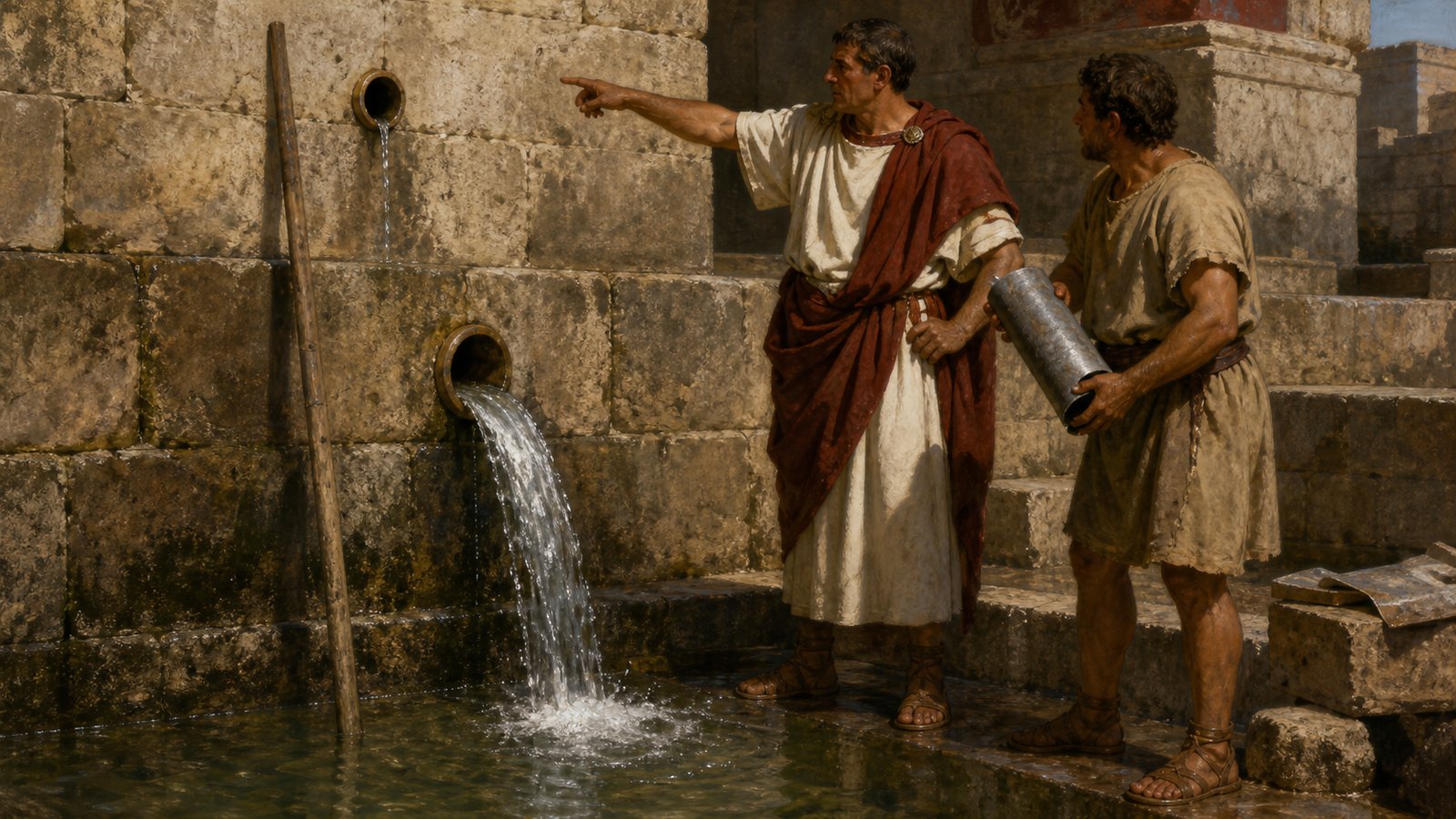
Placement altered flow as well as size. Frontinus warns that outlets must sit level. A lower one drew more water; a higher one drew less. Equal diameters could therefore produce unequal results if they entered the reservoir at different heights.
Some connections had no controlling outlet at all. Frontinus calls them uncontrolled: they could be enlarged or reduced as users pleased. The absence of one small component removed the administration’s physical limit.
Transfer created another opportunity. When a water right passed to a new owner, water-men inserted a new outlet but left the old one in the reservoir. They then drew through the abandoned opening and sold that water. A paperwork change intended to move one entitlement produced two working paths.
Frontinus objects not only because the water was stolen. Repeatedly cutting reservoirs made them leaky. Corruption therefore damaged both allocation and infrastructure. The illicit connection consumed public flow while weakening the structure from which it was taken.
These schemes depended on ordinary maintenance knowledge. The people who understood where to place fittings and how flow responded to bore and height could use the same expertise to defeat the system. Technical competence had no automatic moral direction; oversight had to make each intervention accountable.
Puncturers sold branches beneath commercial streets
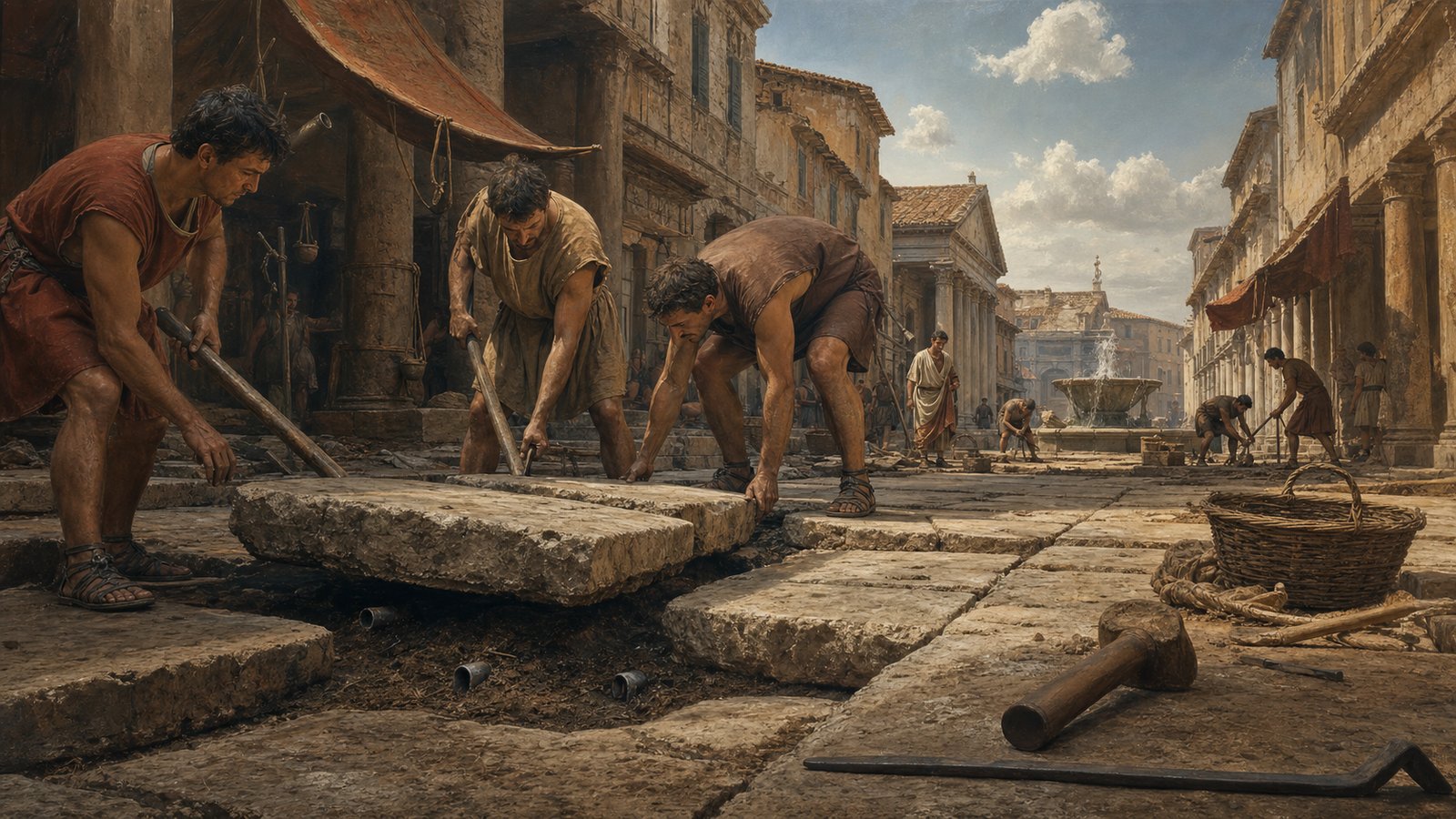
The most vivid practice ran under pavements. Frontinus calls it “puncturing.” Secret pipes crossed extensive areas of the city, and specialists bored branches from them toward businesses along their routes. Water intended for public supply became a commodity sold connection by connection.
The street hid the network twice. Paving concealed the lead, while normal commercial activity disguised the customers. A shop receiving a private trickle did not announce which fountain had lost it. Many small sales accumulated into a public shortage.
Frontinus says only a small quantity reached the places of public distribution as a result. That phrase reveals the social direction of the theft. It was not water lost into soil. It arrived somewhere useful, but access followed private payment rather than civic allocation.
Removal supplied its own evidence. Frontinus estimated the scale from the considerable quantity of lead brought in when the illegal branch pipes were taken out. The material recovered from beneath the streets became an audit trail after the water itself had flowed away.
His reform did more than expose dishonest individuals. It linked measurement at the source to control at the final junction. Intake totals, reservoir levels, stamped fittings, fifty feet of matching pipe and recovered lead all belonged to one chain of proof.
Rome’s grand system depended on honest small parts
Aqueduct history often celebrates gradients, arches and distances. Frontinus forces the eye down to the outlet. A system capable of carrying water across miles could still fail its public purpose in the final inches.
The frauds also explain why law alone was insufficient. Senate resolutions had already described proper connections. The rules were defeated by fittings larger than their stamps, pipes larger than their fittings, outlets set at advantageous levels and old openings never removed.
Frontinus responded by making inspection specific enough to catch each evasion. Officials needed to know not simply that a grantee possessed a right, but exactly what opening embodied it and what pipe continued from it. Accountability moved from archive to reservoir wall.
His account is self-presenting and should not be treated as a neutral modern engineering report. Yet the details he chose are concrete and mutually connected. They show how an administrator represented corruption: as a mismatch among recorded quantity, measured quantity and built connection.
Rome’s water was stolen through technical intimacy. The same hands that kept flow moving knew where a hidden branch would work. Frontinus restored public supply by following that knowledge into the small places where infrastructure became negotiable.
Sources
Frontinus, On the Aqueducts of Rome 72, 75, 105–115