
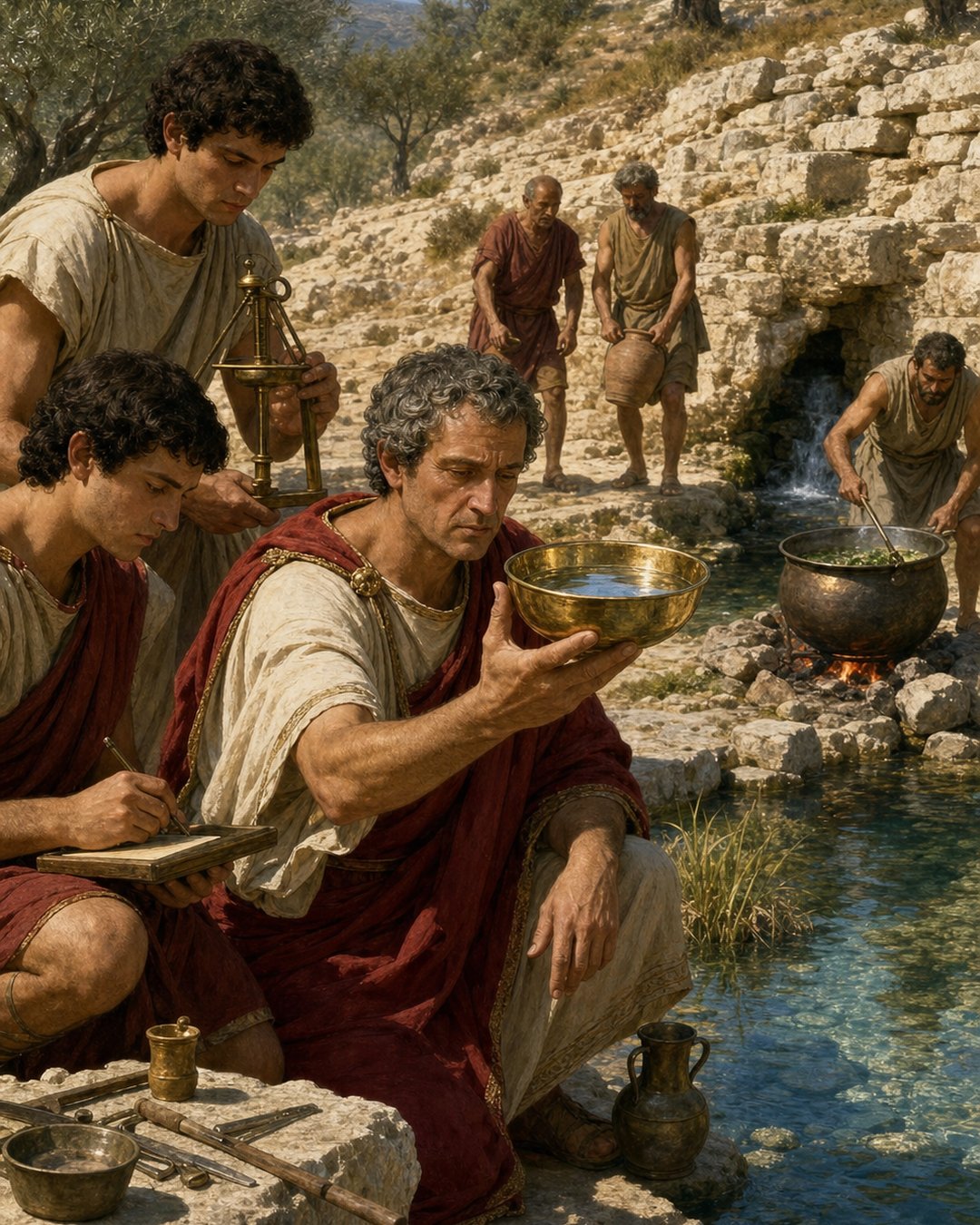
Before water entered a conduit, Vitruvius wanted the architect to look at the people already drinking it.
Were their limbs strongly formed? Did they have fresh colour, sound legs and clear rather than blear eyes? Then came tests on the water itself. A drop from a new spring should leave no stain on good brass. Boiling should leave no sand or clay in the cauldron. Vegetables should cook quickly.
None of this is modern chemistry or microbiology. Vitruvius could not identify pathogens, measure toxic concentrations or run controlled population studies. Yet his chapter does something more disciplined than accepting sparkle as proof. It gathers consequences across bodies, metal, heat, food and the spring’s environment.
The procedure belongs inside architecture because choosing a source determined what an entire settlement might drink. Beauty in a fountain downstream could not repair a bad decision upstream. For Vitruvius, public building began with observing what water did.
Long exposure appeared in neighbouring bodies
Vitruvius introduces the problem with urgency. Human beings can survive shortages of grain by turning to fruits, meat, fish or other foods, he says, but neither animals nor food production can exist without water. Choosing springs therefore deserves the greatest diligence and labour.
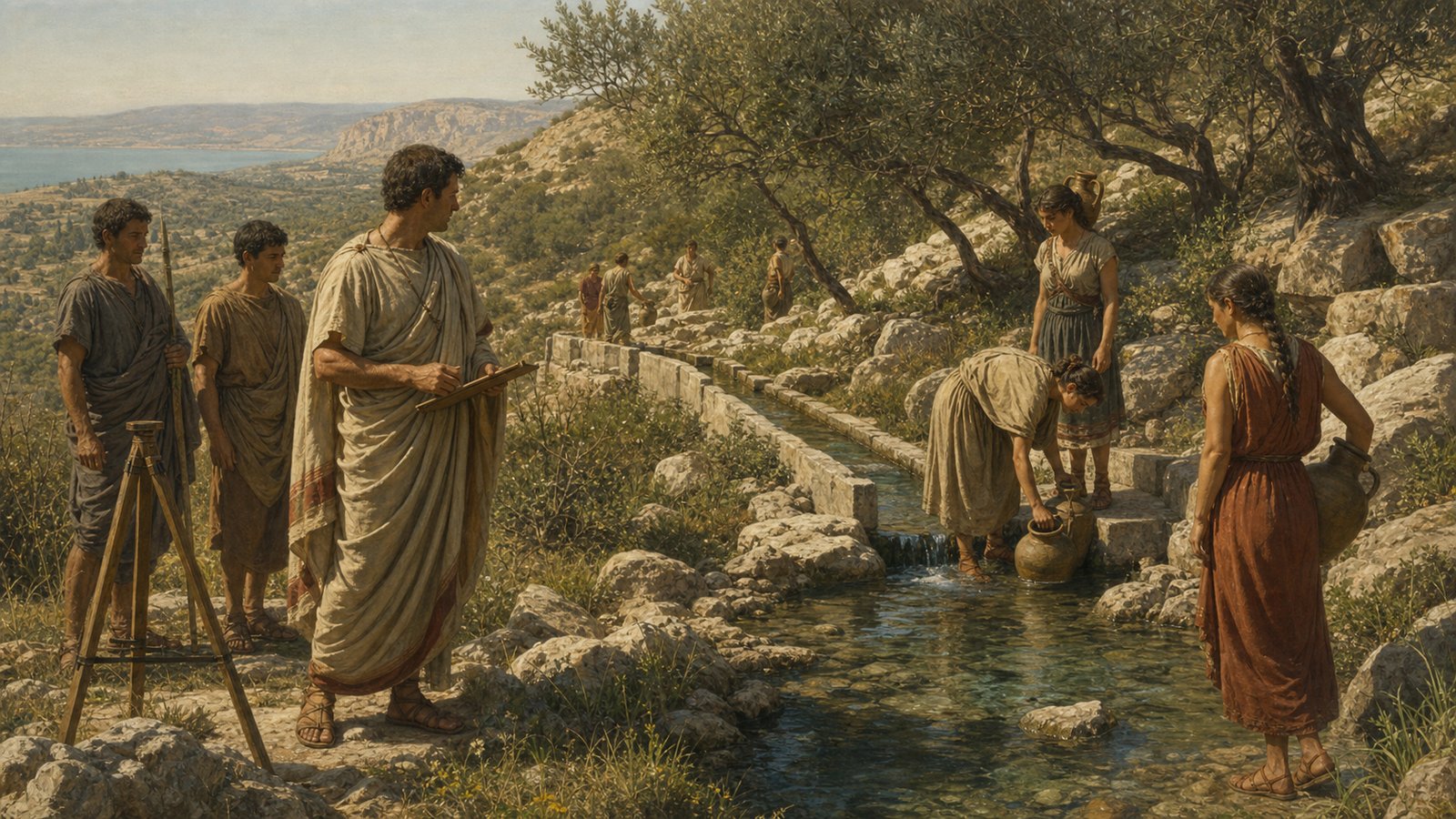
His first test for an open running source is social rather than mechanical. Inspect the inhabitants nearby. Strong bodies, healthy colour, sound legs and untroubled eyes suggest good water. The community becomes a record of repeated exposure.
This reasoning has obvious limits. Appearance reflects diet, labour, wealth, inherited conditions and many diseases besides water. Vitruvius offers no comparison group and no duration. A population could also grow accustomed to a source while visitors reacted differently.
Still, the test recognizes a crucial principle: a water supply should be judged by effects over time, not only by how it looks in one cup. Local bodies contain information that a traveller’s quick taste cannot provide.
Frontinus later followed Rome’s water through measurements, grants and illegal pipes. Vitruvius stands earlier in the chain. Before administration can protect quantity, someone must decide that the source is suitable to carry at all.
Brass and boiling searched for what clear water concealed
For a newly dug spring, there may be no established community to inspect. Vitruvius therefore shifts from accumulated human evidence to portable tests. A drop is placed in a Corinthian vessel made of good brass. If it leaves no stain, the water is judged excellent.
The polished metal acts as a surface on which dissolved or suspended matter might declare itself after the liquid is gone. Vitruvius does not specify the chemistry of every possible stain. The practical test asks whether apparently clear water changes a valued material.
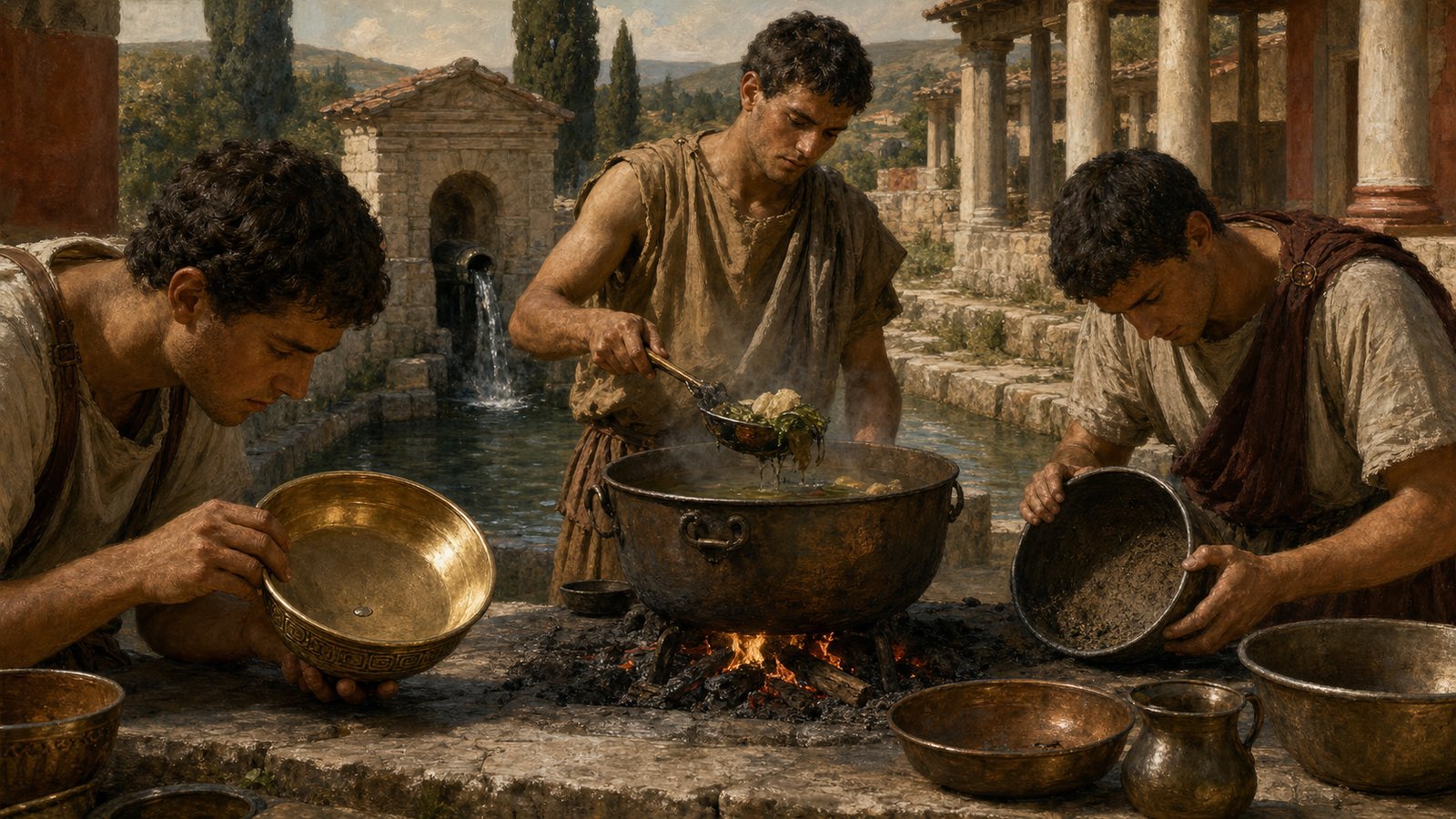
Boiling enlarges the investigation. Water heated in a cauldron should leave no sand or clay at the bottom. Heat and evaporation expose residue that movement in a spring may keep dispersed or difficult to see.
The test does not prove that water without visible sediment is safe. Many harmful substances leave no obvious deposit, and boiling changes some hazards but not others. The historical interest lies in the attempt to make hidden content produce a visible trace.
The article on Archimedes using water to expose hidden silver in a crown also depends on indirect evidence. There, overflow translates volume; here, stain and sediment translate material carried by water. In both stories, a second effect answers a question appearance cannot settle.
Vitruvius’s insistence on good brass is also revealing. A test surface must be trusted before the mark upon it can be trusted. Dirty, corroded or reactive metal could confuse evidence with the condition of the vessel itself.
Vegetables turned water quality into kitchen time
Another test moves into cooking. If vegetables become tender quickly in a vessel full of the water, Vitruvius calls the source good and wholesome. The criterion translates mineral qualities into fuel, time and texture.
Hard water can affect how some foods soften, although Vitruvius does not explain the process in modern terms. His test remains experiential. A cook does not need to name dissolved minerals to notice that one pot refuses to tenderize food while another succeeds.
This kitchen measure broadens the definition of useful water. A city supply must do more than pass the lips without immediate distress. It must work in daily transformations—boiling, soaking and preparing plants for meals.
The choice of vegetables also makes the test repeatable with ordinary materials. It needs no rare instrument beyond a vessel, fire and food whose cooking behaviour is familiar. The household becomes a modest testing ground for infrastructure.
Cooking speed is not perfectly controlled. Vegetable age, size, species, fire intensity and pot shape all matter. Vitruvius gives a sign, not a standardized protocol. A careful modern reader can acknowledge that weakness while recognizing the observational habit behind it.
Taken together, brass, cauldron and vegetables test different consequences. Staining concerns interaction with a surface; residue concerns material left behind; cooking concerns performance under heat. Agreement among them is more persuasive within Vitruvius’s framework than any one result.
The spring’s surroundings completed the judgement
Vitruvius finally returns outdoors. Good water should be limpid and transparent. Its channel should not generate moss or reeds, and filth should not gather nearby. Everything around the source ought to present a clean appearance.
This ecological reading can mislead if turned into an absolute rule. Reeds and moss are not automatically signs of poison, while dangerous contamination can occur in water that looks pristine. The chapter reflects ancient environmental inference, not a universal diagnostic law.
Yet the surrounding landscape matters for sound reasons. Stagnation, waste, muddy inflow and decaying material can affect a source. Vitruvius refuses to isolate a sample from the place producing it. Water and catchment form one system of observation.
The sequence is especially notable. He does not begin and end with clarity. Clear appearance is only one sign after local health, brass, sediment and cooking. The most seductive quality of water—its brightness—must agree with less glamorous tests.
After this chapter, Vitruvius turns to conveyance, levelling and the chorobates. The order makes engineering conditional on source judgement. Measuring a gradient accurately is pointless if the gradient carries unsuitable water.
The procedure also assigns ethical weight to architecture. A poor spring selected carelessly distributes the architect’s error across kitchens and bodies. Diligence at the source is therefore a public-health responsibility, even if the available tests are imperfect.
Vitruvius’s brass bowl, boiling pot and bundle of vegetables are not relics of a laboratory that almost became modern. They belong to a different knowledge system, built from craft observation and visible signs. Their sophistication lies in refusing one easy answer. A spring earns confidence only when people, objects, food and place tell a compatible story.
Scale made the decision unforgiving. A bad household jar could be emptied; a source connected to masonry, gradients and distribution works would be expensive to abandon. Preliminary tests conserved labour as well as health by moving doubt ahead of construction.
The chapter also implies that the architect must listen beyond his own profession. Residents supply bodily evidence, metalworkers supply a trustworthy vessel, cooks know how vegetables usually soften, and labourers read mud and growth around the source. Vitruvius gathers those observations under architectural judgement without pretending that geometry alone can choose drinking water.
What results is a practical dossier rather than a single proof. Its errors are ancient, but its sequence remains intellectually recognizable: compare several independent signs, inspect both source and consequences, and hesitate before turning a local stream into a public dependency.
Sources
Vitruvius, On Architecture 8.3.28–8.4.2