
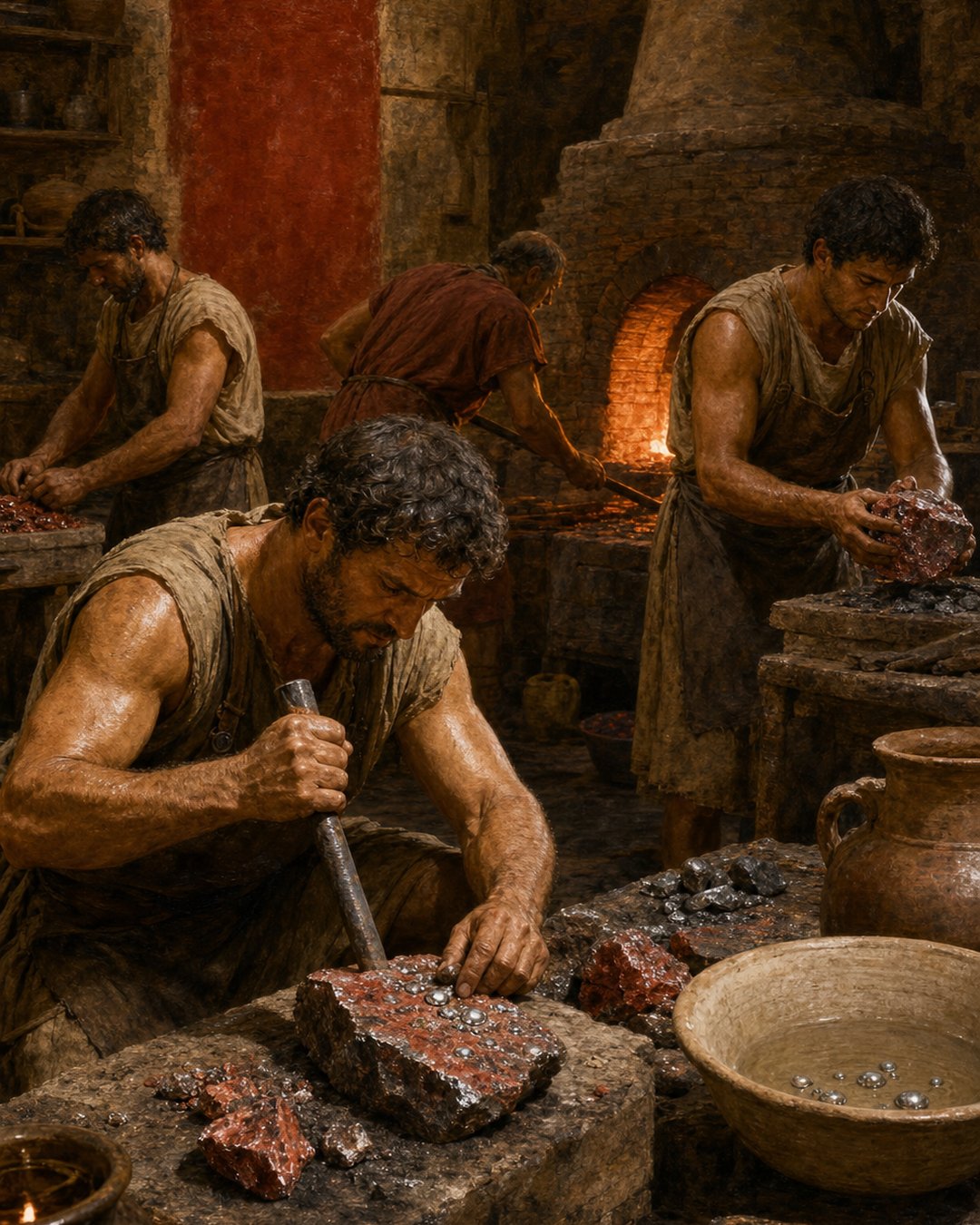
The red clod did not enter the house as paint. First it sweated silver liquid under blows from iron bars.
Vitruvius describes mineral material from the Ephesian region with red veins and dust. Workers struck it until drops of quicksilver appeared. More metal condensed from furnace fumes, too fine to gather individually, so it was swept into water where the droplets reunited.
The remaining material was dried, pounded, washed and dried again until it became vermilion. Even then the chain was unfinished. Sun and moon could darken the brilliant surface, while wax, oil, heat and polishing might preserve it.
A Roman wall’s colour therefore rested on mining, dangerous material behaviour, workshop separation and continuing knowledge of light. Vitruvius’s account follows decoration backward into labour. The finished red concealed a process far more complicated than choosing a shade.
Iron blows released a liquid metal from red stone
Vitruvius says vermilion was first discovered in the Cilbian fields near Ephesus. Before processing, the clod was called Anthrax. It showed veins resembling iron, red in colour, with red dust surrounding them.
Once dug, the material was beaten with iron bars. Drops of quicksilver emerged and were collected immediately. The scene overturns ordinary expectations of metal. A hard red stone yields bright liquid beads that move and combine rather than remaining as chips.
Vitruvius does not describe protective equipment, ventilation or workers’ health in this chapter. Modern readers know mercury exposure is dangerous, but it would be inaccurate to insert a documented poisoning scene he does not provide. The source itself is already physical enough: impact, dust, droplets and hurried collection.
The ore was valuable because it contained more than one useful outcome. Quicksilver served gilding and gold recovery; the processed solid became a celebrated red. The workshop’s skill lay in separating behaviours that had shared one geological body.
Soot and gum became writing ink through controlled collection and mixing. Vermilion demanded a harsher route. Instead of capturing smoke for black, workers fractured and heated ore to divide red pigment from mobile metal.
A furnace caught what the first collection missed
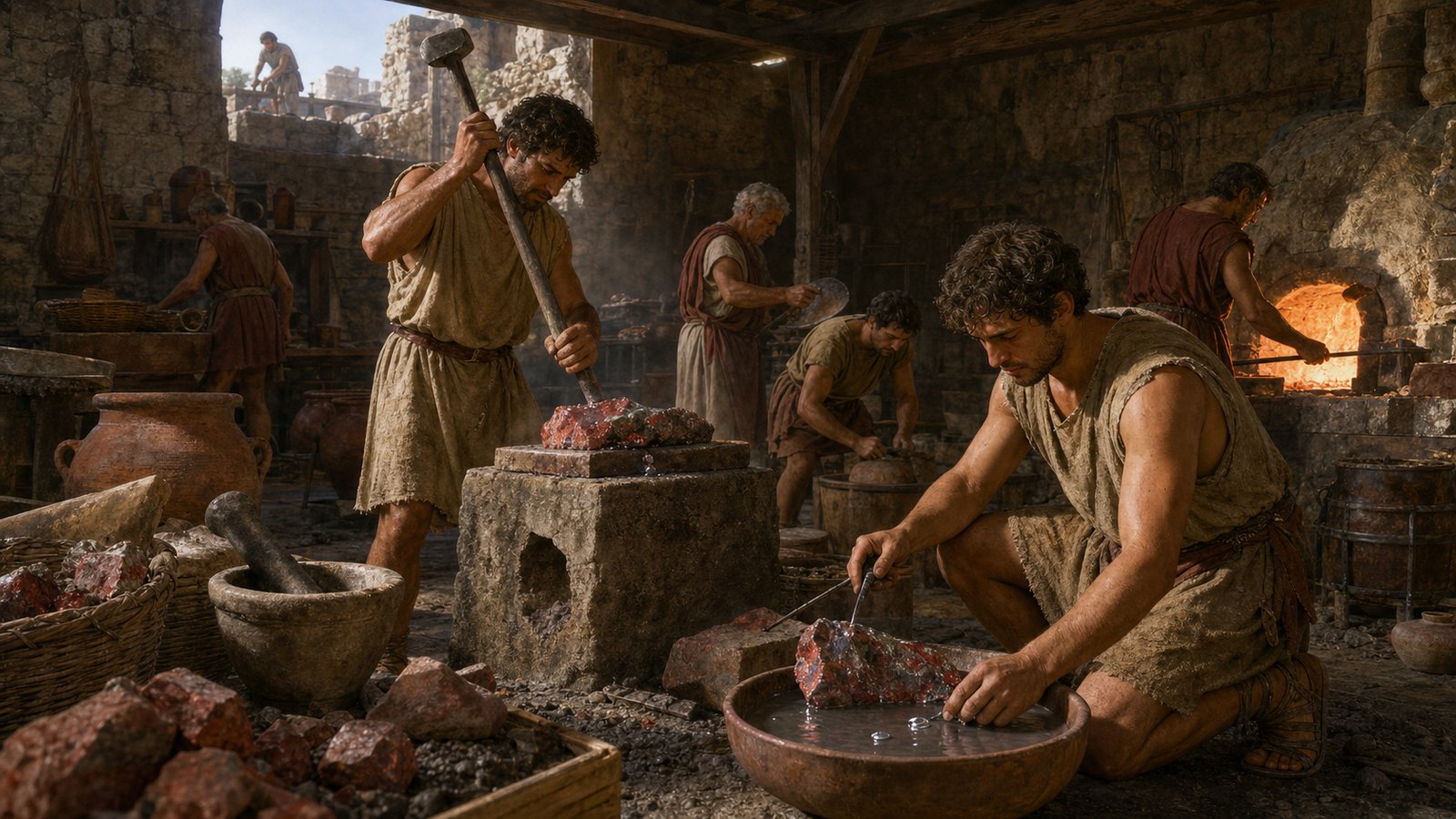
Clods gathered in the laboratory went into a furnace to dry. Heat drove fumes from them. Those fumes condensed on the floor and appeared as quicksilver, extending recovery beyond the droplets produced by hammering.
The condensed beads were too small to pick up efficiently. Workers swept them into a vessel of water. There the divided metal ran together again. Water acted not as a solvent but as a gathering field in which quicksilver’s tendency to unite could be exploited.
Vitruvius marvels at the material’s properties. A heavy stone can float on a body of quicksilver while a tiny amount of gold descends. His explanation belongs to ancient natural philosophy, but the observation supports a practical point: this liquid does not behave like familiar water.
He also describes quicksilver collecting gold from the ashes of worn embroidered cloth. Squeezing the amalgam through fabric lets liquid quicksilver pass while gold remains. The same appetite for gold made the material useful for gilding silver and brass.
The chapter therefore pauses between pigment stages to explore quicksilver as a tool. The red ore supplied a substance capable of moving precious metal across surfaces and recovering it from waste. Colour production intersected with the economy of gold.
Lost-wax casting coordinated heat, mould and molten bronze. Vermilion workshops managed a different sequence of phase changes, with fumes and droplets requiring containment before any wall received colour.
Repeated washing turned dried clods into vermilion
After drying, the clods were pounded with iron beaters and reduced to powder. Repeated washing and drying produced the pigment. Vitruvius says removal of the quicksilver changed the material’s texture, leaving it soft and disconnected enough for the final plaster coat.
That sequence shows why the colour cannot be reduced to “red earth.” The ore’s original cohesion had to be broken. Metal was drawn out, particles were sorted through water, and the remainder was prepared for a binder and surface.
Indoors, vermilion could keep its colour without fading. In peristyles and other places reached by sun and moon, however, it darkened. The same pigment behaved differently according to exposure.
Vitruvius gives a named failure. Faberius, a scribe, used vermilion on the peristyle walls of his Aventine house. Within thirty days the finish had become uneven and unpleasant, forcing him to arrange for other colours.
The anecdote makes luxury accountable to maintenance. Expense could buy intensity, but not immunity from environment. A patron who ignored where the colour would sit converted costly material into a rapid defect.
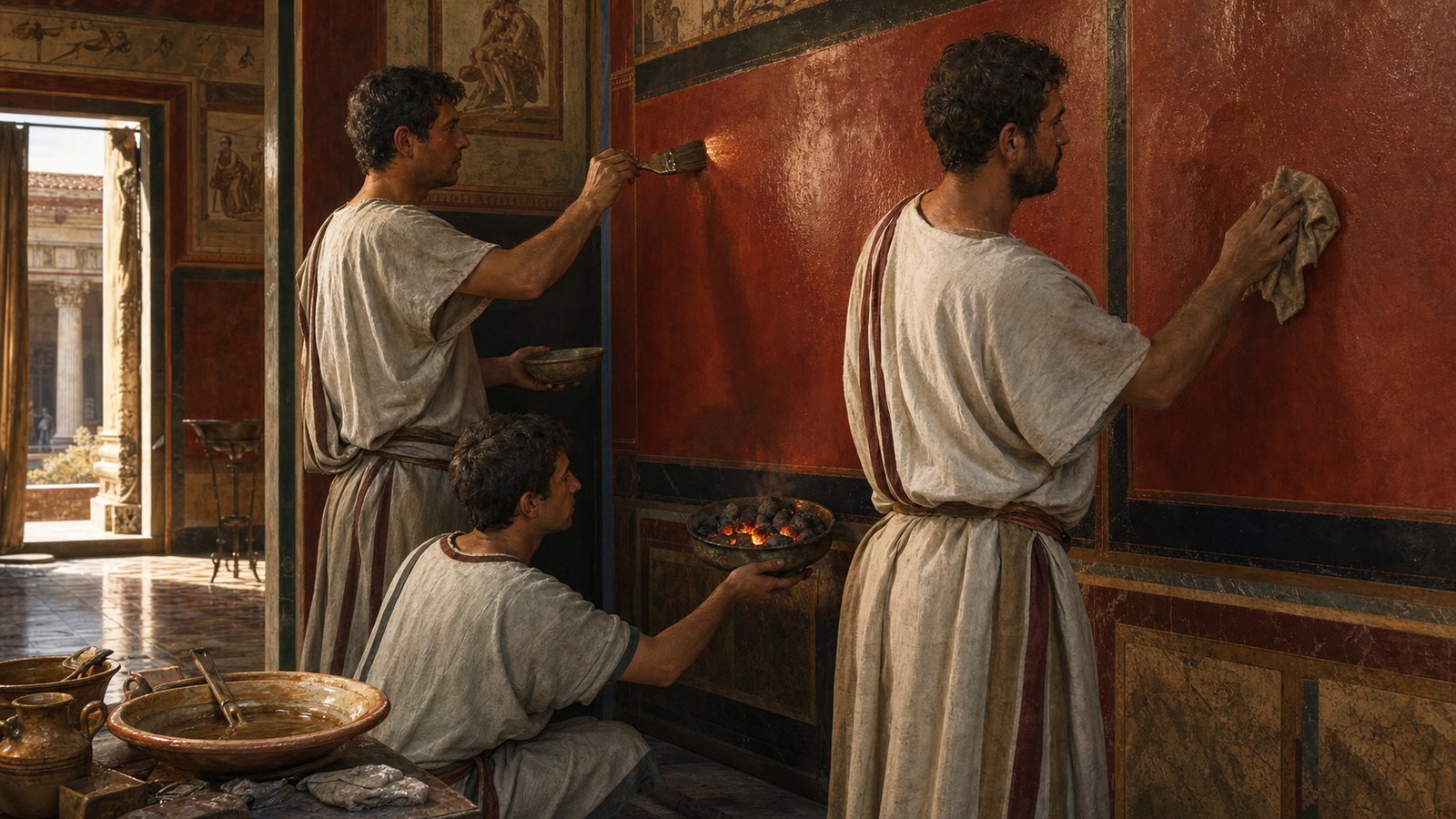
Vitruvius’s remedy was a coat of Punic wax melted and tempered with oil. Applied with a hard brush, the surface was heated with live coals in an iron pan until the wax lay evenly, then rubbed with a candle and clean cloth like a marble statue. Colour survived by acquiring a transparent skin.
Testing and transport kept the red trustworthy
By Vitruvius’s time, workshops formerly associated with Ephesian mines had shifted. Similar deposits had been found in Spain, clods travelled to Rome, and processing occurred between the temples of Flora and Quirinus. A wall pigment therefore connected extraction zones, transport and urban manufacture.
Long movement and high value invited adulteration. Vitruvius says lime was sometimes mixed into vermilion. He offers a heat test: place the pigment on an iron plate until it turns black. If it returns to red after cooling, it is pure; if it remains black, adulteration is exposed.
The test resembles the source-selection procedures Vitruvius gives elsewhere. Material is judged by transformation rather than appearance alone. A convincing red at room temperature must survive a controlled cycle before trust is granted.
Wall finishing consequently required several kinds of expertise. Miners recognized ore. Furnace workers managed fumes and collection. Pigment makers washed and ground. Contractors understood plaster layers. Finishers knew exposure and wax treatment. Buyers or builders needed a way to test purity.
Vitruvius writes as an architect, but the chapter expands architecture beyond geometry. A successful interior depends on supply chains and material histories that remain invisible once scaffolds come down. Knowledge of colour includes knowing where it fails.
The account also warns against imagining ancient luxury as effortless abundance. The brilliant red in an elite room was condensed labour and risk. Iron blows released quicksilver; furnace floors caught fumes; water reunited droplets; repeated washings prepared powder; heat tests detected fraud; wax defended the surface.
Thirty days on Faberius’s wall were enough to expose any break in that chain of knowledge. Vermilion was never simply applied and forgotten. Its beauty survived only when makers treated colour as a process still unfolding under light.
Even the pigment’s name could hide material division. The same clod produced the fluid that carried gold and the powder that carried red. Separation created two workshop economies from one ore, while careless handling could lose either in dust, fumes or tiny droplets. Vitruvius’s attention to collection is therefore attention to value escaping.
The finished wall reunited several transformations. Mineral particles entered wet plaster, wax entered the dry surface, charcoal heat softened the coating, and cloth produced the final polish. None of those stages merely decorated the previous one. Each altered how the material responded to air, touch and light.
That layered history is why a red room can serve as evidence for more than taste. It points toward mines in Spain or Ephesus, transport into Rome, furnace labour, trade in wax and oil, contractual disputes over failed colour, and an architect expected to understand them all.
Sources
Vitruvius, On Architecture 7.8–9