
Rome protected one sacred shield by making it impossible to tell which shield was sacred.
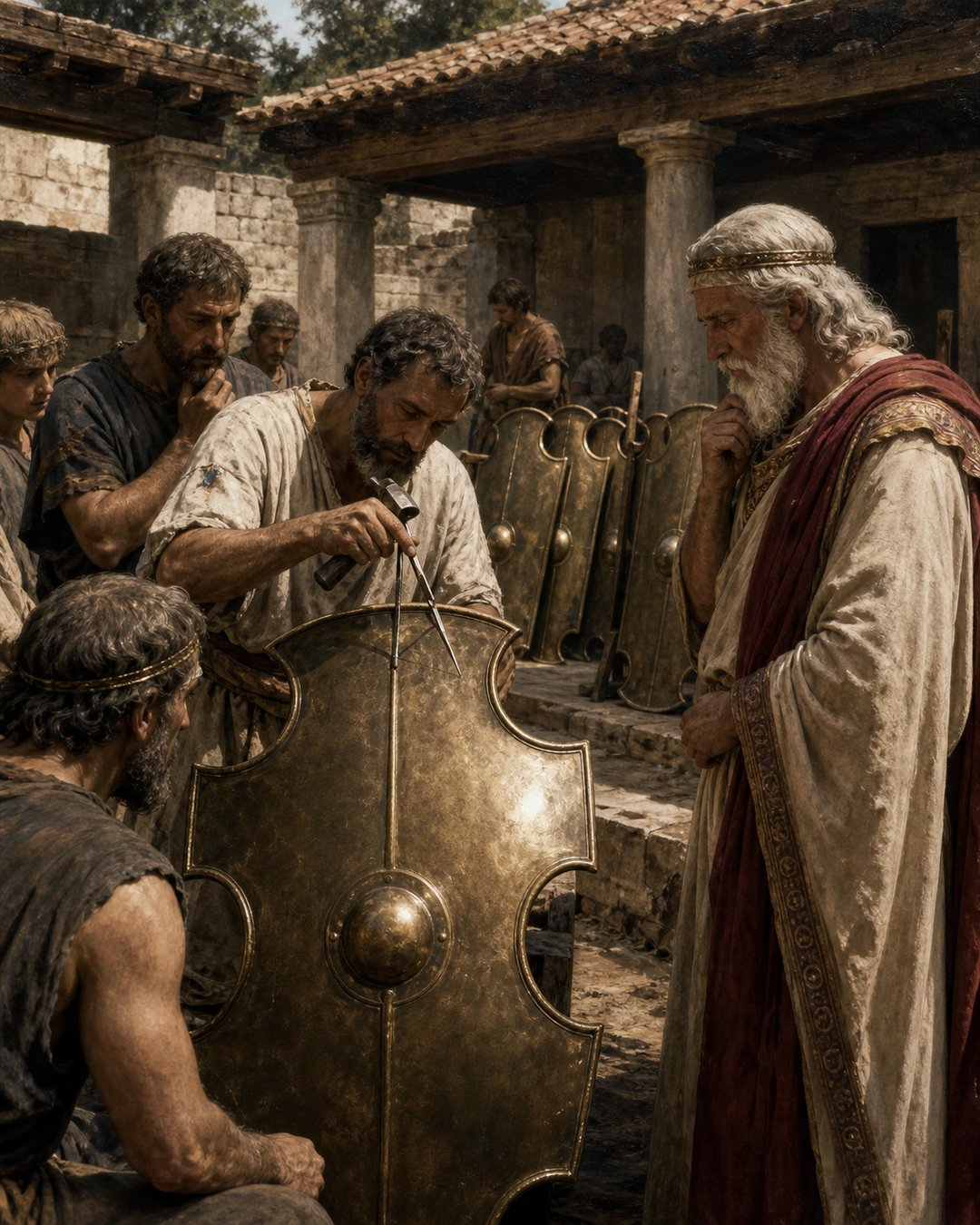
Plutarch says a bronze buckler fell from the sky during a pestilence in Numa’s reign. The king treated it as a pledge of the city’s preservation. A unique object, however, invited a simple danger: a thief needed to steal only one recognizable thing.
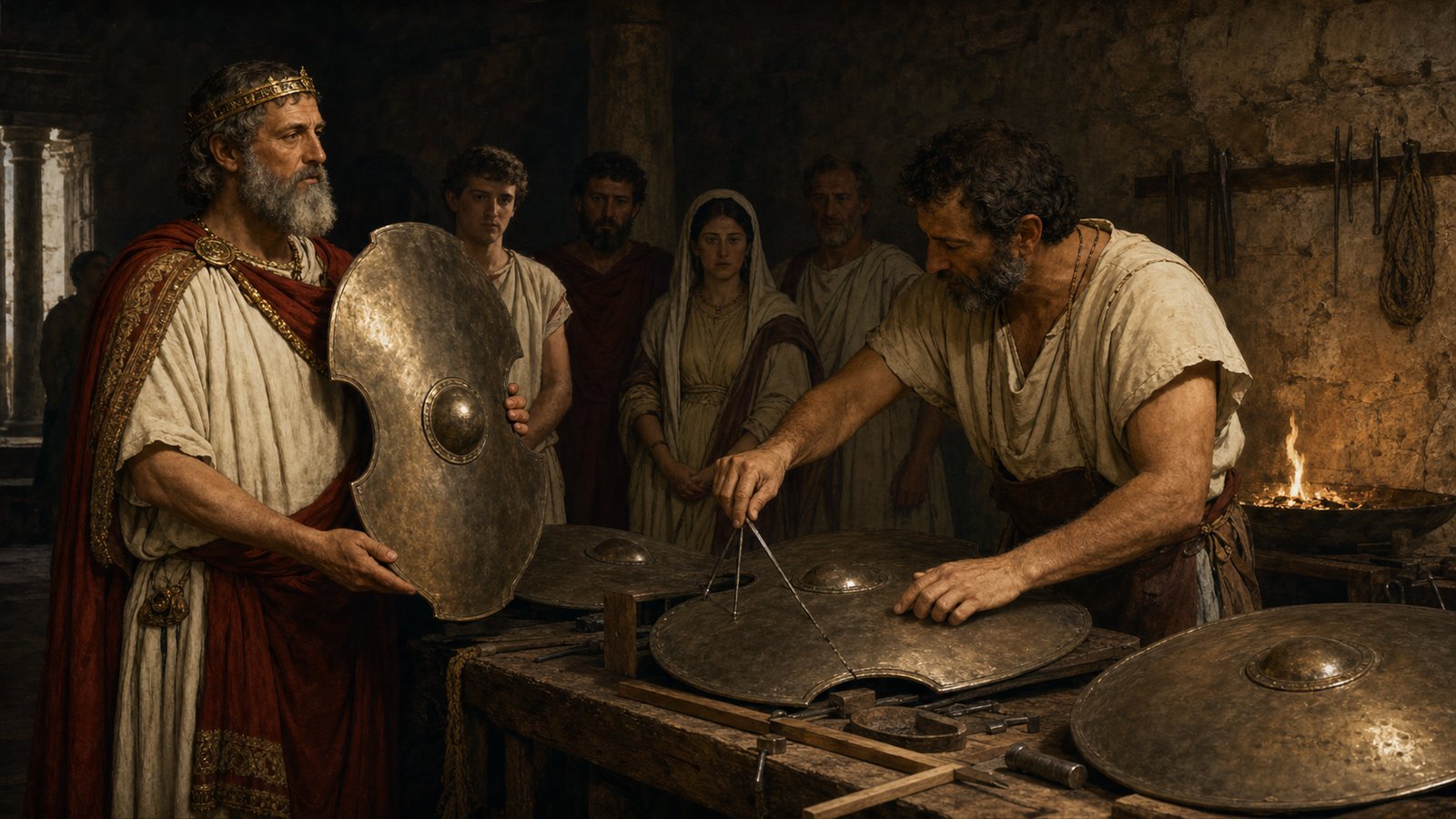
Numa’s answer was eleven copies of the same fashion, size and shape. All craftsmen declined the challenge except Veturius Mamurius. His imitations were so exact that even Numa could not distinguish the original.
The story reverses the usual fear of copies. Duplication did not cheapen authenticity. It became the technology that guarded it. The twelve shields then entered the care of the Salii, whose armoured dance carried the concealed original through Rome each March.
A plague gave the falling shield a civic purpose
Plutarch places the event amid a pestilence afflicting Italy. Rome’s territory, he says, had escaped for a time, but the disease arrived there too. The crisis created the setting in which an extraordinary object could be understood as public protection.
A bronze shield came down into Numa’s hands from heaven. Plutarch reports the claim as part of a tradition about the king, not as an event he could independently verify. The narrative belongs to sacred biography and should retain that distance.
Numa connected the object to Egeria and the Muses, figures who regularly validate his religious knowledge in the Life. He said the shield had come for the preservation of the city. Its value therefore lay less in battlefield use than in a divine relationship.
The pestilence was said to cease immediately, confirming the story for believers within the narrative. Ancient causation and modern historical proof are not the same. The important point is how Plutarch’s source made civic recovery material: protection could be seen and carried.
A pointed vessel shaped how the Vestals handled sacred water. Numa’s shield likewise made protection depend on an object with an unusual form, one whose handling required an institution rather than private possession.
Mamurius used exact imitation as security
Numa was told to guard the shield with eleven others matching its fashion, dimensions and shape. Similarity would make it difficult for a thief to identify the one that came from above.
This is security through uncertainty. A locked chamber announces where value sits. The twelve-shield set dispersed recognition itself. Even access to the group would not reveal which object mattered most.
Numa showed the buckler to craftsmen and asked for copies. All declined except Veturius Mamurius, whom Plutarch calls an excellent workman. The refusal establishes the difficulty before the successful imitation magnifies his skill.
Mamurius made eleven so precisely that Numa himself could not distinguish them. That detail completes the mechanism. If the patron who had received the original could still pick it out, a patient thief might also learn. Perfect protection required the maker to erase visible hierarchy among the objects.
The story raises a paradox. If nobody can identify the original, how can anyone prove it remains in the set? Plutarch does not solve that problem. Ritual trust transfers from recognizing one shield to preserving all twelve together.
The artisan’s work therefore changes religious obligation. Care no longer means guarding one marked relic. It means maintaining a complete collection whose indistinguishability carries the promise.
The Salii moved the hidden original through the streets
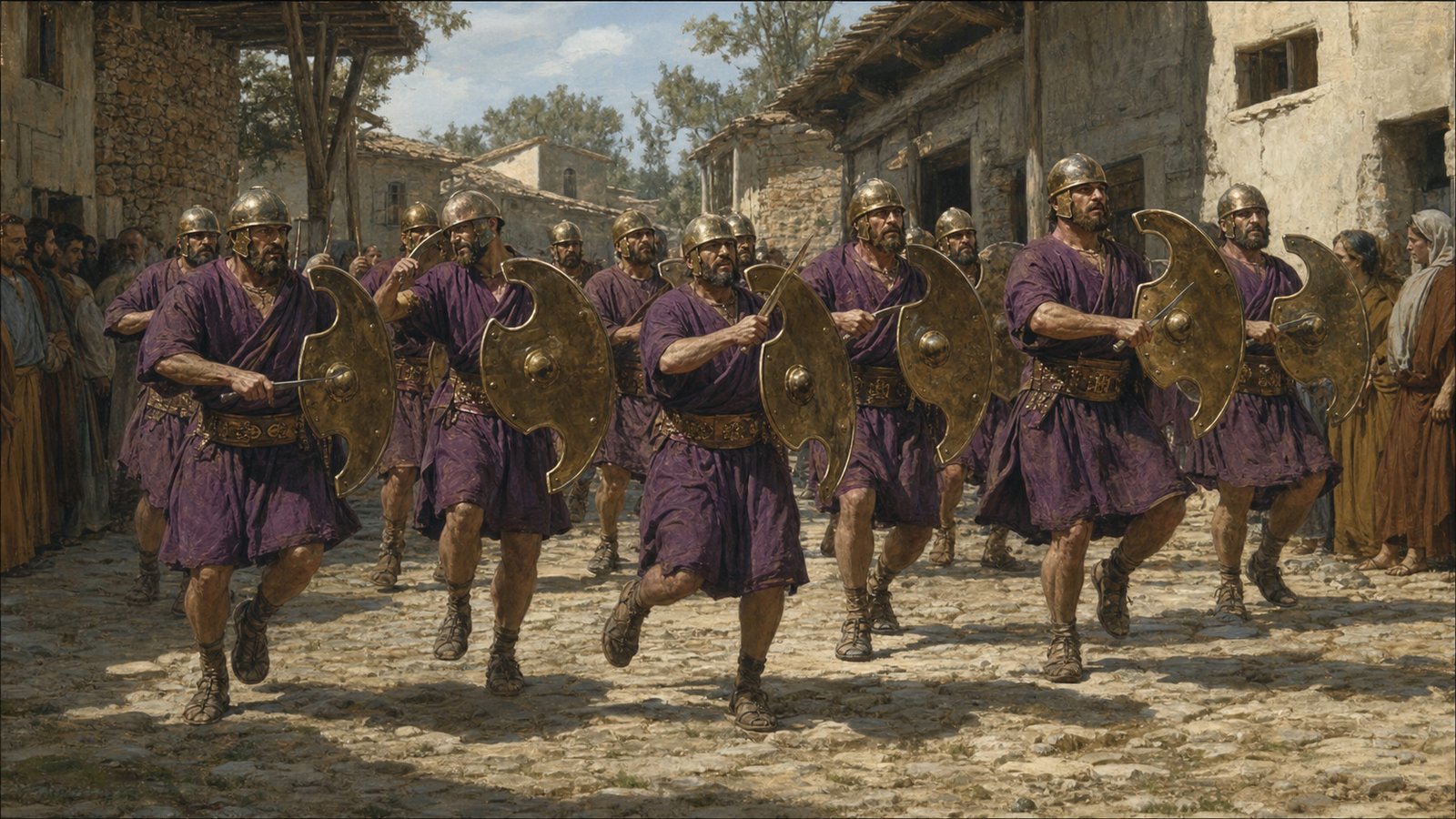
Numa appointed the Salii to watch and care for the shields. Their name, Plutarch suggests, was connected with the leaping movement of their dance, though he records competing explanations.
In March the priests carried the ancilia through Rome. They wore purple tunics, broad belts of bronze and bronze helmets. Small daggers struck the shields as they moved through vigorous, repeated rhythms.
The procession did not reveal which shield had fallen. It displayed the success of concealment. Every object received the treatment owed to the original, and the crowd encountered sacred protection as a synchronized set.
Roman processions carried religious authority into shared urban space. The Salii added sound and uncertainty. Bronze impacts announced the shields while their sameness withheld the single identity at the centre of the tradition.
Plutarch describes the shields as neither round nor normally oval. Curving indentations bent inward and joined at top and bottom. The unusual outline gave Mamurius a demanding template and gave the dancers equipment visually distinct from ordinary military shields.
The armoured appearance did not turn the rite into a battle. The Salii’s choreography, clothing and impacts converted martial materials into calendrical worship. March, a month closely tied to Mars and the traditional opening of campaigning, began with priests controlling weapons through rhythm.
The craftsman entered memory through the objects he hid
Plutarch says Mamurius was rewarded by having his name included in the Salii’s song. He also records an alternative: the phrase may have referred not to Veturius Mamurius but to “ancient memory.” The ambiguity is appropriate for a story about identity concealed by repetition.
If the personal reading is accepted, the maker survived in sound while his individual copies did not. No shield could be singled out as his best imitation because all had to succeed equally. The song supplied distinction that the objects themselves deliberately erased.
The narrative also makes craft part of state religion. Numa can receive and interpret the divine sign, but he cannot manufacture its protection alone. A specialist’s command of proportion, metal and surface turns revelation into a durable security system.
Plutarch wrote centuries after the regal period, assembling traditions that mixed ritual observation, antiquarian explanation and legend. His account cannot prove that a shield fell from the sky or that one workshop moment created the full historical rite. It does reveal how later Romans and Greeks explained an old priesthood and its puzzling equipment.
That explanation is more inventive than hiding a relic behind walls. The shield’s safety came from appearing publicly in a group. Exposure and concealment worked together. A thief might see all twelve and still lack the knowledge needed to target one.
Authenticity became collective. If the set remained complete, the divine pledge remained somewhere inside it. If one shield vanished, uncertainty that once protected the original would become anxiety, because nobody could know what had been lost.
Mamurius’s eleven copies did not replace the sacred object. They changed the conditions under which it could survive. Every March, Rome renewed those conditions by dressing, carrying, striking and guarding all twelve alike. The original was safest when nobody—not thief, spectator or king—could point to it.
The number also transformed loss into a problem of completeness. Twelve shields could be counted even when the original could not be named. Priests did not need secret connoisseurship; they needed to maintain the full set, its distinctive curves and the ritual that kept all members together. A damaged rim, absent shield or failed procession could be recognized without resolving the sacred mystery at the group’s centre.
Replication therefore shifted certainty from identity to inventory. Rome could not say, “this one is the heavenly shield,” but it could say, “the twelve are present.” That is a different kind of authenticity, secured by continuity of the group rather than uninterrupted recognition of one surface.
Plutarch’s alternative explanation of Mamurius’s song deepens the effect. Whether the chant named a craftsman or “ancient memory,” repetition carried the past forward. The shields survived as objects because they looked alike; the story survived as tradition because each generation performed the same uncertainty again.
Sources
Plutarch, Life of Numa 13