
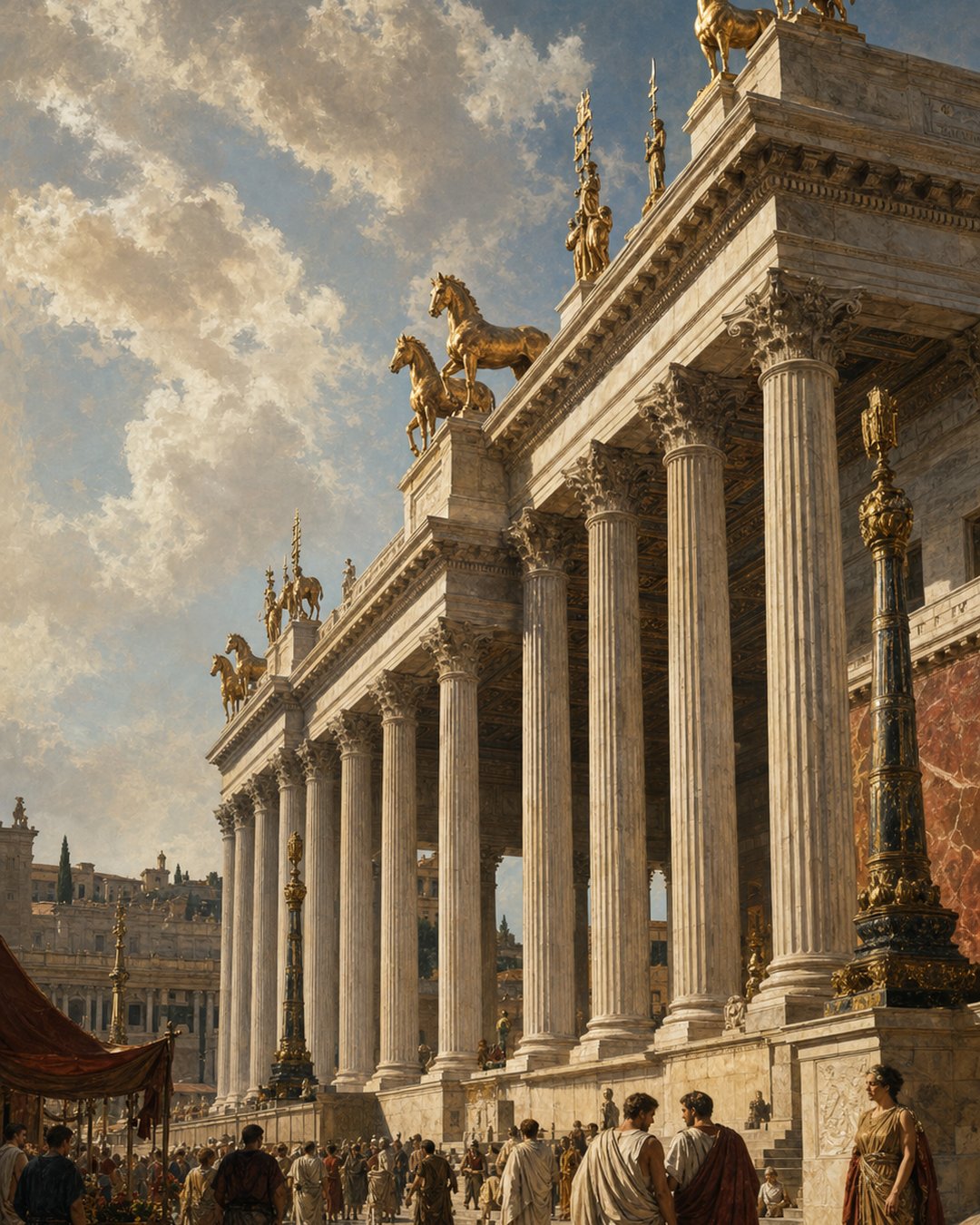
The gilded horses above Trajan’s Forum were not trophies lifted whole from an enemy city. Their inscription pointed to a less visible route.
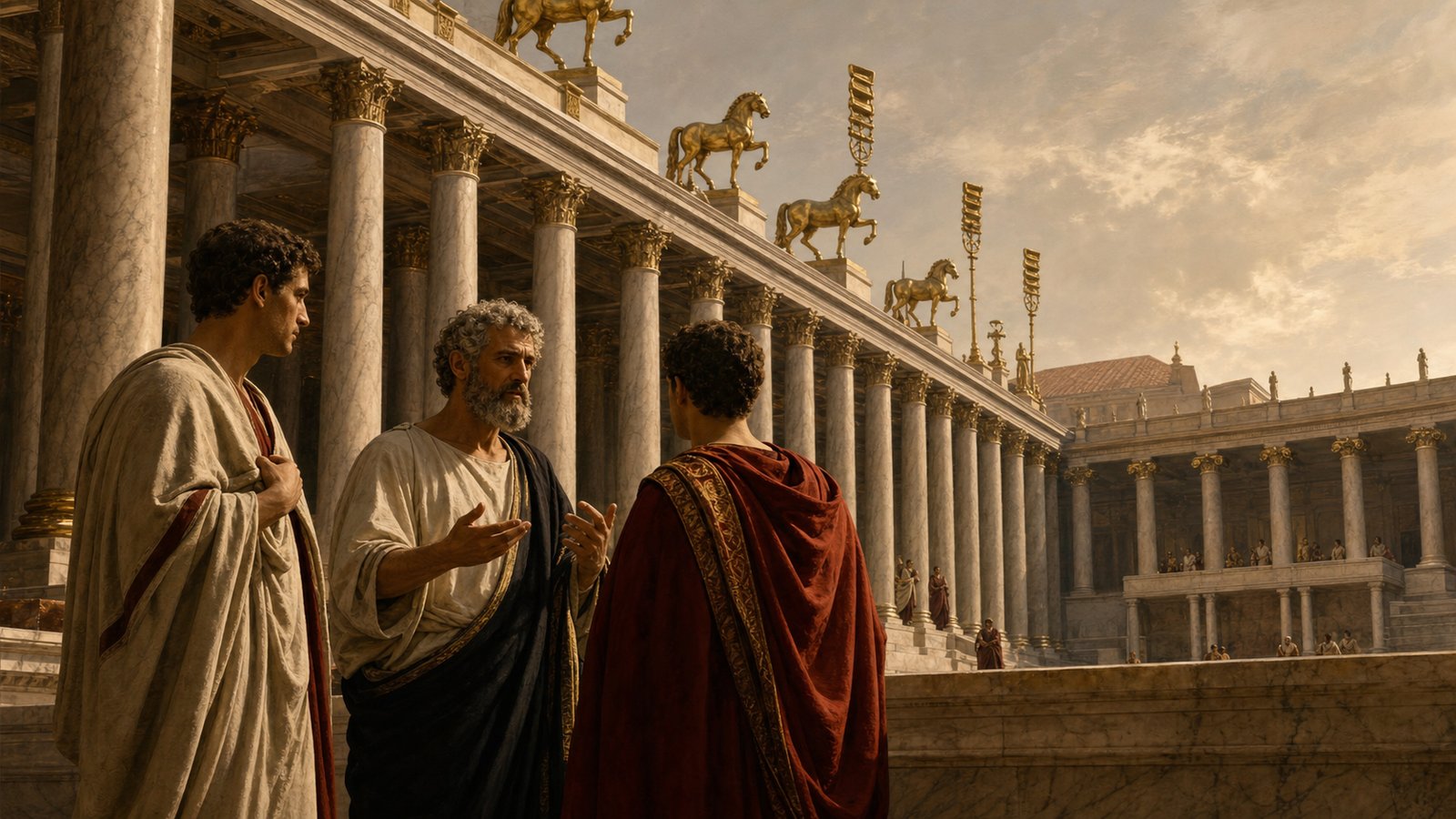
Aulus Gellius remembered walking through the Forum with the philosopher Favorinus while a consul heard cases nearby. Along the roofs of the colonnades stood gilded horses and representations of military standards. Beneath them appeared the phrase ex manubiis.
One companion treated the phrase as a simple claim about booty. Favorinus objected. In careful Latin, he argued, captured things and the money raised by selling them were not identical. Praeda was the property taken; manubiae was the cash collected after its sale.
That distinction changes the monument. Conquest did not jump directly from battlefield to gilded roofline. Objects had to be gathered, accounted for, sold and converted into funds that could be assigned to construction. Two words turned military violence into a public financial history.
A gilded roofline made victory visible from the pavement
Gellius begins with what a visitor could see. Gilded statues of horses and images of standards ran above the colonnades of Trajan’s Forum. They occupied the upper edge of an architectural complex already designed to overwhelm through scale, stone and controlled vistas.
Horses and standards carried military associations without reproducing one battle. A horse could evoke command, movement and triumphal display. A standard condensed the identity and discipline of a unit. Raised above the crowd and repeated along the roof, both motifs made victory part of the Forum’s ordinary skyline.
The article on Trajan’s Column and its spiralling campaign narrative follows conquest through carved scenes. The roof ornaments worked differently. They did not require a viewer to trace episodes upward. Their gold and silhouettes announced military success at a glance.
Gellius does not inventory every statue, name its sculptor or calculate its cost. His attention settles on the inscription beneath the display. The phrase was brief enough to be passed without thought, yet Favorinus treated it as an accounting label whose precision mattered.
The setting sharpened the question. A consul was hearing cases while the group waited in the Forum. Law, language, public finance and imperial display occupied the same space. A monument funded from conquest stood around people engaged in the continuing business of Roman government.
Favorinus tested one word against Cicero’s accusation
A learned companion offered an explanation based on derivation. Manubiae, he said, meant booty taken manu, “by hand,” and was therefore equivalent to praeda. Favorinus already knew that common interpretation. His objection came from usage rather than a rival wordplay.
He recalled Cicero’s speech on the agrarian law, in which the proposed decemvirs were accused of selling praeda and seizing manubiae. Cicero placed both terms in the same sentence and paired them again soon afterward. If they were perfectly interchangeable, a famously careful orator had repeated himself without purpose.
Favorinus spends much of Gellius’s chapter considering whether repetition can still be forceful. Orators often pile near-synonyms together to enlarge an accusation. Plundering, devastating, emptying and pillaging may overlap, yet their accumulation can strike the listener repeatedly. Cato and Homer provide further examples in the discussion.
But Favorinus decides that Cicero’s pairing does not work that way. The two nouns are not ornamental blows aimed at the same target. They identify different assets vulnerable to appropriation. The decemvirs could seize property that had not been sold and money already produced by sales.
This is a practical test of meaning. Instead of asking only where a word might have originated, Favorinus asks what distinction a sentence needs to make. Cicero’s charge becomes coherent when booty has two states and weaker when both terms collapse into one.
Captured objects became money through a public sale
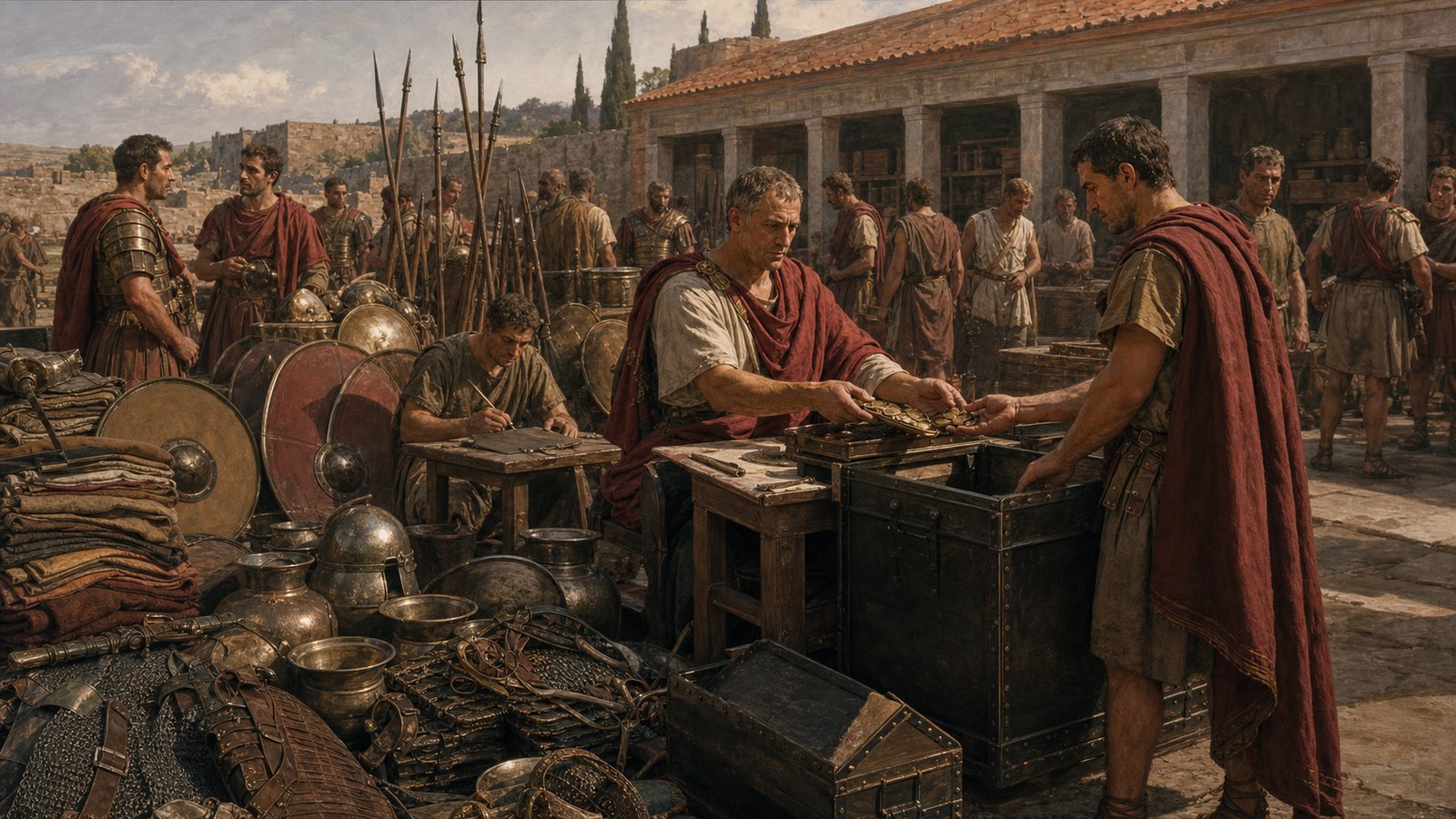
Favorinus defines praeda as the objects composing the booty. Those objects could vary enormously: metal, weapons, textiles, livestock or other property taken in war. Gellius’s chapter does not attach a specific inventory to Trajan’s monument, so none should be invented for this case.
Manubiae, in the careful distinction, was the money collected when such property was sold. Between the two words lies an auction, a buyer and an act of valuation. A captured vessel might be militarily impressive; only its price could be combined easily with other proceeds and assigned toward a new commission.
The distinction also separates possession from liquidity. A heap of objects may represent wealth without being ready to pay masons, metalworkers or suppliers. Sale translates mixed things into a common medium. The public treasury can then redirect value without preserving the original physical form of the booty.
Roman military pay made service measurable in money. Manubiae reveals another conversion at the far end of war: captured property became cash capable of funding civic or monumental purposes. Both processes required administration behind the spectacle of arms.
Favorinus assigns collection of the proceeds to a quaestor of the Roman people, then updates his explanation. By his own time, he says, treasury responsibility had passed to prefects. The correction is small but important. Language preserved an older institutional route even as offices changed.
Sale did not make the origin of the value morally neutral. The coins remained connected to conquest because the inscription retained that provenance. Rome could transform enemy property into a public monument, but it also chose to display the source of payment beneath the gold.
The inscription named money, not captured statues
Favorinus applies the definition directly to the roof. Trajan had not taken those gilded horses and standards from an enemy and carried them into the Forum unchanged. They were made or procured from the manubiae: with money derived from the sale of booty.
The clarification protects viewers from reading the ornaments as literal spoils. Their subject was military, and their funding came from conquest, but their material identities were new. Roman craftsmen turned proceeds into objects designed specifically for this architectural setting.
That creates a chain of substitutions. Enemy property became auction lots. Lots became money. Money became contracts, materials and labour. Those inputs became gilded horses and standards. The inscription compressed every stage into a phrase that a passer-by might read without seeing any of the people who performed the conversion.
The phrase also allowed the monument to claim fiscal legitimacy. It did not merely say that Trajan wanted gold above his colonnades. It assigned a source of funds associated with victory. Whether every viewer understood Favorinus’s strict definition is another question, and Gellius acknowledges that reputable authors sometimes used the terms loosely.
That looseness is part of the story rather than a reason to discard it. Words can overlap in ordinary writing while retaining a sharper meaning in a legal, financial or commemorative context. Favorinus does not claim that every author obeyed his rule. He claims that careful readers should notice when the distinction makes the inscription and Cicero’s accusation more exact.
A monument could preserve an audit trail in two words
Gellius’s chapter is not a treasury ledger. It gives no total revenue, list of buyers or payment schedule for the statues. It is an antiquarian conversation written around a visible monument. Its evidentiary strength lies in the relationship among inscription, remembered usage and administrative explanation.
Even within those limits, the conversation restores motion to a finished building. Marble and gilded bronze look permanent, but their funding had passed through temporary heaps of captured property, moments of sale and offices responsible for receiving the proceeds.
The roofline therefore carried two kinds of military representation. Its horses and standards pictured victory. Its inscription identified the economic afterlife of victory. One addressed the eye; the other, when read precisely, disclosed the mechanism that paid for what the eye admired.
This makes ex manubiis more than a boast. It is a compact provenance statement. The value did not arise inside the Forum, and the statues were not simply gifts detached from public finance. Their gold was connected to a chain beginning beyond Rome and ending in an urban space of law and administration.
Favorinus’s lesson also warns against translating monuments too quickly. “From the spoils” is close enough for a casual paraphrase, but it erases the sale. Once the sale disappears, so do the buyer, treasury officer and decision to redirect cash into architecture.
Above Trajan’s Forum, conquest had already changed form several times. The gilded horses were the visible end of that process, not its beginning. Gellius’s two disputed nouns recover the missing middle: Rome first possessed the booty, then priced it, sold it and made the proceeds stand above the city in gold.
Sources
Aulus Gellius, Attic Nights 13.25