
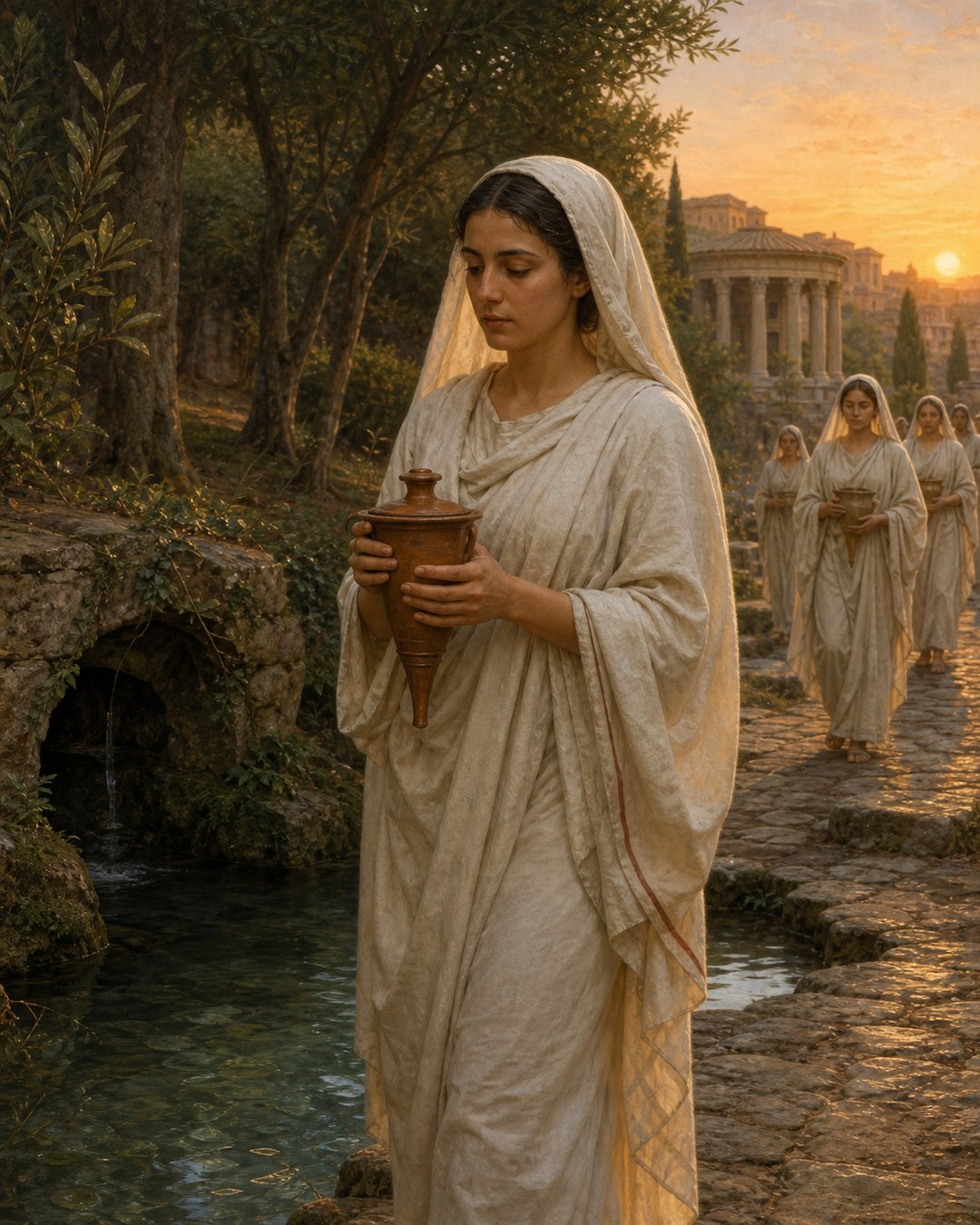
A Vestal returned from the spring carrying a vessel that could not be placed upright on the floor.
Its base came to a point. Release it and the container would tip. Someone had to keep hold of it, support it or complete the task for which the water had been drawn.
Plutarch mentions the object while describing water brought from the spring of Egeria for sacred cleansing. The detail is brief, but its logic is unusually physical. Correct procedure was not written on the jar. It was built into the jar’s refusal to stand.
Roman religion often depended on exact words, times, persons and gestures. Here, shape joined that system. An inconvenient vessel turned attention into a requirement.
Water entered Vesta’s service through a named route
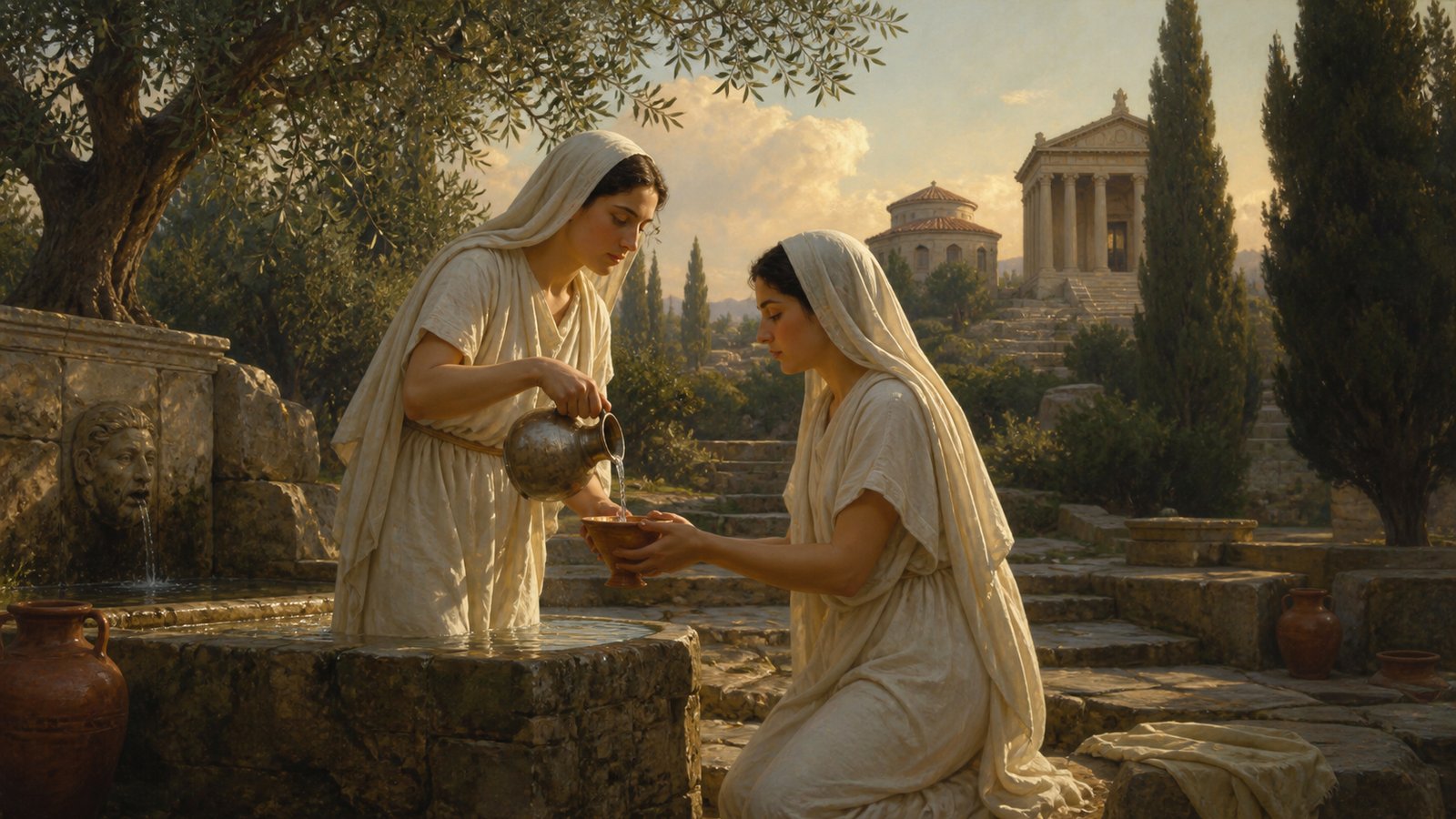
Plutarch places water carrying among the Vestal Virgins’ duties. The water came from a spring associated with Egeria, the divine counsellor linked in Roman tradition to King Numa. It was brought for sprinkling and cleansing the sanctuary.
The route matters because sacred usefulness did not make all water interchangeable. Water from a named spring, obtained by the proper attendants and carried in a particular kind of container arrived with a history. Its movement from source to sanctuary was part of what distinguished it from the contents of an ordinary household jar.
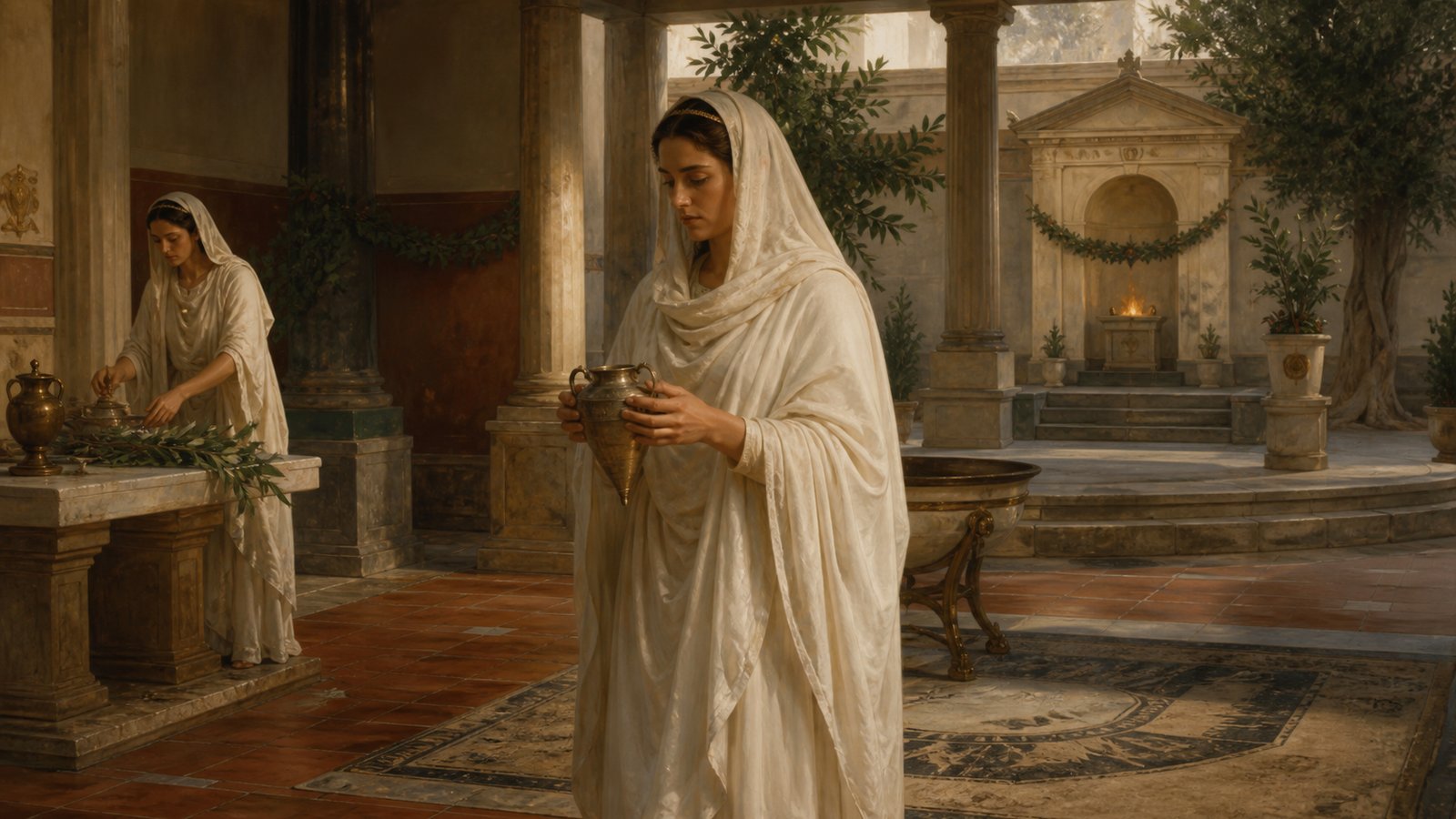
That procedure sat beside a more famous Vestal responsibility: the care of Vesta’s fire. Fire dominates modern images of the priesthood because extinction could be treated as a sign of danger to Rome. Water looks secondary, yet a sanctuary organized around a living flame still required cleansing. The two substances structured different kinds of care—one preserved, the other fetched and used.
The duty adds a practical dimension to the broader political and religious importance of the Vestals. Their public status was not maintained by symbolism alone. It was renewed through repeated work: watching, carrying, cleaning, preparing and performing. A priesthood visible at major ceremonies also depended on journeys to a spring and control of an awkward container.
Plutarch says the spring flowed beneath the city. We should not turn his compact notice into a fully mapped daily itinerary that the source does not supply. What he does preserve is enough to identify a chain: spring, vessel, Vestal, sanctuary, cleansing.
The pointed base removed the easiest careless action
An ordinary flat-bottomed jar invites a pause. Set it on a step, free both hands, speak to someone, leave it beside another vessel and return later. A pointed container interrupts that sequence. Unless placed in a special support or leaned insecurely, it cannot remain upright.
Plutarch explains the form through exactly that inability. The vessel used for the water could not stand when set down because its base was pointed. The observation links design to behaviour without needing a long rule. The object forced its carrier to remain involved.
It is possible to imagine several practical consequences without claiming more than the description allows. Continuous handling reduced casual parking on a potentially unclean surface. It made the vessel hard to confuse with jars waiting for domestic use. It encouraged the water to move directly toward its ritual destination. Those are explanations of the design’s effect, not a preserved Roman instruction manual for every step.
The comparison with the coin-operated temple-water device described by Hero shows two very different ways objects could govern access. Hero’s mechanism released a measured flow after weight moved a lever. The Vestal vessel had no valve. Its geometry governed the human carrier by denying the container a stable resting position.
In both cases, matter disciplined sequence. A worshipper could not obtain the measured water without the coin’s weight. A carrier could not treat the pointed jar like a self-supporting pot. Ritual order did not depend entirely on memory.
The women who carried it belonged to a long institution
Plutarch attributes the Roman foundation of the Vestal priesthood to Numa. In his narrative, Gegania and Verenia came first; Canuleia and Tarpeia were added, and the number later reached six under Servius. Those names place individual women inside an office often discussed only as an abstraction.
He describes a service of thirty years. The first decade was for learning, the second for performing the rites, and the third for teaching successors. Whether every detail operated without change across all Roman centuries is a separate historical question. The structure nevertheless expresses how Plutarch understood the office: sacred competence had to be transmitted, not simply bestowed.
The Vestals received exceptional privileges. They also faced severe discipline when judged to have failed. That combination made their daily actions politically charged. A task as modest as carrying water belonged to women whose conduct Romans connected with the security and moral condition of the community.
The pointed vessel should therefore not be romanticized as a charming antique eccentricity. It was equipment used inside a demanding institution. Its awkwardness matched a world in which sacred service narrowed ordinary choices. The carrier could not decide that any spring, any container or any convenient pause would do.
Learning to carry it would itself have been part of learning the office. The novice had to know where to draw the water, how to keep an unstable load controlled, where it was going and what action followed on arrival. Plutarch’s three-part career—learning, doing and teaching—gives that small movement a generational setting. Experienced Vestals did not pass on doctrine alone. They transmitted sequences performed with real objects whose weight and balance punished inattention. A tipped vessel wasted more than water; it interrupted work defined by its source, carrier and destination.
The office also connected scales. Rome’s public welfare could be imagined through Vesta’s cult; the cult depended on maintained rites; a rite depended on cleansing; cleansing depended on water; and water arrived because one woman kept hold of a jar that would topple if released.
An unstable object could produce a stable practice
Roman containers were normally designed to solve transport and storage problems. Amphorae with pointed ends could be packed in ships, stacked with supports or planted in sand. The Vestal vessel in Plutarch’s description solved a different problem. It made temporary storage inconvenient.
That reversal explains the object’s power. Stability is usually desirable, but sacred procedure valued uninterrupted custody more. The container’s weakness as tableware became its strength as ritual equipment.
The same cult could place flowers and rest on working animals and millstones during the festival of Vestalia, as seen in the holiday treatment of bakers’ equipment. That scene drew ordinary production into Vesta’s calendar. The pointed water vessel moved in the opposite direction: it took a basic domestic action—carrying water—and removed its ordinary convenience.
Neither object needs to speak to direct behaviour. Garlanded millstones announce a pause through their changed appearance. The pointed jar announces continued attention whenever gravity pulls it sideways.
Plutarch’s sentence survives because an unusual shape caught explanation. Yet the vessel belonged to repetition rather than spectacle. Sacred water had to be drawn again. The sanctuary had to be cleansed again. New Vestals had to learn from experienced ones. The object’s meaning returned each time someone reached instinctively for a place to set it and found none.
Its lesson was carried in the hand: this water was still in motion, and the task was not finished.
Sources
Plutarch, Life of Numa 9–13