
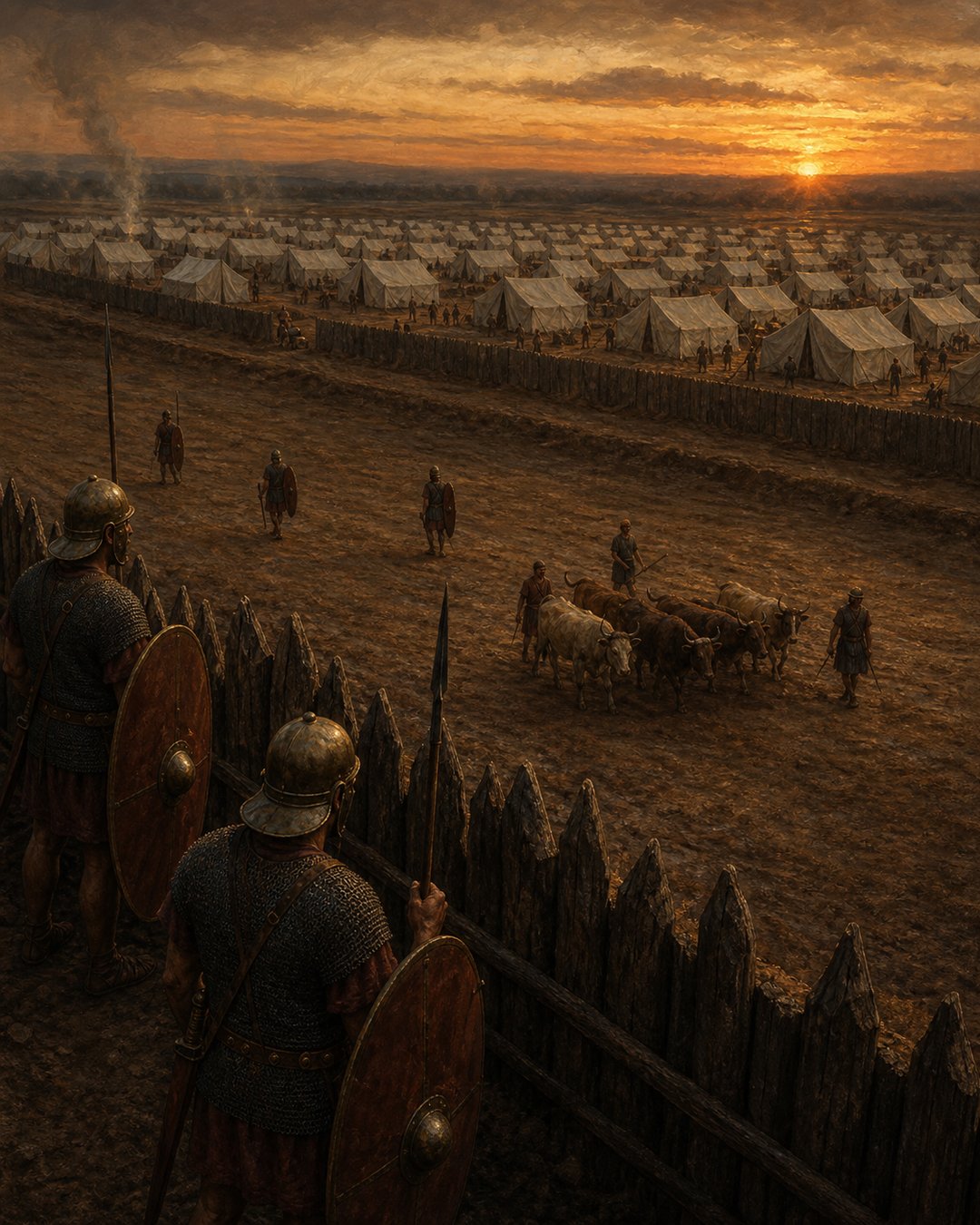
A Roman column stopped marching, chose its ground and built a boundary. Then, inside that defended perimeter, it left an enormous strip empty.
Polybius places the tents 200 feet back from the entrenchment on every side. The distance was not a decorative margin. It protected canvas from missiles and night fire, let soldiers move without crushing through tent lines, and provided room for captured cattle and booty.
The camp therefore relied on something soldiers did not build. Earth, ditch and palisade formed the outer obstacle. Behind them, reserved emptiness turned a breach, spark or sudden order into a problem with space around it.
Roman military engineering is often described through objects. Polybius’s camp shows distance functioning as equipment.
The first defence behind the wall was a refusal to build
Every extra row of tents pushed toward the rampart would have made the occupied camp more compact. A smaller perimeter could require less digging and less timber. Polybius nevertheless describes a standard layout in which the inhabited rows began 200 feet from the entrenchment.
That choice spent labour indirectly. The army had to enclose ground that no unit used for sleeping. A larger defended footprint meant a longer ditch and rampart. Commanders accepted the cost because the vacant strip changed how danger crossed the boundary.
A missile launched over the works lost usefulness if it landed on bare ground rather than canvas, bedding, baggage or men. The same logic applied more urgently to fire. A burning projectile during darkness could create confusion before defenders understood where the attack had begun. Distance kept the first flames away from tightly arranged tents and bought time for a response.
The strip complements the repeatable planning of Roman marching camps. Standardization was not only the ability to place a tent in the same relative district each evening. It included knowing where tents must not go. The blank band was as deliberate as a street or headquarters.
Polybius calls the space important and useful because it solved several problems at once. Its military value came from combination. What delayed attack also eased movement and contained the unstable products of victory.
Two hundred feet converted impact into warning
The entrenchment was not imagined as an absolute seal. Arrows, javelins and other missiles could cross a ditch and palisade. Attackers might approach under darkness with fire. The camp plan assumed some threats would pass the outer line.
Once that assumption is made, the position of the tents becomes part of defence. Two hundred feet imposed a second journey. A missile had to travel beyond the works and across the gap to reach occupied shelter. Fire had to find fuel, or attackers had to carry it deeper while defenders mobilized.
Distance also improved visibility. Movement in a clear strip was easier to read than movement among ropes, baggage stacks and tent walls. Defenders gathering behind the rampart had room to form, receive orders and shift toward pressure without first extracting themselves from domestic clutter.
The open ground did not make the camp invulnerable. Wind could carry sparks; powerful missiles might cover unusual distances; panic could fill any planned space with bodies. Polybius does not promise safety from every assault. He identifies reduced exposure, especially to missiles and night fire, as practical advantages of the setback.
Roman shields could create protection through overlapping material, as the curved scutum did in formation. The camp clearance used the opposite method. Nothing overlapped. Protection came from separating the vulnerable target from the point where danger first appeared.
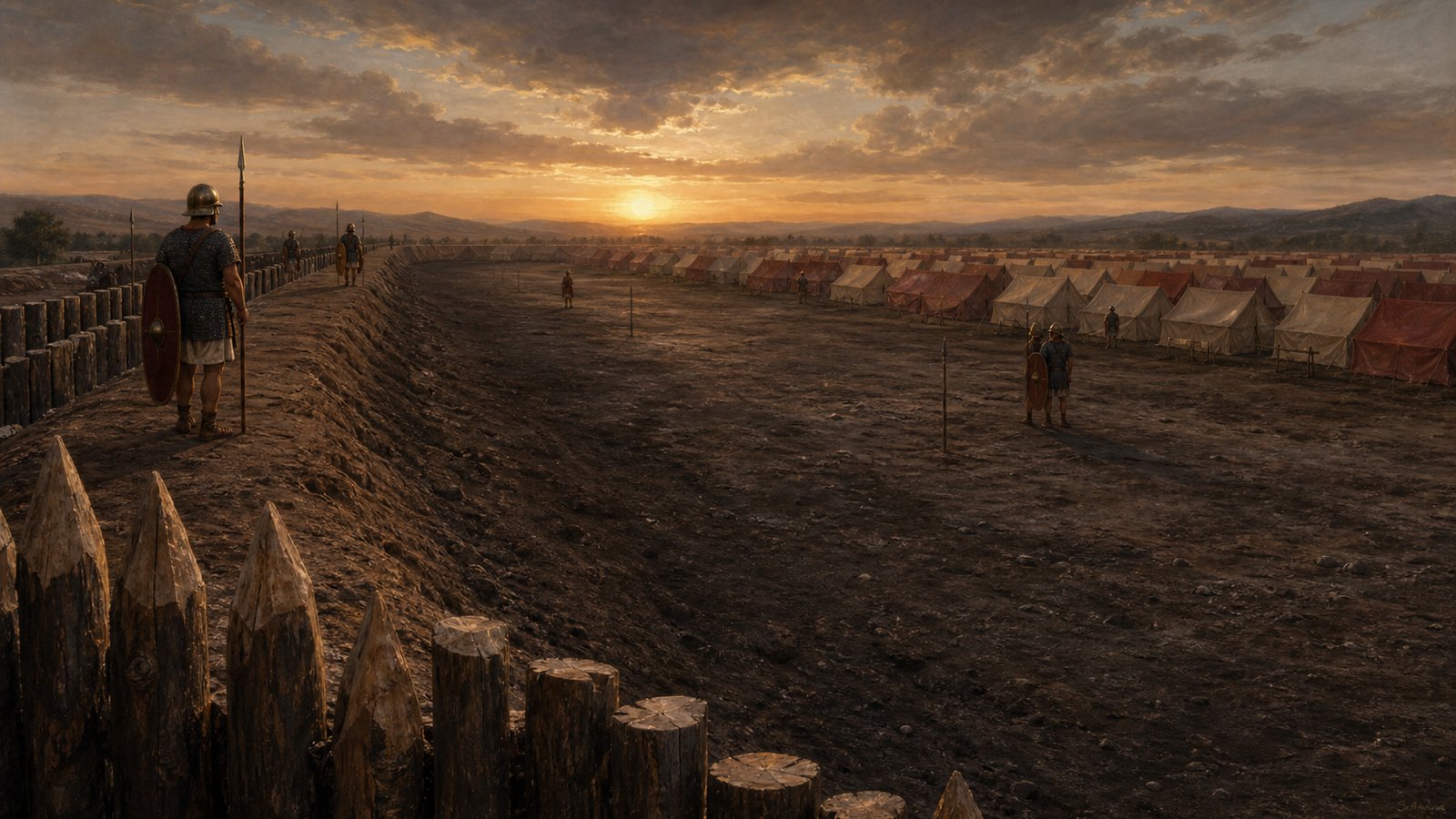
The empty band became a military circulation road
Polybius also says the strip allowed troops to enter and leave without crowding. That function is easy to underestimate. A camp had gates, internal streets, assigned districts, pack animals, servants, officers and soldiers arriving at different moments. If tent ropes and baggage pressed against the inner rampart, every gate would discharge directly into obstruction.
The 200-foot band acted as a distributor. A unit passing through a gate could turn along the perimeter before entering its own lane. Messengers and defenders could move laterally without cutting across sleeping areas. Men ordered to reinforce another side did not need to force a route between tents.
Polybius gives the camp’s principal street a width of 100 feet, another sign that circulation occupied measured ground rather than whatever space remained. The broader layout assigned predictable places to commanders and units. The perimeter clearance connected those fixed districts to the defensive line.
This helps explain why a Roman camp could feel organized soon after arrival. The plan did not eliminate congestion by telling everyone to be careful. It separated flows. Sleeping, command, entry, lateral defence and storage did not all compete for the same narrow passages.
The distinction also clarifies Polybius’s wooden-tablet password chain. That procedure moved information through assigned officers and returned the tablets for verification. The intervallum moved bodies along a reserved route. Both systems reduced dependence on improvisation after dark, but one controlled words while the other controlled space.
Cattle and booty gave the clearance a second life
An army that captured animals and goods faced a problem immediately. Victory produced material that did not belong in a battle line and could not safely be abandoned outside. Cattle wandered, made noise and required handlers. Loot attracted attention, disputes and theft. Both could obstruct a camp if pushed into unit streets.
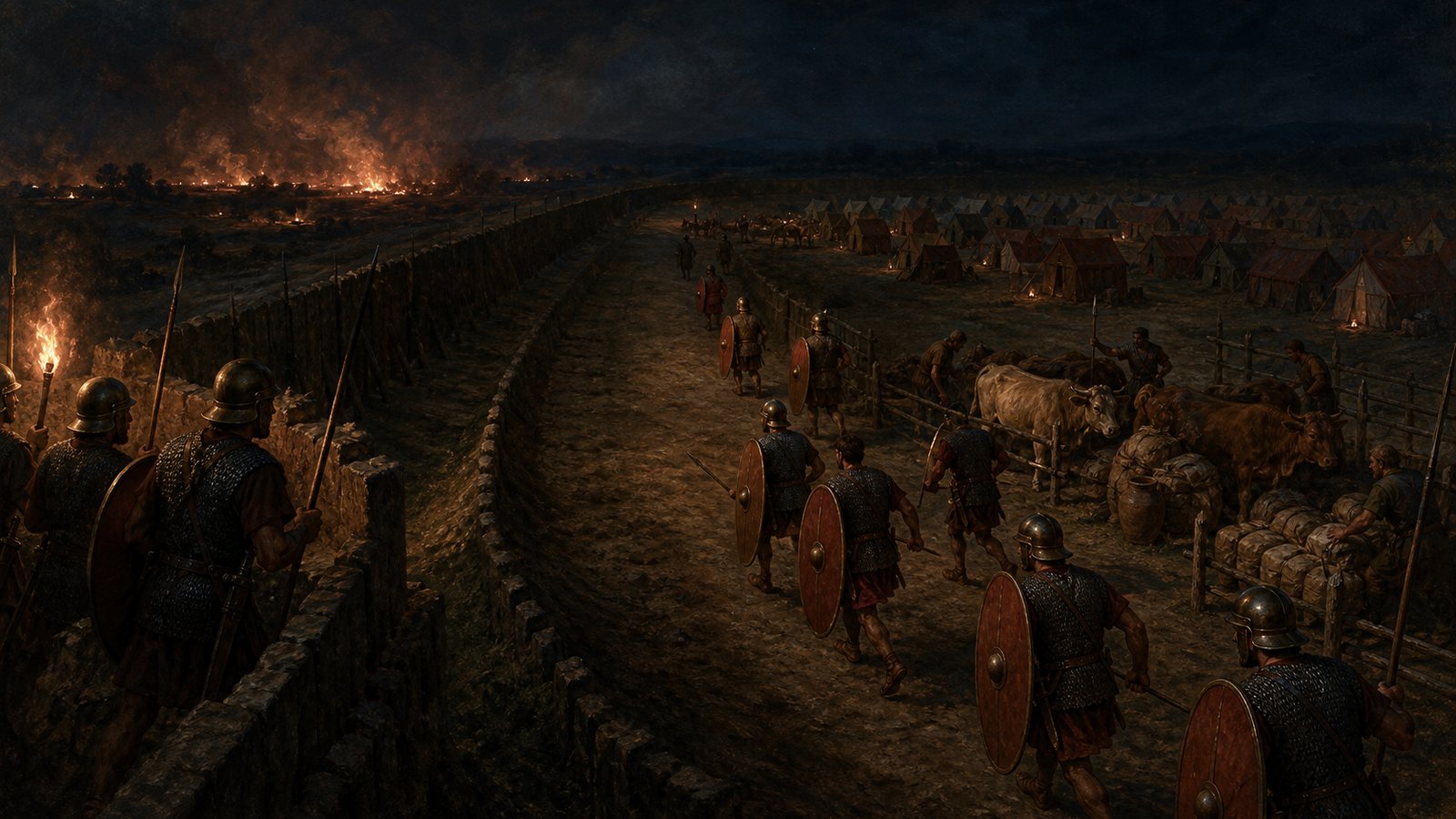
Polybius says captured cattle were brought into the open strip, along with other booty taken from the enemy. The location placed them inside the fortification but outside the ordered tent districts. That was an efficient compromise. The army secured its gains without allowing them to dissolve the layout that kept the army functional.
The same ground could therefore change role over an evening. During entry it absorbed movement. After settlement it held animals and goods. During an alarm it became a firebreak, missile buffer and route for defenders. Empty did not mean permanently unused. It meant uncommitted to structures, leaving capacity for whatever pressure arrived.
There was tension among those uses. Cattle and stacked goods could themselves create clutter or fuel. Polybius’s statement should not be read as a picture of a perfectly bare ring at every hour. The planning principle was flexible reserved space, not ceremonial emptiness. What mattered was keeping tents and their dense human occupation away from the rampart while preserving a controllable zone.
That flexibility made the strip valuable on campaign. The number of captured animals, baggage problems and direction of danger changed from day to day. A permanently built facility would fit only one situation. Open ground could be reassigned quickly.
A standard blank space made unfamiliar ground legible
Polybius contrasts Roman consistency with the tendency of Greek forces to adapt camp form more extensively to each location. Terrain always mattered, and no army could impose geometry without limits. Yet a general Roman template meant soldiers approached each evening’s enclosure with shared expectations.
They knew that the command area, streets, unit districts and perimeter related to one another. That knowledge shortened explanation. It also made absence legible. Seeing tents creep toward the rampart was not harmless opportunism; it violated a space with recognized purposes.
The two-hundred-foot measure should not be mistaken for proof that every Roman camp in every century matched Polybius perfectly. His account is a literary description of a system. Archaeological sites vary, armies changed and ground constrained plans. The value of the passage lies in the reasoning it preserves.
That reasoning is unusually modern in one respect: resilience needs spare capacity. A system packed to maximum density has no room for surprise. Polybius’s camp sacrificed compactness so fire could fall short, troops could turn, and captured material could be contained.
The rampart marked where the army ended. The empty strip determined how safely life began behind it. Between obstacle and tent, Rome reserved 200 feet for events it could not predict but expected to survive.
Sources
Polybius, Histories 6.27–32 and 6.42