
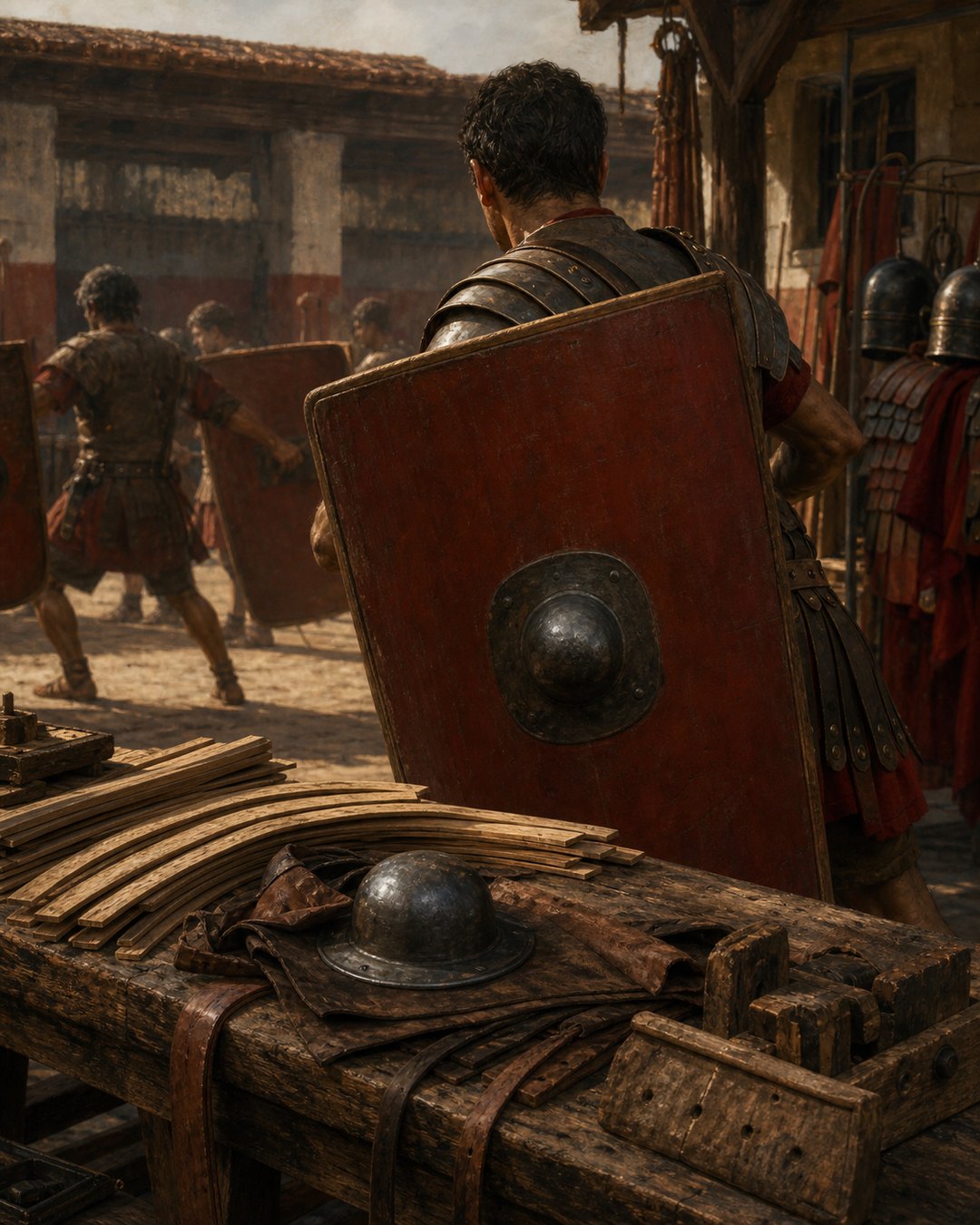
A Roman scutum met the enemy as one object, but it began as many materials persuaded to cooperate. Thin strips of wood crossed one another inside a curved body. Cloth or hide covered the face. An iron boss guarded the fist around a horizontal grip. The result rose from shin toward shoulder while bending around the soldier it protected.
Its size mattered only because structure made that size usable. Curvature stiffened the surface and turned blows away from a flat center. Laminated grain made one split less likely to run through the whole body. Most important, drill brought neighboring shields close enough that separate pieces of wood behaved like a moving wall without becoming a rigid barricade.
A shield began as crossed directions of wood
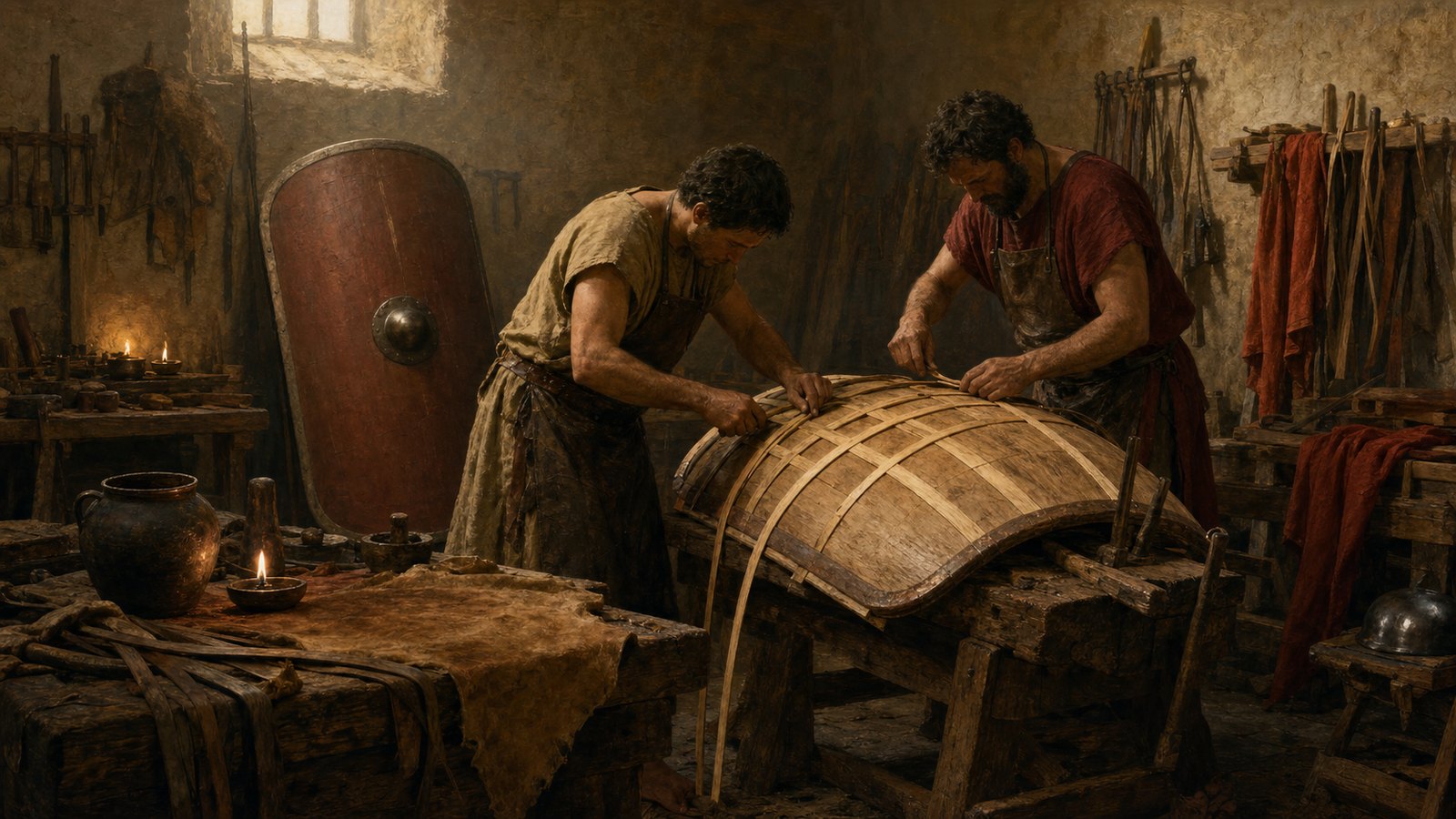
A broad shield cut from one thick plank would carry the weaknesses of that tree through its entire width. Grain that ran helpfully in one direction could guide a split in another. Laminated construction answered by laying thin wooden strips across each other, so a crack trying to follow one layer met fibers running a different way in the next.
The shield from Dura-Europos gives unusually direct evidence for this method. Its survival should not be made to stand for every Roman shield in every century, yet it reveals a sophisticated wooden shell rather than a crude slab. Building that shell required prepared strips, adhesive, a form that established curvature and pressure while the assembly set.
Thin layers also allowed shape without carving away most of a heavy plank. Bent and bonded over a mold, they created a surface that was broad but not needlessly thick. The maker balanced stiffness against mass: too little structure invited failure, while every unnecessary thickness had to be carried through marches before it protected anyone.
This economy of repeated small parts recalls the linked rings of Roman mail. Mail found strength through a flexible network; the scutum used crossed fibers locked into a curved shell. Both turned modest elements into protection whose behavior no single element could provide.
Curvature made a broad surface behave like a shell
A flat shield stands entirely in one plane. A curved scutum wrapped its edges back toward the soldier, covering more of his sides and creating a shallow shell around the torso. The form also helped the wooden body resist bending, much as a folded sheet becomes harder to flex than the same sheet left flat.
An incoming weapon rarely met that surface at a perfect right angle. Near the shoulders of the curve, contact was oblique, encouraging points or edges to glance rather than drive directly inward. Deflection was not guaranteed, and a powerful strike still transferred force, but shape changed the path that force had to take.
The curve brought costs. It occupied space in storage and demanded a deliberate grip to keep the edges from catching a companion. When a soldier turned, the shield swept an arc wider than his body. Close-order movement therefore depended on practiced distance, not simply courage or the possession of large equipment.
Imagine lifting it before a drill. The boss settles over the fist, the near edge hides part of the ground and the far edge closes the view toward the neighboring file. A small change at the wrist shifts a large protected surface. The shield magnified control, including every error in that control.
The boss protected the hand that controlled everything
At the center, a horizontal grip let the soldier hold the shield with one fist. That hand sat inside a hollow created by the projecting boss. Iron or another durable boss material received contact that might otherwise crush fingers against the wood, while its rounded surface encouraged a blow to slide away from the vulnerable opening.
The center grip made the scutum active. The soldier could tilt, lift, punch forward or pull it close rather than merely strap a board to his arm. Such freedom concentrated the shield’s mass through wrist and forearm. Endurance and trained posture were part of the equipment system, especially after hours of movement.
Boss, grip and wooden body had to share load. Fastenings that loosened around the center could turn a sound face into an uncontrollable shield. A cracked handle was equally serious: protection that could not be directed was no longer protection in the required place. Inspection focused on attachments as much as on visible scars.
The central boss also gave a forward press a hard leading point. It could create room when bodies collided, but the scutum should not be reduced to a weapon with a convenient shield attached. Its decisive work remained coverage, control and the preservation of formation while spears, pila and swords performed different tasks.
Facing and edges protected the wooden core
Wood made the shield possible and also made it vulnerable. Moisture could swell layers, impact could crush exposed fibers and repeated rubbing could fray an unprotected rim. Cloth or hide facing helped bind the surface and accept paint or decoration, while edge reinforcement defended the places most likely to be struck or scraped.
These coverings did not turn organic material immortal. Rain entered damaged seams; heat and dryness stressed adhesives; a cut edge admitted dirt and water. After a march, a shield needed to be dried rather than abandoned in a damp stack. Maintenance preserved the bond between layers that could not be inspected easily from outside.
Weight accumulated quietly. Facing, adhesive, boss, grip and edging each added something to the wooden shell. Decoration added little defensive value unless it also served the facing, yet identity and appearance mattered in military display. The maker and user negotiated durability, recognition and burden inside one familiar silhouette.
The same logistical truth appears in Roman marching footwear. A spectacular campaign rested on organic equipment surviving sweat, rain, abrasion and repair. Shield and sandal failed at different scales, but both required armies to care about edges, fastenings and moisture.
Drill connected separate shields without fixing them together
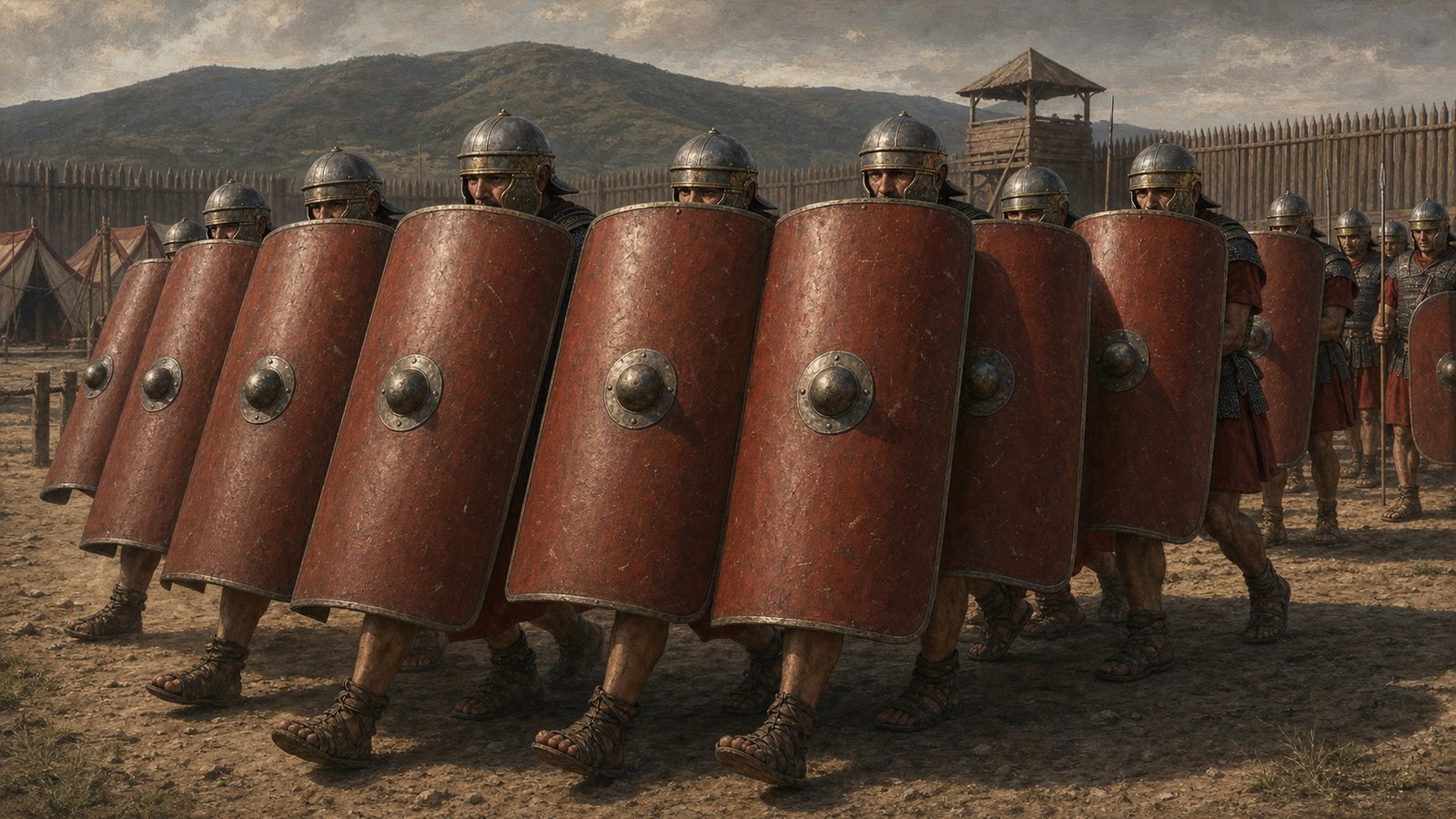
One scutum covered one soldier. Several aligned shields altered the geometry of danger. Edges could approach or overlap so that a weapon searching for a gap met another protected surface. The line gained continuity while each man retained enough movement to step, turn and make room for his own weapon.
That continuity was never automatic. A soldier who surged ahead exposed a flank; one who fell behind opened a seam. The large shield narrowed his view and made uneven ground harder to read. Commands, practiced pace and awareness of neighboring pressure kept the front from dissolving into isolated men carrying cumbersome boards.
Roman sources and later imagination often emphasize spectacular shield formations, but ordinary alignment mattered before any named maneuver. The basic achievement was repeatability: halt with the front covered, advance without tangling edges, receive pressure without rotating sideways and replace tired or injured men without leaving the line naked.
The recently scheduled article on the pilum’s disruptive work shows another part of that sequence. A thrown weapon could disturb an opposing shield before close contact. The scutum then carried the Roman soldier through the dangerous interval in which formation had to become hand-to-hand control.
Damage turned a wall back into individual objects
A shield accumulated a readable history. Dents marked the boss; cuts crossed the facing; edge binding loosened; paint faded under weather and handling. Some scars were superficial. Others announced a weakened layer, a shifting center fitting or a damp seam that could separate under the next heavy impact.
Repair began by deciding which damage mattered structurally. A torn cover could be patched; an edge rebound; fittings tightened or replaced. A deep fracture through the laminated body was harder because the curved shell depended on continuity. The useful question was not whether the shield looked worn, but whether it still transferred force and obeyed the hand.
Variation across Roman history reinforces that practical view. Oval, rectangular and other shield forms belonged to different periods, units and circumstances. The famous curved rectangle is important without being timeless. Roman military equipment changed because materials, opponents, production and tactical expectations changed around it.
Roman scuta turned wood into a moving wall by joining two kinds of structure. Crossed layers, curvature and fittings organized matter; drill organized people. If either arrangement failed, the wall disappeared. What looked from a distance like one red front was always many fragile objects and many trained decisions kept in alignment.
Sources & Further Reading
- Smith Dictionary, Scutum
- Scutum
- World History Encyclopedia, Scutum