
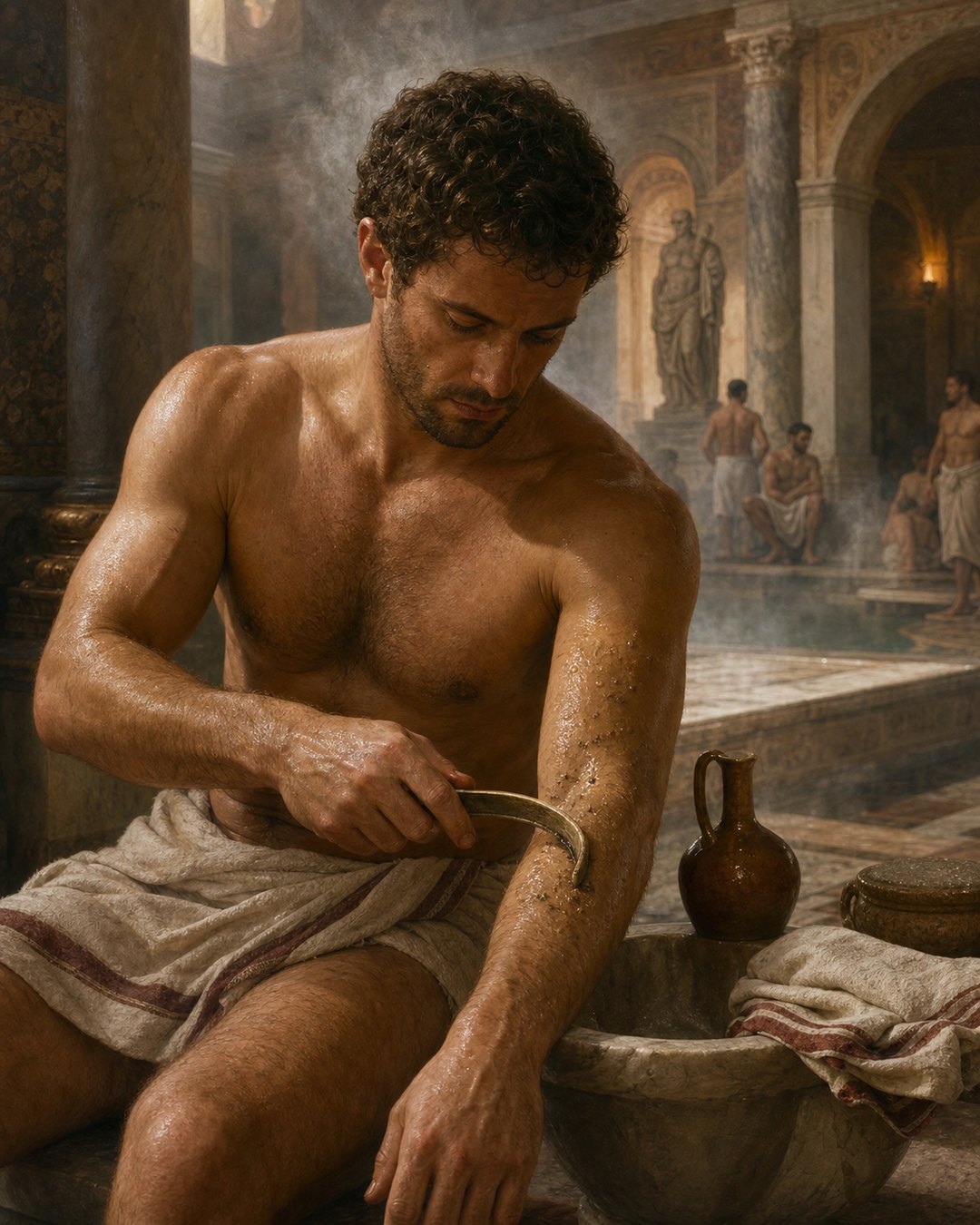
In Greek and Roman bathing and athletic contexts, oil could be applied before a curved strigil scraped the skin. Sources describe the tool removing dirt, perspiration and the applied oil. That basic sequence is secure; an exact recipe, quantity of oil, stroke pattern or universal order for every bather is not.
The tool makes ancient bathing feel less familiar than marble pools alone suggest. Its handle and curved metal blade brought cleaning into direct contact with the body. Strigils belonged beside wider bathing practices rather than replacing them, and some users could receive help from attendants or enslaved workers.
Oil prepared grime for scraping
Sources summarize the applied oil as helping gather dust and grime on the skin. That is the supported mechanism at a broad level. They do not establish a precise account of particle adhesion, skin temperature or the shape of the resulting film, so modern-sounding physical explanations should remain outside the claim.
Oil was part of the cleaning practice because it was applied before scraping and removed with dirt and perspiration. It may also have affected how the tool felt on skin, but the listed summaries do not quantify friction or define ideal amounts. The safe sequence is application followed by scraping.
Oil could be carried in a flask, and strigils are discussed with such flasks as personal bathing equipment. The pairing supports the practical connection between applied oil and scraper. It does not prove that every strigil was owned as a matched set or that all bathers supplied their own equipment.
This direct treatment of skin gives the article a different focus from the linked article about cleaning a Roman toga. The supported subject here is bodily scraping with oil and a curved tool, sometimes performed with assistance.
The curved tool had a recognizable form
A strigil commonly combined a handle with a curved blade or channel. That form identifies it as a scraper suited to bodily cleaning. The summaries support scraping oil, dirt and perspiration from skin, but they do not describe a universal fluid path through the curve or the exact direction of each stroke.
Surviving examples vary, and no single specimen should define every century or region. Bronze and iron examples are known, with differences in form. Those variations establish diversity in manufacture more securely than claims about the precise balance, stiffness or performance of every surviving type.
The tool was used to scrape rather than to cut. Because it was a metal edge moving on skin, controlled handling is a cautious inference, especially if another person assisted. Exact pressure, angle, overlap and preferred direction are not given by these summaries and should not be reconstructed as a standard technique.
Oil and dirt were removed by the tool, so residue on a used strigil is plausible. The sources listed here do not provide a maintenance manual, however. Claims about rinsing, wiping, corrosion prevention, storage conditions or bathhouse cleaning schedules would need more specific evidence than the form of the implement alone.
Using the tool remained bodily work
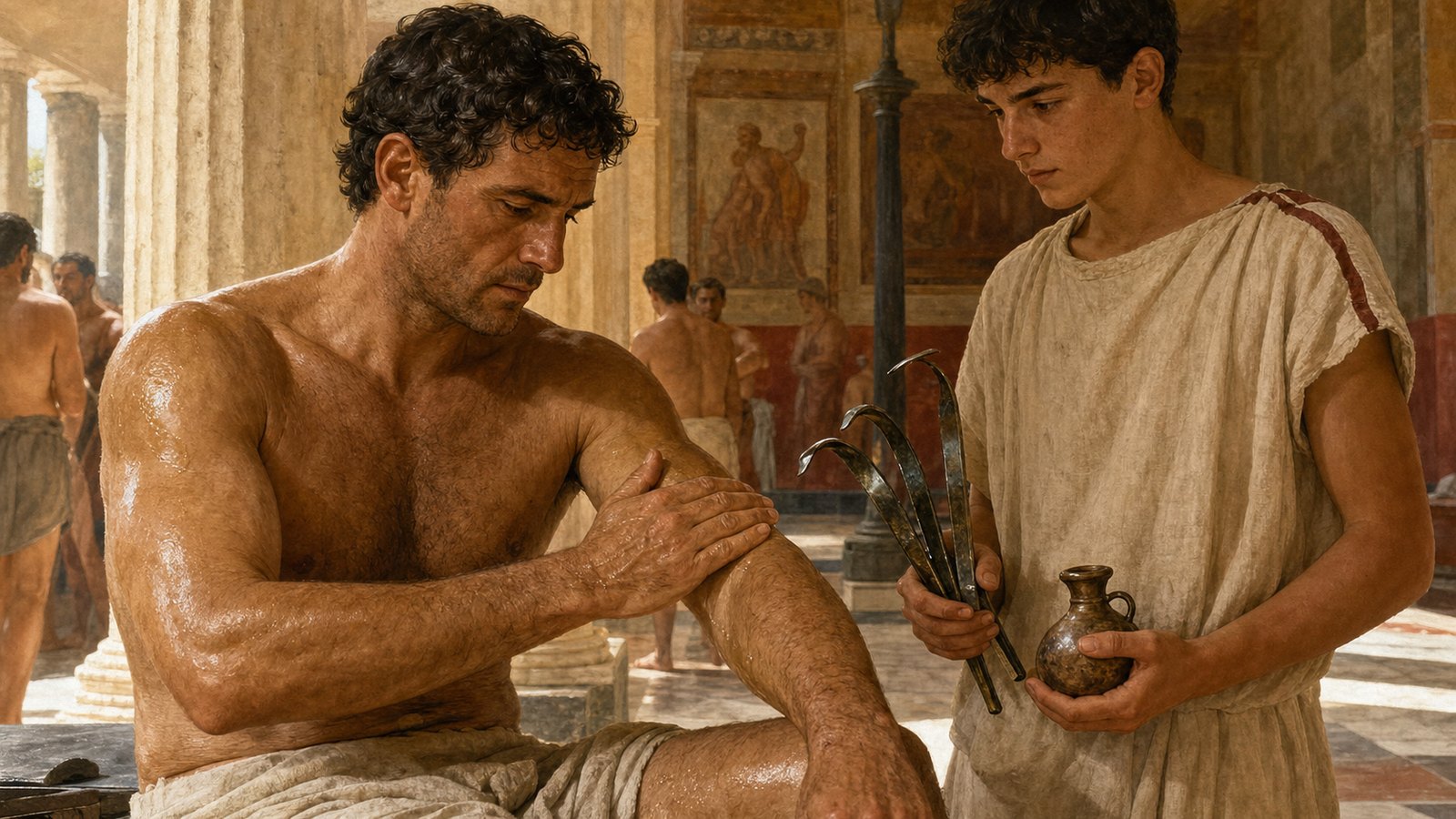
Using a curved metal scraper on skin required handling, whether by the bather or an assistant. Sources describe some wealthy or prestigious users receiving assistance from enslaved people, but they do not map body areas to a prescribed stroke length, grip or direction. Technique should remain general.
A cautious reconstruction can show an athlete after exercise with oil on the skin and a strigil in hand, because that combination is well attested. A dark ribbon in a channel, a specific wrist brace or a downward stroke below the elbow would be visual interpretation rather than details preserved in the summaries.
More than one pass may be plausible in practice, but an exact overlapping pattern, visible endpoint or skin response is not stated here. The limited safe conclusion is that the user controlled a scraping tool closely enough to remove the oily mixture rather than treating the implement as an automatic device.
Cleaning could be a shared task. Sources say some wealthy or prestigious users had enslaved people wield strigils for them. That is a meaningful status context, but it should not be expanded into a claim about every bath, every wealthy user or the complete organization of bathhouse labor.
Exercise made the cleaning sequence visible
The strigil had strong associations with athletics. Sources describe athletes using oil and strigils after exercise as part of cleaning the body. Exercise supplies a clear context for dirt and perspiration, but the summaries do not establish one uninterrupted route through palaestra, oiling, scraping and particular bath rooms.
Athletic use shows why the tool is discussed as more than a decorative bath object. Oil was applied, helped gather grime and was then scraped away with dirt and perspiration. Comparisons with soap, estimates of water supply or claims about what a casual splash could remove go beyond the listed evidence.
The removed material consisted broadly of oil, sweat and dirt, but its appearance and quantity would vary. Unusual ancient anecdotes should not define ordinary practice. The secure point visible in tools and representations is the association of athletes, applied oil and bodily scraping.
The wider setting appears in the linked article on Roman baths. The strigil occupied one bodily practice within that broader subject. Its surviving form and representations show that bathing could involve personal equipment and direct handling, not architecture alone.
Scraping remained part of wider bathing
The strigil did not make the rest of bathing unnecessary. Sources place it within bathing and athletic cleaning rather than presenting it as a complete replacement for all other practices. The summaries do not specify which rooms, water treatments, cloths or drying steps had to surround every use.
Practice could vary with place, means and habit. The portability suggested by an oil flask and strigil does not prove identical access, ownership or routine across Roman society. Nor does evidence from athletes or wealthy users establish what every Roman did when cleaning the body.
Heat and water belonged to the wider world of bathing, but their exact interaction with strigil use is not described in these summaries. Claims about oil viscosity, steam, grip failure or skin temperature would sound technical without direct support. The article can acknowledge context without inventing operating conditions.
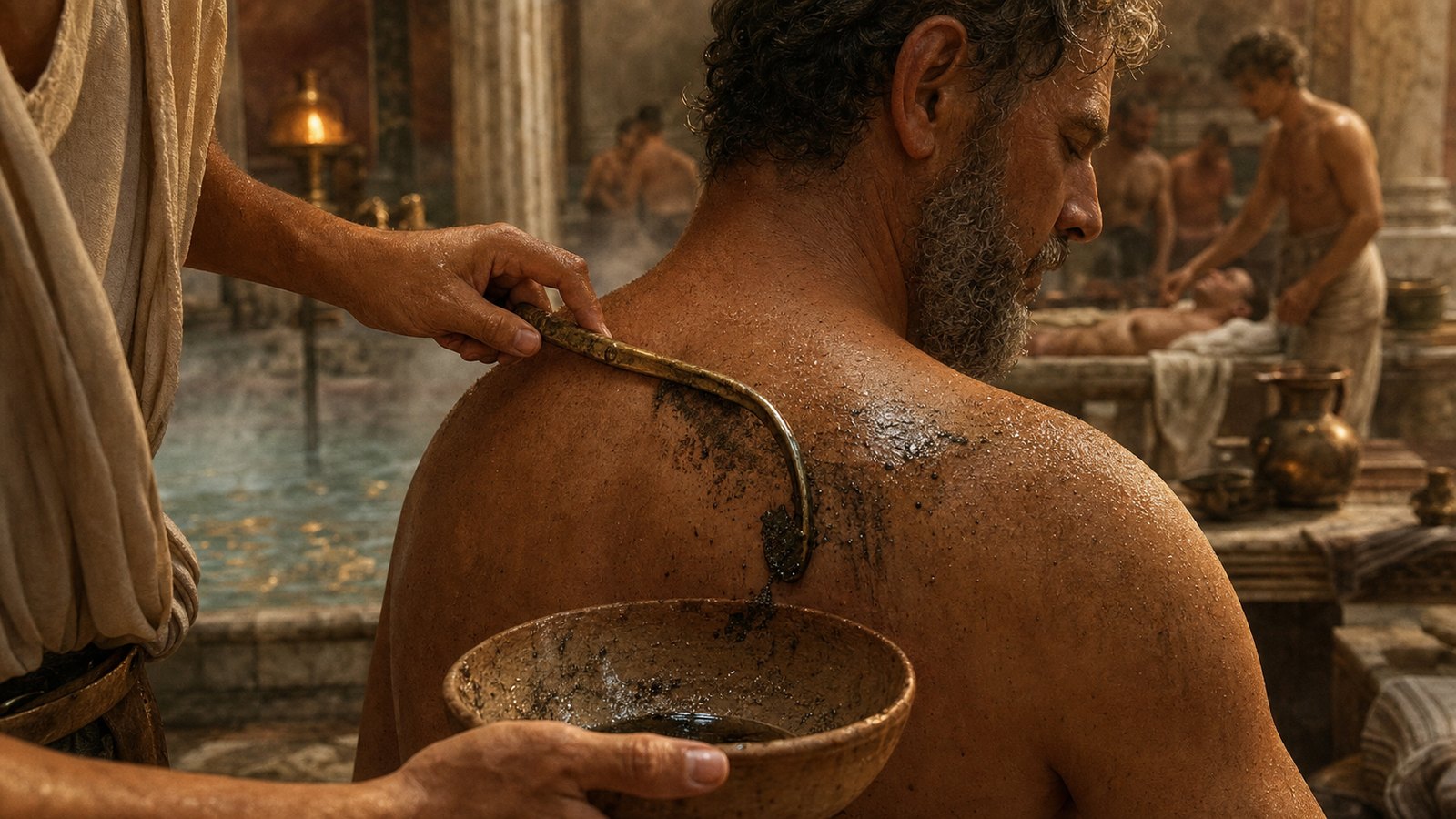
Scraping transferred applied oil, dirt and perspiration away from the skin. The listed evidence does not say exactly where residue was placed afterward or how the tool was cleaned. A vessel, cloth, rinse or disposable material may be plausible, but none should be presented as the standard procedure here.
A small tool reveals the labor inside Roman cleanliness
Museum displays can make a strigil look elegant and static. Its documented use was practical: scraping applied oil, dirt and perspiration from skin. Wear, tarnish and residue are possible consequences for metal tools, but the summaries here do not provide a condition history for ordinary implements after repeated use.
The object also complicates the phrase “the Romans bathed.” Bathing could include personal equipment, oil and assistance as well as architecture and water. The evidence supports attendants and enslaved helpers in some cases; a full list of maintenance roles, supplies and room-cleaning duties would require separate sources.
It also marks a different subject from garment cleaning. A strigil was applied directly to the body, either by the user or by someone assisting. That close contact supports caution about handling, but not a detailed universal technique or a claim that all bathers experienced the practice in the same way.
Roman strigils helped turn applied oil into a cleaning method because oil, dirt and perspiration were scraped from the skin together. The tool’s lesson is both material and social: a curved implement had to be handled directly, and some users received assistance, though neither technique nor access was uniform.
Sources & Further Reading
- World History Encyclopedia, Strigil
- Strigil