
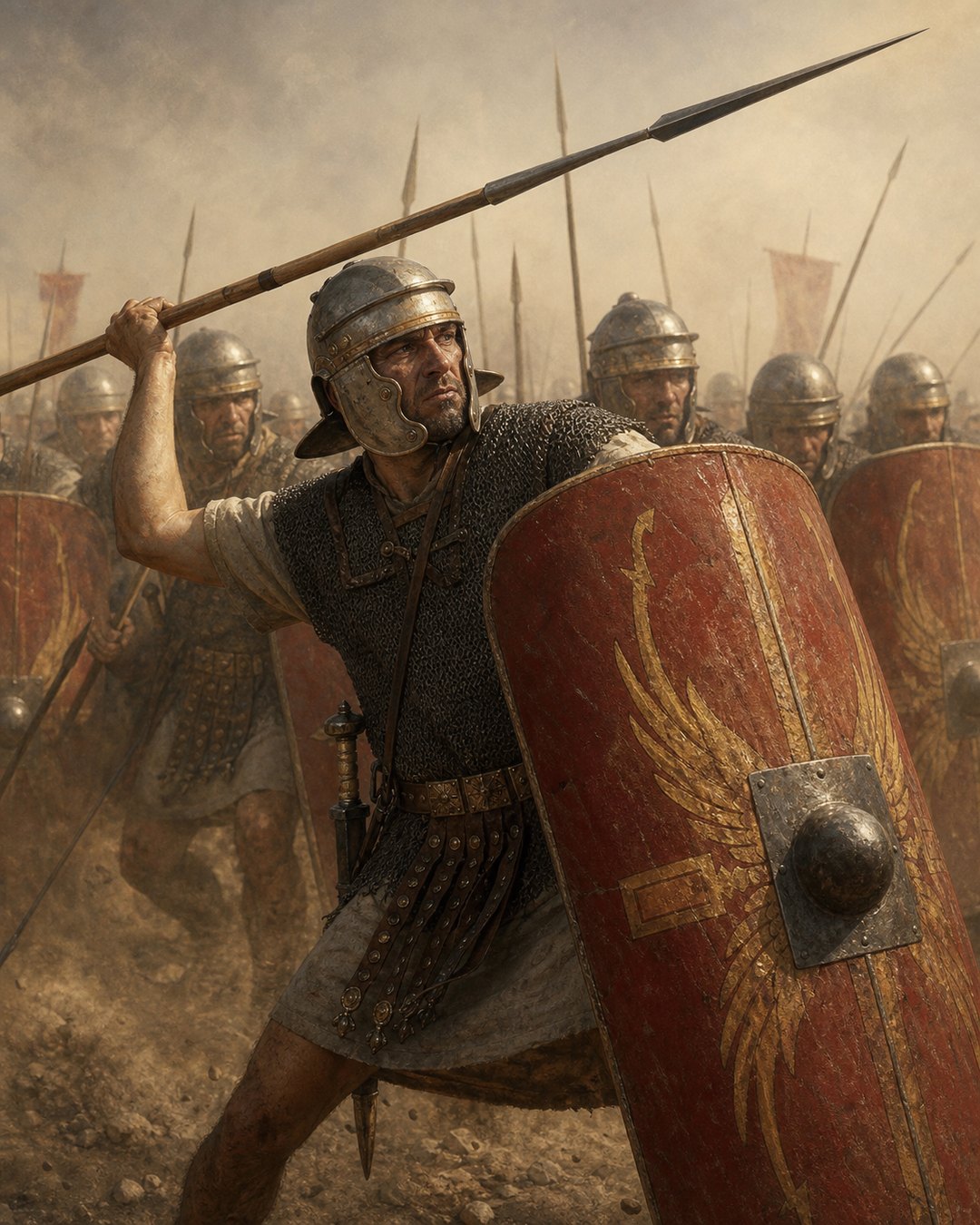
Before close combat, Roman legionaries could throw pila, heavy throwing spears with wooden shafts and long pointed iron sections. Sources especially emphasize their ability to penetrate and lodge in shields. The throw belonged before sword-and-shield fighting rather than replacing it, so its significance lay partly in what could follow an impact.
A pilum that entered a shield could burden or obstruct it. Not every throw hit, every shield was penetrated or every iron shank bent, and explanations of bending remain debated. The cautious tactical point is conditional: where a pilum lodged, it could make a shield more awkward to handle before close combat.
Wood and iron divided the weapon’s work
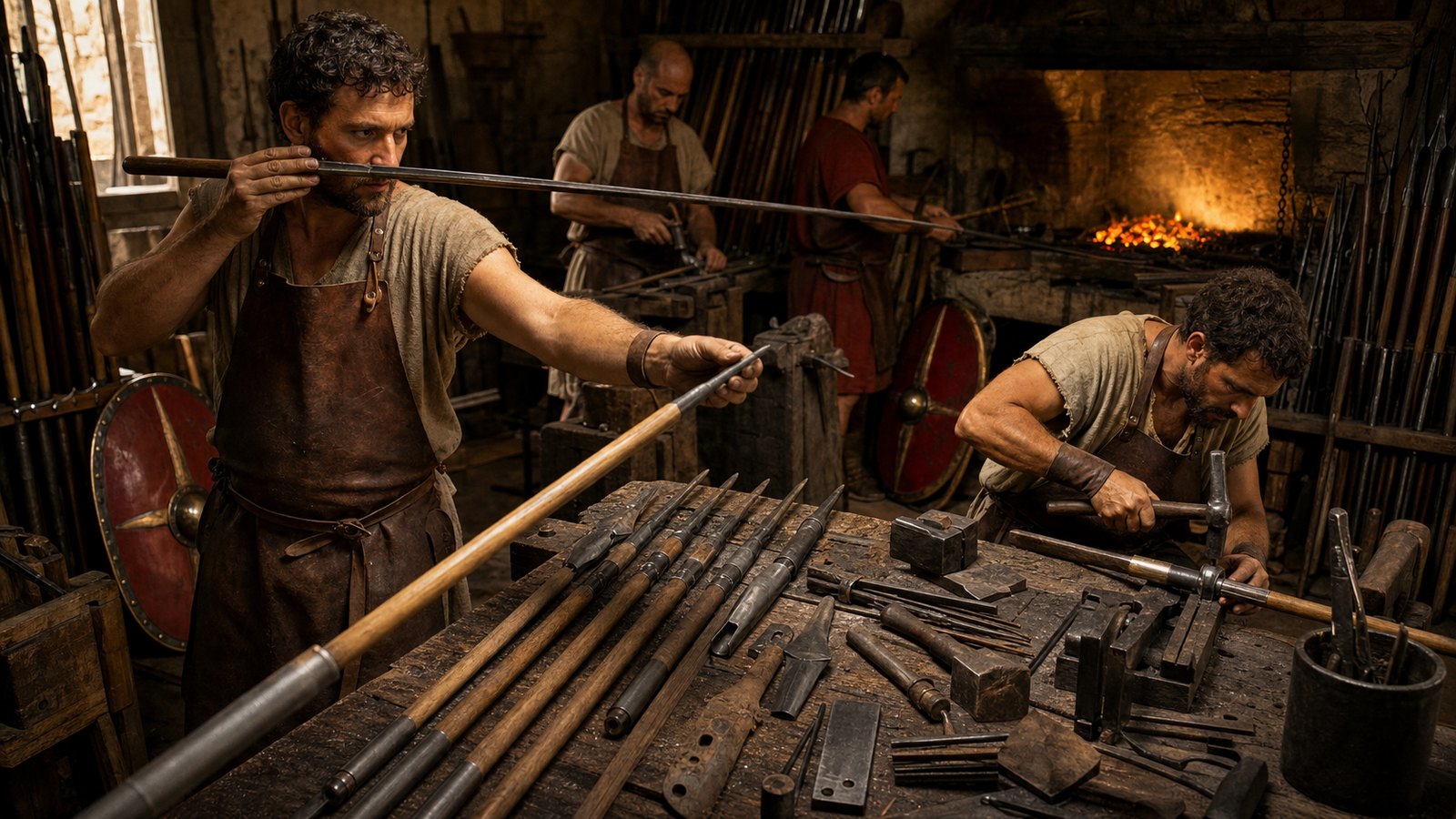
The pilum joined a wooden shaft to an extended iron shank ending in a point. This basic combination is well supported, while exact dimensions and weights varied and are not needed here. It is enough to distinguish the grasped wooden portion from the long iron section intended to penetrate a target.
Construction varied. Surviving heads and fittings include different forms, and descriptions distinguish socketed examples from tang constructions fixed through a block. That diversity matters because “the Roman pilum” names a family of weapons used across long periods, not one factory pattern frozen for every legion and campaign.
The long iron section could remain projecting if the point lodged in a shield. The supported effect is obstruction or added burden, not one inevitable mechanical outcome. Some points failed to penetrate, some weapons could lodge without bending and explanations of deformation differ, so no single impact sequence should be treated as universal.
Unlike Roman torsion artillery storing force in twisted bundles, the pilum was thrown by a soldier. Sources connect its battlefield use with legionary equipment and training, but the listed summaries do not specify one universal stance, run-up, release angle or formation for every period.
The throw belonged to the edge of close combat
The pilum’s documented role was tied to the stage before hand-to-hand contact rather than to prolonged distant shooting. That broad placement is more secure than an exact release distance. The sources summarized here do not support one range figure that can be applied across every weapon variant, soldier, terrain and period.
Timing connected missile use with the fighting that followed. A legionary could throw the pilum before using sword and shield at close quarters, while an opponent whose shield was struck might face a handling problem. The exact time available and the response chosen cannot be reconstructed as one standard sequence.
This transition explains why a maximum-range claim would add little. Pila varied, as did the circumstances of use. The reliable point is comparative rather than numerical: the weapon was intended for throwing before close combat, and Roman practice linked that throw with a subsequent advance into sword-and-shield fighting.
Military drill could help coordinate throwing and advance, but the summaries do not preserve a complete drill manual. Avoiding collisions, maintaining spacing and recovering stance are plausible requirements, not details to present as a quoted Roman procedure. Coordination should therefore remain the supported conclusion.
A shield hit became a handling problem
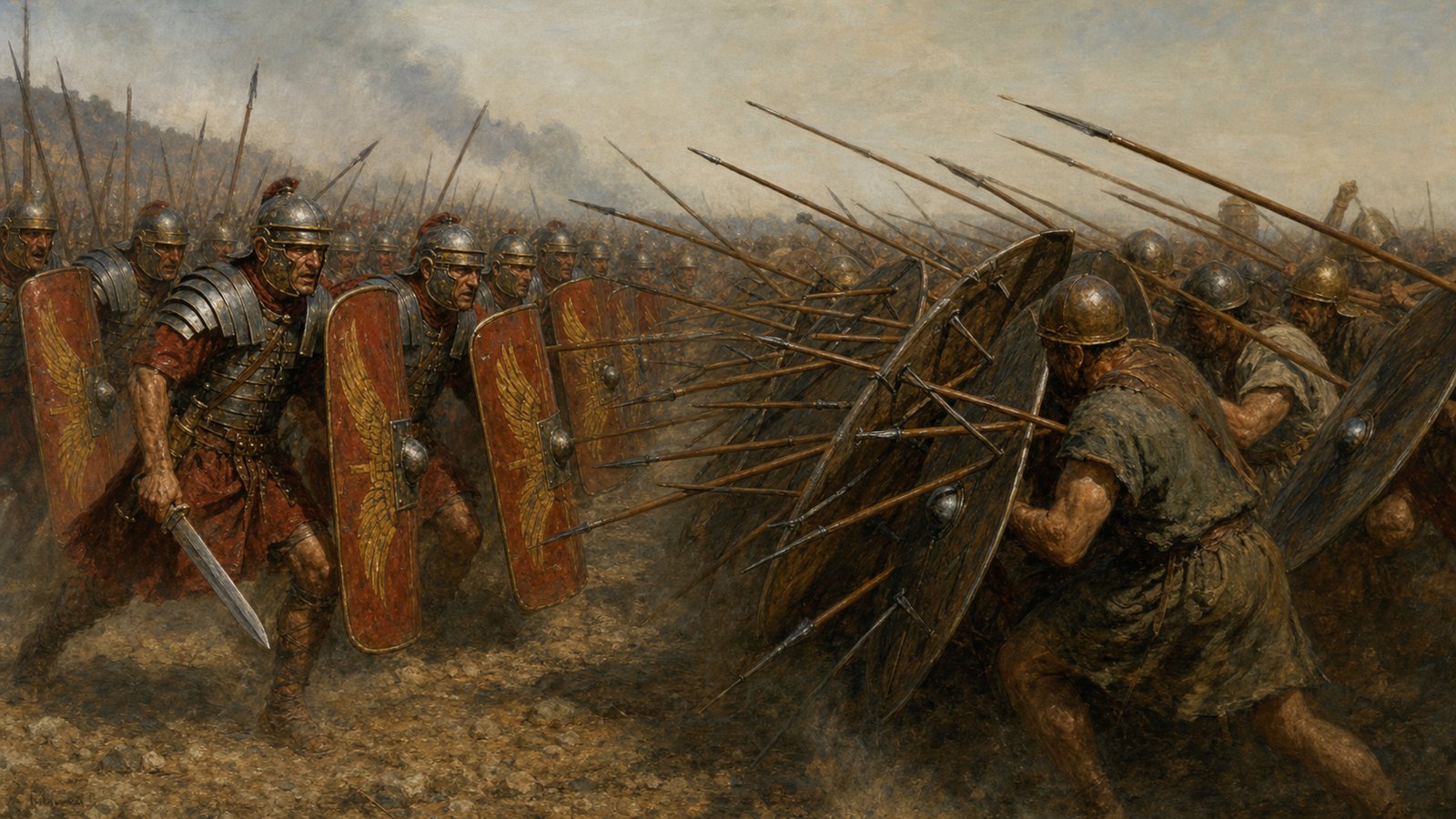
If a pilum point entered and held in a shield, the bearer might remain uninjured while the weapon projected from the defensive surface. Sources describe the lodged pilum as a burden or obstruction. They do not require the shield to break, nor do they show that every hit forced its immediate abandonment.
The safest description stops at impaired handling. A lodged weapon could make a shield awkward, and a bearer might then have to decide how to respond. Claims that the shaft always caught the ground, struck a neighbor, forced a particular grip or produced a predictable gap would make a variable possibility sound certain.
A restrained reconstruction may show one pilum lodged while another misses, because variable results are central to the caution. It should not assign an exact shield material, impact depth, bodily motion or neighboring reaction unless those details are separately sourced. The supported image is obstruction, not choreographed certainty.
The exact behavior of the iron shank should be described cautiously. Popular accounts often claim every pilum was designed to bend on impact, but evidence and construction histories are more complicated. Some examples may deform; some lodge without bending; some fail to penetrate. Tactical disruption did not depend on one guaranteed transformation.
Obstructed shields could affect what followed
Multiple throws could produce multiple outcomes, but the listed summaries do not quantify volley size or guarantee disorder across an entire front. The defensible claim is narrower: Roman drill helped coordinate throwing and advance, and any pila lodged in shields could create handling problems during that tactical transition.
A “gap” is therefore a useful metaphor only if it remains conditional. Obstructed shields could contribute to disorder before close combat, but exact movements—a lowered shield, backward step, widened spacing or turned shoulder—are possible reactions rather than documented consequences of every pilum impact.
No account should turn a possible handling problem into automatic victory. A pilum could miss, fail to penetrate or lodge without producing one predictable response. Its supported value is conditional: where a shield was penetrated and burdened, that obstruction could affect the circumstances before close combat.
The thematic comparison with the corvus article is about transition rather than identical mechanics. This article’s sourced sequence is narrower: a pilum was thrown before close combat, and a lodged weapon could make a shield harder to handle.
The throw preceded sword-and-shield combat
After throwing, a legionary could proceed to sword-and-shield combat. That sequence is supported at a general level. Which hand moved when, how the shield was held and how rapidly another weapon was drawn could vary with equipment and circumstance, so those details should not be turned into a universal drill.
The transition required coordination, but the summaries do not specify exact errors, commands or battlefield footing after the cast. Fallen or embedded pila are plausible physical results of throwing, yet their distribution and effect on movement would depend on what happened in a particular encounter.
Pila were manufactured objects with wooden and iron parts, but the listed source summaries do not describe a complete recovery, repair or supply system. Some weapons may have been damaged or recovered; that is different from asserting standard battlefield practice or assigning specific maintenance work to named specialists.
The object’s tactical role was brief in the sense that it was thrown before close combat. Beyond that, claims about deliberate expenditure, salvage policy or calculations protecting an investment in trained soldiers exceed the summaries. The supported story remains the linked use of throwing spear, shield obstruction and close fighting.
The real weapon was the sequence
Archaeological finds preserve variation in pilum heads and fittings rather than one immutable design. On the field, the object belonged with shields, swords, training and movement. Its significance is therefore best explained through the supported sequence of use, without supplying commands or spacing details absent from these summaries.
Later traditions linked Gaius Marius with a construction change intended to affect the weapon after it struck. Such accounts belong in the history of how Romans explained military effectiveness, but they should not become a simple origin story for every pilum. Archaeological variation resists one elegant universal tale.
The more reliable conclusion is tactical. Roman infantry used a throwing weapon before close combat. Its iron point and shank were intended to penetrate targets such as shields, and a lodged pilum could burden or obstruct one. Training helped connect throwing with advance, though the scale of any resulting disorder varied.
Roman pila could open a problem before the swords because the throw preceded close combat. A point might enter a shield; a lodged weapon might complicate handling; infantry could then advance. Each step is conditional except the broad tactical order, and that caution keeps a useful mechanism from becoming a promise of automatic success.
Sources & Further Reading
- World History Encyclopedia, Pilum
- Pilum