
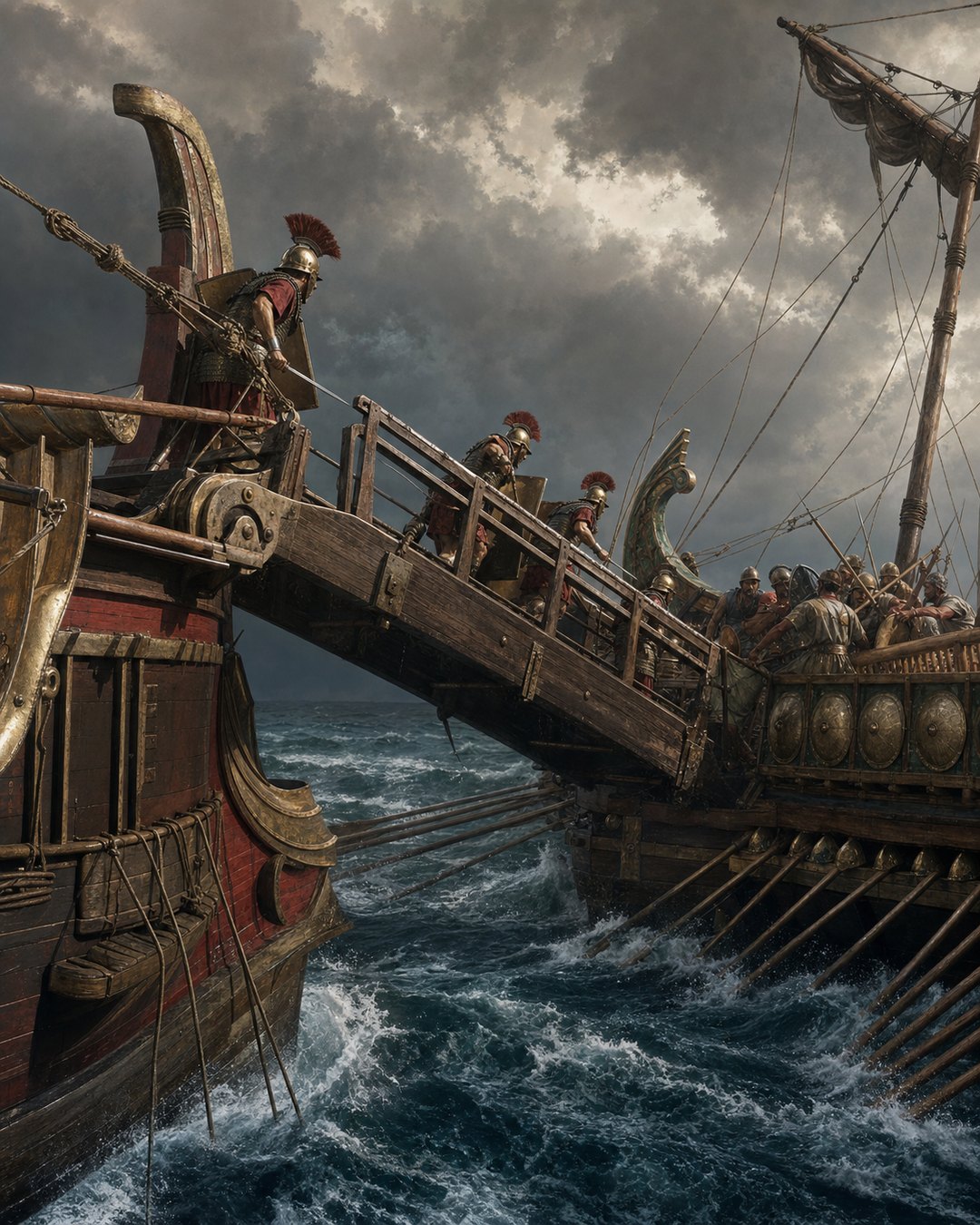
A Carthaginian captain approaching a Roman warship early in the First Punic War expected the familiar contest of oars, angles, rams, and disciplined seamanship. Then a timber gangway swung overhead. Its iron point crashed into the deck, rails framed a narrow passage, and Roman infantry began crossing. The sea had not disappeared, but the decisive ground had suddenly become planks under armored feet.
Polybius describes the mechanism that made this conversion possible. The boarding bridge later called the corvus was thirty-six feet long and four feet wide, pivoted around a pole, and carried a heavy spike beneath its far end. It did not teach Romans to out-sail Carthage. It let them interrupt sailing long enough to fight the kind of close battle they already understood.
Rome entered a war whose roads were water
The First Punic War began in 264 BCE around Sicily, where cities, armies, ports, and supply routes faced one another across narrow seas. Rome could move legions down Italian roads, but holding influence on the island required ships. Carthage possessed a longer tradition of maritime trade and naval campaigning, so the contest confronted Rome with an institutional weakness rather than a lack of courage.
A galley battle rewarded coordinated rowing, rapid turning, awareness of wind and swell, and a commander’s ability to bring the reinforced prow against an enemy hull without exposing his own. Those were learned collective skills. Building a fleet could be accelerated with timber and money; creating veteran crews and officers took repeated practice.
Roman infantry offered the opposite profile. Citizens and allies knew how to advance behind shields, hold formation, throw pila, and finish at close range. The problem was geographical: that competence stood on one deck while the enemy used seamanship to keep a different deck beyond reach.
The corvus answered by treating distance between ships as a temporary engineering problem. Instead of waiting until Roman crews matched every Carthaginian maneuver, the device tried to arrest maneuver itself. It was less a weapon aimed at a body than a machine aimed at the rules of the encounter.
Polybius described a bridge built to fall
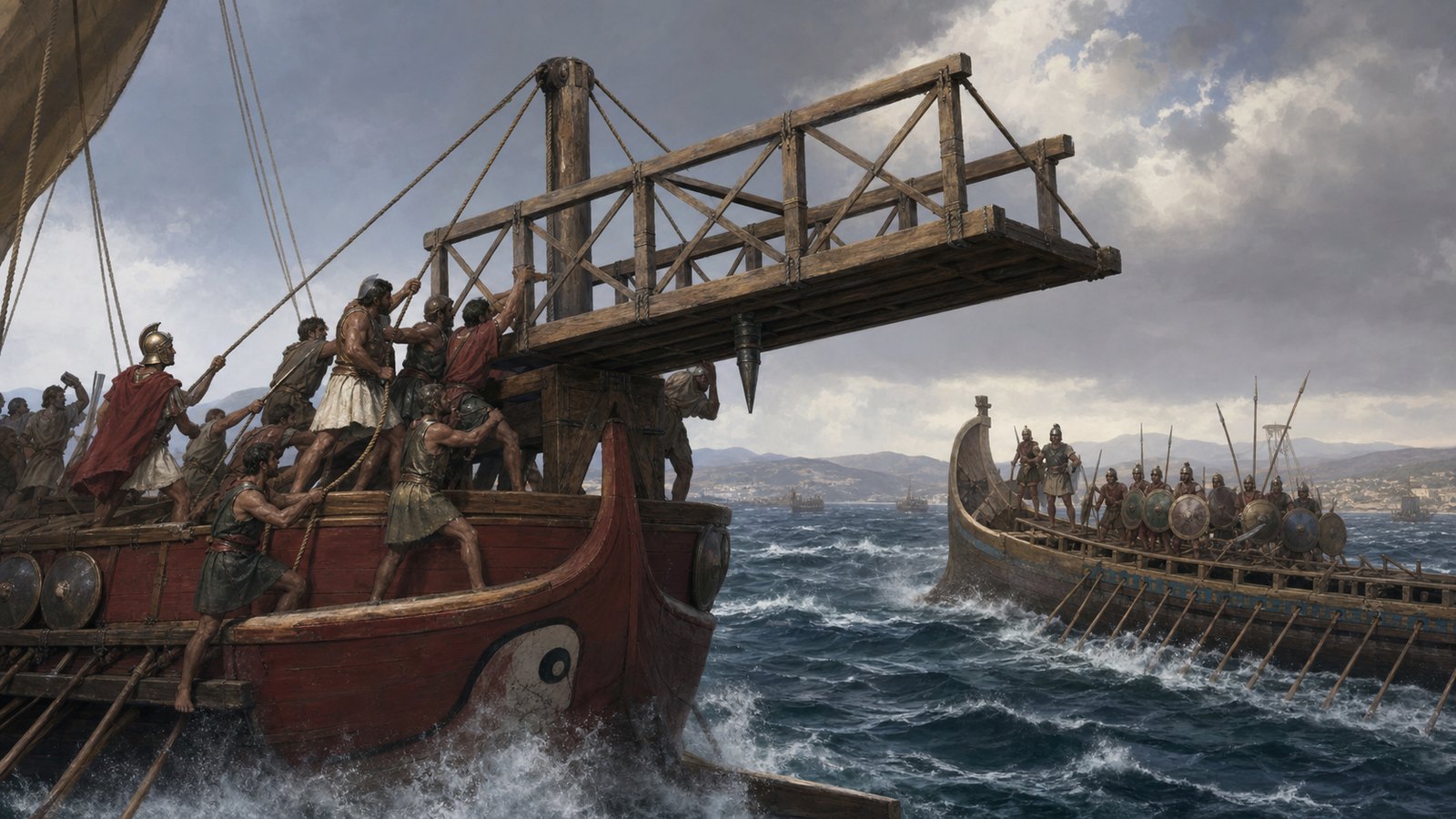
Polybius gives unusually concrete dimensions. The gangway measured thirty-six feet long and four feet wide. A slot near one end fitted around a pole fixed at the ship’s bow, allowing the bridge to rise and pivot. Railings stood along its sides so soldiers had some protection while crossing the exposed gap.
Under the outer end hung a heavy pointed iron piece. When the crew released the bridge over an enemy ship, gravity drove that point into the deck. The shape reminded later readers of a bird’s beak, helping produce the name corvus, or raven. The iron did not need to destroy the ship. It needed to stop separation.
The pivot mattered because opponents did not always approach directly ahead. Crewmen could turn the raised bridge toward a ship arriving from another angle. Once dropped, the corvus linked two moving hulls into an unstable platform whose waves, oars, rigging, and fighting men all pulled against the connection.
This was engineering under violence. Ropes had to run cleanly, the pole had to accept load, the hinge or slot had to turn, and the spike had to strike useful timber rather than vanish into open water. Every part worked while both ships rolled and enemy missiles sought the men operating it.
Mylae made surprise visible in captured ships
At Mylae in 260 BCE, the consul Gaius Duilius commanded a Roman fleet equipped with the device. Polybius says the unfamiliar structures puzzled the Carthaginians. Their leading ships approached confidently, and the falling bridges allowed Romans to board and capture them rather than merely exchange ramming attempts.
The mini-scene unfolds in seconds. Oars beat as the Carthaginian prow closes. Roman deck crews hold the gangway upright. A release runs; timber drops; iron bites. Soldiers who had been waiting behind shields now climb over rails into a fight compressed between masts and benches.
Polybius reports early captures, including the enemy commander’s vessel, and the battle became Rome’s first major naval victory. Exact numbers in ancient battle narratives deserve caution, but the tactical surprise is clear. A device the Carthaginian crews had not planned for changed what approaching a Roman bow meant.
Victory also became public memory. Duilius received a triumph, and Rome commemorated him with the famous rostral column decorated in the language of captured prows. The bridge vanished physically, but the state translated its result into a monument that citizens could read long after the wet decks dried.
Boarding rewarded the skills of a legionary
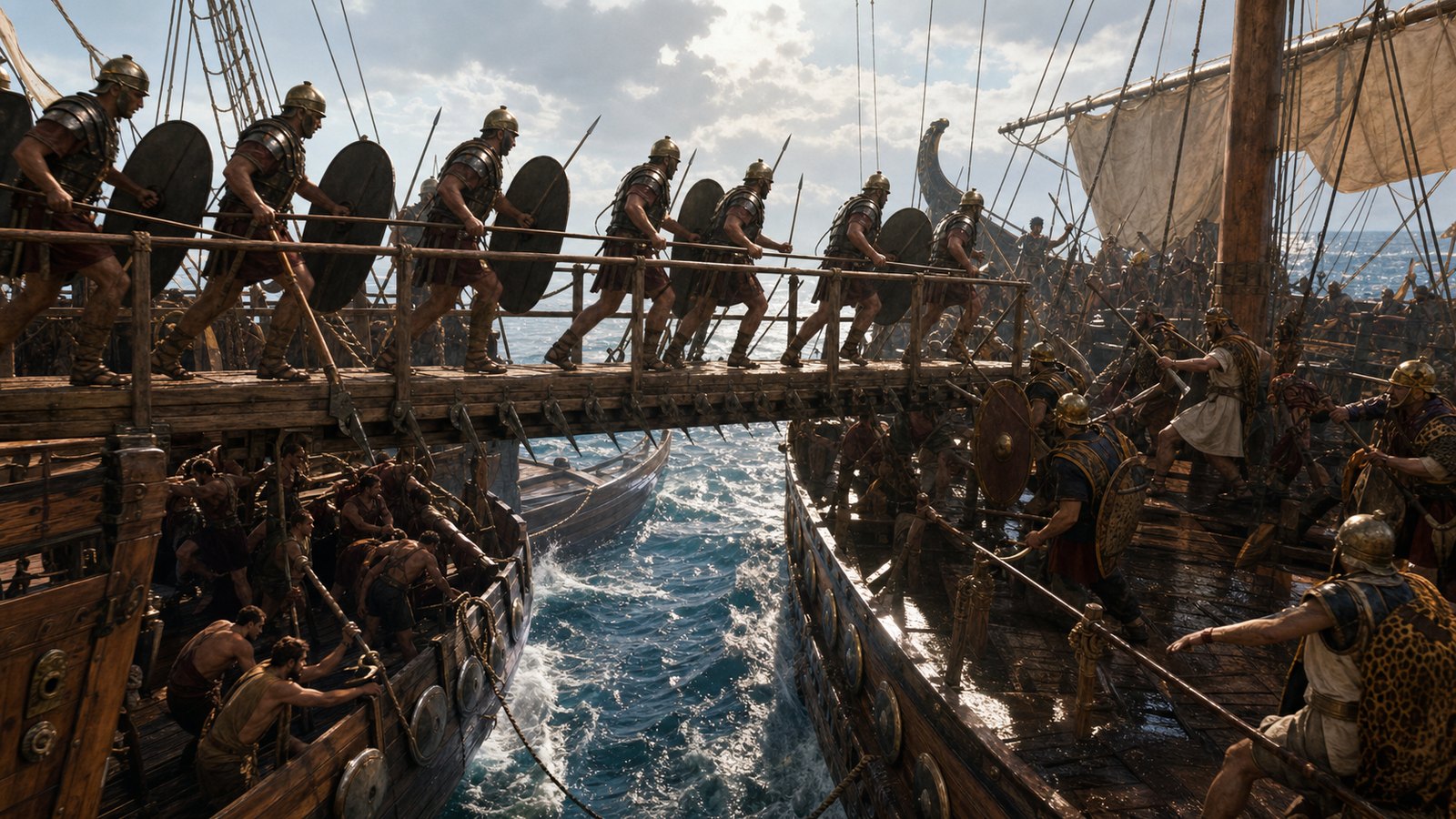
Once the spike held, Roman soldiers crossed in files. The four-foot width was enough for a protected passage, not a broad parade. Men emerged onto the enemy deck with shields forward and companions close behind. A naval contest became a series of small infantry fights constrained by rails, rowing benches, rigging, and the ship’s edge.
This conversion favored Roman habits. Heavy infantry could use cohesion and close-combat confidence without needing the two vessels to remain politely still. The corvus forced them together. Its success depended on soldiers being ready at the right place, sailors placing the bow, and operators dropping the bridge at a moment when the spike could hold.
The mechanism therefore joined two labor systems rather than replacing one. Roman sailors still had to approach, avoid being rammed, and keep their own ship responsive. Infantry still needed order after the crossing. The bridge merely created a narrow interval in which both groups could hand the battle from seamanship to boarding.
That differs from the maintenance world of Roman navalia. Ship sheds made fleets durable through repair, storage, and skilled waterfront work. The corvus exposed what happened when that infrastructure delivered a hull to battle but tactical experience still lagged behind the opponent.
The adaptation carried a price in weight and weather
A thirty-six-foot bridge, vertical pole, ropes, rails, and iron point added weight high and forward on a galley. That burden could make a ship slower to answer or less comfortable in rough water. The device solved one danger by introducing another: a tool meant to seize an enemy deck also altered the behavior of the Roman deck beneath it.
Modern accounts sometimes blame the corvus for catastrophic Roman losses in storms. The connection is plausible enough to discuss because top-heavy equipment affects stability, but the ancient evidence does not provide a neat engineering verdict. Roman fleets also suffered from inexperienced command, difficult coasts, overloading, weather, and the inherent vulnerability of oared warships offshore.
The device disappears from later descriptions. Its absence may reflect improved Roman seamanship, changing tactics, practical drawbacks, or simply the uneven survival of evidence. Rome did not win the long war by freezing naval learning at Mylae. It built replacement fleets, trained crews, suffered enormous losses, and kept returning to sea.
The corvus matters precisely because it was temporary. It shows adaptation as a bridge between weakness and competence. Rome did not deny Carthage’s advantage; it attacked the form that advantage took. For a few decisive encounters, the iron beak turned open water into a doorway for infantry, and a fight between ships became a fight on deck.
A machine can change a battlefield without lasting forever
The most revealing part of the corvus is not its resemblance to a raven. It is the decision behind it. Roman commanders looked at their strongest institution—the legion—and asked what machinery could make it relevant in an unfamiliar environment. The result did not abolish the sea; it created a brief patch of contested ground above it.
That logic echoes the repeatable routines of Roman marching camps. Both systems converted uncertainty into ordered actions. Raise, turn, release, hold, cross: the bridge gave crews and soldiers a sequence that could be rehearsed even if the waves refused to behave alike twice.
Its limitations are part of the lesson. Effective adaptations often carry costs that make them unsuitable as permanent doctrine. The corvus could surprise, capture, and empower infantry while adding weight and demanding a dangerous approach. A device can be historically important without becoming the final form of the technology it changes.
At Mylae, the mechanism gave Rome time. Time to learn the sea, time to replace losses, and time to discover that naval war required more than courage transported onto timber. The spike in the enemy deck was the visible moment. The larger achievement was institutional: turning a temporary workaround into experience that outlived the bridge.
Sources & Further Reading
- Polybius, Histories, Book 1
- World History Encyclopedia, First Punic War
- Corvus overview and references