
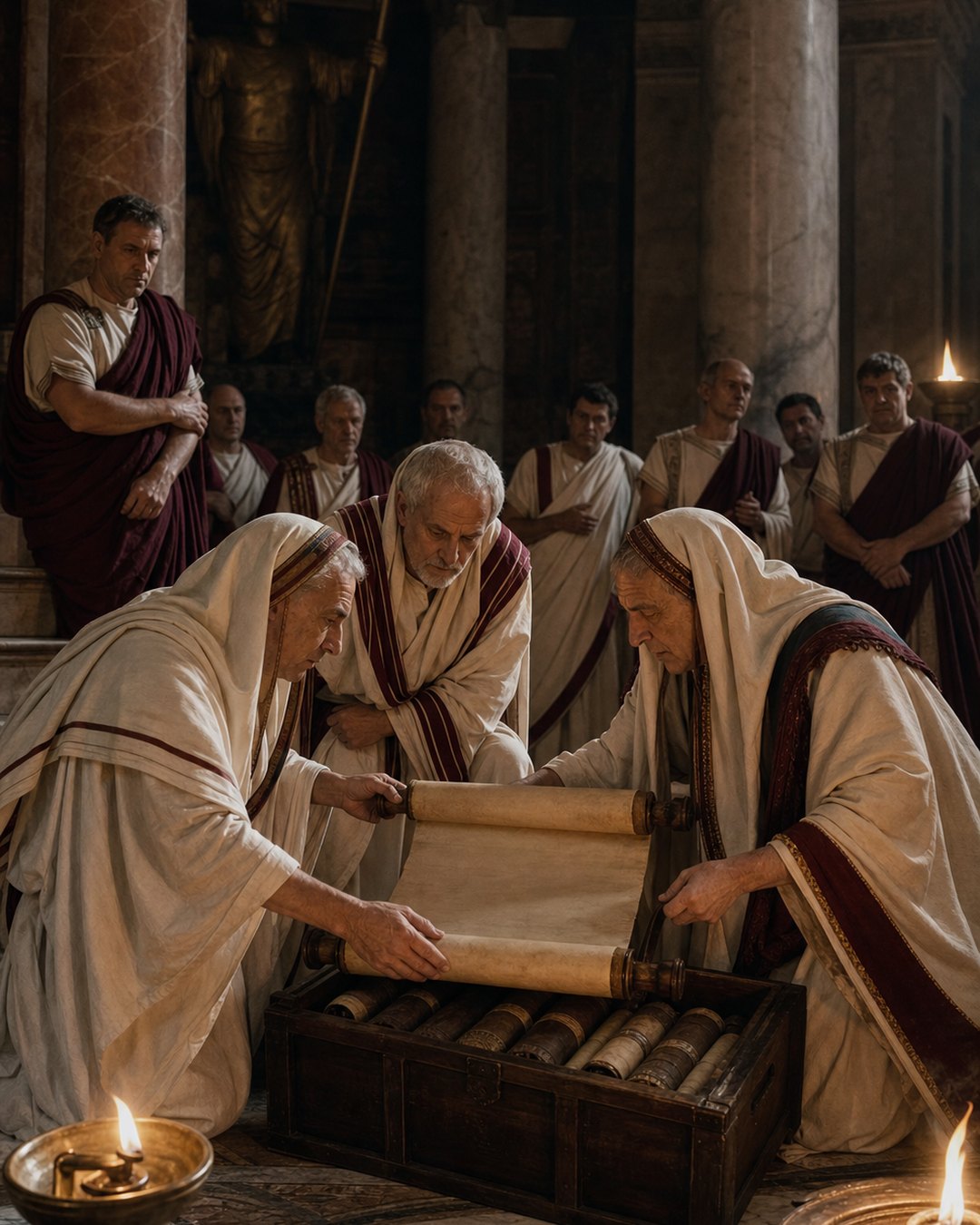
Rome did not open the Sibylline Books to ask who would win a private lawsuit or whom a young aristocrat should marry. The collection belonged to the state, rested under guarded custody, and entered public life when plague, prodigy, defeat, or some other rupture made normal ritual feel insufficient. The senate authorized consultation; appointed priests searched Greek verses; their answer became an action Rome could perform.
That sequence made the books an emergency instrument rather than a simple prophecy machine. Their authority came partly from scarcity. Most citizens never handled them, and even magistrates could not browse them at will. Rome placed ambiguity behind procedure, then used procedure to turn fear into sacrifices, imported cults, public feasts, or other visible repairs.
The origin story made refusal expensive
Roman tradition wrapped the collection in a story about King Tarquinius and an old woman who arrived with nine books. She demanded a price the king considered absurd. When he refused, she burned three, returned with six, and asked the same price. Refused again, she burned three more and still demanded the original sum for the final set.
The king’s advisers recognized that this was no ordinary seller. Tarquinius bought the remaining three, and the woman disappeared. The tale gives Roman state religion a harsh lesson in valuation: sacred knowledge becomes more expensive as human confidence destroys it. Bargaining fails because the object does not obey market logic.
Whether the scene happened as later authors told it is less important than what Romans preserved in it. The books entered public custody already marked by loss. Six volumes had vanished through royal disbelief. Every later consultation therefore carried an implied warning that arrogance could leave the community with less guidance than it had been offered.
The old woman’s identity was linked with the Sibyl, a prophetic female voice located by tradition in the Greek world. Rome did not erase that foreign origin. Greek hexameter verse became part of the capital’s religious machinery, showing that Roman security could depend on knowledge claimed from beyond Rome.
Custodians turned prophecy into procedure
The collection was traditionally kept in the temple of Jupiter Optimus Maximus on the Capitoline. Access belonged to appointed keepers: first a board of two, later ten men, and eventually fifteen. These custodians did not wander the streets selling predictions. Their office made consultation a controlled act inside the state.
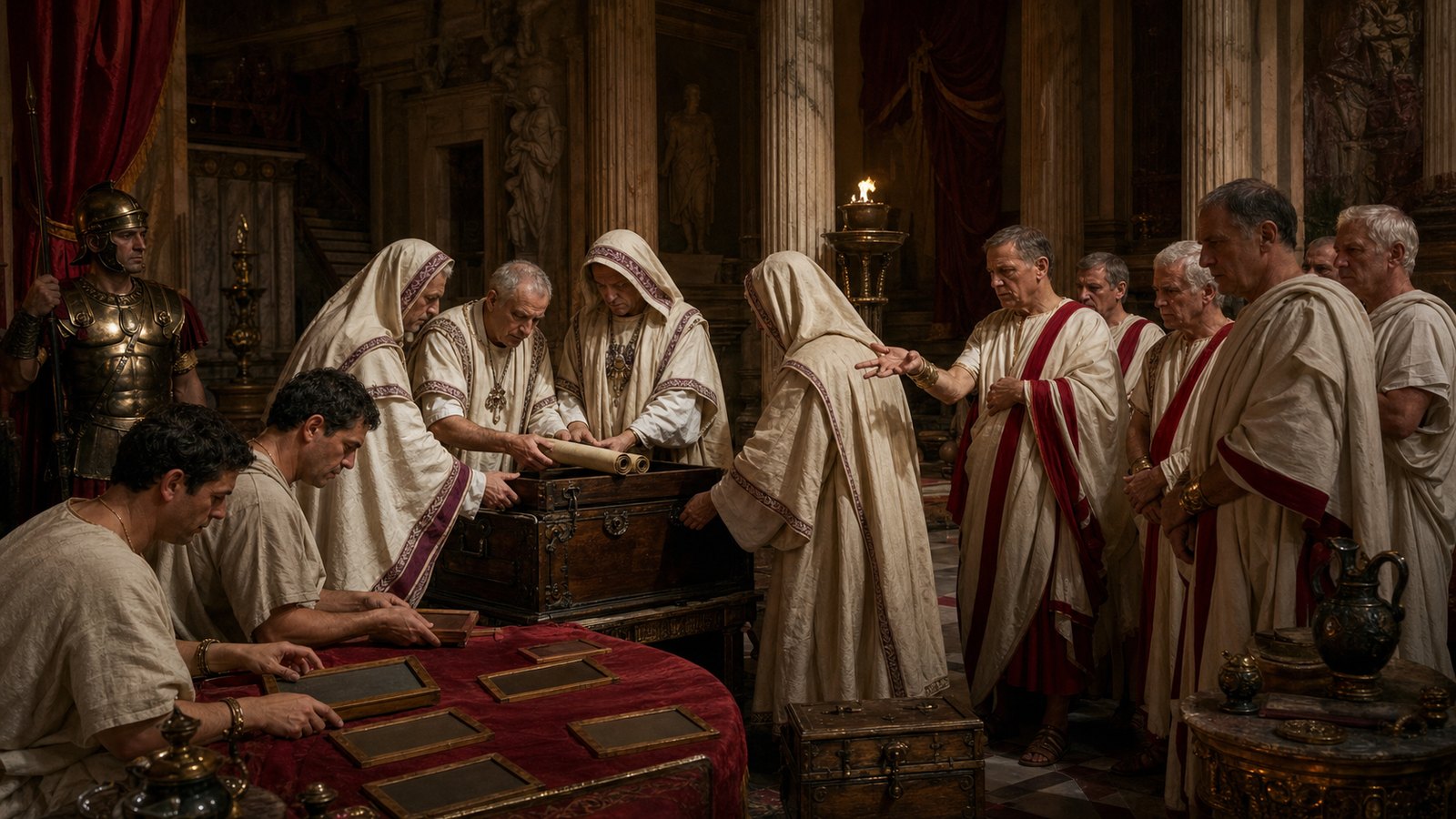
The senate authorized a search when prodigies or disasters demanded an answer. Priests then interpreted difficult verses and reported the ritual remedy. This separation mattered. Political authority decided that a crisis warranted consultation; religious specialists handled the text; magistrates and communities carried out the response.
Secrecy protected prestige but also limited competing interpretations. If everyone could cite a line, every faction might manufacture divine endorsement. Guarded access allowed the state to define which oracle was official and which reading would govern public action. Ambiguity remained, but it moved through a recognized chain.
The books therefore resembled a Roman archive with controlled access only up to a point. Archives preserved records of acts already completed. The Sibylline collection preserved language whose relevance had to be discovered anew under pressure. It was a cabinet of possible emergencies.
A plague produced couches for the gods
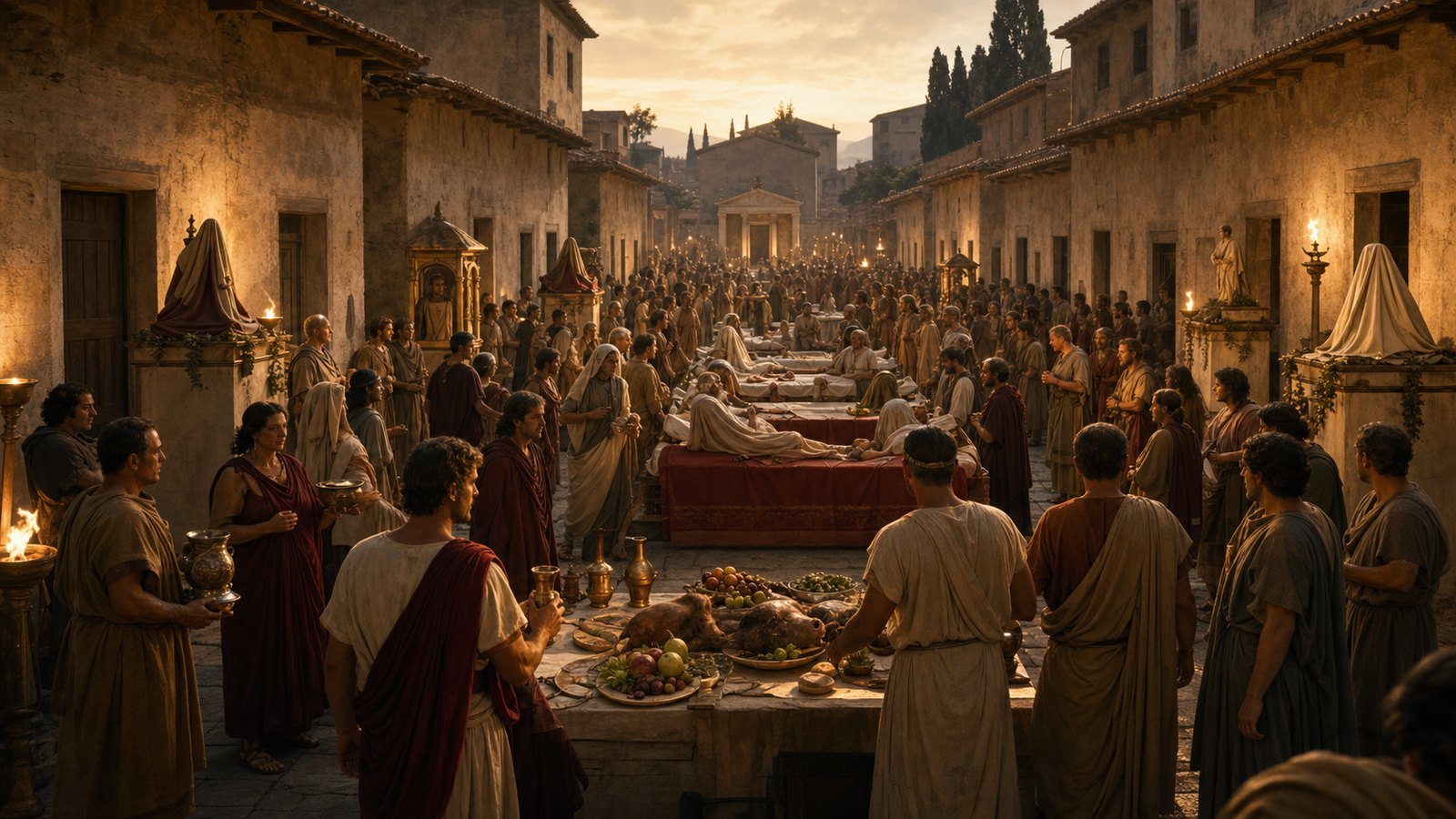
Livy places one memorable consultation during a severe pestilence in 399 BCE. The authorities turned to the Sibylline Books, and Rome held its first lectisternium. Couches were arranged for divine figures, and the ritual imagined the gods as honored guests receiving public hospitality.
The response was physically different from a decree hidden in a record room. For eight days, Livy says, private doors were opened and provisions made available. Enmities were softened, quarrels paused, and prisoners received relief. The ritual tried to repair relations among humans while displaying welcome to the divine.
Picture the city under disease: workshops quiet, households counting the sick, rumors moving faster than officials. Then couches and sacred images appear, meals are laid out, and doors stand open. The oracle has not explained infection. It has given frightened people a coordinated behavior that makes divine reconciliation visible.
This did not cure plague in a medical sense. Its political and emotional work was different. Consultation converted an invisible threat into a sequence of shared gestures. Rome could not command disease to leave, but it could command hospitality, suspension of hostility, ritual display, and the feeling that the city had answered together.
After Cannae, ritual answered military catastrophe
The defeat at Cannae in 216 BCE brought another scale of panic. Tens of thousands were dead or missing, allied loyalty seemed uncertain, and Hannibal remained in Italy. Livy’s narrative records prodigies, consultation, embassies, sacrifices, and even the shocking burial alive of a Greek man and woman and a Gallic man and woman in the cattle market.
The episode shows how dangerous emergency religion could become. Roman authorities were not merely soothing fear with harmless theater. Under catastrophic pressure, they authorized rare and violent rites that later Romans themselves treated as alien to normal practice. Crisis expanded the boundary of what the state could call necessary.
The Sibylline mechanism did not provide a military plan. It addressed a different battlefield: the suspicion that defeat revealed a broken relationship with the gods. Generals could recruit and fortify; priests and senators had to decide what ritual debt, pollution, or neglected obligation might still hang over the community.
That division complements the role of Roman omens before combat. Auspices helped determine whether an action began under acceptable signs. Sibylline consultation came forward when the accumulated facts of disaster seemed to demand a larger repair than one commander’s postponed maneuver.
The Capitol fire destroyed the guarded original
In 83 BCE, fire on the Capitoline destroyed the temple of Jupiter and the official collection kept there. The disaster was perfectly shaped to test the institution: the books meant to interpret catastrophe had themselves become a casualty. Rome could not simply copy a backup hidden in another state office.
Officials sought verses from communities in Italy, Greece, Asia Minor, and other parts of the Mediterranean where Sibylline material was said to survive. They had to collect, compare, and judge texts that might be authentic, corrupted, invented, or attached to local traditions. Reconstruction turned sacred custody into textual criticism.
The search reveals a network broader than Rome’s political boundaries. The capital claimed authority over an oracle tradition whose fragments were dispersed among Greek-speaking places. Recovering it required messengers, witnesses, copies, language skills, and decisions about which lines could enter the official body.
Augustus later reviewed prophetic writings, destroyed many unauthorized collections, and placed accepted Sibylline material in the temple of Apollo on the Palatine. The transfer joined religious curation to imperial order. Controlling the future began with controlling which texts were permitted to speak about it.
The books managed panic by making it actionable
The official collection was not the same as the later Sibylline Oracles preserved in Jewish and Christian traditions. Similar names can blur very different texts, dates, and communities. Rome’s guarded books belonged to a civic priesthood and state procedure; the surviving oracle literature followed another transmission history.
Their loss means modern readers cannot reconstruct each consultation from a master text. We depend on historians such as Livy, antiquarian summaries, inscriptions, and later references. That fragmentary survival suits the institution’s ancient character. Citizens usually encountered outcomes rather than pages, and we too see the public ritual more clearly than the guarded verse behind it.
The system’s power rested in its ability to end indecision. A prodigy could provoke endless rumor: whose fault, which god, what remedy? Senate authorization and priestly interpretation produced a bounded answer. The response might be costly, theatrical, foreign, or frightening, but it gave magistrates something definite to organize.
When Rome panicked, it opened the Sibylline Books because uncertainty needed a door with official keepers. The verses did not make disaster predictable. They made response governable. Once priests translated an obscure line into a couch, procession, sacrifice, imported cult, or forbidden text, fear acquired a schedule, a place, and people responsible for carrying it out.
Sources & Further Reading
- Smith Dictionary, Sibyllini Libri
- Livy, History of Rome 5.13
- Livy, History of Rome 22.57
- Sibylline Books overview and references