
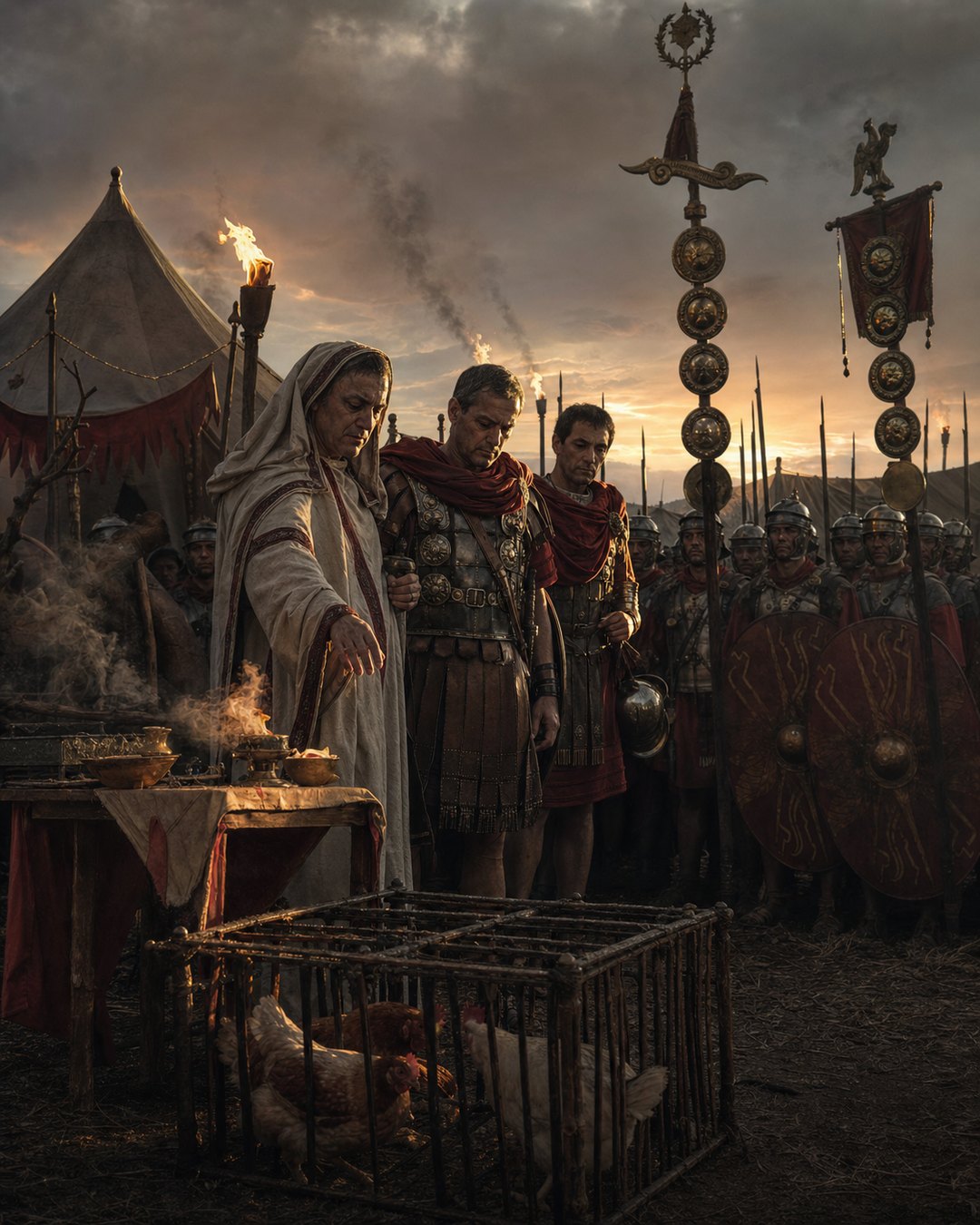
Roman omens before battle were not a decorative superstition tacked onto an otherwise modern army. They were part of how command became public, how risk was shared, and how a decision could be made to feel legitimate before men were asked to kill or die. A Roman general did not simply inspect weapons, count rations, and give the signal. He also moved inside a world where gods, signs, magistrates, and soldiers all had to be acknowledged.
That does not mean every Roman officer trembled helplessly before a bird. The better question is what the ritual did. It slowed a dangerous decision. It gave officers a language for uncertainty. It let the army see that the commander had not acted alone or carelessly. In a camp full of noise, smoke, animals, standards, and men waiting for orders, ritual turned fear into a sequence.
The signs made command visible
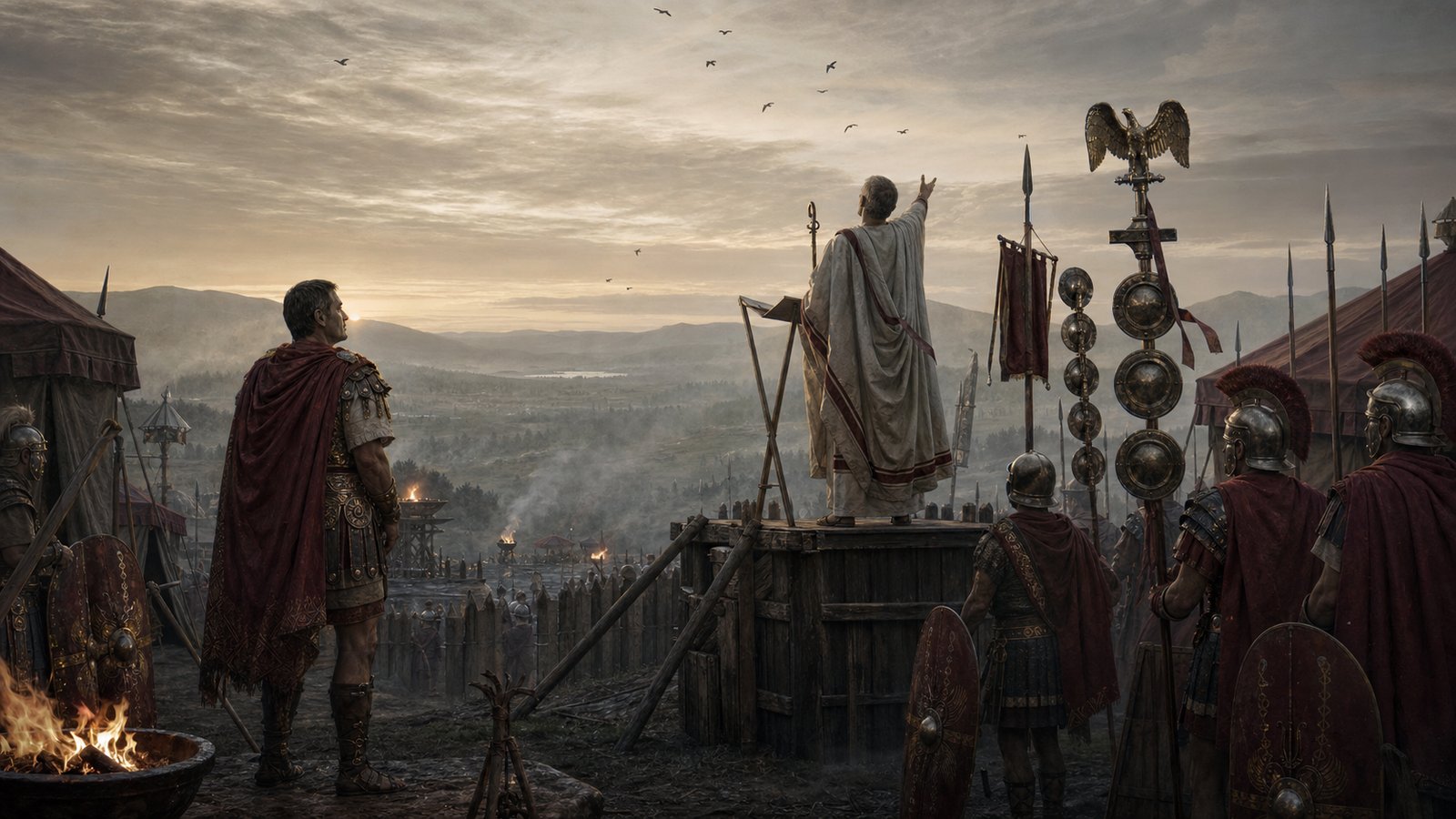
Roman magistrates with imperium acted under auspices. Augurs interpreted signs, especially the behavior or flight of birds, while other ritual specialists handled more specific procedures. Before a battle, the point was not only prediction. It was display. The commander could stand before witnesses and show that the decision to move had been placed inside Rome’s religious order.
That visibility mattered. Soldiers did not vote on battle plans, but they watched their leaders. A general who respected signs looked disciplined, traditional, and careful. A general who mocked them risked looking reckless before the first spear flew. Polybius, writing about Roman institutions, saw religion as one of the forces that helped bind Roman public life and restrain behavior. In the army, that restraint was not abstract. It lived in repeated gestures before danger.
The sacred chickens made doubt physical
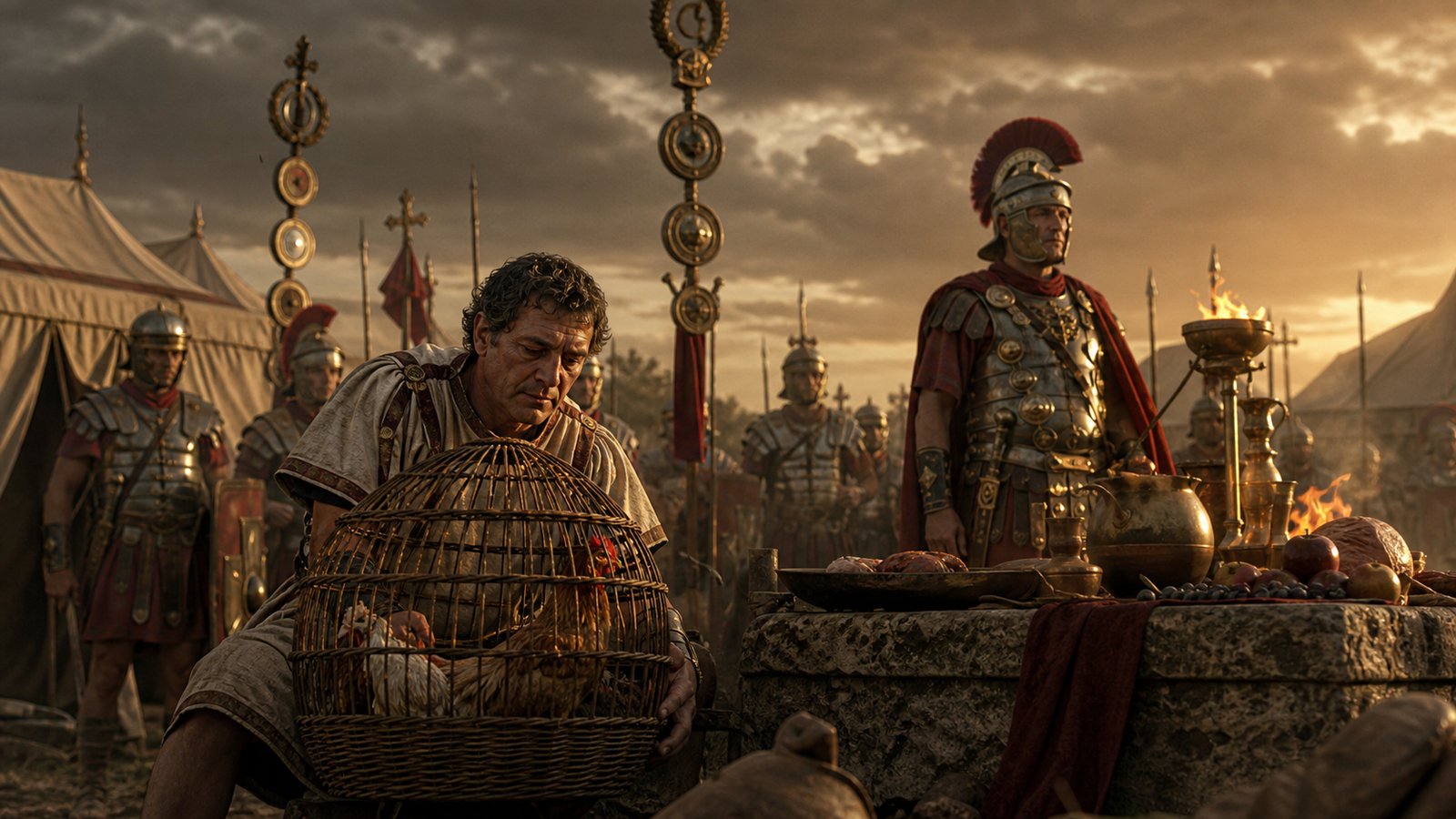
The most memorable battle omen was wonderfully concrete: sacred chickens. A pullarius cared for the birds, and their feeding could be read as favorable or unfavorable. If the chickens ate eagerly, the sign could encourage action. If they refused, the commander had a problem that everyone near the ritual could understand without a philosophical lecture.
This is why the ritual worked so well as public language. Doubt became visible in a wicker cage. The question “should we attack?” became a scene: birds, grain, handlers, officers, and waiting soldiers. The commander could proceed, delay, repeat, or explain. Whatever he chose, the choice now had witnesses.
Drepana became the warning story
The famous negative example is Publius Claudius Pulcher before the naval battle of Drepana in 249 BC. Later Roman authors remembered him as the man who, when the sacred chickens would not eat, threw them into the sea with a bitter joke that if they would not eat, they could drink. He then suffered defeat against Carthage.
The story is too perfect to treat as a neutral transcript, but that is exactly why it matters. Romans preserved it as a moral shape: the commander who mocked ritual and lost. Whether every detail happened as told is less important than the memory it carried. Defeat became easier to explain when impiety had already been staged at the beginning.
Omens also protected commanders
A favorable sign could strengthen a commander’s hand. A doubtful one could give him cover to delay. In war, delay might be cowardice, prudence, or strategy, depending on who told the story afterward. Ritual gave postponement a respectable form. “The signs were unfavorable” sounded different from “I lost nerve.”
That usefulness did not make the ritual fake. Roman religion did not divide cleanly between belief and utility. Public acts could be sincere and practical at the same time. A commander could believe the gods mattered while also knowing that his soldiers needed confidence and his peers would judge him by traditional expectations.
Battlefield religion was part of discipline
Omens placed individual fear inside collective order. The army did not become brave because chickens ate grain. It became easier to move because the men had seen the proper steps taken. Standards, sacrifices, vows, and auspices all reminded soldiers that they belonged to a state whose wars were supposed to be lawful, watched, and remembered.
That is what Roman omens really did before a battle. They did not replace tactics. They framed tactics. They gave commanders a ritual script for uncertainty and gave soldiers a visible sign that command had not broken with Rome’s gods or customs. When the battle went well, the signs fit the victory. When it failed, ignored or polluted signs could become part of the explanation. In either case, the omen had already done its work before the fighting began.
A bad sign could travel farther than the battlefield
The afterlife of an omen mattered because Roman defeat always demanded explanation. A failed plan could be blamed on weather, terrain, betrayal, rashness, or divine anger. Ritual gave historians and politicians a way to connect military loss with moral disorder. The commander who ignored a sign had not merely guessed wrong. He had broken the relationship between army, city, and gods before the enemy finished the lesson.
That is why the stories are so memorable. The sacred chickens at Drepana, the reported prodigies in Livy, and Cicero’s discussions of divination all show Romans using signs as a language for accountability. Before battle, omens helped men act. After battle, they helped Romans remember who had acted properly and who had not. The ritual was therefore both preparation and archive: a small public drama that could become part of the official moral story of a campaign.
The ritual also made hesitation easier to obey. In a Roman camp, thousands of men could hear rumors before they heard orders. If the auspices were unfavorable, delay was not merely one officer’s anxiety; it had a recognized public cause. If the signs were favorable, advance carried the weight of tradition. Either way, the omen turned uncertainty into something the army could understand together.
For The Lost Eagles, the useful question is not whether later memory made the story dramatic. It did. The useful question is which hard details let the drama survive: a year, a named actor, a public setting, an ancient source, and a physical object or ritual that people could remember. Those details keep the article from floating into slogan. They also show why Roman political culture was so powerful and so fragile. It could turn law, religion, and memory into order; under pressure, the same tools could turn into accusation, panic, and force.
The ritual also gave ordinary soldiers a way to read command. Most men in the ranks could not inspect strategy or argue with a consul, but they could see whether the familiar signs had been sought. In that sense, omens were a public grammar of trust. They told the camp that a terrifying decision had passed through recognized forms before the trumpet sounded.
That shared grammar mattered most when courage was thin. A commander could order movement, but ritual helped make obedience feel like participation in Rome’s order rather than blind exposure to chance.
Sources & Further Reading
- Britannica
- Livy, History of Rome, 22
- Polybius, Histories, 6.56
- Smith Dictionary
- Cicero, De Divinatione, 1
- Cicero, De Natura Deorum, 2.7
- Britannica