
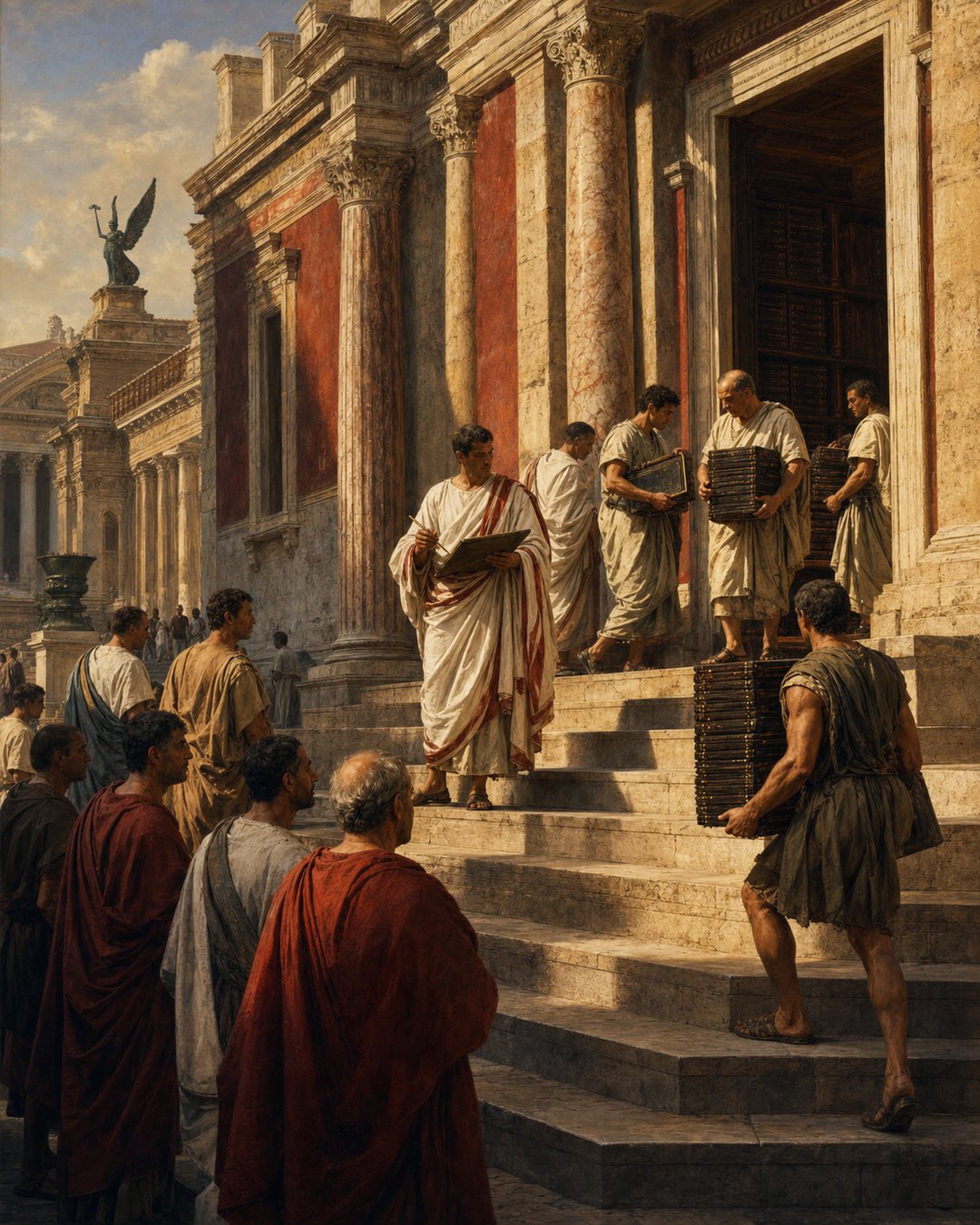
A spoken order can sound powerful in the forum and still fade before the dust settles. Rome’s solution was not only louder speech. It was record, storage, display, and the repeated habit of making authority leave a material trace.
Roman archives made state memory public because they turned political acts into objects that could be kept, consulted, copied, challenged, and remembered beyond the voice that first announced them.
The tabularium gave memory a civic address
Tabularium names the public record office, and the word matters because memory becomes different when it has a place. A record kept somewhere recognizable is not merely a private recollection; it is a civic resource that can be approached.
Imagine the concrete scene: citizens on stone steps, a clerk carrying tablets, seals stacked on a bench, and someone waiting for a document to answer a dispute. The archive makes authority less like air and more like a door people know how to find.
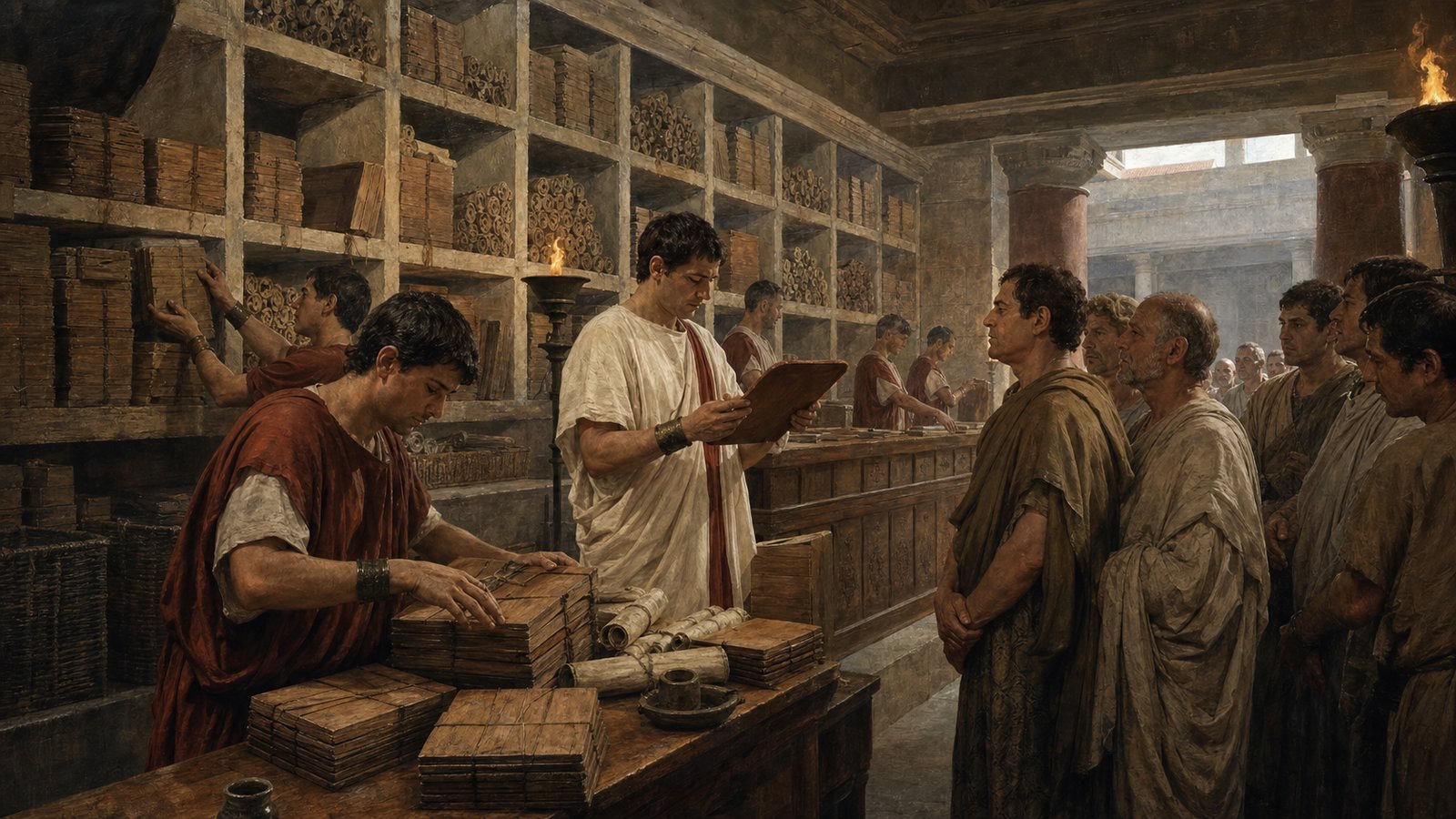
Tablets made public acts survive the day
Tabulae turned names, sums, laws, and decisions into things that could outlast the argument. A tablet could be stored, copied, compared, and brought back when memory became inconvenient.
This connects with Roman public notices. Display made information visible now; archiving made it harder for the same information to vanish later.
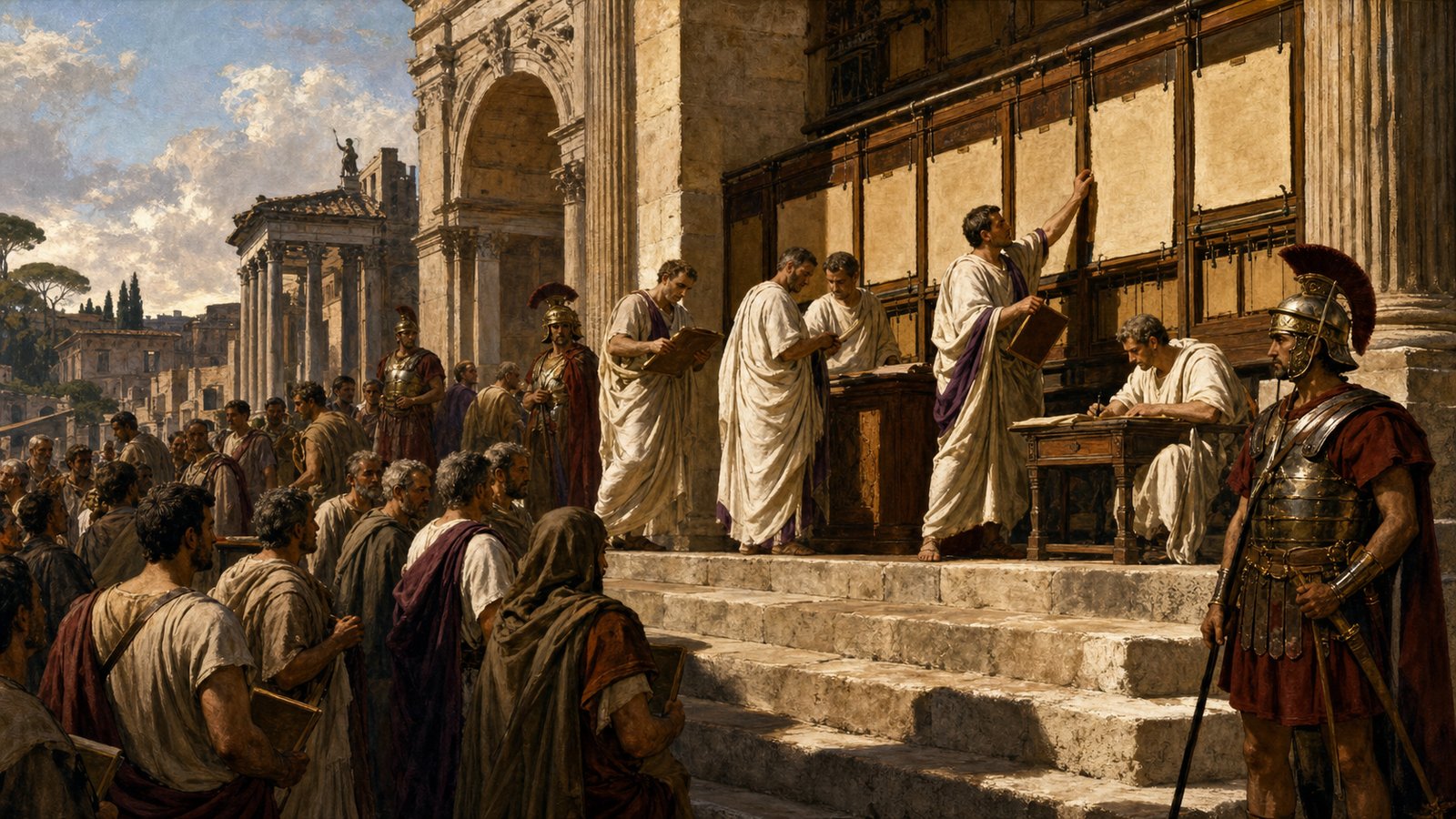
Public boards and stored records worked together
Album, the whitened board for public notices, shows the front edge of Roman publicity. A board told people what mattered today. The archive gave that announcement an afterlife when the board was erased or replaced.
The two forms solved different problems. A board gathered eyes. A stored record gathered time. Together they helped Rome turn official speech into a sequence: announce, record, preserve, consult, and argue again.
Law needed more than memory
Lex was strongest when people could point to it, cite it, and connect it to a remembered decision. Oral authority could overawe a crowd, but written authority could return after the crowd had gone home.
That did not make Rome equal or gentle. Powerful people still shaped access, interpretation, and enforcement. Yet the written record created a stubborn object that could embarrass forgetfulness and complicate convenient denial.
A record office made the state visible in small motions
The archive’s power lay in repeated motions rather than spectacle: carrying tablets, opening shelves, checking seals, comparing entries, and letting a citizen wait while an official looked for a trace.
State memory became public when people could imagine that acts had not simply dissolved into rumor. Somewhere, a tablet, clerk, shelf, and seal held the possibility that yesterday could answer today.
The Roman archive should not be pictured as a modern neutral bureaucracy. Access could be uneven, literacy was limited, and the meaning of a record depended on those who controlled it. But the physical existence of records still changed public life.
A magistrate’s voice became less solitary when it could be attached to a tablet. The record did not remove politics; it gave politics a material witness. People could ask what had been written, where it was kept, and whether the present claim matched the stored memory.
This is why the architecture matters. Steps, columns, shelves, and guarded thresholds taught people that memory had a hierarchy and a route. The state did not merely remember; it staged where remembrance could be sought.
The sensory details were ordinary: wax, wood, dust, seal impressions, the scrape of sandals, a clerk’s hand moving across a tablet. Those details made power less mystical and more administrative.
Administration can sound dull until a conflict depends on it. A boundary, debt, decree, citizenship claim, public contract, or official act could become urgent when someone needed yesterday to be available in a form stronger than recollection.
Archives also changed the politics of blame. If records existed, a missing document, altered entry, or inaccessible shelf could itself become suspicious. Preservation created new responsibilities as well as new confidence.
Rome’s state memory was therefore both public and controlled. The archive made memory visible, but not necessarily easy. It invited people to believe that public acts had a durable form, while reminding them that someone guarded that form.
The official notice and the archive formed a cycle. One projected authority into public view; the other pulled that authority back into storage. The state needed both the bright surface and the darker room behind it.
This gave Roman public life a special kind of continuity. The city could be noisy, competitive, and violent, yet its institutions kept producing objects that claimed to remember. A tablet could sit quietly while factions shouted.
The record’s quietness was part of its force. It did not need to persuade like an orator. It waited for the moment when someone had to ask what had been done before.
For ordinary observers, the archive made the state feel less like a single person and more like a chain of offices and objects. Authority lived in men, but also in the things those men left behind.
Roman archives made state memory public by giving the past a managed presence. The archive was not simply a storehouse of documents. It was the place where power admitted that yesterday might still be called as a witness.
The archive also changed how public time felt. A magistrate might serve for a year, a crowd might gather for an afternoon, and a dispute might flare for an hour, but a stored record could sit beyond all three. That longer life gave Roman authority a memory that outlasted officeholding.
Citizens did not need to read every document for the archive to matter. The knowledge that records existed shaped expectation. It suggested that a decision had entered a world of tablets, seals, and shelves where someone might later search for it.
This made public memory partly architectural. A person could point not only to a law or decree, but to the kind of place where such acts should be preserved. The building gave memory a body in the city.
The archive also made forgetting politically risky. If a record should exist and could not be produced, the absence raised questions: was it lost, hidden, damaged, inconvenient, or never made? Material memory created material suspicion.
Roman power often worked through that mixture of confidence and anxiety. The record reassured people that public acts had form, but it also exposed how much depended on clerks, storage, access, and the integrity of those guarding the tablets.
In a city crowded with monuments, the archive was a quieter monument to continuity. It did not celebrate one victory. It made many small public acts capable of returning when later Romans needed the past to speak.
The waiting citizen is important because public memory only mattered when someone could imagine using it. A man who climbed the steps for a record was also acknowledging that authority had left a track he might follow.
Even when access failed, the expectation changed the argument. People could ask for documents, accuse officials of hiding them, or compare a public claim with the memory of a written act. The archive made the past a possible participant in conflict.
Sources & Further Reading
- Smith Dictionary, Tabularium
- Smith Dictionary, Tabulae
- Smith Dictionary, Acta
- Smith Dictionary, Album
- Smith Dictionary, Lex