
A river is not only water. It is delay, risk, negotiation, weather, memory, and the chance that movement will fail at exactly the wrong place. Rome understood that a crossing could be political before anyone called it that.
Roman bridges made rivers feel governable because they turned an uncertain edge into a repeated route. Stone, surveying, arches, roads, and milestones made a natural interruption look like part of a system.
A pons changed the meaning of the bank
Pons means bridge, but the practical meaning is larger than a structure. A bridge tells travelers that the route does not end at the water. It turns the far bank from a hope into an expected continuation.
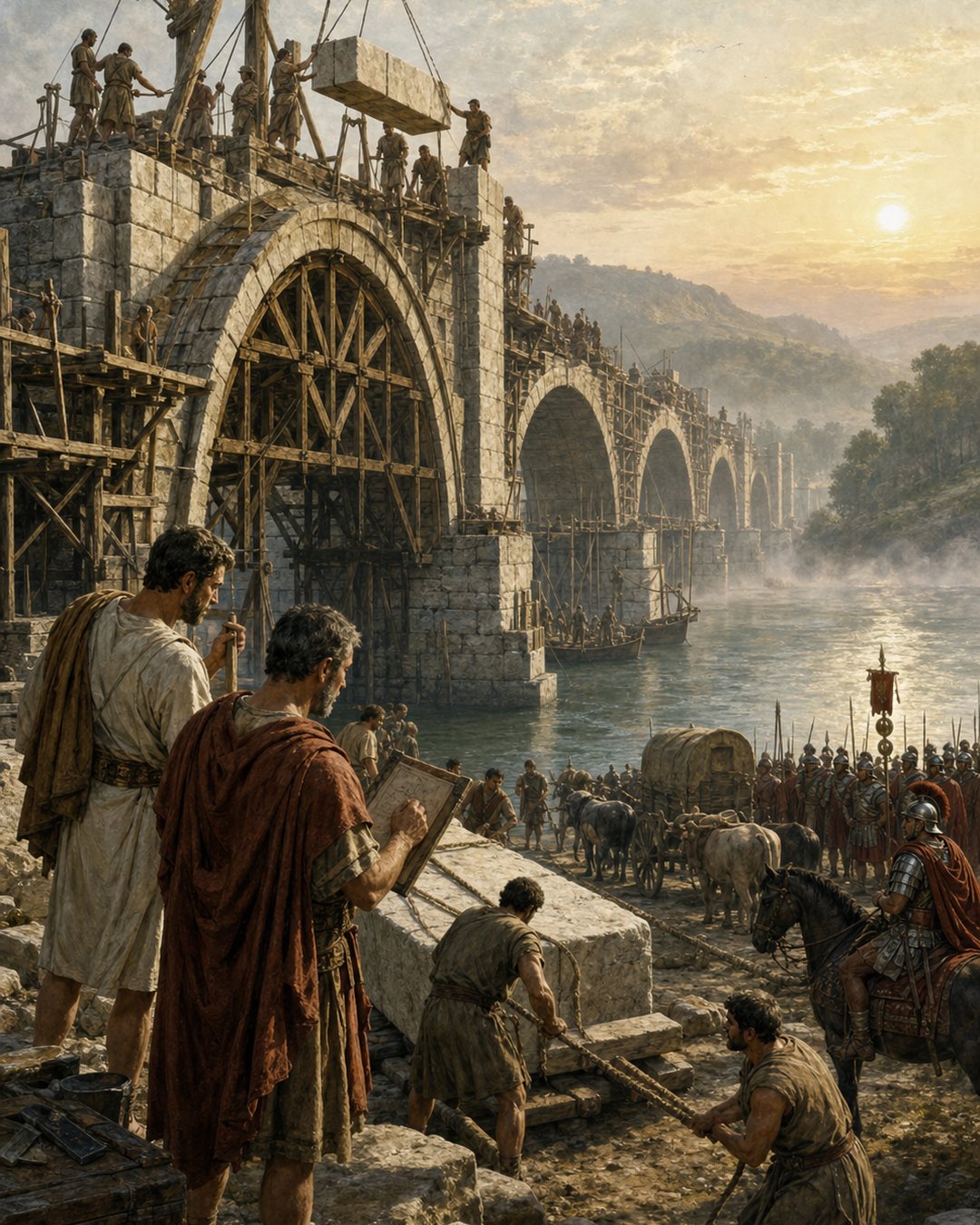
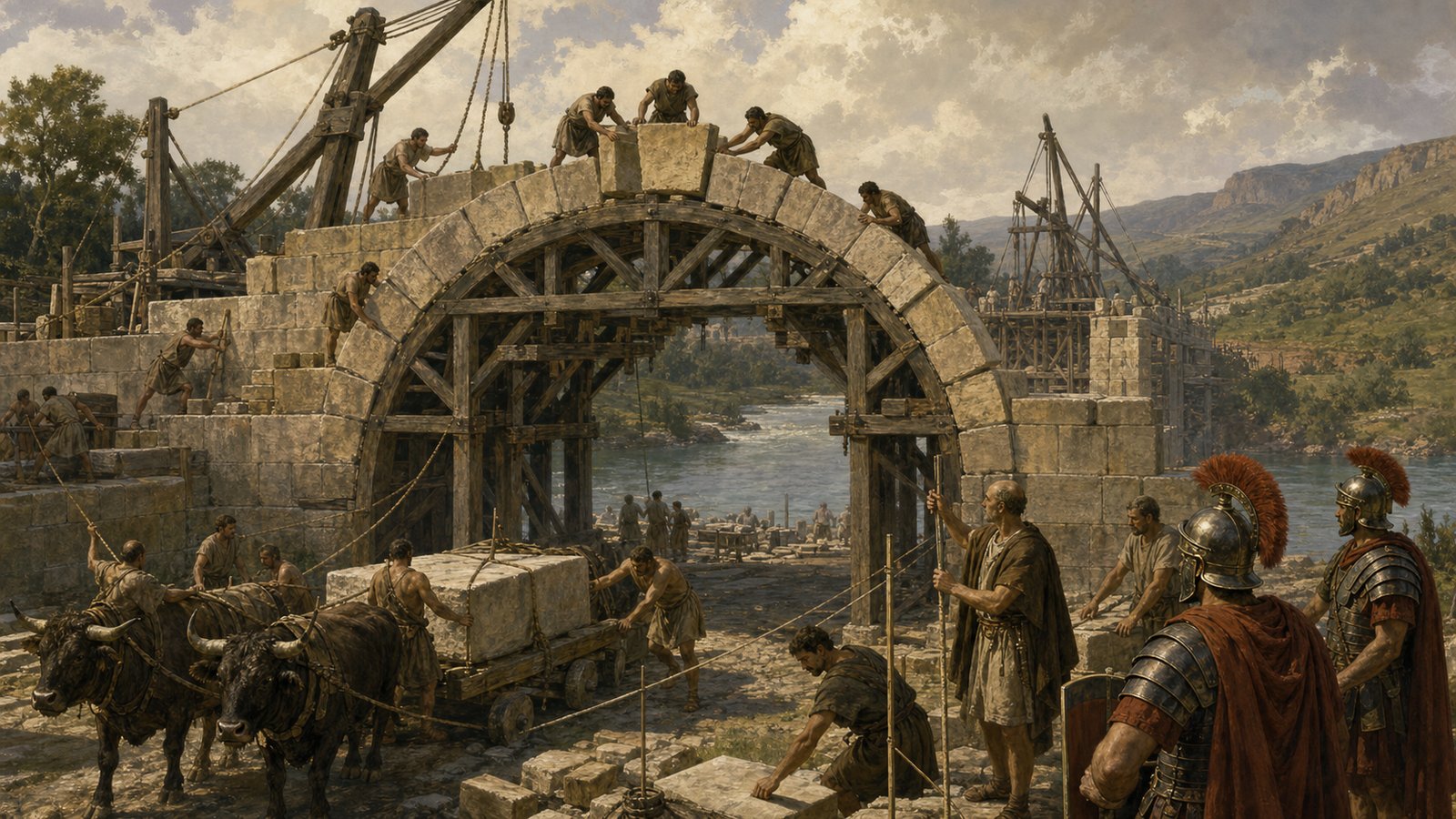
Picture the building scene: ropes under tension, surveyors checking lines, laborers guiding stone, soldiers waiting with carts, and the river moving below while the arch slowly takes shape. The crossing becomes a public promise.
Surveyors made the river measurable
Agrimensores, the surveyors, remind us that Roman movement depended on measurement before it depended on confidence. A ford might belong to local knowledge, but a bridge project required lines, levels, distances, and repeatable decisions.
This connects with Roman surveyors. The same culture that measured land could also make a river crossing feel less like luck and more like administration.
The road made the bridge more than a local object
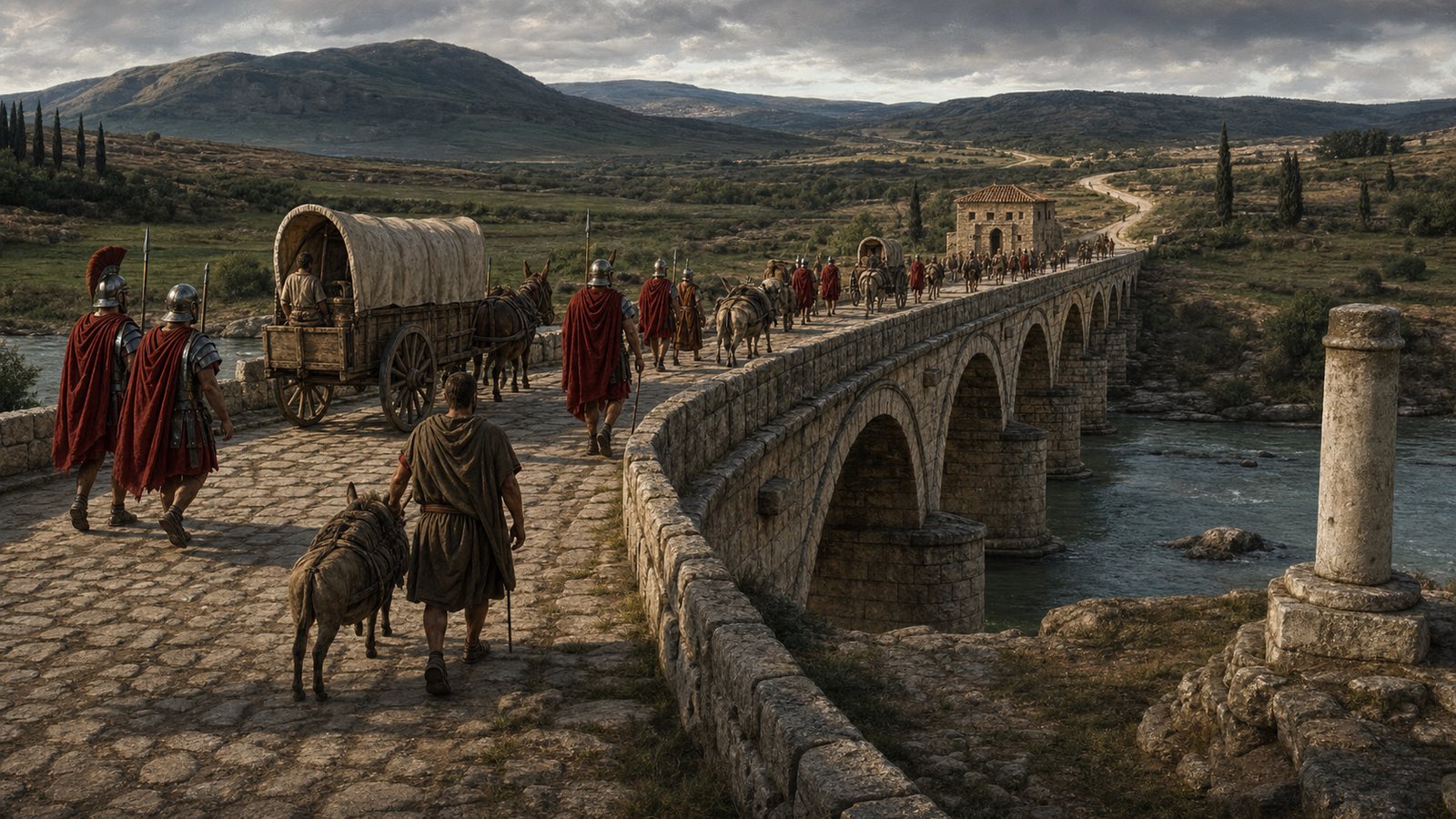
A bridge mattered because it joined a road. Without a route, it was an impressive stone answer to a small local question. With a road, it became part of wider movement: carts, troops, couriers, merchants, and officials.
This is why a bridge could change time. The journey became easier to plan because a dangerous pause had been replaced by a known crossing. A traveler could imagine the next stage before reaching the river.
Arches made durability visible
Arcus, the arch, gave the bridge a visual language of strength. People did not need to understand every engineering calculation to read the message: weight was being carried, water was being spanned, and the route would repeat tomorrow.
The arch also made Roman power look calm. Floods, repairs, and failures still mattered, but the repeated sight of traffic over stone made control appear normal rather than exceptional.
Milestones turned crossing into counted distance
A milestone near a route did something subtle. It told travelers that they were not simply moving through landscape; they were moving through counted space. The bridge helped turn riverbanks into points inside a measured network.
Roman bridges made rivers feel governable by changing the imagination of movement. Water remained powerful, but it no longer held the route hostage in the same way. Stone made passage visible, repeatable, and countable.
The bridge was therefore an argument about time. A ferry or ford might work today and fail tomorrow. A bridge claimed that tomorrow’s crossing had already been considered, built for, and incorporated into the road.
It also gathered different kinds of labor. Engineers, surveyors, stonecutters, haulers, guards, and local workers all met at the river. The finished arch hid much of that labor, but the construction scene revealed that control was made by many hands.
For soldiers, a bridge could mean speed and reliability. For merchants, it could mean fewer lost loads and easier scheduling. For villagers, it could bring more opportunity and more intrusion at the same time.
This double meaning is important. A governable river was not automatically a kinder river. Easier passage could carry tax collection, recruitment, officials, and armies as well as grain, news, and relatives.
The bridge made conquest practical after the battle. Holding territory required routes that did not collapse whenever water interrupted them. Stone gave victory a way to move back and forth.
The completed crossing also became a landmark of confidence. People could speak of meeting near it, counting distance from it, or using it to explain a journey. The structure entered ordinary memory.
A bridge can look static, but it is really a machine for repeated motion. Every cart, mule, patrol, messenger, and traveler proves the same claim again: the river has been incorporated into Roman habit.
Maintenance mattered because the claim was never finished. Floodwater, damaged paving, loose stones, and weakened supports could turn permanence back into anxiety. Rome had to keep governing the bridge after building it.
That maintenance tied engineering to administration. Someone had to know what needed repair, who owed labor, which route mattered most, and how failure would affect movement. The bridge made bureaucracy touch stone.
The public saw the result more than the paperwork. It saw an arch, a parapet, a road surface, and traffic. Yet behind that visibility stood measuring, funding, labor, and memory.
Roman bridges made rivers feel governable because they reduced a natural obstacle to a repeatable civic action: approach, cross, continue. The river did not disappear. It was made to serve the rhythm of movement.
In that rhythm, Roman power became almost ordinary. People crossed, grumbled, traded, marched, and returned. The bridge had done its work when the miracle of crossing began to feel like routine.
The bridge also concentrated attention at a specific point. People who once crossed at scattered fords could be drawn toward a built passage where movement was easier to observe, tax, protect, or control. Engineering created a place of administration.
A river crossing could become a memory of Roman competence. The traveler who crossed without fear experienced control in the body: the wheels stayed level, the animals kept moving, and the water passed below rather than deciding the route.
This bodily confidence mattered because empire was often encountered through infrastructure rather than ideology. A road surface, a milestone, and a bridge could teach the same lesson without a speech: movement has been anticipated here.
The construction process would have been just as instructive. Scaffolding, ropes, cranes, and measured stone showed local observers that Rome could organize labor around a difficult natural problem and leave a durable answer behind.
Bridges also made vulnerability visible. If a span failed, the break was public and humiliating. A damaged crossing exposed the dependence of soldiers, merchants, and officials on the very system that had promised reliable movement.
That risk sharpened the achievement. A working bridge was not simply stone over water. It was maintained confidence: the repeated proof that a dangerous interruption could be made part of Roman routine.
The bridge also made the far side feel politically nearer. A community across the water could be reached by tax collectors, soldiers, traders, and relatives with a regularity that changed expectations on both banks.
Its public surface mattered. Wheels, sandals, hooves, and pack animals wore the route into habit. Each crossing taught users that the river was no longer a private local obstacle but a managed point in a Roman road system.
That habit helped make authority feel continuous. The traveler did not experience command as a single decree; he experienced it as a sequence of prepared passages, counted distances, and visible repairs.
Even the view from below carried meaning. A boatman or farmer seeing traffic above the current could read the structure as an answer to the river’s older power. The bridge made control visible from water and road alike.
Sources & Further Reading
- Smith Dictionary, Pons
- Smith Dictionary, Agrimensores
- Smith Dictionary, Mansio
- Smith Dictionary, Mansio
- Smith Dictionary, Arcus