
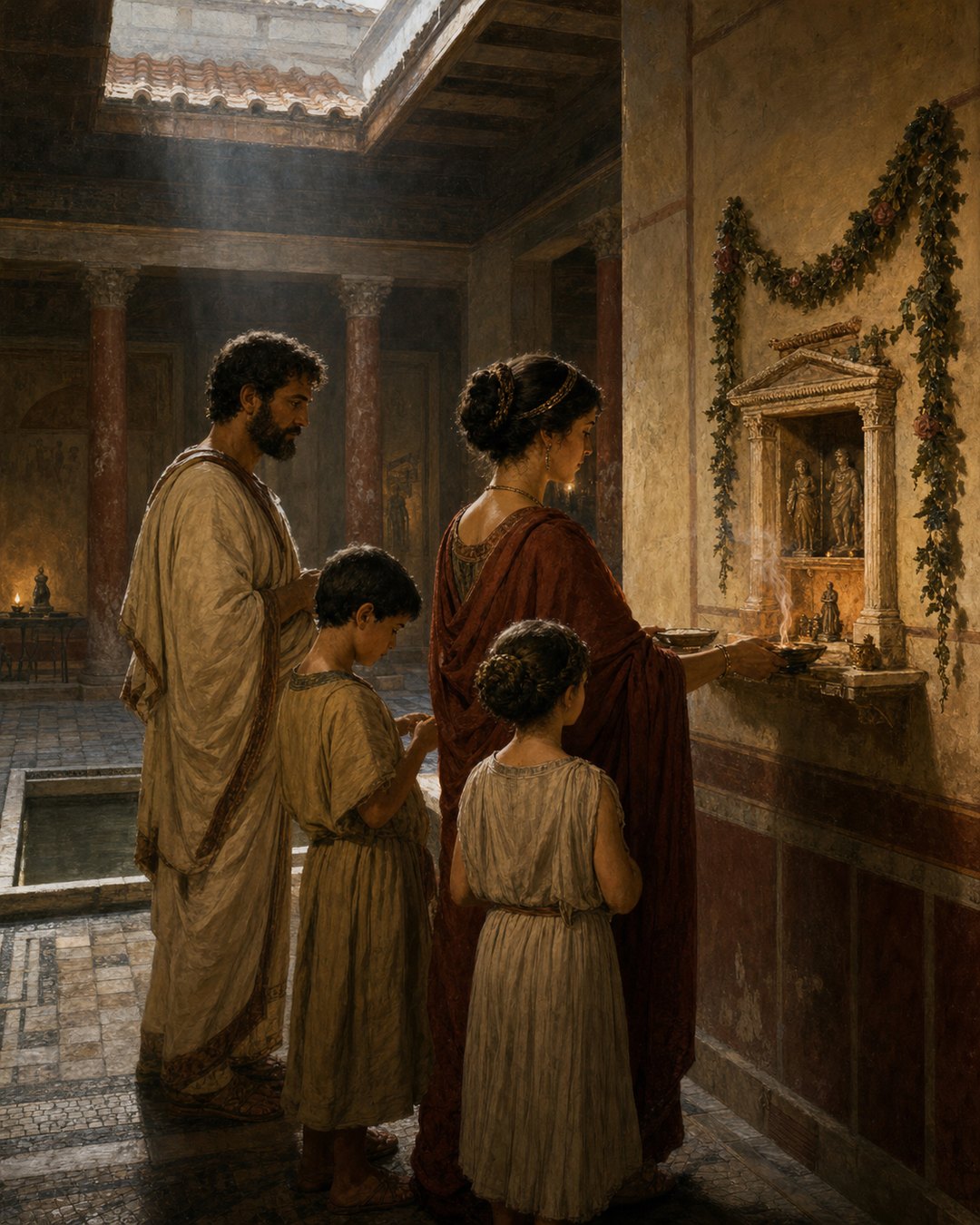
A Roman house could contain its own focus of worship. A niche, painted panel or small shrine could hold images of the Lares alongside other divine figures. Food, wine, incense or garlands are among the offerings associated with domestic practice, placing acts of worship within the same broad setting as household life.
The household Lares belonged to domestic religion without representing every Roman rite or every Roman home in one uniform way. Sources connect them with protection, meals and important family occasions, while archaeology preserves varied shrines and images. Together, that evidence shows sacred attention situated inside a lived place.
The household shrine gave protection an address
A lararium made an invisible relationship spatially specific. It might be a niche, a painted composition, a small architectural shrine or another designated place within the house. Images of the Lares could stand there with other divine figures. The arrangement varied, but the principle was clear: worship returned to a recognizable point.
The shrine placed sacred imagery within domestic space. That location is safer to describe than a universal schedule of rites: the surviving evidence does not establish that every household approached its Lares at the same hour, in the same room or with the same sequence. It establishes a recognizable household focus for worship.
Images do not prove that every household followed one identical ritual. Archaeological survivals differ, and written descriptions reflect particular contexts. What they show more securely is that Roman domestic religion could be materially present. Paint, sculpture and shrine architecture made divine figures visible inside some homes.
This domestic focus differs from the crossroads shrines that made neighborhoods visible. A street shrine addressed people sharing an outdoor junction. A lararium addressed the people and routines gathered under one roof, even when the same broad idea of protective presence crossed both settings.
Offerings turned food into a relationship
Sources associate domestic practice with offerings that could include food, wine, incense and garlands. The evidence supports those categories more safely than one fixed recipe or gesture. An offering made attention material, but surviving summaries do not justify reconstructing exact quantities, words, hand movements or disposal in every household.
Food is especially relevant because accounts place statues of domestic Lares at family meals. That connection brought protective deities into a familiar social setting, though it does not prove that each meal included an offering or that all families followed one procedure. Presence at the table is the supported point.
Repeated domestic attention is a reasonable interpretation of an established shrine and recurring household occasions, not a preserved timetable. Shrines and images could remain available across more than one event, while offerings were renewable materials. Beyond that broad pattern, frequency and household participation should remain open questions.
The material focus differs from the altar discussed in Roman public and private vows. Here the secure evidence is domestic: household shrines, divine images and listed offerings. Scale, audience, spoken words and frequency could vary and should not be inferred from the surviving objects alone.
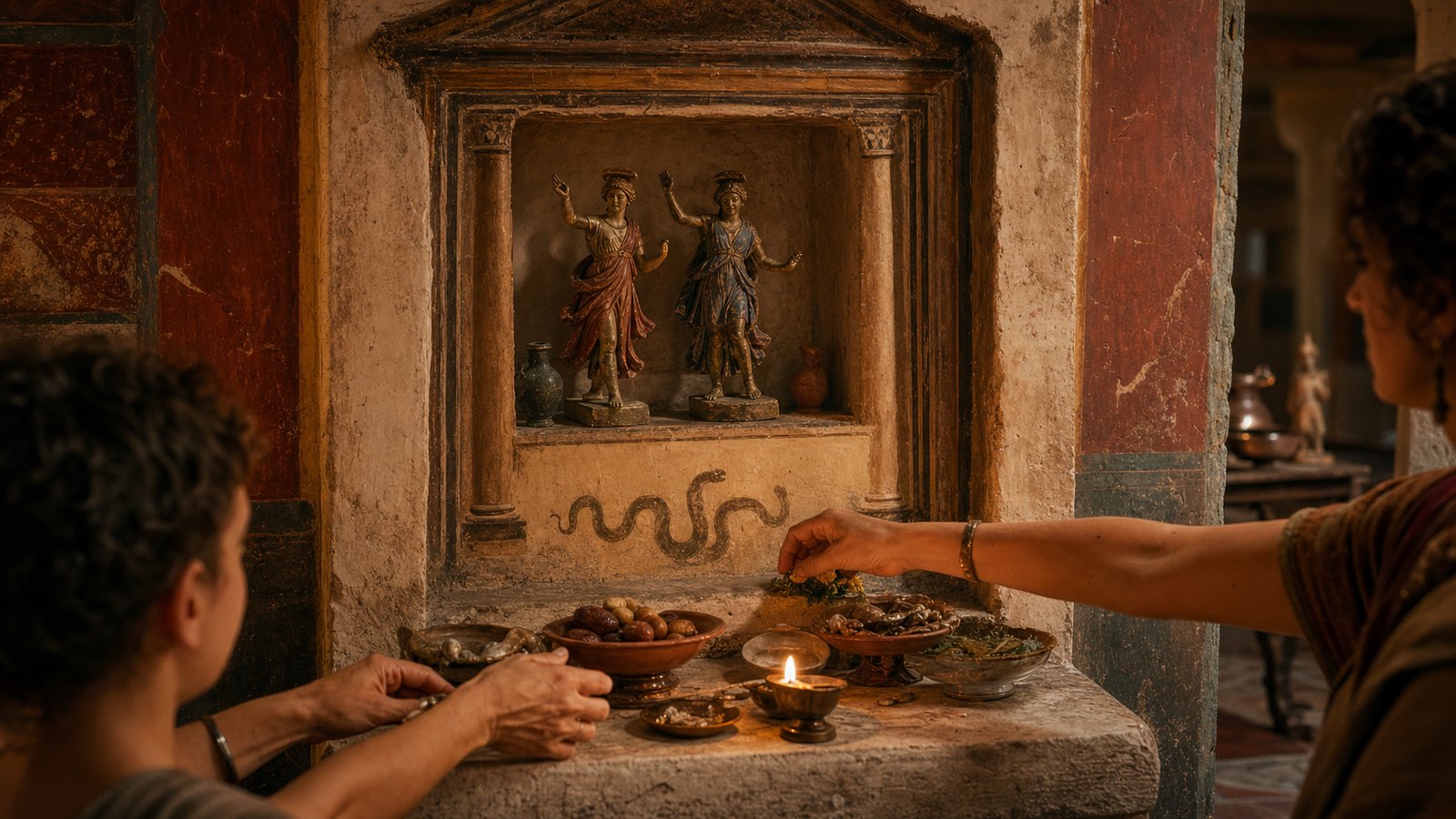
Meals placed the divine beside ordinary appetite
Accounts connecting Lares with family meals place them beside an ordinary form of household gathering. That does not mean every bite followed a fixed ceremony. It means that domestic protection could be represented where household members ate, a narrower conclusion that respects variation in time, place and status.
Roman writers sometimes identified or conflated Lares with Penates, and both belonged to domestic religion. Modern labels can help discussion, but they should not impose a rigid division that the sources themselves do not consistently maintain. Their shared presence in household contexts is the safer point.
A cautious visual reconstruction may place a painted or sculpted pair of Lares near a family meal, because both shrine images and meal associations are attested. Details such as a particular lamp, serving order, spoken formula or exact portion would be illustrative choices rather than facts supplied by these summaries.
The meal association matters because it places images of protective deities at a household gathering. It does not reveal what each participant thought or whether one act carried the same meaning for everyone present. The evidence establishes ritual proximity more securely than private belief, emotion or memory.
Different Lares protected different settings
Lares were not limited to one domestic title. Named forms were associated with households, crossroads, roads, seafaring and public communities. That range warns against making every Lar perform the same function. It also shows that Roman protective categories could be attached to different places and collective settings.
The listed evidence does not establish a standard departure or homecoming rite at every lararium. A household shrine could provide a focus for worship, and some Lares were associated with roads or travel, but joining those points into one exact threshold ceremony would go beyond the summaries. The connection should remain possible, not asserted.
A Roman household was a social group as well as a building, but these summaries do not specify who performed each domestic act or how participation was divided by status. It is therefore safer to speak of household worship collectively and avoid assigning routine roles to family members, servants, visitors or enslaved people without closer evidence.
The Lares should not be reduced to decoration, because the sources describe cult, offerings and protection. At the same time, a household shrine by itself cannot reveal harmony, belief or equal participation among everyone under the roof. Material evidence establishes religious presence more securely than the private motives or social effects of each worshipper.
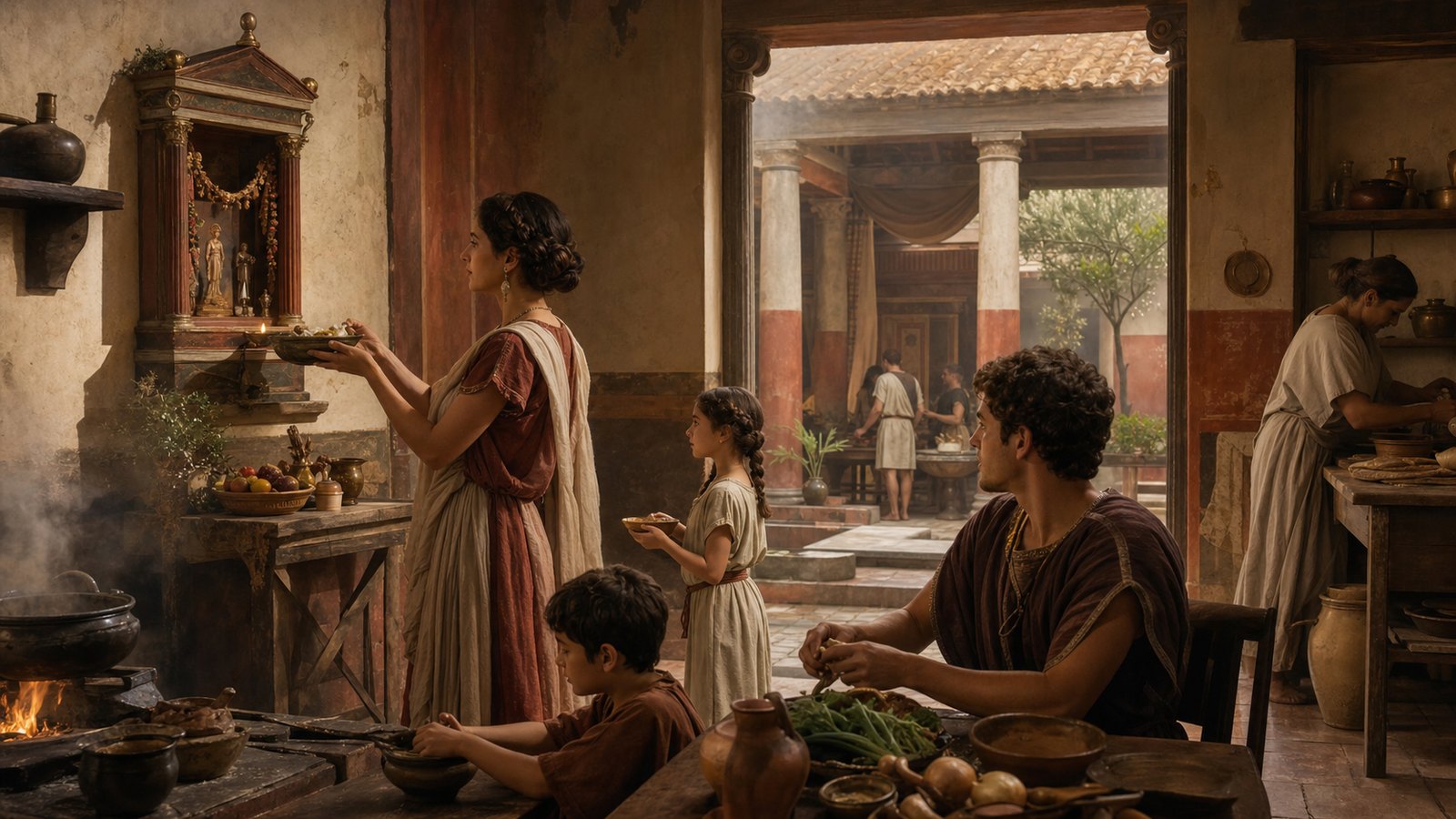
Family change accumulated around a stable sacred place
Sources place domestic Lares at important family occasions, including births, marriages and adoptions. A shrine could remain in the house across such events, offering a visible point of continuity. The evidence does not, however, supply one ritual script for each transition or show that every household marked all occasions alike.
Offerings such as garlands and food were not permanent objects, so continued practice required renewed materials at some point. That modest inference should not become an invented maintenance schedule. Who supplied, cleaned or arranged a shrine could differ, and the listed summaries do not assign those tasks to a particular member of the household.
Archaeology catches the material residue unevenly. Pompeii is unusually vivid because destruction preserved painted lararia and household arrangements, but it cannot stand for every Roman home across every century. Portable images vanish, organic offerings decay and later rebuilding moves walls. Caution is part of understanding what survives.
Even with those limits, the pattern is significant. Religion occupied interiors through placement, imagery and recorded practice, not belief alone. A shrine made the household’s association with protective deities visible. Claims about how particular children learned, how adults remembered or how often gestures recurred require evidence beyond the material arrangement itself.
The Lares linked home, neighborhood and Roman community
Lares also belonged at crossroads and in other collective settings. Lares Compitales were associated with neighborhood junctions and the Compitalia. The cult moved protection beyond one doorway to the place where local routes and residents met. The same category of divinity could therefore articulate several layers of belonging.
Those layers should not be collapsed. A household lararium and a Compitalia crossroads shrine were different settings, while other named Lares were linked with roads, seafaring or public communities. Their coexistence demonstrates varied protective associations without requiring one institution to be interpreted as a larger copy of another.
Household, neighborhood and public forms could exist within the same wider religious landscape, although the summaries do not provide a weekly itinerary for any individual. Their coexistence is enough to show that Lares operated at more than one social scale. Each setting must still be interpreted on its own evidence.
Household Lares made domestic religion visible by giving protection a place inside the home. Food, wine, incense, garlands and divine images are supported elements; an exact daily frequency is not. The safest conclusion is that shrines and household practices connected protective deities with meals and important family life.
Sources & Further Reading
- World History Encyclopedia, Lares
- Lares