
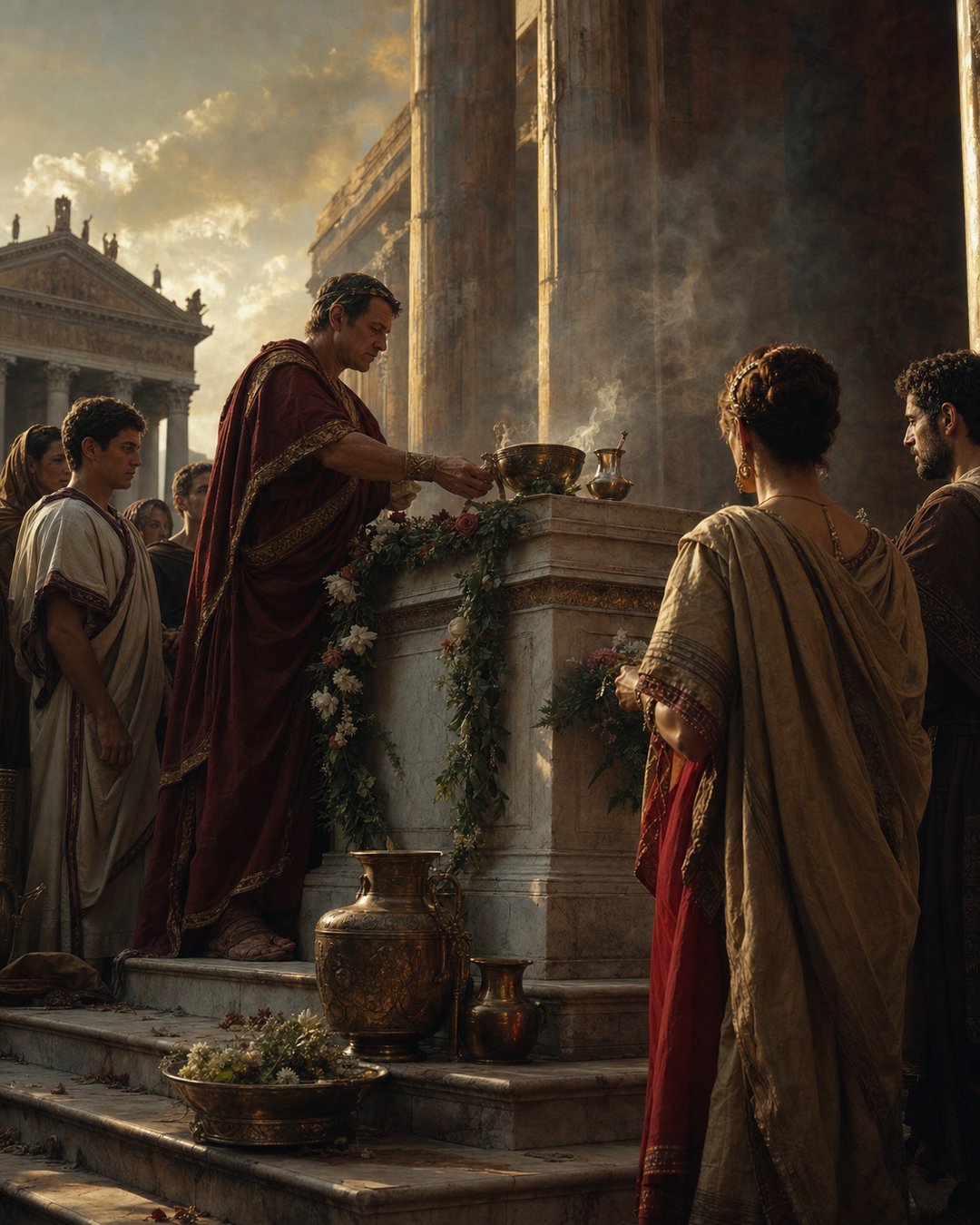
A vow can sound private when we imagine it as a thought whispered in fear or gratitude. Rome often made that promise harder to hide. It gave the promise stone, smoke, a route, witnesses, and a place where memory could return.
Roman altars made vows visible because they turned religious obligation into public action. The altar did not only receive offerings. It made a relationship with the gods legible to human eyes.
The altar turned promise into place
Ara, the altar, matters because it made a vow local. A promise made near a recognizable stone could be remembered as something that happened there, not merely as a feeling that passed through a person’s mind.
Imagine the concrete scene: morning light on marble steps, a bronze vessel in a hand, incense smoke drifting toward columns, and neighbors watching a magistrate or household representative approach. The vow has acquired weight before anyone explains it.
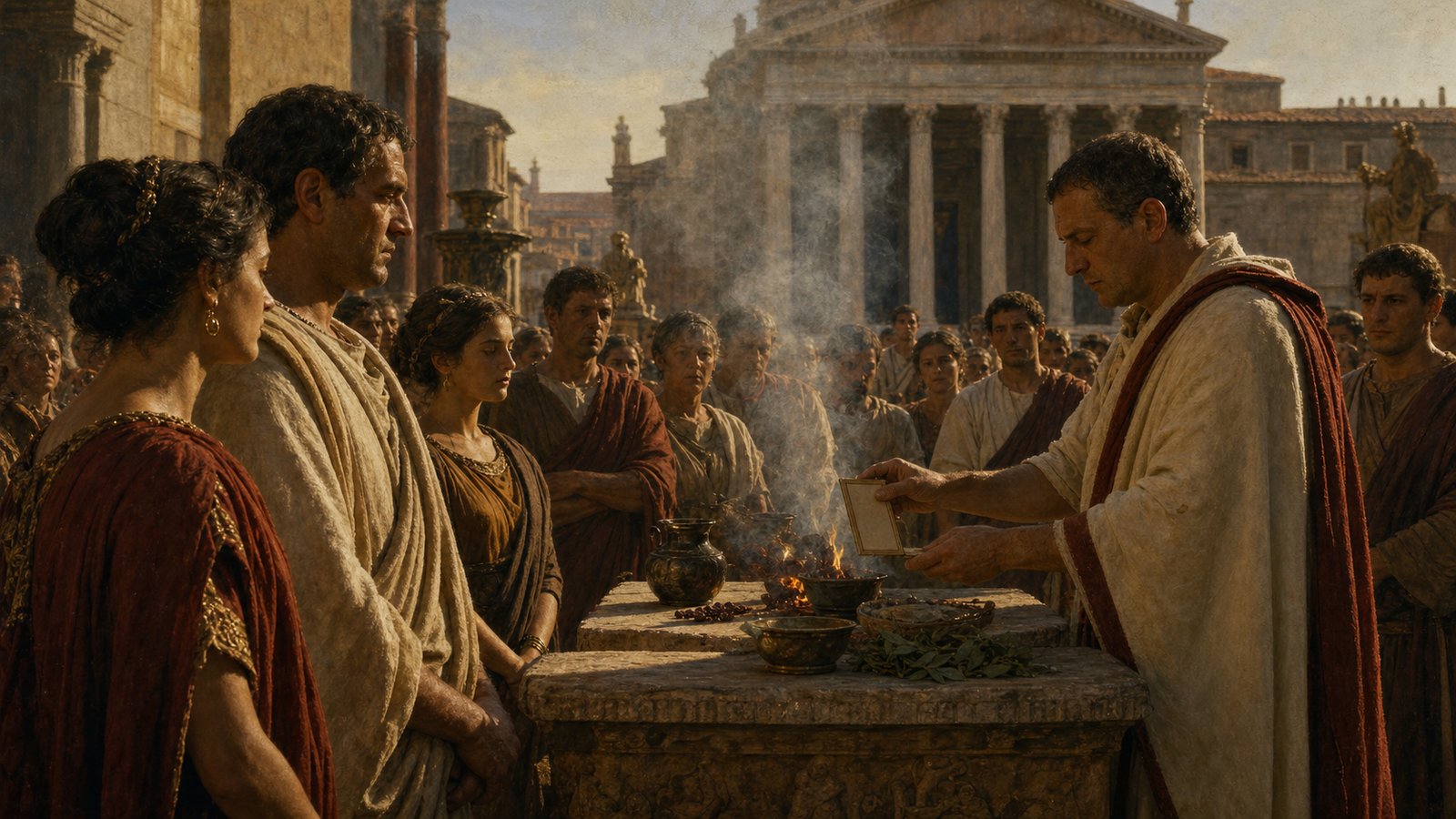
Sacrifice made the act public
Sacrificium was not casual emotion. It involved procedure, offering, people who knew what should happen, and observers who could recognize when the ritual was being done properly.
That procedure made religious action social. A person might fear the gods alone, but an offering at an altar exposed the fear, gratitude, or request to a community that knew the gestures and could remember the day.
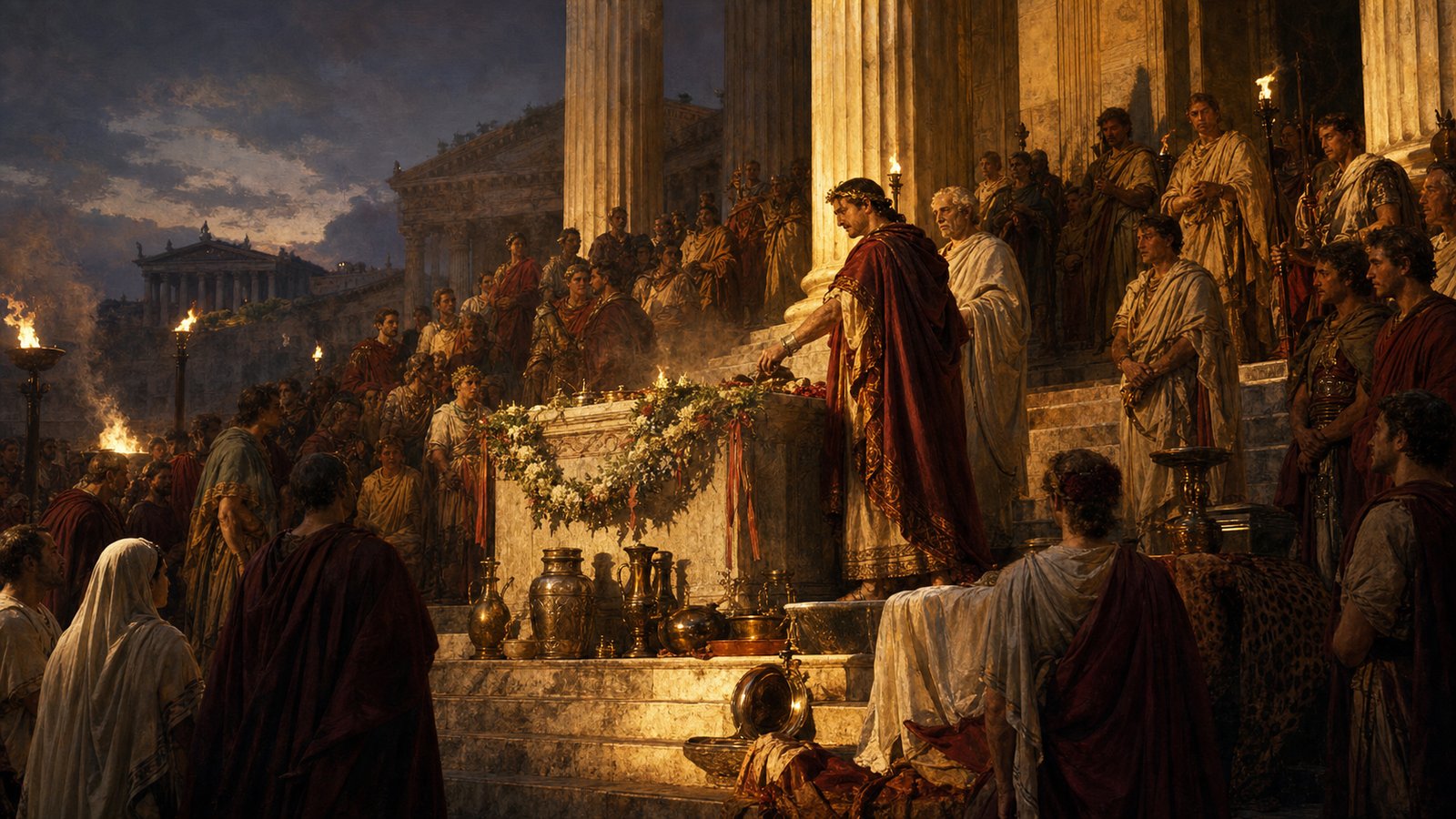
Consecrated space taught people where the vow belonged
Templum reminds us that sacred action needed bounded meaning. A consecrated place separated ritual from ordinary movement and told viewers that this was not simply another corner of the street.
The boundary mattered. It helped Roman religion move between invisible obligation and visible order. The gods were addressed, but the city also learned where such addressing should be seen.
Tablets and memory could outlast the smoke
Tabulae made Roman public life stubborn. Names, accounts, and promises could be preserved after a crowd dispersed. The same habit mattered around vows because memory needed supports beyond flame and speech.
This links the altar to the broader Roman world of records and notices. Rome repeatedly made important acts leave traces: on tablets, in places, through repeated routes, and in the stories people carried away.
A vow became a public relationship
The altar made a vow visible in two directions. It pointed upward toward divine attention, but it also pointed outward toward human memory. People could see who promised, who witnessed, and whether fulfillment ever returned.
That is the quiet power of the scene. A stone altar did not make Roman religion simple. It made obligation hard to pretend away.
A public altar also made time visible. A vow might begin in danger and return in relief. The gap between promise and fulfillment could be remembered because the altar gave both moments a common address.
This is why garlands, vessels, smoke, and repeated approach mattered. They were not decoration only. They helped the act become recognizable. Religion worked through signs that bodies could perform and other bodies could read.
The forum and nearby civic spaces intensified the effect. A vow made in or near public movement could become part of the city’s shared memory, not just a household story. People passing later might remember the ritual or hear why an offering had appeared.
The altar also disciplined language. A person who had spoken a vow could be measured against the public expectation that vows were answered with action. The stone made promise and fulfillment part of a visible sequence.
None of this made Roman religion purely transparent. Motives could be mixed, performances could flatter ambition, and elite ritual could turn piety into display. Yet even that ambiguity shows the altar’s force. Display mattered because people understood what the object was supposed to do.
The sensory details carried authority: heat from the flame, the smell of smoke, wool and garland against stone, the scrape of sandals, the silence before a cut or libation. These details made the invisible claim feel present.
A vow without a visible return risked becoming a rumor. A vow fulfilled at an altar became an event with witnesses. It could enter memory as a scene rather than a sentence.
Roman public religion often worked by making obligations repeatable. People learned where to stand, what to bring, when to watch, and how to recognize completion. The altar was the fixed point around which those repeated motions gathered.
This also helps explain why religious and civic life were difficult to separate. A public vow could concern victory, health, office, danger, harvest, or collective anxiety. The altar gave those concerns a ritual grammar the city could understand.
For ordinary spectators, the key may not have been theology in the abstract. The key was recognition: someone had promised, something was offered, and a place now held the memory of the exchange.
Altars therefore made Roman vows more than private bargaining with the divine. They made promises visible, inspectable, and memorable. A vow became a public fact because stone and smoke taught the city where to look.
The altar also solved a problem of scale. A household fear or a magistrate’s anxiety could be translated into a form that strangers understood. People did not need to know every private detail to recognize that an obligation had been declared in a serious place.
Public ritual created accountability through memory. If the promised return never came, the absence itself could be noticed by those who remembered the earlier offering or by those who knew the place where such promises were supposed to be completed.
The object therefore stood between human uncertainty and civic order. It allowed Romans to treat fear, gratitude, danger, and relief as things that could be handled through visible action rather than left as invisible emotion.
Even a small altar could gather a large social meaning. It taught that important promises should have witnesses, gestures, materials, and a location. The city did not need to read a hidden heart when it could remember a public act.
In that sense, the altar made religious trust work like many other Roman systems. It joined place, record, repetition, and display. Rome kept making important claims visible because visible claims were easier to remember, contest, and fulfill.
A vow could also bind reputation to timing. If the promised act followed victory, recovery, safe travel, or relief from danger, the community could connect outcome and obligation through a known place rather than through rumor alone.
The altar made that connection durable without needing a permanent speech. People could return to the same stone, see new offerings, recall older ones, and understand that public religion depended on repeated completion as much as dramatic request.
For Roman observers, this was a practical form of memory. The gods might judge what humans could not see, but humans still watched the objects, routes, and gestures by which a vow was made visible.
That human watching gave the ritual its civic edge. A completed vow reassured people that promises could be carried back into public view; an absent fulfillment left a silence around a place that had once taught the crowd to expect return.
Sources & Further Reading
- Smith Dictionary, Ara
- Smith Dictionary, Sacrificium
- Smith Dictionary, Templum
- Smith Dictionary, Tabulae
- Smith Dictionary, Forum