
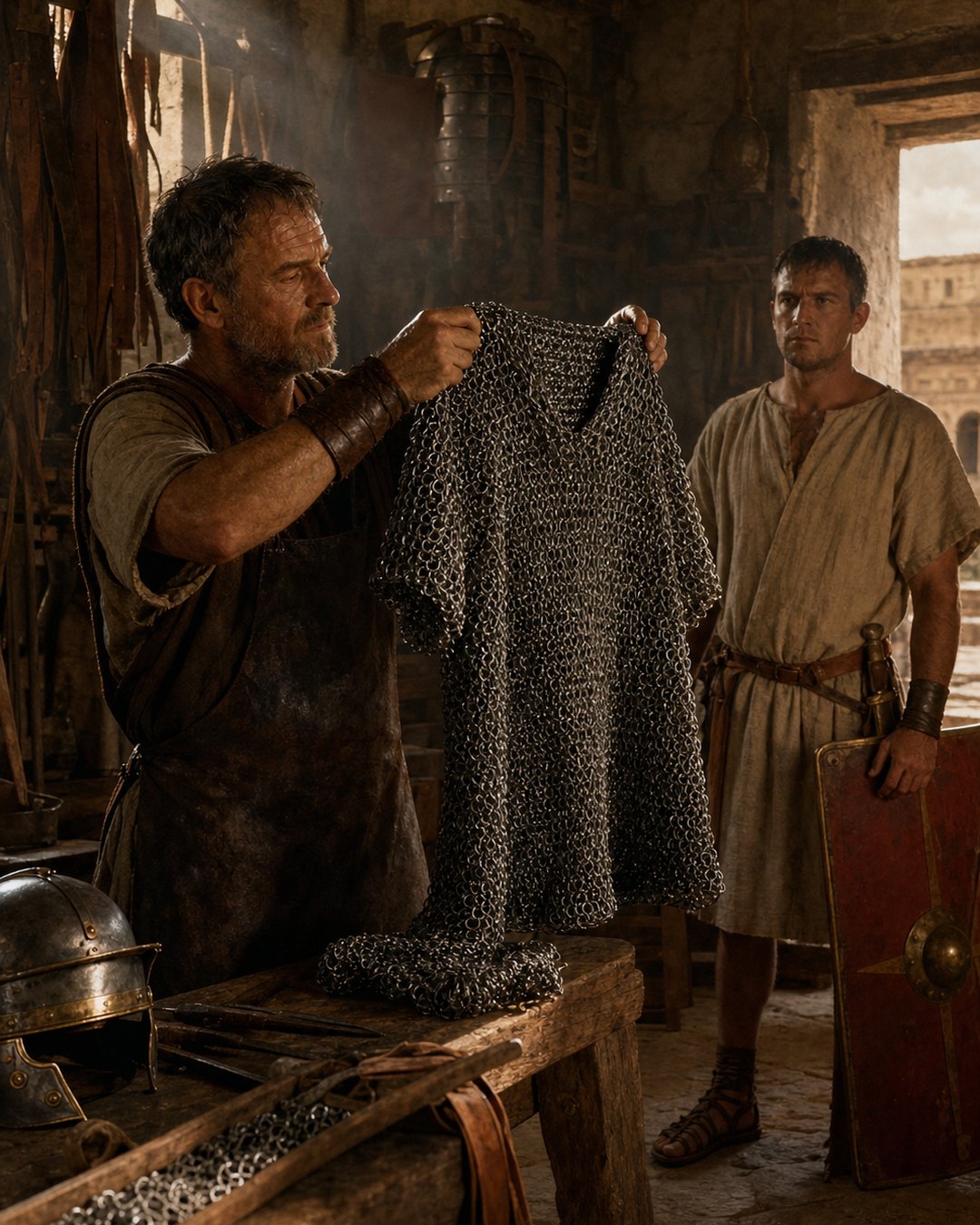
A Roman mail shirt moved before it protected. Lifted from a chest, thousands of iron rings slid against one another with a dry metallic whisper. On the body the same mesh bent at the shoulder, folded near the waist and followed a soldier reaching for shield or spear. Its strength began with controlled movement, not stiffness.
Lorica hamata turned metal into something like a heavy textile. Every ring depended on its neighbors, so a blow met a network rather than an isolated piece. That flexibility came with obligations: the shirt had to be belted, worn over cloth, kept free of destructive rust and searched for opened links. Protection was a routine of construction and care.
Thousands of rings became one defensive surface
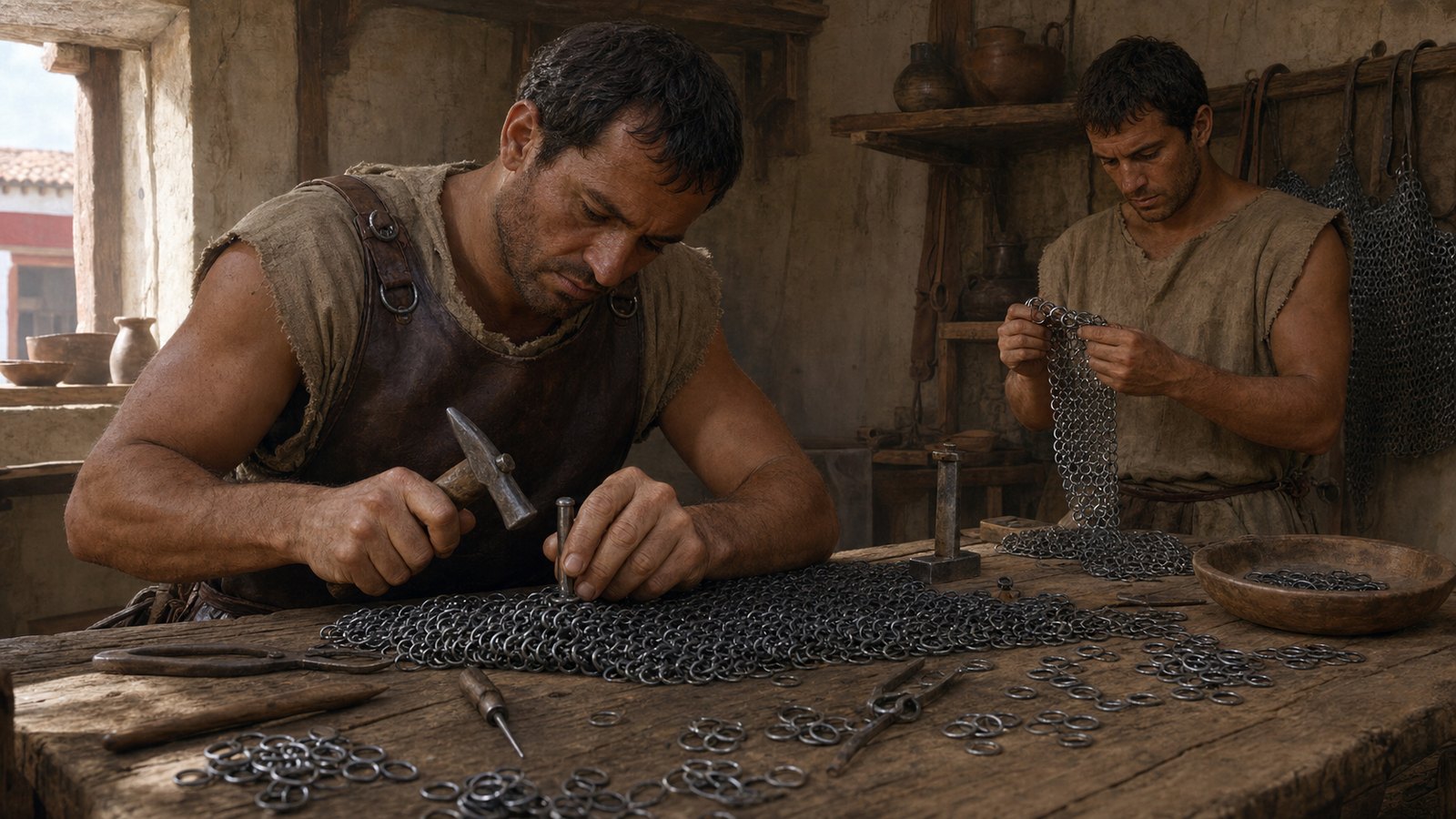
A mail shirt was assembled link by link. In a common pattern, one ring passed through several around it, and the sequence continued across the garment. Solid rings could be punched from sheet while others were closed with tiny rivets. The result was neither chain in a straight line nor plate, but a repeating field of connected circles.
The pattern mattered because force could travel. A cut that met one ring also pulled against adjoining rings, which pulled against more beyond them. No single link became magically unbreakable. Instead, the mesh made an attacker deform or break several small pieces while the garment spread disturbance over a wider area.
Riveting answered the obvious weakness of an open loop. The ends of a ring were overlapped, pierced and fixed with a minute rivet. That task demanded patient, repeatable work: draw or prepare wire, coil it, cut rings, flatten ends, punch holes and close each joint without leaving a snag against clothing.
This labor made mail expensive in time even when iron was available. A finished shirt concealed countless decisions beneath its uniform shimmer. Like a torsion engine built from repeated strands, its power emerged from many small elements arranged so that none worked alone.
Flexibility kept protection attached to a moving body
Rigid protection can resist well but must be shaped around joints or divided into moving parts. Mail solved the problem differently. The rings rotated at their contacts, letting the surface drape over curves and change shape when an elbow rose or the torso twisted. Coverage continued across movements that would challenge one solid shell.
That did not make the garment light. Iron remained iron, and thousands of rings accumulated substantial mass. Much of the load hung from the shoulders until a belt gathered the shirt at the waist and transferred part of the drag. Correct adjustment changed the armor from a swinging burden into weight shared by the body.
Length balanced coverage against fatigue. More mesh protected more of the hip, upper arm or thigh, yet every added row increased weight and trapped heat. A soldier marching for hours experienced this calculation more continuously than a sculptor depicting armor. Protection had to survive the road before it met a weapon.
The four-horn saddle in Roman cavalry equipment also worked by fitting structure to motion. Mail used the opposite material strategy—flexible links rather than a rigid tree—but both succeeded only when equipment and trained posture cooperated.
Cloth beneath iron was part of the armor system
Mail placed thousands of hard edges close to skin. A tunic or padded underlayer stood between them, reducing rubbing and preventing sweat-soaked metal from grinding directly against the wearer. The layer also softened ordinary knocks and helped keep the shifting rings from pinching hair or gathering skin.
Underclothing could not erase impact. Mail was especially useful against edges because rings resisted a slicing path, but a hard strike could still drive the flexible mesh inward. The body beneath received blunt force even when no blade passed through. Armor reduced certain injuries; it did not abolish the physics of being hit.
Shoulder doubling added protection where blows and the garment’s own load concentrated. Extra mail panels created more rings for an attack to defeat and reinforced the upper shirt, but they also increased stiffness and mass at precisely the place already carrying weight. Design was an exchange between coverage, mobility and endurance.
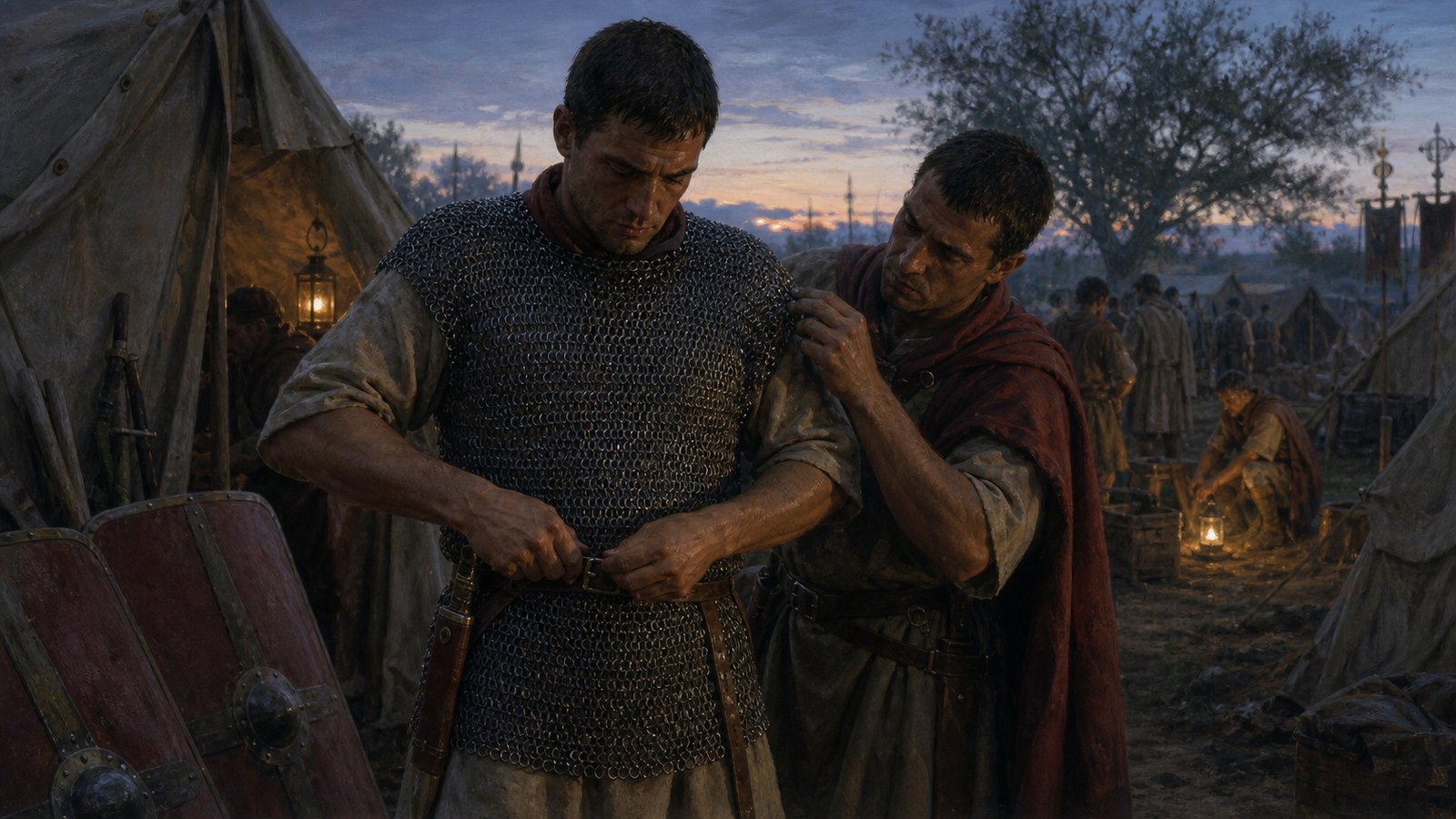
Imagine fastening a belt before dawn: cold rings settle over wool, the shoulder panels pull downward and the shirt briefly sways as the wearer turns. A few steps make the mesh find its place. The sound becomes familiar background, a private test that the garment is hanging freely rather than caught or twisted.
A damaged link made maintenance visible
Mail could fail locally. A rivet loosened, a ring split, or corrosion thinned one side until it opened under stress. Because the garment was a network, one missing link did not cause the whole shirt to fall apart at once. It did, however, leave neighbors carrying load in a pattern they were not meant to bear.
Inspection therefore meant reading small irregularities. Fingers and eyes searched for a gap, a bright fresh break, reddish corrosion or a patch that hung differently. The same flexibility that made mail wearable let a damaged area distort. A trained handler could notice the change before the weakness widened through repeated use.
Repair was possible at the scale of the fault. A worker could remove a bad ring and connect a replacement through the surviving neighbors. Riveting in the field still required fine tools and skill, but it was less drastic than remaking an entire rigid body defense. The garment could accumulate repairs without losing its identity.
This repairability linked soldiers to armorers, smiths and supply. Spare rings and rivets looked insignificant beside helmets or shields, yet they preserved an investment of thousands of earlier operations. Readiness depended on a bench, small hammer and patient eyesight as much as on spectacular equipment displayed before battle.
Rust attacked the network one ring at a time
Iron exposed to sweat, rain and damp storage corroded. Mail offered an enormous surface area of edges and contacts where moisture could linger. Rings rubbed each other during movement, sometimes cleaning a bright spot, while sheltered recesses retained grime. A shirt abandoned wet could deteriorate without any enemy touching it.
Care involved drying, cleaning and using protective grease or oil where practical. Handling the garment shifted rings and exposed surfaces, helping remove loose scale. Storage mattered too: a dry, ventilated place protected the labor already embodied in the mesh, while a damp heap converted flexibility into a mass of stained, weakened links.
Corrosion was not merely ugly. Pitting reduced the cross-section of wire, making a ring easier to stretch or break. Rust around a rivet attacked the closure that kept the loop complete. A shirt could appear broadly intact yet contain dozens of small losses in strength, which is why maintenance had to precede crisis.
The routine resembles the attention given to leather and hobnails in Roman marching footwear. Different materials failed differently, but both armor and sandals translated imperial campaigns into daily inspection of wear, moisture, fit and replaceable parts.
Mail protected because a system stayed connected
No Roman soldier experienced lorica hamata as an abstract type in a museum case. He experienced pressure on the shoulders, warmth under the rings, the belt at his waist and the sound of metal following his stride. Familiarity let him distinguish normal movement from a snag, loose panel or unexpectedly dragging patch.
The armor’s long use makes sense in that bodily context. It offered broad, flexible coverage and could be repaired, adapted and handed on. Other Roman defenses used scales or segmented plates, each with advantages and demands. Mail remained useful because its combination of motion and networked resistance answered recurring military needs.
It also reveals the false simplicity of the phrase “wearing armor.” The act depended on miners, smelters, wire workers, ring makers, riveters, tailors, armorers and soldiers who maintained what they received. A protective surface was the visible endpoint of a distributed economy of repeated precision.
Roman chain mail made protection flexible by connecting weakness into strength. One ring was small, one rivet vulnerable and one row easy to bend. Thousands arranged together became coverage that moved with the body and survived through repair. Its defense was never just iron; it was the continued integrity of every connection.
Sources & Further Reading
- Lorica hamata
- World History Encyclopedia, Roman Body Armour