
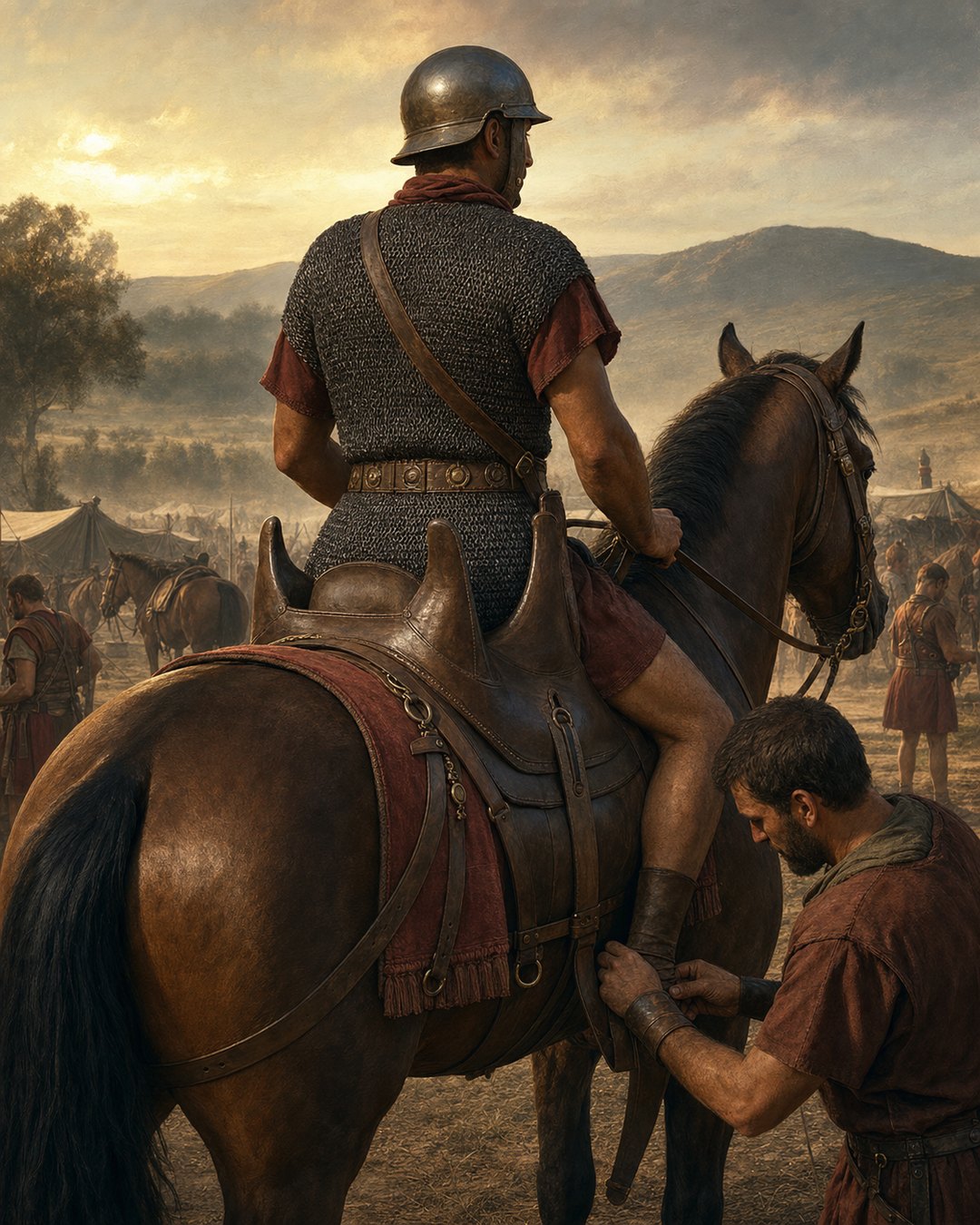
A Roman cavalryman could carry a spear, shield or sword while the ground moved beneath him—and no iron stirrup waited under either foot. Stability came from somewhere else. A rigid saddle sat on the horse’s back, and four projecting horns closed around the rider’s thighs like the corners of a seat built for motion.
The arrangement did not make falling impossible. It changed how horse, rider and equipment shared force. The tree spread weight; girths held position; horns braced the legs; training taught the body when to yield and when to resist. Roman cavalry worked because an entire riding system replaced the single device modern viewers expect to see.
Four horns created a seat inside the motion
The distinctive Roman military saddle is often reconstructed with four horns, two rising near the front and two behind the rider’s thighs. They did not form a chair back. Their job was to meet the body at points where sideways or forward motion could be checked before the rider slid beyond recovery.
A rider settled between these projections rather than perching above a flat pad. Thighs could press and brace while the pelvis remained able to follow the horse’s stride. The shape offered boundaries, not immobility. Too rigid a body would bounce; too loose a seat would arrive late to every turn.
The horns changed weapon movement as well. Reaching, turning or absorbing contact shifted weight away from the center. A shaped saddle gave the rider surfaces against which that shift could be managed. Stability therefore came from the relationship between moving anatomy and structure, not from hooks that simply locked a person in place.
Reconstruction requires caution because leather and wood survive unevenly. Metal fittings, archaeological fragments and images preserve portions of the system. The exact upholstery and variations changed, but the repeated four-horn logic reveals a deliberate answer to mounted balance before western stirrups became normal.
The tree protected both rider and horse
Beneath covering and horns, a saddle tree created a firm shape. Its importance faced downward as well as upward. A rider’s weight needed to cross a broad area of the horse’s back instead of pressing through one narrow ridge, knot or strap. Distribution made long use possible without immediately creating injury.
Fit could not be reduced to one standard object. Horses varied in back shape, condition and movement. A tree that pinched beside the spine or rocked over the ribs produced pain and sores. The animal might shorten its stride, resist saddling or behave unpredictably under pressure, turning an equipment problem into tactical danger.
Padding softened contact but could not rescue gross mismatch. Sweat, dust and hair accumulated beneath tack, adding friction. Grooms had to clean surfaces, inspect skin and notice swelling before another ride. The polished military image began with someone lifting the saddle and looking carefully at the back underneath.
This bodily maintenance parallels the ordinary logistics of legionary footwear. A hobnail and a saddle tree seem distant in scale, yet both converted imperial movement into pressure on living tissue. Successful equipment kept that pressure tolerable through fit, inspection and repair.
Girths made security adjustable rather than permanent
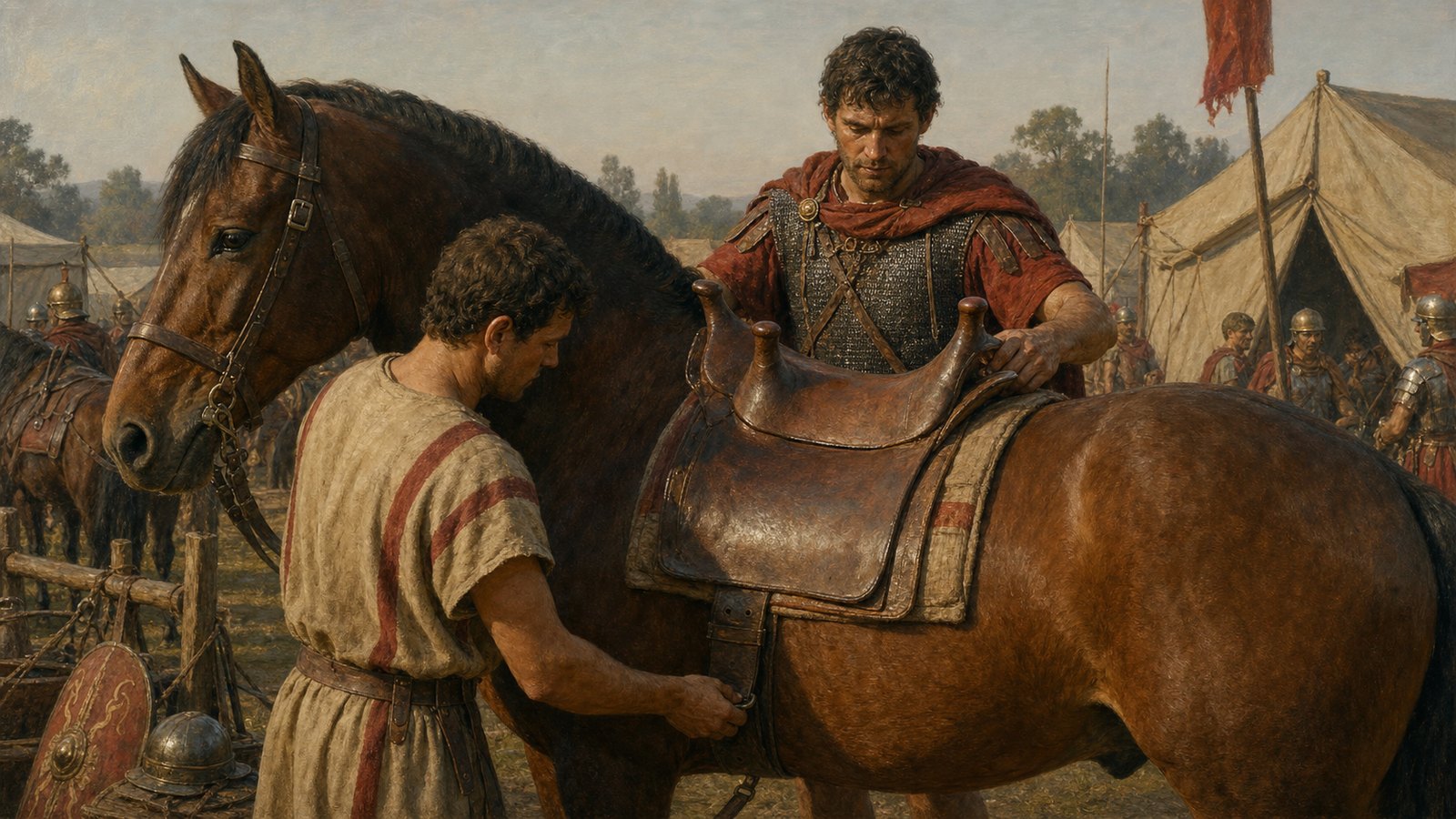
A saddle stayed on the horse because straps passed around the body and held the tree down against movement. The girth had to be tight enough to resist rolling when the rider mounted or leaned, but not so tight that breathing and muscle action became painful. Security was an adjustment continually judged, not a fixed property.
Horses can alter their bodies while being saddled, and leather changes with moisture and use. A rider or groom checked tension after initial movement rather than trusting the first pull. A loose girth announced itself when the whole structure shifted; an over-tight one might produce subtler resistance until discomfort became obvious.
Straps also failed at holes, buckles and stitched joins where force concentrated. Dust dried leather; rain softened it; sweat carried salts into the fibers. Camp maintenance required cleaning, oiling where appropriate, stitching and replacement pieces. Mounted readiness depended on leatherwork as surely as on a sharp spear.
Imagine the minutes before a patrol: one horse stamps, another turns toward the groom, a rider presses a knee into the saddle and reaches under the belly to test the girth. No enemy is present, yet the success of the mission is already being decided by fingers reading tension in a strap.
Balance lived in the rider rather than in a foot rest
Without stirrups, the legs did not hang uselessly. Thighs contacted the saddle and horse; the pelvis followed the stride; the upper body adjusted over changing support. Riders learned to remain organized while walking, trotting, turning and stopping, then repeated those skills while handling weapons and watching terrain.
The horns helped when acceleration or impact pushed the body toward an edge, but they could not supply timing. A rider who fought every movement exhausted both himself and the horse. Effective balance alternated softness and brace, allowing ordinary motion through while meeting sudden force with structure at the correct moment.
Mounting also demanded technique. The rider had to reach the seat without a low step and avoid dragging the saddle sideways during the climb. Assistance, terrain, a mounting aid or practiced vaulting could solve the problem. The absence of stirrups shifted tasks into other methods rather than making them impossible.
The modern misconception treats one later technology as the beginning of serious cavalry. Roman evidence instead shows several components cooperating. Stirrups eventually offered valuable support, especially for mounting and sustained foot pressure, but the four-horn saddle had already made a stable military seat through a different geometry.
The horse was trained equipment only in metaphor
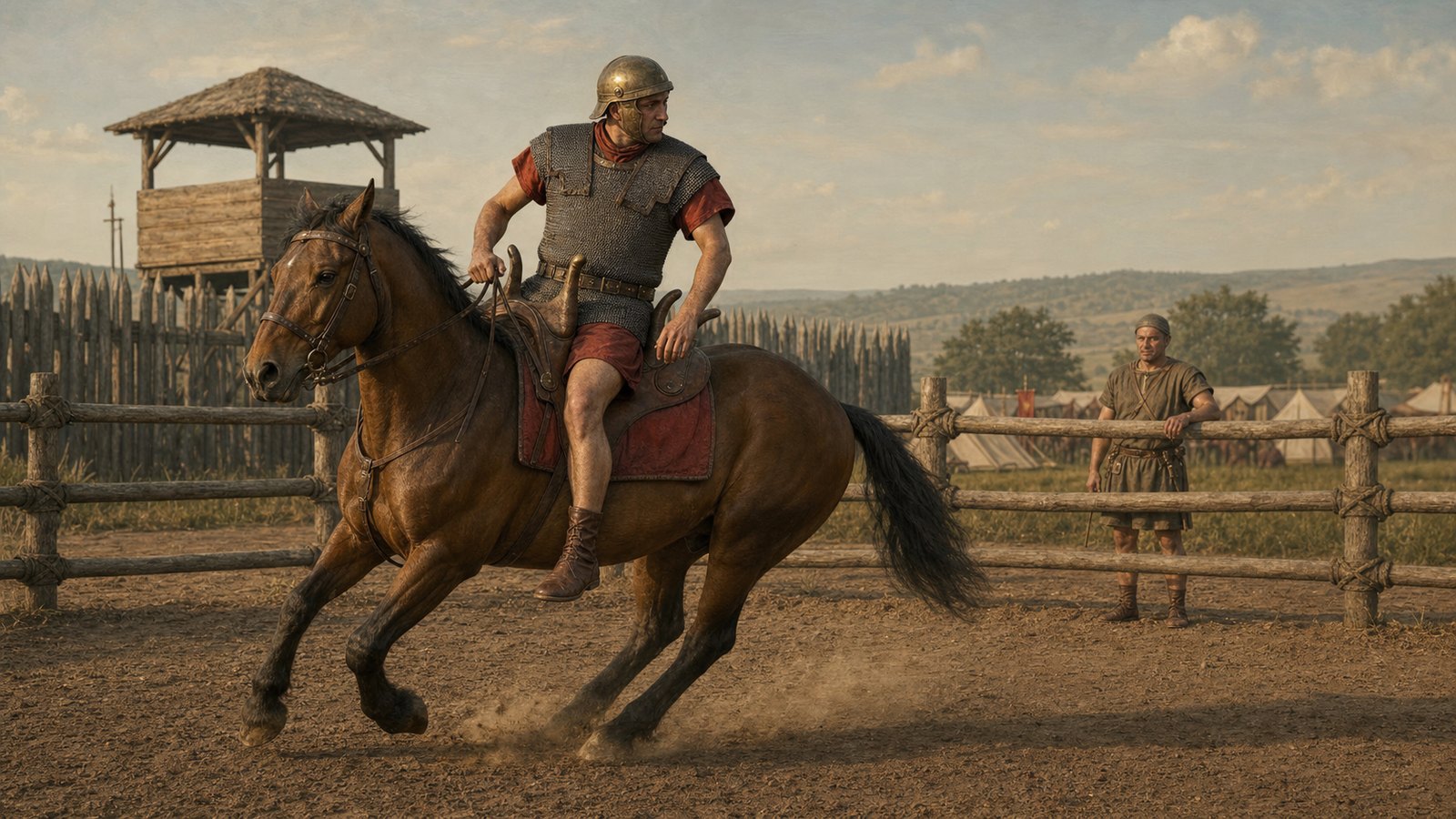
A saddle is inert until placed on an animal with memory, fear, strength and preferences. Roman cavalry needed horses accustomed to pressure from legs, shifting weapons, noise and nearby bodies. Training taught responses, but it did not convert the horse into a machine. Attention remained necessary because fatigue and alarm changed behavior.
The rider communicated through weight, reins and legs while also preserving his own seat. A turn succeeded when the horse interpreted signals and the rider anticipated the resulting motion. Tack transmitted some of that communication, yet excessive force could produce confusion or pain. Skill lay partly in making commands small and timely.
Cavalry roles multiplied the demands. Scouting required alert movement and controlled distance; screening demanded coordination; pursuit rewarded speed but risked disorder; close combat added shock and weapon handling. The same saddle supported these tasks only because training adapted bodies and formations around it.
That system belonged beside the visible coordination of Roman standards. A standard helped people orient within a unit; trained horses and riders kept mounted elements coherent across ground. Neither symbol nor saddle guaranteed discipline, but each gave disciplined practice a structure it could use.
Cavalry stability rested on an invisible supply chain
The finished silhouette hides its makers. Wood had to be shaped for the tree, leather tanned and cut, fittings cast or forged, padding prepared and straps assembled. Different materials wore at different rates. A unit needed spare leather, tools and people who could judge whether damage was repairable before the next movement.
Horses added a heavier chain of fodder, water, shelter, grooming and replacement. A cavalryman’s speed existed only while the animal remained healthy enough to carry him. The saddle joined military stores to animal care: badly maintained equipment wasted the food and training already invested in the horse.
Campaign images celebrate the charge because it compresses mounted power into one moment. Most cavalry value appeared elsewhere—in messages delivered, roads watched, flanks screened and retreating enemies followed. The saddle earned its place through hours of ordinary riding in which nothing dramatic happened because equipment and training continued to work.
Roman cavalry saddles made stirrups unnecessary for their own system, not irrelevant forever. Four horns, a fitted tree, secure girths, practiced thighs and a trained horse produced stability by cooperation. The missing foot rests are not evidence of absence. They direct attention toward the more complex technology already present.
Sources & Further Reading
- Roman cavalry
- World History Encyclopedia, Roman Cavalry
- Saddle